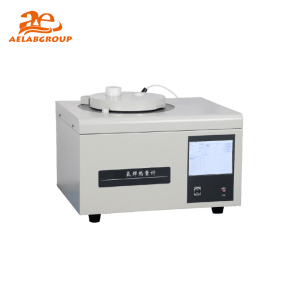
AELAB | Petroleum Testing Equipment | Bomb Calorimeter
Bomb Calorimeter
Introduction
A Bomb Calorimeter precisely measures the heat of combustion to determine calorific value for fuels, foods, and materials. It is indispensable for energy analysis in research labs, fuel testing facilities, and food science. This guide covers bomb calorimeter working principles, features, and how to choose the right instrument.
What Is Bomb Calorimeter?
A bomb calorimeter is a sealed, high-strength oxygen combustion system used to determine the gross calorific value (higher heating value) of solid and liquid samples. A sample combusts inside a metal “bomb” pressurized with oxygen; the released heat is absorbed by a surrounding water jacket. The measured temperature rise—recorded by a high-precision sensor and homogenized by a stirrer—yields the heat of combustion after applying standard corrections (fuse wire, acid formation).
Devices in This Category
Manual Bomb Calorimeter (analog readout, manual calculations)
Semi-Automatic Bomb Calorimeter (electronic measurement with partial automation)
Fully Automatic Bomb Calorimeter (automated ignition, data logging, calculations)
Oxygen Bomb Calorimeter assemblies (bomb, ignition leads, crucibles)
Isoperibol/Water-Jacketed systems with controlled temperature
Software-enabled calorimeters with USB/network connectivity
Technical Features and Specifications
FeatureDetails
Measurement PrincipleCombustion in pressurized oxygen; temperature rise of a water jacket converted to energy (HHV)
Key ComponentsCombustion bomb, water jacket, stirrer, precision thermometer/sensor, ignition system
Typical Sample Mass0.5–1.0 g (dried, finely ground)
Oxygen Charge~25–30 atm pure O2 inside the bomb
AccuracyUp to ±0.1% with proper calibration (e.g., benzoic acid)
Operation ModesManual, semi-automatic, or fully automatic (with data logging & calculations)
ComplianceASTM D5865, ISO 1928 (fuel calorific value testing)
Data & ConnectivityOnboard software, USB/network interfaces for export and LIMS integration
Benefits
Highly accurate, repeatable calorific value measurement across diverse samples.
Delivers gross calorific value (higher heating value) needed for fuel grading.
Robust construction for routine industrial and research applications.
Configurable automation to match sample throughput and workflow needs.
Traceable calibration and standardized corrections for reliable reporting.
Applications and Tests
🔬 Molecular Biology
Occasional energy-content studies of biomaterials (e.g., lyophilized biomass)
Teaching thermodynamics of combustion in educational labs
🧪 Clinical Diagnostics
Not routinely used in clinical diagnostics
Supports nutrition science by determining caloric content of formulated foods
🏭 Industrial & Food Testing
Fuel and energy industry: coal, oil, biomass calorific value certification
Food and nutrition: energy content labeling of food products
Materials testing: polymers, explosives, chemicals combustion energy
🌱 Environmental & Agricultural Labs
Assessment of agricultural residues and biofuels for waste-to-energy
Comparative studies of biomass feedstocks
Baseline energy content for lifecycle and emissions analyses
Bomb Calorimeter vs. Differential Scanning Calorimeter (DSC)
AspectBomb CalorimeterDifferential Scanning Calorimeter (DSC)
Primary PurposeHeat of combustion (HHV)Heat flow during phase transitions/reactions
Sample TypesFuels & organics (solids/liquids)Polymers, pharmaceuticals, foods
AccuracyVery high for combustion energyModerate to high for transitions
DestructivenessDestructive (complete combustion)Mostly non-destructive
Temperature ConditionsHigh-temperature combustion in O2Programmed heating/cooling, wide range
Typical Use CaseFuel grading, food energy contentMelting points, glass transitions, curing
Expert Tips for Choosing the Right Bomb Calorimeter
Select automation level (manual, semi, fully automatic) based on sample throughput.
Verify compliance with ASTM D5865 or ISO 1928 for fuel testing.
Ensure stable temperature control of the water jacket and efficient stirring.
Prioritize models with easy bomb disassembly and durable seals for faster maintenance.
Look for data interfaces (USB/network) and software for automatic corrections and reporting.
Maintenance Best Practices
Calibrate routinely using benzoic acid and document system heat capacity (C).
Clean the combustion chamber, crucibles, and ignition leads after each run.
Inspect O-rings, valves, and safety relief components; replace on schedule.
Use high-purity oxygen and verify charge pressure before ignition.
Check temperature sensors and stirring performance to maintain response time.
FAQ
Q: What is a bomb calorimeter used for?
A: Measuring the heat of combustion (calorific value) of fuels, foods, and other organic materials for quality control and research.
Q: How accurate is a bomb calorimeter?
A: With proper calibration and corrections, accuracy can reach approximately ±0.1% for critical industrial applications.
Q: Is bomb calorimetry safe?
A: Yes—combustion occurs in a sealed, high-strength vessel with controlled oxygen pressure and standardized safety checks.
Q: Which standards apply to fuel calorific value testing?
A: Commonly ASTM D5865 and ISO 1928 for determining higher heating value using oxygen bomb calorimeters.