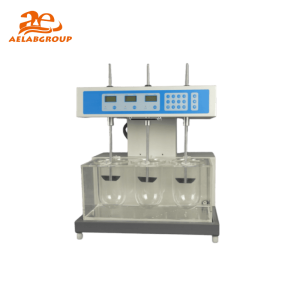
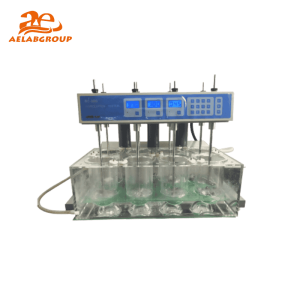
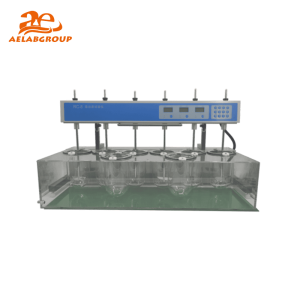
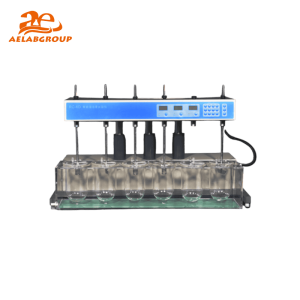
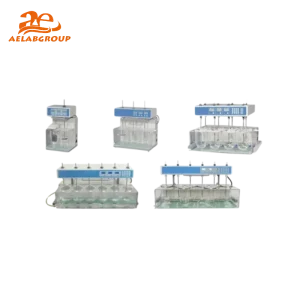
AELAB | Pharmaceutical Equipments | Dissolution Tester
Dissolution Tester
Introduction
A Dissolution Tester is a critical pharmaceutical quality-control instrument used to measure how quickly an active ingredient releases from tablets or capsules into a medium. Understanding Dissolution Tester performance supports drug formulation, regulatory approval, and patient safety.
What Is Dissolution Tester?
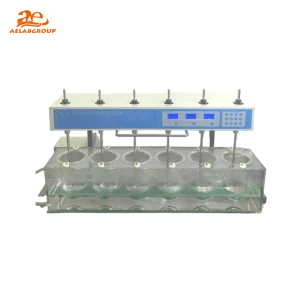
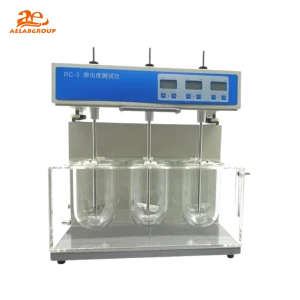
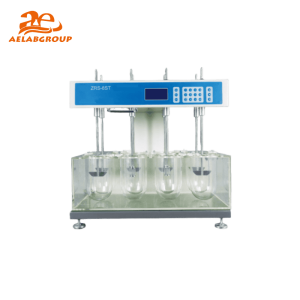
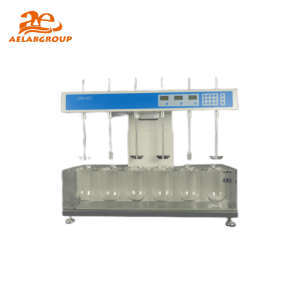
A Dissolution Tester measures the rate at which an API dissolves from its dosage form into a solvent under standardized, physiologically relevant conditions. Typical systems include vessels with dissolution medium, rotating paddles or baskets for agitation, precise temperature control at ~37 °C, and a sampling system that withdraws aliquots at defined timepoints for generating dissolution profiles used in formulation, bioequivalence, and regulatory submissions.
Devices in This Category
USP Apparatus 1 – Basket method (capsules, floating dosage forms)
USP Apparatus 2 – Paddle method (most common for tablets)
USP Apparatus 3 – Reciprocating cylinder (modified-release forms)
USP Apparatus 4 – Flow-through cell (poorly soluble drugs, transdermals)
Automated sampling modules (autosamplers with timed filtration/cooling)
Media preparation & deaeration units
Technical Features and Specifications
FeatureDetails
Apparatus TypesUSP 1 (Basket), USP 2 (Paddle), USP 3 (Reciprocating Cylinder), USP 4 (Flow-Through Cell)
Agitation SpeedProgrammable RPM per method; stable, low-vibration drive
Temperature ControlHeated bath or individual heaters targeting ~37 °C with tight accuracy
Vessel CapacityTypically hundreds of mL to ~1 L media per vessel (method dependent)
Sampling SystemManual cannulas or automated sampling with timed filtration and optional cooling
Stations / VesselsMulti-vessel configuration (commonly 6–8) for parallel testing
Materials of ConstructionBorosilicate glass vessels; 316L stainless steel paddles/baskets; chemically resistant tubing
Compliance & DataSupports pharmacopeial methods; method programming, data logging, and report export
Benefits
Regulatory compliance for FDA, USP, and EMA requirements
Batch-to-batch consistency and robust quality control
Predictive modeling for in vivo performance and bioequivalence
Accelerates formulation optimization and scale-up
Objective, trendable dissolution profiles for decision-making
Applications and Tests
🔬 Molecular Biology
Solubility and release studies of APIs in different mediaPolymer matrix and coating release characterizationPre-formulation screening and excipient impact assessment
🧪 Clinical Diagnostics
Hospital pharmacy/compounding QC checks for oral dosage formsMethod verification for generic substitution policiesDevice/drug in-vitro release studies (where applicable)
🏭 Industrial & Food Testing
Nutraceutical and dietary supplement dissolution profilingProcess validation and lot release testingStability studies across storage conditions
🌱 Environmental & Agricultural Labs
Release testing of fertilizer or pesticide granules/tablets in aqueous mediaLeaching and controlled-release assessments for formulated activesComparative testing of media pH to simulate field conditions
Dissolution Tester vs. Disintegration Tester
AspectDissolution TesterDisintegration Tester
What It MeasuresRate of API release into the medium over timeTime for dosage form to break apart
Primary OutputDissolution curve (% release vs. time)Single disintegration time endpoint
Typical ApplicationBioavailability prediction, bioequivalence, formulation developmentPreliminary QC prior to dissolution testing
Method ComplexityHigher—requires media selection, RPM, temperature, samplingLower—focus on mechanical breakup under set conditions
Regulatory RoleEssential for regulatory submissions and routine QCSupportive QC to confirm dosage integrity
Expert Tips for Choosing the Right Dissolution Tester
Confirm compliance with USP/EP and align apparatus type (1–4) to your dosage form.
Plan for scalability—select systems that serve R&D through pilot and production.
Prioritize automation (autosampling, filtration, data logging) for high-throughput labs.
Seek robust IQ/OQ/PQ support and clear documentation from the vendor.
Evaluate usability—easy vessel access, intuitive method programming, and maintenance reach.
Maintenance Best Practices
Clean vessels, paddles/baskets, and tubing thoroughly after each run to prevent carryover.
Calibrate RPM, temperature, and sampling intervals at defined schedules using standards.
Use deaerated media and verify volume/pH before each test; replace filters regularly.
Inspect components for wear or contamination; document all changes and checks.
Maintain method and system logs for traceability and audit readiness.
FAQ
Q: Why is dissolution testing required for oral dosage forms?
A: It verifies bioavailability and bioequivalence, supports batch consistency, and satisfies regulatory expectations from agencies such as FDA, USP, and EMA.
Q: Which USP apparatus should I choose?
A: Use baskets (USP 1) for capsules/floating forms, paddles (USP 2) for most tablets, reciprocating cylinders (USP 3) for modified-release, and flow-through cells (USP 4) for poorly soluble or transdermal products.
Q: What parameters most affect dissolution results?
A: Agitation speed (RPM), temperature accuracy near 37 °C, medium volume and composition/pH, sampling timepoints, and consistent dosage placement.
Q: How can I reduce variability between runs?
A: Calibrate regularly, use deaerated media, standardize procedures and sampling, and avoid cross-contamination with dedicated tools.
Q: Are certain brands commonly used in industry?
A: Commonly used manufacturers include Agilent Technologies, Electrolab, ERWEKA, Hanson Research, and Sotax; select based on compliance, scalability, automation, and support.