Laboratory Equipment Used in Animal Feed Manufacturing and Quality Control Overview
In animal feed manufacturing, animal feed quality control laboratory equipment is used to verify nutritional composition, screen for contaminants, evaluate physical quality, and support consistent production. The required laboratory configuration depends on the feed materials, tests performed, sample volume, turnaround time, and whether the laboratory needs routine screening or more advanced quantitative analysis.
For a typical feed quality control laboratory, the main equipment groups include sample preparation tools, analytical balances, drying or moisture-analysis equipment, protein and fat analysis systems, fiber analyzers, muffle furnaces, and instruments for mineral and contaminant testing. Depending on the testing scope, laboratories may also require NIR, HPLC, AAS or ICP systems, ELISA readers, and microbiological equipment.
In practical terms, the equipment should follow the testing requirement: sample preparation → moisture and proximate analysis → mineral or nutrient analysis → contaminant screening → physical and microbiological quality control. This test-to-instrument approach helps avoid both missing critical capabilities and purchasing advanced instruments that are not justified by the laboratory’s actual workload.
What Is Animal Feed Quality Control Laboratory Equipment?
Animal feed quality control laboratory equipment encompasses the instruments, analyzers, and auxiliary tools used to test raw materials, in-process samples, and finished animal feeds against defined quality parameters. This includes equipment for chemical, physical, and microbiological analysis, such as analytical balances, drying ovens, digestion systems, spectrophotometers, and chromatography units.
Together, these instruments can support determination of moisture, protein, fat, fiber, ash, minerals, amino acids, vitamins, mycotoxins, and other relevant feed characteristics. The exact equipment list should be selected according to the tests the laboratory is responsible for rather than treating every analytical instrument as a universal requirement.
Main Testing Requirements
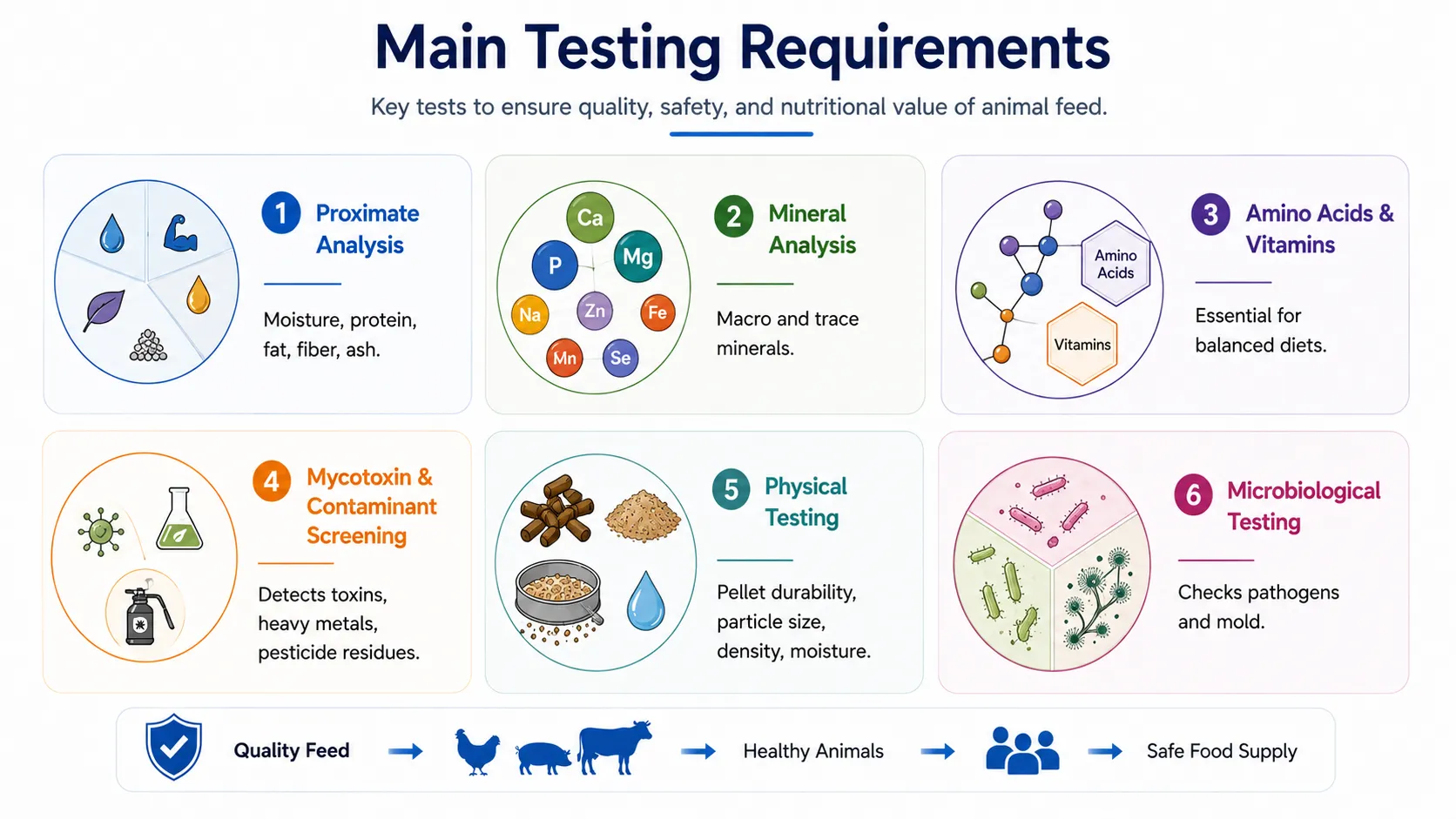
Animal feed quality control can cover several analytical groups depending on the ingredients, feed type, manufacturing process, and quality program. The main testing requirements include:
- Proximate Analysis: Quantifies moisture, crude protein, crude fat, crude fiber, and ash. These measurements provide core information for feed composition and formulation control.
- Mineral Analysis: Determines macro-minerals such as calcium, phosphorus, magnesium, and sodium, as well as trace elements such as zinc, copper, iron, manganese, and selenium when these are included in the laboratory’s testing scope.
- Amino Acid and Vitamin Profiling: Supports more detailed nutritional evaluation and formulation verification. HPLC and dedicated analyzers may be used where this level of analysis is required.
- Mycotoxin and Contaminant Screening: Evaluates contaminants such as aflatoxins, ochratoxins, heavy metals, and pesticide residues using methods and instruments appropriate to the target analyte.
- Physical Testing: Measures properties such as pellet durability, particle size, bulk density, and moisture to support process control, handling quality, and finished-feed consistency.
- Microbiological Testing: Supports feed hygiene assessment through testing for relevant microorganisms such as Salmonella, E. coli, and molds where microbiological testing is required.
Animal Feed Quality Control Testing Workflow
A well-structured testing workflow helps ensure that samples are handled consistently and that analytical results can be traced back to the correct raw material, process stage, or finished batch. The following stages illustrate a typical feed quality control laboratory workflow.
1. Sample Collection and Preparation
Representative sampling is fundamental because even highly accurate analytical instruments cannot compensate for a sample that does not represent the material being tested. Samples may be collected from incoming raw materials, in-process streams, and final product batches according to the laboratory’s sampling procedure.
Solid samples are commonly reduced and homogenized before representative test portions are taken. Consistent preparation is particularly important when ingredients or finished feeds contain particles with different sizes, densities, or compositions.
Key QC checks: Verify sampler cleanliness, confirm sample identity, document the batch or source, prevent cross-contamination, and check grinding and homogenization consistency.
Recommended equipment:
- Sample probes or automatic samplers
- Laboratory grinder or homogenizer
- Sample dividers (riffle splitter)
- Analytical balance


2. Moisture and Dry Matter Determination
Moisture content can be determined by drying a weighed sample under the conditions specified by the laboratory’s selected method or by using a suitable moisture analyzer. Moisture measurement is important because changes in water content affect storage behavior and the interpretation of nutrient concentrations. Dry matter results also provide a common basis for comparing feed composition.
Key QC checks: Use consistent sample mass and drying conditions, include appropriate quality-control samples, and verify balance performance according to the laboratory’s documented procedure.
Recommended equipment:
- Drying oven or moisture analyzer
- Analytical balance (0.1 mg readability)
- Desiccator for cooling

3. Proximate Analysis (Protein, Fat, Fiber, Ash)
Proximate analysis provides several of the most widely used measurements in feed quality control. Crude protein can be determined through nitrogen analysis using Kjeldahl or combustion methods. Crude fat can be measured using solvent extraction, fiber through appropriate digestion procedures, and ash by controlled ignition in a muffle furnace.
Near-infrared (NIR) analyzers can provide rapid multi-parameter screening when suitable calibrations have been developed and maintained against appropriate reference data. This makes NIR particularly useful where laboratories need higher sample throughput, while wet-chemistry methods remain important for reference measurements and calibration work.
Key QC checks: Use appropriate blanks and quality-control materials, control reagent and digestion conditions, verify extraction procedures, and maintain NIR calibrations using suitable reference results.
Recommended equipment:
- Kjeldahl digestion and distillation unit or Dumas nitrogen analyzer
- Soxhlet extraction system or fat analyzer
- Fiber analyzer (crude fiber or dietary fiber)
- Muffle furnace
- NIR analyzer (optional)


4. Mineral and Trace Element Analysis
Mineral analysis generally requires suitable sample preparation or digestion followed by measurement with an analytical technique appropriate to the target elements. Instruments such as atomic absorption spectroscopy (AAS) and inductively coupled plasma optical emission spectrometry (ICP-OES) can be used for elemental analysis. Colorimetric methods with a UV-Vis spectrophotometer may also be suitable for specific determinations such as phosphorus, depending on the analytical method used.
Key QC checks: Use suitable calibration standards, verify sample preparation and digestion, include blanks and appropriate quality-control samples, and evaluate potential matrix effects where relevant.
Recommended equipment:
- Block digester or microwave digestion system
- AAS or ICP-OES
- UV-Vis spectrophotometer
- Analytical balance


5. Contaminant and Mycotoxin Screening
Feed ingredients, particularly agricultural raw materials, may require testing for mycotoxins or other contaminants according to the laboratory’s risk and quality-control program. Mycotoxins such as aflatoxin B1, deoxynivalenol, and zearalenone can be screened or quantified using techniques such as ELISA and chromatography. Elemental contaminant analysis may use AAS or ICP-based techniques, while more complex residue analysis can require chromatographic systems coupled with appropriate detectors.
The analytical technique should be selected according to the contaminant being measured, the required sensitivity and specificity, sample volume, and whether the purpose is rapid screening or quantitative confirmation.
Key QC checks: Use appropriate positive, negative, blank, calibration, or quality-control samples for the selected method, maintain consistent extraction procedures, and control sample handling to reduce cross-contamination.
Recommended equipment:
- ELISA microplate reader
- HPLC system with UV/FLD detector
- AAS or ICP-MS for heavy metals
- Sample extractor or shaker
- Centrifuge


6. Physical and Microbiological Testing
Physical testing evaluates properties that affect manufacturing performance, handling, and finished-feed consistency. A pellet durability tester measures resistance to breakdown during handling, while sieve analysis provides information about particle size distribution.
Where microbiological testing is included in the QC program, the laboratory also needs appropriate sample handling, sterilization, incubation, and contamination-control equipment. The exact microbiological workflow depends on the organisms and methods being investigated.
Key QC checks: Follow documented procedures for sample preparation, incubation conditions, equipment cleanliness, and microbiological quality controls. Separate activities appropriately to reduce the risk of cross-contamination.
Recommended equipment:
- Pellet durability tester
- Sieve shaker and sieves
- Autoclave
- Microbiological incubator
- Laminar flow hood


Key Quality Control Tests for Animal Feed Manufacturing
The table below summarizes the relationship between common feed QC requirements, their purpose, and the laboratory equipment typically associated with each test.
| Quality Control Test | Purpose | Common Laboratory Equipment | Relevant Product Types / Applications |
|---|---|---|---|
| Moisture Content | Determine water content for stability and nutrient density | Moisture analyzer, drying oven | All feed types |
| Crude Protein | Quantify nitrogen to estimate protein level | Kjeldahl system, NIR analyzer | Protein meals, complete feeds |
| Crude Fat | Measure lipid content for energy calculation | Soxhlet extractor, NIR analyzer | Oilseed meals, mixed feeds |
| Crude Fiber | Assess indigestible carbohydrate fraction | Fiber analyzer | Forages, high-fiber feeds |
| Ash | Determine total mineral content | Muffle furnace | All feeds |
| Calcium & Phosphorus | Verify minerals for bone development | AAS, ICP-OES, spectrophotometer | Layer feeds, growing animal diets |
| Salt (NaCl) | Check sodium level for electrolyte balance | Titration, ion-selective electrode | All mixed feeds |
| Mycotoxins (e.g., Aflatoxin B1) | Detect harmful fungal toxins | ELISA reader, HPLC | Grains, complete feeds |
| Amino Acid Profile | Balance essential amino acids for optimal growth | HPLC, amino acid analyzer | Premixes, starter feeds |
| Microbial Pathogens | Ensure feed safety from Salmonella, E. coli | Microbiological incubator, autoclave | All feeds, especially poultry |
Recommended Laboratory Equipment for Animal Feed Quality Control Laboratories
Not every feed laboratory requires every instrument listed below. A practical equipment plan starts with the tests that must be performed routinely, then adds specialized analytical capabilities when the required parameters, sample throughput, or analytical complexity justify them.
| Laboratory Equipment | Main Application | Why It Matters |
|---|---|---|
| Analytical Balance | Precise weighing of samples and reagents | Supports quantitative sample preparation and gravimetric analytical methods. |
| Drying Oven | Moisture and dry matter determination | Provides controlled drying for moisture and dry matter measurements. |
| Muffle Furnace | Ash content determination | Provides the controlled high-temperature conditions required for ash determination. |
| Kjeldahl System | Crude protein analysis | Supports nitrogen determination used for crude protein analysis. |
| Soxhlet Extractor | Crude fat/oil extraction | Provides solvent extraction for gravimetric lipid determination. |
| Fiber Analyzer | Crude and dietary fiber determination | Supports standardized digestion and filtration steps used in fiber analysis. |
| UV-Vis Spectrophotometer | Phosphorus, some minerals, colorimetric tests | Supports a range of colorimetric analytical methods used in routine wet chemistry. |
| AAS or ICP-OES | Trace mineral analysis (Ca, Mg, Zn, Cu, etc.) | Provides elemental analysis where mineral and trace-element verification is required. |
| HPLC | Amino acids, vitamins, mycotoxins | Provides chromatographic separation and quantitative analysis for suitable feed components and contaminants. |
| NIR Analyzer | Rapid multi-parameter proximate analysis | Can increase routine screening throughput when appropriate calibrations are available and maintained. |
| ELISA Microplate Reader | Mycotoxin and anti-nutritional factor screening | Supports higher-throughput screening where validated ELISA methods are used. |
| Laboratory Grinder / Homogenizer | Sample size reduction for consistent analysis | Helps produce representative and consistent test portions before analysis. |
Essential vs. Advanced Equipment for an Animal Feed Testing Laboratory
The distinction between essential and advanced equipment depends on which analyses will actually be performed in-house. A laboratory focused on routine feed composition may begin with sample preparation equipment, balances, moisture determination, ash testing, and the systems required for routine protein, fat, or fiber analysis.
More advanced instrumentation becomes relevant when the laboratory needs rapid multi-parameter screening, detailed mineral profiling, amino acid or vitamin analysis, mycotoxin quantification, trace contaminant analysis, or higher analytical throughput.
| Laboratory Level | Typical Testing Focus | Equipment Considerations |
|---|---|---|
| Routine QC | Sample preparation, moisture, ash, protein, fat, fiber, and basic physical checks | Prioritize reliable sample preparation, weighing, wet-chemistry, drying, furnace, and physical-testing equipment required by the routine test plan. |
| Expanded QC | Faster screening plus broader nutritional or mineral analysis | NIR, UV-Vis, AAS, or other analytical systems may be added according to the parameters and throughput required. |
| Advanced Analytical Laboratory | Detailed nutrient profiling, mycotoxins, trace elements, and complex contaminant analysis | HPLC, ICP-based systems, advanced detectors, and more extensive sample-preparation infrastructure may be justified when these analyses are performed in-house. |
This staged approach helps laboratories distinguish between instruments needed for daily production control and specialized systems that should be purchased only when their analytical workload supports the additional capability.
How to Choose Laboratory Equipment for Animal Feed Testing
Selecting equipment for a feed quality control laboratory should begin with the required tests, not with an instrument list. Define which parameters must be measured in incoming materials, during production, and in finished feed. Then determine which analyses will be performed routinely in-house and which, if any, can be handled by an external laboratory.
Testing scope: A laboratory performing moisture, ash, protein, fat, and fiber analysis requires a different configuration from one responsible for mineral profiling, amino acids, vitamins, mycotoxins, or trace contaminants.
Sample type and preparation: Raw grains, meals, pellets, premixes, and liquid materials can require different sampling, grinding, homogenization, extraction, or digestion procedures. Sample preparation equipment should therefore be planned together with the analytical instrument.
Throughput and turnaround time: Traditional wet-chemistry methods can be appropriate for many routine laboratories, while higher sample volumes may justify faster or more automated systems. NIR, for example, can support rapid routine screening when suitable calibrations are available.
Screening vs. quantitative analysis: The required analytical objective matters. Rapid screening methods may be sufficient for some routine decisions, while detailed quantitative analysis can require chromatography, elemental analysis, or other advanced instrumentation.
Quality control and calibration: Consider how the instrument will be checked, calibrated, and maintained within the laboratory’s quality system. Suitable standards, reference materials, consumables, and documentation can be as important as the instrument itself.
Operating requirements: Evaluate reagent use, consumables, ventilation, utilities, waste handling, operator training, and maintenance requirements. The purchase price alone does not represent the complete operating cost of an analytical system.
Service and future expansion: Spare-parts availability, technical support, training, and the ability to expand analytical capability can reduce downtime and make future laboratory development easier.
When selecting instruments, it is useful to work with a supplier that can match equipment to the actual feed testing workflow rather than selecting instruments independently. AELAB provides laboratory equipment for multiple stages of animal feed analysis, allowing the laboratory configuration to be planned around the required tests and analytical workload.
Frequently Asked Questions
What equipment is commonly used for protein analysis in animal feed?
Kjeldahl systems and Dumas combustion analyzers are commonly used for nitrogen determination and crude protein analysis. Near-infrared (NIR) analyzers can also provide rapid routine protein estimates when suitable calibrations have been developed and maintained against reference results.
Is it necessary to test for mycotoxins in all feed ingredients?
Mycotoxin testing should follow the laboratory’s feed-safety and risk-based testing program. Grains and grain-derived ingredients can be important targets for screening, particularly when storage conditions, ingredient history, or other risk factors indicate potential fungal contamination. ELISA and chromatographic methods can be used depending on the required screening or quantitative analysis.
Can NIR analysis replace traditional proximate analysis methods?
NIR can significantly speed up routine screening for parameters such as moisture, protein, fat, and fiber, but its performance depends on appropriate calibration and ongoing verification against suitable reference data. It is therefore particularly useful for high-throughput routine QC, while reference analytical methods remain important for calibration and verification.
How often should laboratory equipment be calibrated?
Calibration and performance-check frequency depends on the instrument, analytical method, workload, laboratory quality procedures, and manufacturer recommendations. Rather than applying one frequency to every instrument, laboratories should maintain a documented schedule for balances, spectrometers, chromatographic systems, NIR instruments, and other equipment according to their specific use and quality requirements.
What are the most important safety precautions in a feed testing laboratory?
Important precautions include appropriate personal protective equipment, suitable ventilation or fume extraction when handling hazardous chemicals or solvents, proper chemical and biological waste procedures, and contamination-control practices for microbiological work. Safety procedures should match the reagents, instruments, and testing activities performed in the laboratory.
What is the difference between a pellet durability tester and a sieve shaker?
A pellet durability tester evaluates how well feed pellets resist breakdown during handling, while a sieve shaker measures particle size distribution in ground materials or feeds. The two instruments therefore address different aspects of physical feed quality.
Conclusion
An effective animal feed quality control laboratory should be designed around the tests it actually needs to perform. The process begins with representative sampling and sample preparation, followed by appropriate equipment for moisture and proximate analysis, mineral or nutrient testing, contaminant screening, physical quality, and microbiological testing where required.
For routine laboratories, reliable sample preparation and core wet-chemistry equipment may provide the foundation of the QC program. NIR, HPLC, AAS, ICP, ELISA, and other advanced systems should be added when the required parameters, analytical sensitivity, throughput, or in-house testing scope justify them.
By mapping each quality-control requirement to its purpose, method, and instrument before purchasing equipment, feed manufacturers can build a laboratory that supports consistent production while remaining practical to operate, maintain, and expand.