Laboratory Equipment for Soil Testing Laboratories Overview
Accurate soil analysis supports geotechnical engineering, agriculture, environmental monitoring, and construction quality control. The laboratory equipment for soil testing laboratories should match the properties being measured, the applicable test methods, expected sample throughput, and the level of accuracy and automation required.
For a typical soil laboratory, the core equipment includes drying ovens, balances, test sieves, sample-preparation tools, Atterberg limits apparatus, and compaction equipment. Geotechnical laboratories may additionally require direct shear, triaxial, unconfined compression, consolidation, permeability, and CBR equipment, while agricultural and environmental laboratories may add pH, conductivity, spectrophotometric, and other chemical-analysis instruments.
The most useful way to plan a soil laboratory is therefore to start with the required tests and then map each test to its purpose and equipment. This guide explains that workflow and highlights the main considerations when selecting instruments for a basic or more advanced soil testing laboratory.
What Is Soil Testing?
Soil testing is the analysis of soil samples to determine physical, chemical, biological, or mechanical properties relevant to a particular application. Geotechnical engineers use soil data to evaluate properties that affect foundations, earthworks, slopes, and pavements. Agricultural laboratories assess properties such as pH, salinity, and nutrient-related parameters, while environmental laboratories may investigate contamination and remediation conditions.
A soil testing laboratory may therefore need to measure particle size distribution, moisture content, Atterberg limits, compaction characteristics, shear strength, consolidation behavior, permeability, bearing characteristics, and chemical composition. Not every laboratory requires every instrument: the appropriate configuration depends on the laboratory’s application and required testing scope.
Main Soil Testing Parameters and Applications
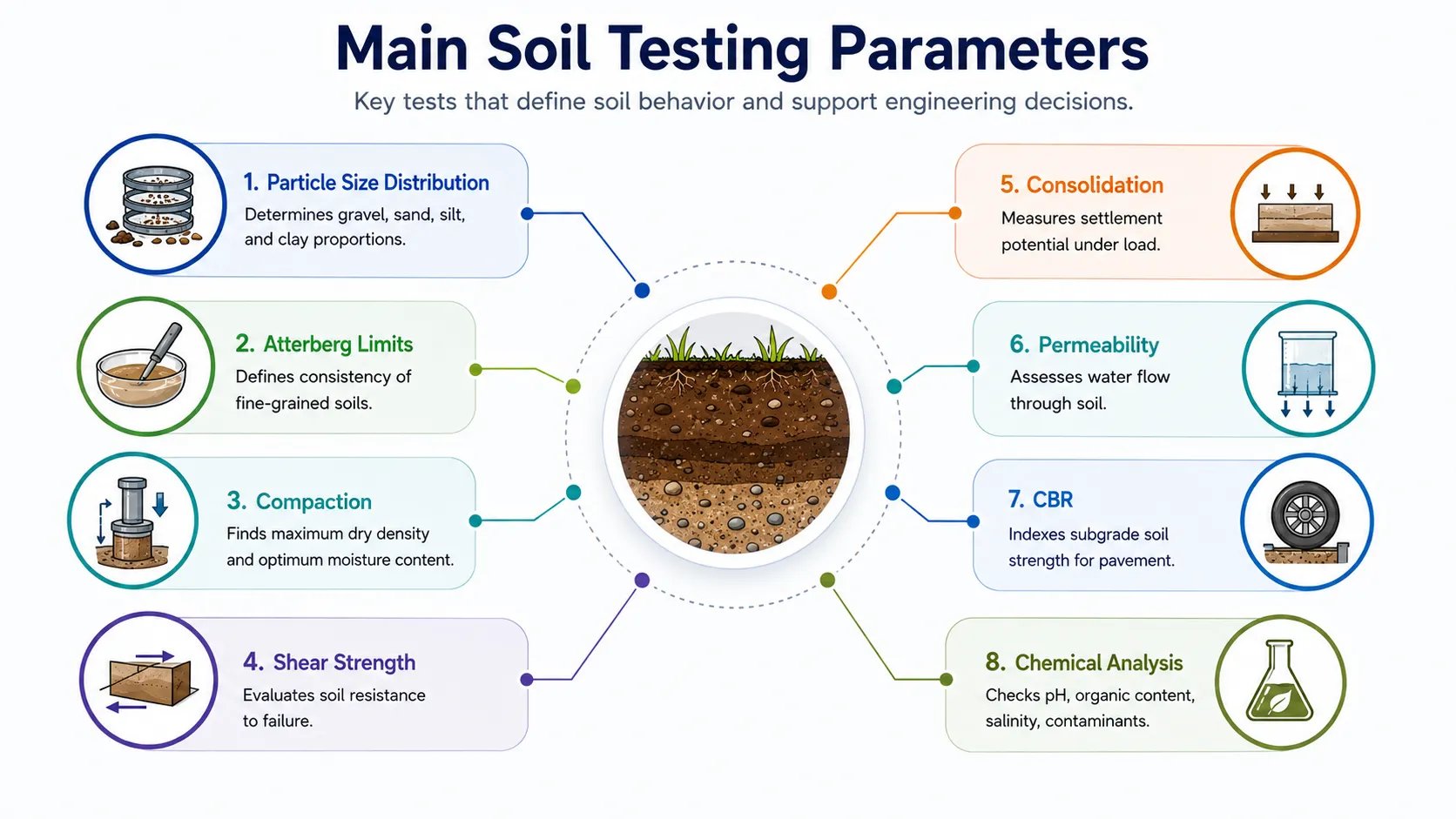
The following test groups represent common relationships between a soil property, the reason for measuring it, and the equipment needed to generate the result:
- Particle Size Distribution (Sieve and Hydrometer Analysis): Determines the proportions of coarse and fine soil fractions and supports soil classification and interpretation of engineering behavior.
- Atterberg Limits (Liquid, Plastic, Shrinkage Limits): Characterizes the consistency and plasticity behavior of fine-grained soils for classification and engineering evaluation.
- Compaction Characteristics (Proctor Test): Establishes the relationship between moisture content and dry density under a defined compactive effort.
- Shear Strength (Direct Shear, Triaxial, Unconfined Compression): Evaluates resistance to shear or compressive failure and provides parameters used in geotechnical assessment.
- Consolidation (Oedometer Test): Evaluates deformation and settlement behavior under applied loading.
- Permeability (Constant/Falling Head): Evaluates hydraulic conductivity and water movement through soil.
- California Bearing Ratio (CBR): Provides an index used in evaluating soils and materials for pavement-related applications.
- Chemical Analysis (pH, Organic Content, Salinity, Contaminants): Supports agricultural assessment, environmental investigation, and other applications requiring soil chemistry data.
Soil Testing Laboratory Workflow
A typical laboratory workflow moves from sample receipt and preparation through classification, mechanical or chemical testing, quality checks, data review, and reporting. Because soil testing covers different applications, the exact sequence varies, but careful sample preparation and equipment verification are important throughout the process.
Sample Preparation and Classification
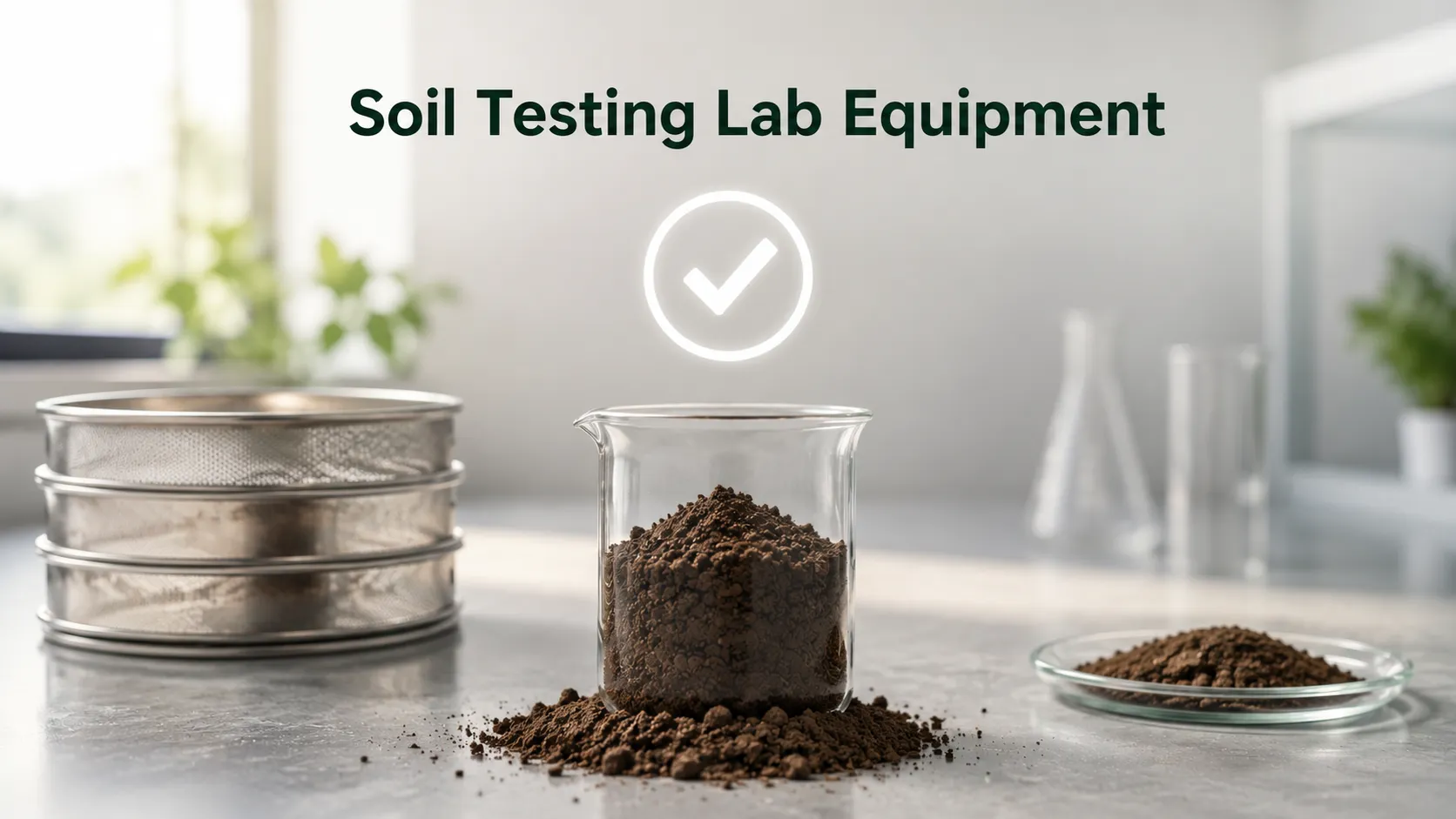
Upon arrival, soil samples are logged and prepared according to the intended test. Drying equipment may be used for moisture determination or sample preparation, while soil grinders, mortars, sieves, and sample-splitting tools help produce suitable test portions.
Particle-size analysis uses test sieves for the coarser fractions and may use sedimentation or hydrometer equipment when the fine fraction must also be characterized. Accurate weighing is required throughout preparation and classification.
QC Checks: Verify oven temperature performance, sieve condition and cleanliness, balance performance, and sample identification before testing.
- Drying oven with temperature controller
- Desiccator for moisture protection
- Set of test sieves
- Precision balance
- Mortar and pestle or soil grinder


Atterberg Limits Determination
For fine-grained soils, Atterberg limits testing helps characterize consistency and plasticity. Liquid limit testing may use a Casagrande device or fall cone apparatus depending on the selected method, while plastic limit determination involves preparing and rolling soil specimens under controlled conditions.
Because these tests can be sensitive to preparation and operator technique, laboratories should pay particular attention to apparatus condition, dimensions, weighing, moisture determination, and procedural consistency.
QC Checks: Inspect the liquid-limit apparatus and accessories, verify relevant dimensions and operating condition, and confirm balance and moisture-content equipment performance.
- Casagrande liquid limit device
- Fall cone penetrometer
- Grooving tool
- Moisture content tins
- Glass plate for plastic limit rolling
- Balance
Standard and Modified Proctor Compaction
Compaction testing evaluates the relationship between soil moisture content and dry density under a defined compactive effort. The resulting moisture-density relationship is commonly used when establishing or evaluating field compaction requirements.
The required mold, rammer or hammer, preparation accessories, and procedure should be selected according to the test method being followed. Laboratories handling frequent construction-control samples should also consider equipment durability, workflow efficiency, and repeatability.
QC Checks: Verify the compaction apparatus condition, relevant dimensions and mass, mold volume, balance performance, and moisture-content equipment.
- Proctor compaction mold and collar
- Proctor hammer or rammer with controlled drop
- Sieve for sample preparation
- Balance
- Drying oven
- Steel straightedge for trimming
Shear Strength Testing
Shear-strength testing can include direct shear, triaxial compression, and unconfined compression depending on the soil type, required parameters, and engineering application. Direct shear equipment applies shear along a defined plane, while triaxial systems allow the specimen to be tested under controlled confining and axial loading conditions.
The appropriate system depends not only on the test name but also on the required loading control, pressure control, drainage conditions, measurement channels, data acquisition, and sample throughput. Advanced testing therefore requires greater attention to system configuration than basic classification tests.
QC Checks: Verify load and displacement measurement devices, pressure measurement where applicable, specimen dimensions, system alignment, and specimen preparation condition.
- Triaxial test system (with cell, pressure panel, loading frame)
- Direct shear apparatus (shear box, loading system, displacement measurement)
- Unconfined compression tester
- Sample extrusion and trimming tools
- Moisture content equipment

Consolidation and Permeability Testing
Consolidation testing evaluates deformation under applied loading, while permeability testing measures the movement of water through a soil specimen. Although these are different tests, both require careful specimen preparation and control of test conditions.
For consolidation work, the laboratory should consider loading capability, deformation measurement, specimen rings, drainage components, and the number of stations required. Permeability equipment should be selected according to the soil type and the required test method.
QC Checks: Inspect specimen rings and porous components, verify deformation measurement and zero settings, and maintain the required water and drainage conditions.
- Consolidation test apparatus (oedometer, loads, dial gauge or LVDT)
- Constant/falling head permeability setup
- Stopwatch and graduated cylinders
- Specimen trimming ring cutter
- Water supply appropriate to the method
Chemical and Environmental Soil Testing
Soil laboratories serving agricultural or environmental applications may require chemical analysis in addition to physical and mechanical testing. Common measurements include pH and electrical conductivity, while more extensive laboratories may investigate organic matter, nutrients, metals, or other target analytes using appropriate preparation and analytical methods.
Instrument selection depends strongly on which analytes must be measured. A basic agricultural laboratory may focus on routine electrochemical and spectrophotometric measurements, whereas more advanced environmental work may require additional sample-preparation and instrumental-analysis capability.
QC Checks: Use appropriate calibration or reference solutions, blanks, duplicates, and other quality-control procedures required by the selected analytical method.
- pH meter with suitable electrode
- Conductivity meter
- UV-VIS spectrophotometer
- Flame photometer or ICP where required by the analytical scope
- Shaker or magnetic stirrer for extractions
- Analytical balance


Key Quality Control Tests for Soil Testing Laboratories
The following table provides a direct test-to-equipment reference for common soil laboratory requirements.
| Quality Control Test | Purpose | Common Laboratory Equipment | Relevant Product Types / Applications |
|---|---|---|---|
| Moisture Content | Determine water content for test calculations and sample characterization | Drying oven, desiccator, balance | Common requirement across many soil tests |
| Sieve Analysis | Determine particle-size distribution of the coarser soil fractions | Test sieves, sieve shaker, balance | Soils and aggregate-related materials |
| Hydrometer Analysis | Characterize fine particle-size fractions | Sedimentation cylinder, hydrometer, preparation accessories | Fine-grained soil fractions |
| Liquid Limit | Characterize soil consistency and plasticity | Casagrande device or fall cone apparatus | Fine-grained soils |
| Plastic Limit | Determine the lower boundary of the plastic state | Glass plate, moisture containers, balance | Fine-grained soils |
| Proctor Compaction | Determine the moisture-density relationship under specified compactive effort | Compaction mold and hammer/rammer, balance, oven | Subgrade, earthwork, and fill materials |
| Direct Shear | Evaluate shear-strength behavior | Shear box, loading system, displacement measurement | Geotechnical soil evaluation |
| Unconfined Compression | Evaluate unconfined compressive behavior of suitable cohesive specimens | Compression loading and deformation measurement system | Cohesive soil assessment |
| Consolidation | Evaluate deformation and settlement behavior under loading | Oedometer, loading system, dial gauge or LVDT | Compressible soil and foundation-related studies |
| pH and Conductivity | Evaluate selected chemical properties including acidity/alkalinity and salinity-related behavior | pH meter, conductivity meter, extraction vessels | Agricultural and environmental soil testing |
Recommended Laboratory Equipment for Soil Testing Laboratories
A complete equipment list should be based on the laboratory’s actual test scope rather than purchasing every available soil-testing instrument. The following equipment families cover many common laboratory requirements.
| Laboratory Equipment | Main Application | Why It Matters |
|---|---|---|
| Standard Test Sieves | Particle-size distribution | Core equipment for soil classification and sample preparation |
| Sieve Shaker | Routine mechanical sieving | Supports more consistent sieving and higher sample throughput |
| Atterberg Limits Test Equipment | Liquid and plastic limit determination | Supports classification and evaluation of fine-grained soils |
| Proctor Compaction Molds and Hammers | Compaction testing | Provides the apparatus required to establish moisture-density relationships |
| Triaxial Test System | Advanced shear-strength testing | Supports controlled loading and confining conditions for geotechnical investigation |
| Direct Shear Apparatus | Shear-strength testing | Provides a widely used approach to evaluating soil shear behavior |
| Consolidation Frame (Oedometer) | One-dimensional consolidation testing | Measures deformation behavior under incremental loading |
| Moisture Content Oven | Water-content determination and sample preparation | Supports many soil preparation and testing workflows |
| Benchtop pH and Conductivity Meters | Chemical property analysis | Provide routine measurements for agricultural and environmental soil applications |
| Analytical and Precision Balances | Mass measurement | Support sample preparation, moisture determination, and chemical analysis |
| Falling Head Permeameter | Hydraulic conductivity testing | Supports permeability evaluation where the selected method calls for falling-head testing |
| Sample Preparation Tools (Extruders, Trimmers, Mortars) | Specimen and sample preparation | Help produce specimens appropriate for subsequent mechanical or analytical testing |
Basic vs Advanced Soil Testing Laboratory Equipment
Not every soil testing laboratory needs an advanced geotechnical or analytical system. A practical equipment plan can be divided into basic routine capability and specialized capability.
Basic Soil Testing Laboratory
A basic laboratory focused on routine soil classification and construction-related checks may begin with:
- Drying oven and desiccator
- Precision balances
- Test sieves and a sieve shaker
- Sample preparation tools
- Atterberg limits equipment
- Compaction equipment
- Moisture-content accessories
Depending on the laboratory’s work, a pH or conductivity meter and a basic strength-testing device may also be appropriate.
Advanced or Specialized Soil Laboratory
A laboratory performing detailed geotechnical investigations or broader environmental analysis may add:
- Direct shear equipment
- Triaxial testing systems
- Unconfined compression equipment
- Consolidation systems
- Permeability equipment
- CBR testing equipment
- Digital load, displacement, and pressure measurement
- Data acquisition and analysis software where appropriate
- Spectrophotometric or other analytical instrumentation for the required chemical tests
The decision to add advanced equipment should follow actual testing requirements rather than laboratory size alone.
How to Choose Laboratory Equipment for Soil Testing Laboratories
Selecting soil testing equipment should begin with a test matrix: list the soil properties that must be measured, the methods the laboratory must follow, the expected number of samples, and the reporting requirements. This prevents both under-equipping the laboratory and purchasing advanced systems that are not needed for the intended workload.
1. Define the required tests. A laboratory focused on routine classification may need sieves, moisture equipment, Atterberg limits apparatus, and compaction equipment. A geotechnical investigation laboratory may additionally require shear, triaxial, consolidation, permeability, or CBR systems. Agricultural and environmental laboratories may prioritize pH, conductivity, extraction, and analytical instruments.
2. Match equipment to the required method. Similar soil properties can sometimes be measured using different apparatus or procedures. Confirm that the equipment configuration is suitable for the method and standard your laboratory is required to follow rather than selecting an instrument by test name alone.
3. Consider sample throughput. A laboratory processing occasional samples has different requirements from one handling routine construction-control or commercial testing workloads. Higher throughput can justify sieve shakers, multiple testing stations, more efficient sample preparation, and digital data collection.
4. Evaluate measurement and control requirements. For mechanical systems, consider the required load, displacement, pressure, and other measurement functions. For chemical instruments, consider the analytes and methods the laboratory actually needs to support. Required performance should be determined from the applicable method rather than assumed from a generic equipment list.
5. Plan calibration and maintenance. Instruments should be practical to inspect, verify, calibrate, clean, and maintain. Availability of replacement parts, accessories, consumables, technical documentation, and service support can be as important as the initial purchase.
6. Decide how much automation is justified. Manual equipment can be appropriate for lower-throughput routine testing. Digital measurement and data acquisition become more valuable when the laboratory needs higher throughput, multiple measurement channels, detailed test curves, or more efficient data handling.
7. Allow for future expansion. Where the testing scope may grow, modular systems can make it easier to add measurement channels, accessories, test cells, or additional stations without replacing the complete laboratory setup.
AELAB offers laboratory equipment for soil testing applications across sample preparation, physical testing, mechanical testing, and analytical workflows. Equipment selection should be based on the laboratory’s required tests, methods, sample volume, and desired level of automation.
Frequently Asked Questions
What is the most basic equipment needed for a soil testing lab?
A basic soil testing laboratory commonly starts with a drying oven, balances, test sieves, sample-preparation tools, Atterberg limits equipment, and compaction apparatus. The exact setup should follow the tests the laboratory needs to perform. Strength-testing or pH/conductivity equipment can then be added where required by the application.
How often should soil testing equipment be calibrated?
Calibration and verification intervals should follow the applicable test method, equipment manufacturer guidance, laboratory quality system, usage frequency, and instrument stability. High-use or measurement-critical equipment may require checks between formal calibration intervals, so laboratories should maintain documented calibration and verification schedules rather than relying on one interval for every instrument.
Can one soil testing device perform multiple tests?
Some configurable loading frames and measurement systems can support more than one test when fitted with the appropriate accessories and controls. Other equipment, including many specimen molds, consolidation cells, and dedicated test apparatus, is specific to a particular method. Confirm the supported test configuration before purchasing a multi-purpose system.
What standards should soil testing equipment comply with?
The equipment should be suitable for the specific ASTM, AASHTO, BS, ISO, or other test method required by the laboratory, client, project, or jurisdiction. Because equipment dimensions, loading conditions, preparation procedures, and measurement requirements can differ between methods and editions, verify the exact applicable standard before selecting the apparatus.
How do I maintain soil testing equipment for long-term accuracy?
Keep equipment clean, inspect moving and measurement components, protect sieves and sensitive accessories from damage, and follow the manufacturer’s lubrication and maintenance instructions. Laboratories should also document calibration, verification, repairs, component replacement, and relevant QC checks so equipment condition can be traced over time.
Is digital data acquisition necessary in soil testing?
No. Manual readouts can be appropriate for many routine soil tests. Digital data acquisition becomes more useful when a test requires multiple measurement channels, continuous data collection, detailed curves, higher throughput, or more efficient reporting. The appropriate level of automation should therefore be selected according to the laboratory’s test methods and workload.
Conclusion
The right laboratory equipment for soil testing laboratories depends on what the laboratory must measure rather than on a universal equipment list. Routine soil classification may require only sample preparation, moisture, sieving, Atterberg limits, and compaction equipment, while advanced geotechnical work can require shear, triaxial, consolidation, permeability, and digital measurement systems. Agricultural and environmental applications introduce a different set of chemical-analysis requirements.
For equipment planning, start with the required soil tests, map each test to its purpose and instrument, confirm the applicable method, estimate sample throughput, and then decide which capabilities are essential now and which can be added later. This approach produces a laboratory configuration that is easier to operate, maintain, and expand.