Seed Quality Testing and Analysis Overview
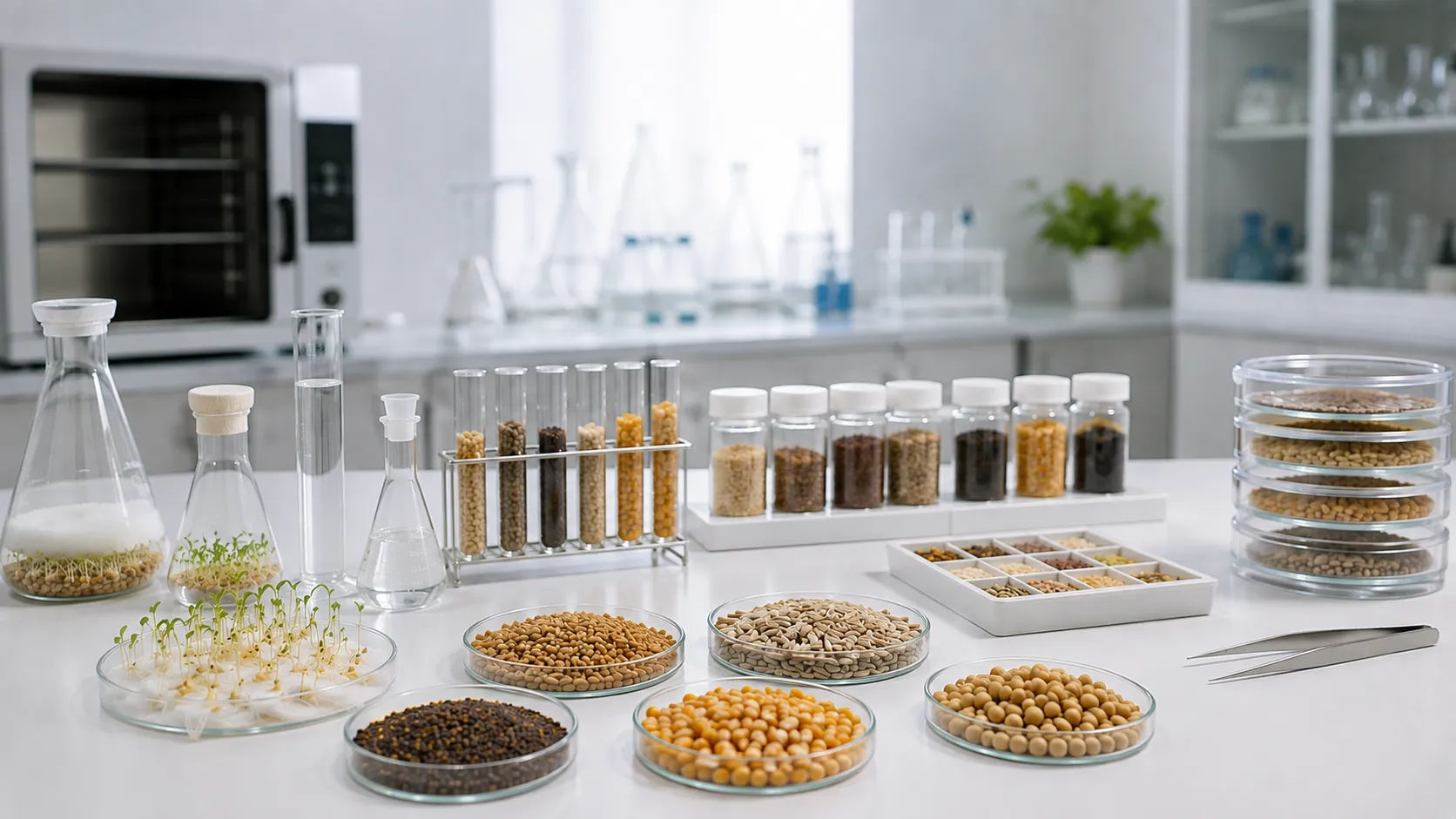
Seed quality testing typically combines representative sampling, physical purity analysis, germination and viability assessment, seed health screening, vigor testing, and moisture determination. A practical laboratory therefore needs equipment for sample preparation, controlled germination, weighing and moisture measurement, visual inspection, and—where the testing scope requires it—microbiological or molecular analysis.
In agricultural seed production, seed quality testing equipment is fundamental to ensuring high crop yields, regulatory compliance, and customer trust. Seed quality testing involves a series of laboratory analyses that evaluate physical purity, germination potential, moisture content, seed health, and genetic integrity. These tests directly impact planting success and are the backbone of any professional seed certification program.
For seed companies, investing in a well-equipped quality control laboratory is not only a regulatory necessity but also a competitive advantage. Reliable laboratory equipment enables precise monitoring of seed lots from harvest to packaging, helping manufacturers detect substandard batches early, reduce returns, and maintain brand reputation. Whether for vegetables, cereals, or oilseeds, accurate seed testing underpins the entire supply chain.
Main Products and Applications
The seed industry covers a wide range of agricultural and horticultural products. Quality testing is adapted to each type, but the core principles remain similar across categories:
- Cereal Seeds – Wheat, rice, maize, barley, and sorghum; tested for purity, germination, and moisture.
- Oilseeds and Legumes – Soybean, sunflower, groundnut, pea, and bean; require vigor and health testing due to high oil content.
- Vegetable Seeds – Tomato, pepper, onion, and leafy greens; often tested for seed-borne pathogens and germination uniformity.
- Forage and Grass Seeds – Alfalfa, clover, ryegrass; purity analysis is critical due to contamination with weed seeds.
- Flower and Ornamental Seeds – High-value seeds demanding precise germination and purity testing for export markets.
Seed Quality Testing Quality Control Workflow
1. Sampling and Sample Preparation
Representative sampling is the first critical step in seed quality control. Poor sampling can lead to incorrect test results and misclassification of entire seed lots. Technicians must collect proportionate subsamples from different parts of a seed lot following established protocols, then reduce them to working samples using dividers. This stage ensures that subsequent tests truly reflect the lot’s quality.
Quality risks at this stage include uneven mixing, biased sampling, and contamination. Parameters to control are sample size, division method, and homogenization. Test results from the prepared sample serve as the foundation for all downstream analyses, so any error here propagates through the entire quality control workflow.
Recommended laboratory equipment for this stage:
- Seed Divider (Rifle or Boerner Type) – Splits seed samples into representative portions for analysis, minimizing bias.
- Analytical Balance – Weighs subsamples to required precision, complying with ISTA sampling standards.
- Seed Blower or Aspirator – Separates light impurities from seed samples during preparation.
- Sample Storage Containers – Airtight containers to preserve seed moisture and viability between tests.

2. Physical Purity Analysis
Physical purity testing identifies the composition of a seed lot by separating pure seeds, other crop seeds, weed seeds, and inert matter. Physical purity results are commonly used in seed quality assessment and can support certification and labeling decisions where applicable. High purity ensures that farmers receive clean seed with minimal foreign material, which affects planting efficiency and crop uniformity.
The main quality risks include high inert content, noxious weed seeds, or misidentified species. Analysts measure the percentage of pure seeds, number of other seeds, and weight of inert matter. The results determine if the lot meets the applicable purity criteria for its intended use or certification program.
Recommended laboratory equipment for this stage:
- Purity Workboard – A well-lit, static-free station with magnifier for manual separation and inspection.
- Sieve Set – Stackable sieves for size-based fractionation of seed and impurities.
- Seed Counter – Electronic counter to quickly quantify small seed lots or contaminants.
- Stereomicroscope – Supports visual identification of weed seeds and other foreign particles by morphological features.
- Precision Balance – Measures weight fractions of separated components to calculate purity percentages.

3. Germination and Viability Testing
Germination testing is the most recognized seed quality test, measuring the ability of seeds to produce normal seedlings under optimal conditions. This test predicts field emergence potential and is a key factor in sales contracts and labeling. Consistently low germination rates can indicate storage problems, mechanical damage, or dormancy issues.
During testing, seeds are placed on moist media and incubated at controlled temperatures and light cycles. The resulting seedlings are evaluated for normal growth according to species-specific criteria. The test reports the percentage of normal seedlings, abnormal seedlings, hard seeds, and dead seeds. Results directly affect the seed lot’s marketability and recommended planting rates.
Recommended laboratory equipment for this stage:
- Germination Chamber or Cabinet – Provides precise temperature, humidity, and light control for reproducible germination conditions.
- Germination Paper or Substrate – Special paper towels or sand used as growth media, selected to suit the germination method and seed type.
- Seed Counter – Dispenses exact numbers of seeds per replication for statistical validity.
- Seedling Evaluation Board – Illuminated workstation for uniform assessment of seedling structures.
- Cold Test Growth Chamber – Simulates stressful field conditions to test vigor in addition to standard germination (optional but valuable).
4. Seed Health and Pathogen Screening
Seed health testing detects the presence of seed-borne pathogens, including fungi, bacteria, viruses, and nematodes. Infected seeds can introduce diseases into fields, cause seedling blights, and reduce crop yields. Seed health requirements can vary by crop, destination, buyer specification, and applicable plant-health rules, so laboratories should define the required screening scope before selecting methods and equipment.
Quality risks include pathogen transmission across regions and crop failure. Tests may include blotter incubation, agar plating, ELISA, or PCR-based methods. Results can support decisions on seed treatment, lot disposition, and additional confirmatory testing where required. Early detection allows for physical or chemical interventions before distribution.
Recommended laboratory equipment for this stage:
- Laminar Flow Cabinet – Provides a sterile work area for handling seeds and inoculating media without contamination.
- Incubator – Maintains specific temperatures for fungal and bacterial growth on agar or blotters.
- Autoclave – Sterilizes media and glassware to prevent cross-contamination.
- Stereomicroscope with Dark-Field – Examines fungal structures and spores on incubated seeds.
- PCR Thermal Cycler – Amplifies pathogen DNA for highly sensitive and specific molecular detection.
- Gel Documentation System – Visualizes and documents PCR products for pathogen identification.


5. Vigor and Stress Tolerance Testing
Vigor testing goes beyond standard germination to assess seed performance under unfavorable conditions. It measures the speed and uniformity of seedling emergence, particularly important for seeds planted in cold, wet, or crusted soils. High-vigor seeds establish faster, compete better with weeds, and often produce higher yields.
Common vigor tests include accelerated aging, electrical conductivity, cold test, and seedling growth rate. These tests help identify lots that may germinate well in the lab but fail in the field. Results assist seed companies in making storage and marketing decisions, and farmers in selecting high-performing seed.
Recommended laboratory equipment for this stage:
- Accelerated Aging Chamber – Exposes seeds to high temperature and humidity for a controlled period to stress them.
- Conductivity Meter – Measures electrolyte leakage from imbibed seeds, an indicator of membrane integrity.
- Cold Test Germination Chamber – Combines low temperature with soil to mimic early planting stress.
- Automated Seedling Imaging System – Captures and analyzes root and shoot growth over time, calculating vigor indices.
- Balance – Used in seedling growth rate tests to measure dry weight accumulation.

6. Moisture Content Determination
Seed moisture content is a critical parameter influencing storage life, viability, and susceptibility to mold or insect damage. Testing moisture immediately after harvest and periodically during storage ensures that seeds remain below thresholds for safe storage. High moisture accelerates respiration, leading to heat buildup and rapid quality loss.
Moisture testing must be fast and accurate, especially when deciding drying regimes or conditioning steps. Both primary (oven-drying) and secondary (electronic meter) methods are used, with proper calibration against standard reference methods. Results guide warehouse management and prevent downgrading due to spoilage.
Recommended laboratory equipment for this stage:
- Moisture Analyzer (Halogen or Infrared) – Rapidly determines seed moisture content through loss-on-drying, with built-in weighing.
- Laboratory Oven – The reference method for moisture determination, drying samples at constant temperature for gravimetric analysis.
- Seed Moisture Meter – Handheld or benchtop electronic device calibrated for specific seed types, providing rapid readings when the appropriate crop calibration is available.
- Analytical Balance – Required for precise pre- and post-drying weight measurements in oven methods.
- Desiccator – Cools dried samples in a moisture-free environment to prevent reabsorption before final weighing.


Common Quality Control Challenges in Seed Production
- Inconsistent sampling leading to non-representative test results across lots.
- Seed-borne diseases that remain undetected until after distribution and planting.
- Moisture content variability within a single seed lot, causing hot spots and storage loss.
- Mechanical damage during processing that affects germination but is not visible externally.
- Low seedling vigor despite acceptable standard germination, resulting in poor field stand.
- Contamination with GMO or off-type seeds that affect genetic purity certification.
Key Quality Control Tests for Seed Quality
| Quality Challenge | Quality Control Test | Recommended Laboratory Equipment | Application |
|---|---|---|---|
| Non-representative sample | Proper sampling and dividing | Seed divider, analytical balance | Ensures test results reflect the seed lot |
| Low physical purity | Purity analysis | Purity workboard, stereomicroscope | Certifies label claims of pure seed percentage |
| Poor germination rate | Standard germination test | Germination chamber, seed counter | Determines seed lot eligibility for sale |
| Seed-borne pathogens | Seed health testing | Incubator, laminar flow cabinet, PCR cycler | Supports pathogen control and applicable plant-health decisions |
| Low field emergence | Vigor testing (e.g., cold test) | Cold test chamber, conductivity meter | Predicts performance under stress conditions |
| Excess moisture | Moisture content determination | Moisture analyzer, laboratory oven | Ensures safe storage and prevents spoilage |
| Genetic impurity | Isozyme or DNA-based purity test | Electrophoresis system, thermal cycler | Supports varietal identity or targeted genetic screening |
| Seed aging during storage | Accelerated aging test | Aging chamber, germination chamber | Estimates storage potential and shelf life |
Laboratory Equipment Required for Seed Quality Control
Establishing a seed quality control laboratory requires a balanced combination of physical, environmental, and analytical instruments. The core equipment categories include mechanical dividers and sieves for sample preparation, controlled-environment chambers for germination and vigor tests, optical instruments for purity and pathology inspection, and electronic meters for rapid moisture and conductivity measurements. Each piece plays a role in generating the data needed for certification and internal quality management.
Physical testing instruments like seed blowers, purity workboards, and analytical balances handle the tangible separation and quantification of seed components. Environmental chambers—germination cabinets, incubators, and aging chambers—provide the precise conditions necessary for biological assays. Analytical equipment such as moisture analyzers, PCR systems, and spectrophotometers extend the lab’s capability to detect hidden defects, pathogens, or moisture anomalies. Together, these tools form a comprehensive quality control ecosystem that addresses the multifaceted nature of seed quality.
| Testing Requirement | Laboratory Equipment | Why Manufacturers Need It |
|---|---|---|
| Sample division and homogenization | Seed divider, analytical balance | Ensures representative subsamples for all tests |
| Purity determination | Purity workboard, stereomicroscope, sieves | Verifies seed lot composition and label accuracy |
| Germination assessment | Germination chamber, seed counter | Predicts seedling emergence and viability |
| Seed health screening | Laminar flow cabinet, incubator, PCR equipment | Detects pathogens to prevent disease outbreaks |
| Vigor evaluation | Aging chamber, conductivity meter, cold test chamber | Identifies high-performance seed lots |
| Moisture measurement | Moisture analyzer, laboratory oven | Monitors storage safety and drying requirements |
| Genetic purity and GMO testing | Thermal cycler, gel electrophoresis system | Confirms varietal identity for certification |
| Seed counting and weighing | Electronic seed counter, precision balance | Provides accurate replication and test calculations |
With these instruments, a seed quality control laboratory can cover the full spectrum of required testing—from physical purity to molecular diagnostics—enabling reliable decision-making in production, storage, and marketing.
Basic Laboratory Setup for Seed Quality Manufacturers
| Laboratory Level | Recommended Equipment | Suitable For |
|---|---|---|
| Basic QC Laboratory | Seed divider, analytical balance, purity workboard, germination chamber, moisture analyzer, basic microscope | Small to medium seed producers performing routine purity, germination, and moisture tests |
| Advanced QC Laboratory | All Basic equipment, plus: stereomicroscope with camera, conductivity meter, accelerated aging chamber, PCR thermal cycler, laminar flow cabinet | Larger seed companies and laboratories conducting vigor, health, and initial genetic purity testing |
| Advanced Analysis Laboratory | All Advanced equipment, plus: automated seed counter, gel documentation system, NIR analyzer, cold test chamber, seedling imaging system | Research-oriented seed centers and reference labs requiring high-throughput and in-depth analytical capabilities |
How to Choose Laboratory Equipment for Seed Quality Testing
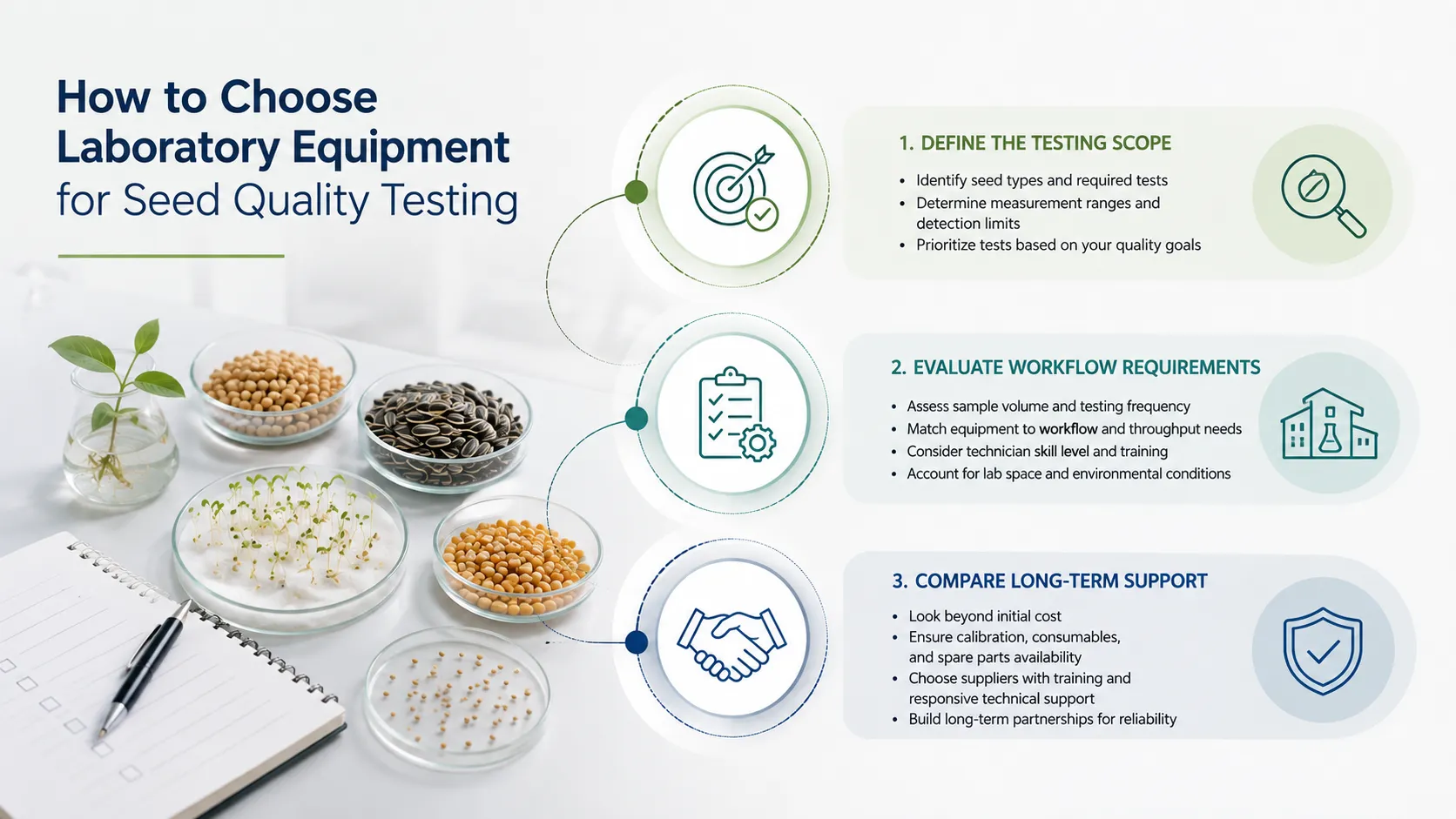
Selecting the right laboratory equipment for seed quality testing depends on your specific product types, testing volume, and quality goals. Start by mapping out the required tests and then identifying instruments that deliver the necessary accuracy and throughput.
Define the Testing Scope
Consider the seed species you handle and the range of tests you need to perform. For example, if you produce large volumes of cereal seeds, rapid moisture analysis and high-capacity germination chambers are priorities. If you export seeds, PCR-based pathogen screening may be essential. Define the measurement ranges (e.g., moisture from 5% to 20%) and the detection limits required for pathogens or contaminants to narrow down equipment specifications.
Evaluate Laboratory Workflow Requirements
Assess your daily or seasonal sample load. A laboratory that processes hundreds of samples per week during harvest will benefit from automated seed counters and multi-shelf germination chambers. Consider the skill level of your technicians; some equipment like automated moisture analyzers are push-button simple, while PCR machines require trained molecular biologists. Factor in laboratory space and environmental conditions—germination chambers need stable room temperature and dedicated power.
Compare Long-Term Equipment Support
Look beyond the initial purchase price. Reliable calibration, readily available consumables, and responsive technical support are critical for maintaining testing accuracy and uptime. Instruments like moisture analyzers and balances need regular calibration, while PCR cyclers require reagents. Consider suppliers that offer training and application support, such as AELAB, which can guide you toward instrument configurations matching your testing scope and workflow. Long-term partnerships reduce operational risks and keep your laboratory current with evolving standards.
Who Needs Laboratory Testing Solutions for This Industry?
- Seed Production Companies – To certify seed lots and ensure quality before sale.
- Contract Seed Growers – To verify seed quality meets buyer specifications.
- Agricultural Research Institutes – For breeding, storage, and pathology studies.
- Government Seed Certification Agencies – To enforce national seed regulations.
- Seed Treating and Processing Facilities – To monitor quality changes after treatment.
Frequently Asked Questions
What is the most essential equipment for a basic seed testing lab?
A basic seed testing laboratory requires a seed divider for sample preparation, an analytical balance for weighing, a germination chamber for viability tests, and a moisture analyzer for water content determination. A purity workboard with magnification completes the core setup for fundamental quality analysis.
How often should germination chambers be calibrated?
Calibration frequency for germination chambers depends on usage intensity and manufacturer recommendations, but quarterly temperature and humidity checks are common. Regular calibration against certified sensors ensures that test conditions remain within specified tolerances, which is critical for reliable germination results.
Can one moisture meter work for all seed types?
Moisture meters are often calibrated for specific seed types because the electrical properties of seeds vary with oil content, shape, and density. It is important to use a meter with crop-specific calibrations or to validate its readings against the oven-drying reference method for each new seed type.
What is the difference between germination and vigor testing?
Germination testing measures the percentage of seeds that produce normal seedlings under ideal conditions, while vigor testing evaluates seed performance under stress. Vigor tests, such as cold tests or accelerated aging, provide additional information on field emergence potential and storability, helping to rank seed lots beyond standard germination percentages.
Conclusion
A well-designed seed quality control laboratory supports more consistent product decisions, earlier detection of quality problems, and better alignment between testing capability and commercial or certification requirements. By matching the right equipment to each stage of the testing workflow—from sampling to pathogen detection—seed companies can build robust quality systems that safeguard their reputation and market access.
Laboratory Equipment Solutions for Seed Quality Testing
AELAB helps seed quality laboratories translate their testing needs into practical equipment configurations. By considering the types of seeds you process, the specific quality control tests required, your desired accuracy levels, and your daily sample throughput, AELAB can recommend a laboratory setup that aligns with your operational workflow. Whether you need a simple purity and moisture station or a full-fledged pathology and molecular biology lab, the right combination of instruments ensures that your quality data is trustworthy and actionable.
To get started, share details about your seed products, the test methods you follow, your expected testing volume, and any current quality challenges you face. With this information, AELAB can help you design a seed quality testing laboratory that is both practical and scalable, ensuring you meet regulatory demands and exceed customer expectations.