Laboratory Equipment for Dairy Manufacturing Overview
Laboratory equipment for dairy manufacturing supports quality control from raw milk reception through processing and final product release. A typical dairy laboratory combines instruments for compositional analysis, pH and acidity measurement, microbiological testing, physical-property testing, and process verification. The exact equipment configuration depends on the dairy products manufactured, required test methods, sample throughput, and applicable quality or regulatory requirements.
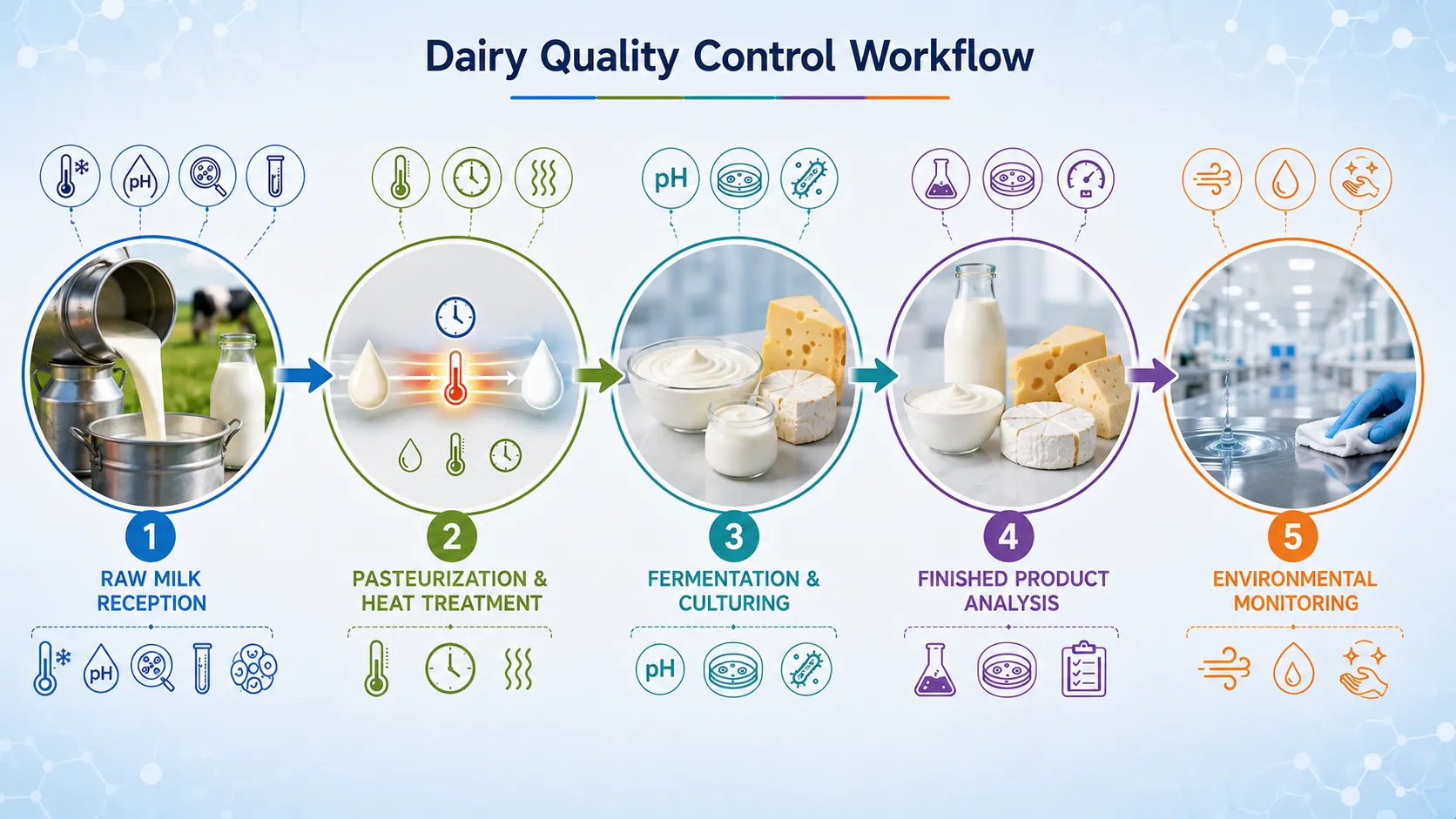
For most dairy plants, the core testing workflow can be summarized as production stage → required quality test → suitable test method → laboratory equipment → acceptance decision. Raw milk may require composition, acidity, adulteration, residue, and microbiological screening; fermentation requires pH and viscosity monitoring; and finished products may require composition, moisture, texture, and microbiological analysis.
Modern dairy manufacturing therefore depends on laboratory testing not only for product safety and consistency but also for process control. Detecting deviations in raw materials or in-process samples allows production teams to investigate and adjust the process before affected material reaches final release.
What Is Laboratory Equipment for Dairy Manufacturing?
Laboratory equipment for dairy manufacturing includes the analytical instruments, testing devices, and supporting laboratory equipment used to evaluate raw materials, monitor production processes, and verify finished dairy products.
Common testing groups include:
- Compositional analysis: Fat, protein, lactose, moisture, total solids, and other formulation parameters.
- Process control: pH, titratable acidity, temperature, and fermentation development.
- Physical testing: Viscosity, texture, melting behavior, bulk density, and other product-dependent properties.
- Microbiological testing: General microbial quality, spoilage organisms, hygiene indicators, and other microbiological targets defined by the laboratory’s testing program.
- Hygiene and environmental monitoring: Surface, air, water, and sanitation verification where required by the facility’s quality system.
In a typical dairy laboratory, testing is organized around raw milk reception, in-process controls, finished-product analysis, and environmental monitoring. This structure helps the laboratory connect each test to a specific production decision instead of selecting instruments as isolated pieces of equipment.
Main Dairy Product Types and Testing Requirements
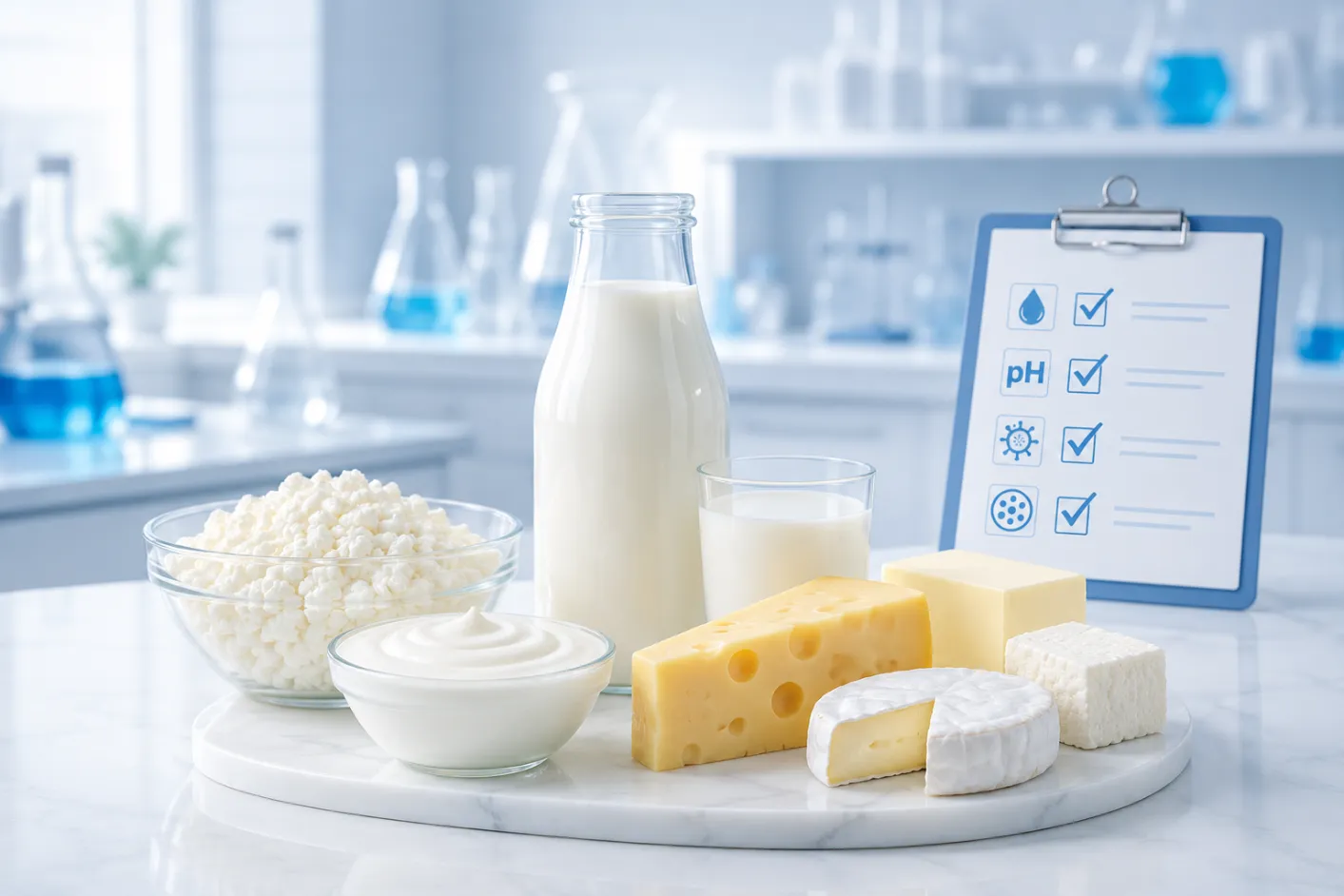
Different dairy products require different combinations of chemical, physical, microbiological, and process-control tests. Equipment selection should therefore begin with the product matrix and required test program.
- Fluid Milk: Common testing includes fat and protein composition, freezing point or adulteration screening, microbiological quality, and other incoming or finished-product checks required by the plant.
- Cheese: Moisture, fat, salt, pH, microbiological quality, and texture may be important depending on the cheese type and production specification.
- Yogurt and Fermented Products: pH, titratable acidity, viscosity, fermentation development, and microbiological testing are commonly relevant.
- Butter and Ghee: Fat, moisture, oxidation-related testing, and other product-specific quality parameters may be monitored.
- Milk Powder: Moisture, bulk density, solubility or dispersibility-related properties, and product-specific physical and microbiological tests may be required.
- Ice Cream: Composition, overrun, melting behavior, texture, and physical stability can be important process and finished-product parameters.
This product-specific approach helps laboratories distinguish between equipment that will be used across almost every production line and instruments needed only for particular dairy products or methods.
Dairy Manufacturing Quality Control Workflow
Raw Milk Reception Testing
Raw milk reception testing determines whether incoming material meets the plant’s acceptance criteria before processing. Depending on the facility and applicable test program, laboratories may evaluate temperature, pH or titratable acidity, composition, antibiotic residues, freezing point, somatic cell count, and other indicators of milk quality or authenticity.
A cryoscope can support freezing-point determination for detecting abnormal dilution or added water, while a mid-infrared milk analyzer can provide rapid compositional measurements such as fat and protein. Somatic cell counters provide a dedicated measurement for raw milk quality assessment.
Key QC Checks: Incoming milk temperature, composition, acidity or pH, residue-screening result, freezing point, somatic cell count, and other acceptance parameters specified by the plant, customer, test method, or applicable regulation.
Recommended Laboratory Equipment:
- Milk cryoscope
- Mid-infrared milk analyzer
- Somatic cell counter
- pH meter
- Antibiotic residue test kits

Pasteurization and Heat Treatment Control
Heat-treatment control combines process temperature/time records with suitable verification tests. Alkaline phosphatase testing is commonly used as an indicator of adequate pasteurization in applicable dairy products and methods. Temperature measurement and recording equipment supports verification of the actual thermal process.
Where homogenization performance is part of the quality program, laboratories may also evaluate relevant physical characteristics such as fat-globule size using an appropriate microscopy or particle-analysis approach.
Key QC Checks: Required heat-treatment time and temperature, phosphatase test result where applicable, and homogenization-related parameters defined by the process specification.
Recommended Laboratory Equipment:
- Spectrophotometer for applicable phosphatase methods
- Digital thermometer with data logger
- Microscope or particle size analyzer where required
Fermentation and Culturing Processes
For yogurt, cheese, and other cultured dairy products, fermentation control depends on tracking changes that indicate culture activity and product development. pH and titratable acidity are common process measurements, while viscosity can be monitored when rheological development is important to the finished product.
Microbiological tools may also be used when the plant needs to evaluate culture activity, viable counts, or other microbiological parameters using an established method.
Key QC Checks: pH development, titratable acidity, fermentation time, viscosity or texture development, and culture-related microbiological parameters where required.
Recommended Laboratory Equipment:
- Benchtop pH meter with temperature compensation
- Titration setup for acidity
- Phase contrast microscope
- Colony counter
- Rotational viscometer


Finished Product Analysis
Finished dairy products are tested against the composition, physical-property, microbiological, and sensory requirements relevant to the product and market. The required methods differ substantially between fluid milk, cheese, yogurt, butter, powders, and frozen dairy products.
Protein can be determined using established nitrogen-analysis methods such as Kjeldahl or Dumas where appropriate. Fat and moisture can be measured using methods selected for the specific matrix. Texture analyzers provide objective measurements of product characteristics such as firmness, adhesiveness, and spreadability when these properties form part of the product specification.
Key QC Checks: Product composition, moisture or solids, physical characteristics, microbiological criteria, and other release specifications defined for the finished dairy product.
Recommended Laboratory Equipment:
- Automatic Kjeldahl or Dumas nitrogen analyzer
- Soxhlet extraction for fat
- Moisture analyzer or oven method
- Texture analyzer
- Incubators and autoclave for microbiology
- Laminar flow hood for sterility


Environmental Monitoring
Environmental monitoring helps a dairy plant verify hygiene and sanitation controls around production and laboratory operations. Depending on the facility’s monitoring plan, samples may be collected from surfaces, air, process water, or other defined locations.
ATP monitoring can provide rapid hygiene-screening information, while microbiological sampling and incubation provide method-specific microbial results. Water activity measurement is particularly relevant for products where available moisture influences stability or microbial growth potential.
Key QC Checks: Environmental and surface hygiene results, water quality where applicable, sanitation verification, and product water activity when relevant to the product specification or shelf-life program.
Recommended Laboratory Equipment:
- Air sampler
- ATP monitoring system
- Water activity meter
- Conductivity meter for cleaning solutions
Key Quality Control Tests for Dairy Products
The table below maps common dairy quality-control requirements to their purpose, typical equipment, and relevant product types. The exact method should be selected according to the product matrix, laboratory quality system, customer specification, and applicable regulatory requirements.
| Quality Control Test | Purpose | Common Laboratory Equipment | Relevant Product Types / Applications |
|---|---|---|---|
| Fat Content Determination | Verifies composition, standardization, and labeling data where applicable | Gerber centrifuge, Mojonnier extraction, mid-infrared analyzer | All dairy products |
| Protein Analysis | Determines protein content for formulation, standardization, or reporting | Kjeldahl apparatus, Dumas combustion analyzer | Milk, cheese, yogurt, powder |
| Titratable Acidity | Supports raw-material assessment and fermentation monitoring | Titrator, pH meter | Raw milk, cultured products |
| Somatic Cell Count | Supports raw milk quality assessment | Somatic cell counter, flow cytometry | Raw milk |
| Alkaline Phosphatase Test | Supports verification of pasteurization where the method is applicable | Spectrophotometer | Pasteurized milk and cream |
| Moisture/Solids Determination | Controls composition, processing, yield, and product consistency | Moisture analyzer, oven drying | Cheese, butter, powder |
| Microbiological Plate Count | Enumerates microorganisms specified by the selected microbiological method | Incubator, colony counter, sterile media | Raw materials, process samples, finished products |
| Texture Profile Analysis | Measures physical characteristics such as firmness, springiness, and cohesiveness | Texture analyzer with suitable probes | Cheese, yogurt, butter |
| Freezing Point Determination | Supports milk authenticity and added-water assessment | Cryoscope | Raw milk |
Recommended Laboratory Equipment for Dairy Manufacturing Laboratories
A dairy laboratory should be configured around the tests it actually performs rather than around the longest possible equipment list. Core instruments support frequent process and release decisions, while more specialized systems are justified when a particular product, test method, throughput requirement, or reporting purpose requires them.
| Laboratory Equipment | Main Application | Why It Matters |
|---|---|---|
| Mid-Infrared Milk Analyzer | Rapid compositional analysis such as fat, protein, lactose, and solids | Supports rapid raw milk assessment and process standardization |
| Kjeldahl/ Dumas Nitrogen Analyzer | Protein determination using the selected nitrogen-analysis method | Provides quantitative protein data for applicable laboratory methods |
| Soxhlet Extraction System | Fat extraction for applicable dairy matrices and methods | Supports laboratory fat determination where extraction-based methods are required |
| Gerber Centrifuge | Routine fat testing using the Gerber method | Provides a practical option where the method suits the laboratory’s testing requirements |
| pH Meter with Temperature Compensation | pH monitoring during processing and fermentation | Supports rapid process decisions across multiple dairy product lines |
| Titration System | Titratable acidity and other applicable titrimetric tests | Supports repeatable process and composition measurements |
| Texture Analyzer | Firmness, spreadability, gel strength, and other physical-property measurements | Provides objective comparison of product texture between formulations or batches |
| Somatic Cell Counter | Raw milk quality assessment | Provides rapid quantitative somatic cell measurement |
| Cryoscope | Milk freezing-point determination | Supports added-water and authenticity assessment |
| Water Activity Meter | Measurement of water activity in applicable dairy products | Supports product stability and moisture-management studies |
| Autoclave | Sterilization of suitable microbiological materials | Supports routine microbiology laboratory operations |
| Incubator with Temperature Control | Controlled incubation for microbiological methods | Supports plate-count and other culture-based testing procedures |
Essential vs Advanced Dairy Laboratory Equipment
The most appropriate dairy laboratory configuration depends on the decisions the laboratory must make.
Core or routine equipment generally supports high-frequency tests used across several production stages. Depending on the plant, this may include pH measurement, temperature measurement, weighing, titration, moisture testing, basic microbiological equipment, and routine milk-composition or fat-testing equipment.
Application-specific or advanced equipment becomes appropriate when the laboratory requires higher throughput, more specialized measurements, greater automation, or tests specific to particular dairy products. Examples can include automated milk analyzers, somatic cell counters, texture analyzers, particle size analyzers, advanced nitrogen-analysis systems, and dedicated physical-property instruments.
The distinction should be based on required methods and production decisions rather than simply purchasing the most sophisticated instrument available.
How to Choose Laboratory Equipment for Dairy Manufacturing
Selecting laboratory equipment for a dairy manufacturing facility starts with the product matrix and required test list. A fluid milk plant may prioritize rapid compositional analysis, freezing-point determination, and incoming milk screening, while a cheese or yogurt facility may place greater emphasis on fermentation monitoring, moisture, salt, viscosity, texture, and microbiological testing.
Next, determine the purpose of each result. Routine process-control testing may allow a different method or instrument configuration from testing used for official reporting, customer certification, payment grading, or labeling. The laboratory should confirm that the selected method and instrument are suitable for the intended purpose.
Sample throughput is another major selection factor. Laboratories processing large numbers of samples may benefit from automated sampling, faster analysis, data handling, and reduced operator intervention. Lower-volume laboratories may achieve their required quality-control objectives with simpler manual or benchtop systems.
Other important selection considerations include:
- Sample matrix: Confirm that the instrument and method are suitable for milk, cheese, yogurt, butter, powder, or the other products being tested.
- Required test method: Determine whether the laboratory needs a routine screening method, a reference method, or another defined procedure.
- Measurement performance: Evaluate the performance required by the method and the laboratory’s quality objectives rather than selecting equipment on a specification in isolation.
- Calibration and verification: Confirm the availability of appropriate standards, reference materials, verification procedures, and documented maintenance requirements.
- Operator requirements: Consider sample preparation, training, cleaning, workflow complexity, and the risk of operator-dependent variation.
- Data management: For high-throughput laboratories, consider how results are recorded, reviewed, exported, or integrated into the laboratory’s data system.
- Service and consumables: Review technical support, spare parts, consumables, and maintenance requirements before purchase.
- Future testing needs: Where expansion is expected, consider whether the equipment can support additional products, methods, or higher sample volumes.
The most useful purchasing question is therefore not simply “Which dairy laboratory instrument is best?” but “Which instrument can perform the required test on our product matrix at the required throughput and according to the method our laboratory must follow?”
Frequently Asked Questions
What are the most essential laboratory instruments for a dairy processing plant?
The core equipment depends on the products and required tests. For many dairy laboratories, frequently used instruments include a milk analyzer or appropriate fat-testing system, pH meter, analytical balance, temperature-measurement equipment, titration equipment, and basic microbiology equipment. Raw milk laboratories may also require a cryoscope and somatic cell counter. Product-specific laboratories may add moisture, viscosity, texture, or other analytical systems.
How often should dairy laboratory equipment be calibrated?
There is no single calibration interval that applies to every dairy laboratory instrument. Calibration and verification frequency should follow the instrument manufacturer, selected analytical method, laboratory quality system, instrument stability, usage frequency, and applicable regulatory or customer requirements. Laboratories should document the schedule and use suitable standards or reference materials where required.
What is the role of texture analysis in dairy quality control?
Texture analysis provides objective measurements of physical properties such as firmness, adhesiveness, cohesiveness, and springiness. For products such as cheese, yogurt, and butter, these measurements can help compare formulations, investigate process changes, and monitor batch-to-batch consistency.
Why is the alkaline phosphatase test critical in dairy processing?
Alkaline phosphatase testing is used as a pasteurization-verification tool for applicable dairy products and methods. Because the enzyme is sensitive to heat treatment, the test can provide evidence about whether the required pasteurization process has been achieved. The appropriate method and acceptance criteria should follow the applicable testing procedure and regulatory requirements.
Can one laboratory serve multiple dairy product lines?
Yes. A central dairy laboratory can support multiple product lines when its equipment, sample workflow, methods, and contamination controls are suitable for each product. Shared instruments such as pH meters, balances, spectrophotometers, and some general laboratory equipment may support several lines, while product-specific tests may require dedicated accessories or instruments.
What are the key considerations for purchasing a milk analyzer?
Start with the parameters the laboratory must measure, the milk or dairy matrices to be tested, the required analytical method, and expected sample throughput. Then evaluate calibration and verification requirements, sample preparation, cleaning, maintenance, operator workload, data handling, service support, and whether the analyzer is suitable for the intended reporting or quality-control purpose.
Conclusion
Laboratory equipment for dairy manufacturing should be selected by connecting each production decision to the required test and then to an appropriate analytical method and instrument. Raw milk reception may require compositional, authenticity, residue, and quality screening; processing requires temperature, pH, acidity, and other process measurements; and finished dairy products may require composition, microbiological, moisture, texture, and product-specific physical testing.
A well-planned dairy laboratory therefore does not need every available instrument. It needs the right combination of core and application-specific equipment for its products, test methods, sample volume, quality system, and release requirements. Building the laboratory around these relationships improves testing efficiency while making future equipment expansion easier to plan.