Water and Wastewater Testing Equipment Overview
Reliable water quality analysis depends on matching water and wastewater testing equipment to the parameters being measured, the sample matrix, the analytical method, and the laboratory’s expected workload. Routine laboratories commonly use pH and conductivity meters, turbidity meters, spectrophotometers, balances, filtration equipment, and sample-preparation tools, while BOD/COD systems, microbiology equipment, and elemental analyzers are added when those tests fall within the laboratory’s scope.
Water laboratories support drinking water assessment, environmental monitoring, industrial processes, wastewater treatment, and discharge monitoring. A capable laboratory therefore needs more than a list of instruments: it needs a workflow that connects each sample and test to suitable preparation, measurement, quality control, and reporting procedures.
What Is Water and Wastewater Testing Equipment?
Water and wastewater testing equipment includes the laboratory instruments, field devices, sample-preparation systems, and supporting equipment used to evaluate the physical, chemical, and biological properties of water. Depending on the required analysis, equipment can range from handheld electrochemical meters to UV-Vis spectrophotometers and advanced elemental analysis systems.
Wastewater testing can place additional demands on laboratory equipment because samples may contain higher concentrations of suspended solids, dissolved substances, organic matter, or other interfering matrix components. Appropriate filtration, digestion, dilution, preservation, or other method-defined preparation may therefore be needed before analysis.
Main Water Quality Testing Parameters
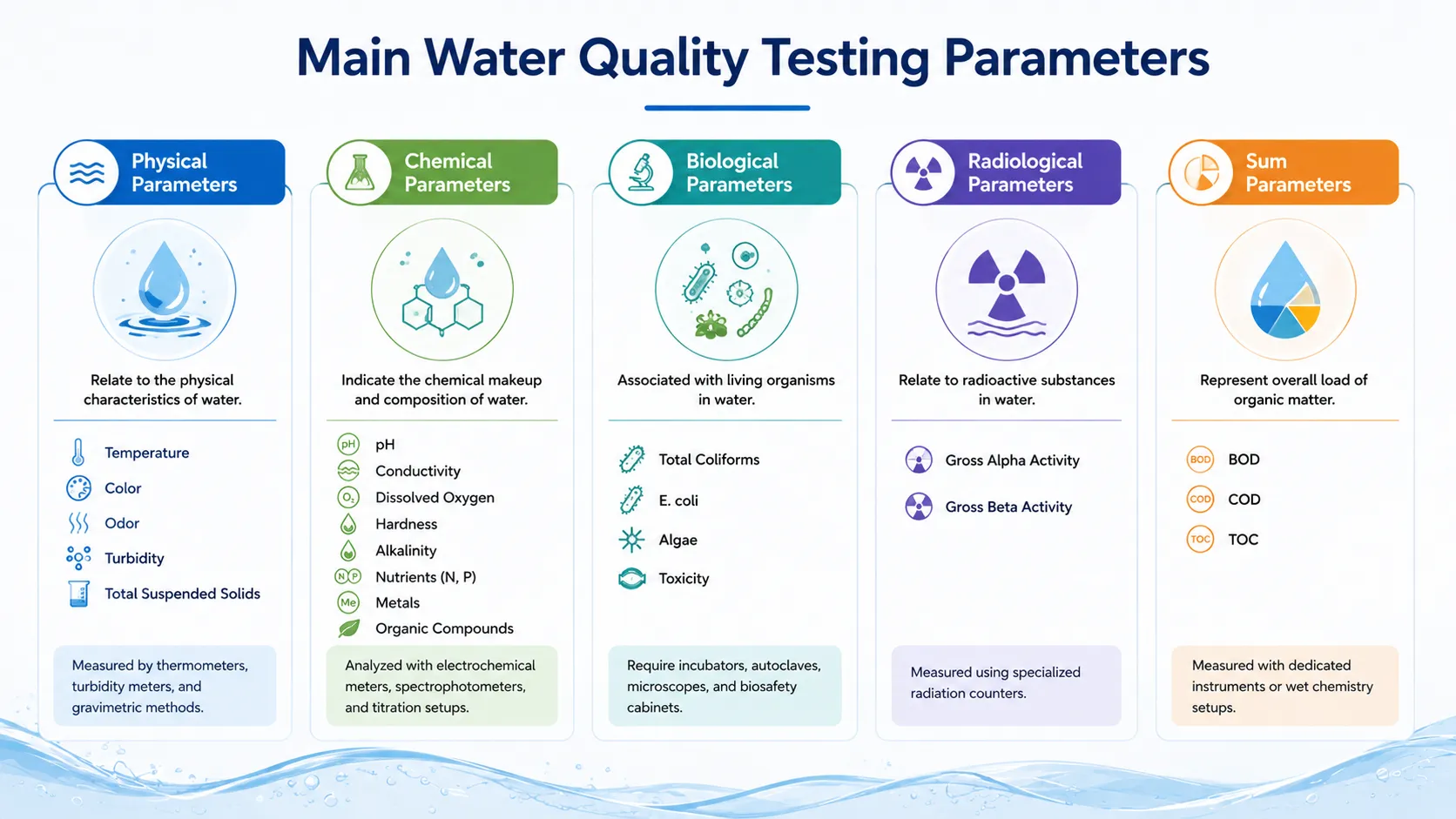
The required equipment depends first on which parameters the laboratory must measure. Major testing groups include:
- Physical parameters: temperature, color, turbidity, total suspended solids, and other observable or measurable physical characteristics. Depending on the parameter, laboratories may use thermometers, turbidity meters, filtration equipment, drying ovens, and analytical balances.
- Chemical parameters: pH, conductivity, dissolved oxygen, hardness, alkalinity, nutrients, metals, and organic compounds. Common equipment families include electrochemical meters, titration equipment, spectrophotometers, digestion systems, and advanced analytical instruments where required.
- Biological and microbiological parameters: indicators or organisms such as total coliforms and E. coli, as well as other biological assessments within the laboratory’s scope. Equipment may include filtration systems, incubators, autoclaves, microscopes, colony counters, and suitable controlled work areas.
- Radiological parameters: measurements such as gross alpha and beta activity require specialized instrumentation and are normally relevant only to laboratories with radiological testing in their scope.
- Aggregate or sum parameters: tests such as BOD, COD, and TOC provide different measures of organic or oxidizable material and require method-specific equipment and sample handling.
Water and Wastewater Laboratory Testing Workflow
A consistent workflow helps maintain sample traceability and analytical quality from collection through reporting. The exact procedure depends on the method and sample type, but most laboratories move through the following stages.
Sample Collection and Preservation
Sampling is the first point at which analytical quality can be affected. Samples should be collected in containers appropriate for the intended test and preserved according to the applicable method or laboratory procedure. Parameters that can change rapidly after collection may need to be measured in the field.
Typical equipment and supplies include:
- Field meters for parameters such as pH, conductivity, and dissolved oxygen
- Coolers and ice packs where temperature-controlled transport is required
- Method-appropriate preservation reagents
- Suitable sampling containers, including sterile containers for microbiological samples
Quality controls can include sample identification, chain-of-custody documentation, field blanks where applicable, preservation records, and collection-time information.
Sample Reception and Preparation
After receipt, samples are logged, inspected, and prepared for the required analytical method. Preparation may involve filtration, digestion, mixing, dilution, or other method-specific steps. Laboratories should also verify relevant sample condition, preservation, and holding-time requirements before analysis.
Common equipment includes:
- Analytical balances
- Filtration apparatus
- Digestion blocks or microwave digestors
- Pipettes and dispensers


Instrumental and Chemical Analysis
Routine chemical testing can combine electrochemical measurements, spectrophotometry, titration, gravimetric procedures, digestion, and advanced instrumental analysis. The appropriate technique depends on the parameter, concentration range, sample matrix, and selected analytical method.
Common equipment families include:
- UV-Vis spectrophotometers for applicable colorimetric methods
- pH and ion meters for electrochemical measurements
- Turbidity meters
- Conductivity meters
- BOD and COD testing equipment
- Atomic absorption spectrometers or ICP-OES systems when elemental analysis is required
Calibration and analytical QC should follow the applicable method, laboratory procedure, and instrument requirements. Depending on the test, QC may include calibration standards, blanks, duplicates, control samples, or other verification checks.


Microbiological Analysis
Microbiological water testing requires controlled handling practices designed to reduce contamination and maintain the integrity of samples, media, and cultures. The analytical approach may include membrane filtration, multiple-tube techniques, enzyme-substrate methods, or other procedures selected by the laboratory.
Common supporting equipment includes:
- Autoclave
- Temperature-controlled incubators appropriate for the selected method
- Suitable microbiological work cabinet or controlled work area
- Microscopes where required by the laboratory’s testing scope
- Colony counters for applicable culture-based methods
Quality control may include sterility checks, positive and negative controls, media QC, temperature monitoring, and other method-defined controls.


Data Management and Reporting
After analysis, results are reviewed against the laboratory’s method, QC, and reporting requirements. Laboratories may use a laboratory information management system (LIMS) to manage sample records, calculations, results, review status, and audit trails.
Supporting systems may include:
- Computers with LIMS or other laboratory data-management software
- Printers and labelers
- Appropriate data backup systems
Key Quality Control Tests for Water and Wastewater Laboratories
The following table connects common water-quality measurements with their analytical purpose and typical equipment. The actual test list should be determined by the laboratory’s application, methods, sample types, and regulatory or customer requirements.
| Quality Control Test | Purpose | Common Laboratory Equipment | Relevant Sample Types |
|---|---|---|---|
| pH | Assess acidity or alkalinity | pH meter, electrode, buffers | Drinking water, surface water, groundwater, wastewater and process water |
| Turbidity | Measure light scattering associated with suspended or colloidal material | Turbidity meter, standards | Drinking water, surface water, treated water and wastewater |
| Conductivity | Assess the water’s ability to conduct electrical current as an indicator of ionic content | Conductivity meter, standard solutions | Drinking water, groundwater, process water and wastewater |
| Total Dissolved Solids (TDS) | Assess dissolved material | Gravimetric equipment or conductivity-based measurement where appropriate to the method/application | Water, wastewater and industrial effluent |
| Dissolved Oxygen (DO) | Measure dissolved oxygen concentration | DO meter or applicable titration setup | Surface water, wastewater and treatment-process samples |
| Biochemical Oxygen Demand (BOD) | Evaluate oxygen demand associated with biodegradable material under defined test conditions | BOD incubator, DO measurement equipment, BOD bottles | Wastewater and applicable environmental water samples |
| Chemical Oxygen Demand (COD) | Assess chemically oxidizable material under the selected method | COD digestion equipment, spectrophotometer or other method-appropriate measurement setup, reagents/vials | Wastewater and contaminated or industrial water samples |
| Total Coliforms / E. coli | Detect indicator organisms used in microbiological water assessment | Incubator, filtration manifold or other method-specific system, media, autoclave | Drinking water, recreational water and other applicable water samples |
| Heavy Metals (e.g., Pb, As, Cd) | Measure selected elemental contaminants | AAS, ICP-OES, and suitable sample-preparation equipment | Drinking water, environmental water, industrial discharge and wastewater |
| Nutrients (Nitrate, Phosphate) | Measure nutrient concentrations relevant to water quality and treatment monitoring | Spectrophotometer and method-specific sample-preparation equipment and reagents | Surface water, wastewater, groundwater and treated effluent |
Recommended Laboratory Equipment for Water and Wastewater Testing Laboratories
Not every laboratory requires every instrument. A basic routine laboratory should be configured around its required parameters first, while specialized or advanced equipment should be added when the testing scope, detection needs, sample matrix, or workload justifies it.
| Laboratory Equipment | Main Application | Why It Matters |
|---|---|---|
| pH/Ion Meter | pH and applicable ion-selective measurements | Supports routine electrochemical water analysis when these parameters are included in the laboratory’s scope |
| Conductivity/TDS Meter | Conductivity and applicable TDS estimation | Provides rapid assessment of ionic content for routine water-quality and process monitoring |
| Turbidity Meter | Turbidity measurement | Supports clarity, treatment-process, and suspended-material assessment where turbidity is a required parameter |
| UV-Vis Spectrophotometer | Applicable colorimetric water analyses | Can support multiple chemical parameters when validated methods and suitable reagents are available |
| BOD Incubator | Controlled incubation for BOD testing | Provides the controlled conditions required by the laboratory’s selected BOD method |
| COD Digestion Block | Controlled digestion for applicable COD methods | Supports routine COD sample digestion when COD is part of the testing program |
| Autoclave | Sterilization of suitable microbiological materials and waste | Supports contamination control and microbiological laboratory procedures |
| Microbiological Incubator | Controlled-temperature incubation | Required for culture-based microbiological methods that specify controlled incubation |
| Analytical Balance | Preparation of standards and reagents and applicable gravimetric measurements | Accurate mass measurement supports sample preparation and gravimetric analytical work |
| Atomic Absorption Spectrometer (AAS) or ICP-OES | Elemental analysis | Provides advanced metals analysis when required by the laboratory’s methods and detection needs |
| Laminar Flow Cabinet | Controlled clean work area for suitable microbiological preparation tasks | Can help reduce contamination during appropriate aseptic procedures; cabinet selection should match the work and safety requirements |
| Deionized Water System | Preparation of reagents, standards, blanks, and laboratory rinsing where suitable | Helps control background contamination by supplying water of appropriate quality for the laboratory’s methods |
Basic vs Advanced Water Testing Laboratory Equipment
A practical way to plan a laboratory is to separate routine equipment from instrumentation that is justified by specialized analytical requirements.
| Laboratory Level | Typical Testing Scope | Equipment Approach |
|---|---|---|
| Basic / Routine | Common physical and chemical parameters and straightforward sample preparation | Prioritize meters, turbidity measurement, balances, filtration, general sample-preparation equipment, and spectrophotometry where required |
| Microbiology-Capable | Routine microbiological water testing in addition to physical and chemical parameters | Add method-appropriate incubators, sterilization equipment, filtration or other microbiological test systems, and suitable controlled work areas |
| Wastewater / Treatment Laboratory | Process monitoring, organic-load indicators, solids, nutrients, and other wastewater parameters | Add BOD/COD equipment and the preparation systems required for the laboratory’s wastewater methods |
| Advanced Analytical | Metals or other parameters requiring higher analytical capability | Add techniques such as AAS or ICP-OES only when justified by required analytes, methods, performance requirements, workload, and available technical resources |
This staged approach helps avoid both under-equipping a laboratory and purchasing advanced instruments that do not match its actual analytical workload.
How to Choose Laboratory Equipment for Water and Wastewater Testing
Selecting water and wastewater testing equipment should begin with the required tests rather than with an instrument list. A useful purchasing sequence is: required parameter → analytical method → sample matrix and concentration range → required performance → sample throughput → instrument and supporting equipment.
Key factors include:
- Testing requirements: Define the parameters the laboratory must report and identify the methods or procedures that will be used for each one.
- Sample types: Drinking water, groundwater, surface water, process water, wastewater, and industrial effluent can present different concentration ranges and matrix challenges. The selected equipment and preparation workflow must suit the actual samples.
- Required analytical performance: Confirm that the selected instrument and method can meet the laboratory’s required measurement range, sensitivity, precision, and other performance criteria without assuming that one instrument configuration suits every application.
- Throughput: Estimate samples per day, parameters per sample, batch sizes, and peak workload. Higher-throughput laboratories may benefit from automation or multi-sample systems, while lower-volume laboratories may prioritize flexibility.
- Sample preparation: Consider filtration, digestion, dilution, preservation, reagent preparation, sterilization, and other supporting steps. The main analyzer is only one part of a complete testing workflow.
- Calibration and QC: Check how calibration, verification, blanks, controls, standards, and routine performance checks will be performed for the selected methods.
- Maintenance and support: Consider routine maintenance, consumables, replacement parts, service access, training, and expected downtime as part of the purchasing decision.
- Data management: Where needed, assess instrument data export, calculation workflows, traceability, and compatibility with the laboratory’s LIMS or other reporting systems.
- Quality and compliance framework: Select equipment that can support the laboratory’s applicable methods, quality system, customer requirements, and regulatory framework. Laboratories working within ISO/IEC 17025 or other formal systems should evaluate equipment within their documented method-validation, calibration, traceability, and quality-control processes.
- Budget and lifecycle cost: Evaluate purchase price together with reagents, consumables, accessories, service, training, utilities, and expected instrument life. The most appropriate system is the one that meets the required testing scope reliably without unnecessary analytical capability.
Frequently Asked Questions
What basic equipment does every water testing lab need?
There is no single equipment list for every water laboratory because the required setup depends on the parameters and methods within its testing scope. For many routine laboratories, common starting equipment includes a pH meter, conductivity meter, turbidity meter, analytical balance, sample-preparation equipment, and a spectrophotometer where colorimetric methods are used. Microbiology, BOD/COD, or metals testing requires additional equipment.
How often should water testing instruments be calibrated?
Calibration frequency depends on the instrument, analytical method, laboratory procedure, workload, and manufacturer requirements. Some measurements may require calibration or verification before each analytical run or batch, while other equipment follows scheduled calibration and intermediate performance checks. The laboratory should document the applicable requirement for each instrument and method.
Can one instrument test both water and wastewater?
Yes. Many instrument types, including pH meters, conductivity meters, turbidity meters, and spectrophotometers, can be used for both water and wastewater when the analytical method and instrument configuration are suitable. Wastewater may require additional filtration, digestion, dilution, or other sample preparation because of its concentration range and matrix.
What is the difference between BOD and COD testing?
BOD evaluates oxygen demand associated with biodegradable material under defined biological test conditions, while COD measures chemically oxidizable material using a chemical oxidation procedure. They provide different information and require different test workflows, so one should not automatically be treated as a direct substitute for the other.
How do I ensure my lab meets ISO 17025 requirements for water testing?
ISO/IEC 17025 applies to laboratory competence and quality systems rather than prescribing one universal equipment list. A laboratory should use suitable methods and equipment, establish calibration and metrological traceability where applicable, control records and data, demonstrate method performance, implement relevant quality-control activities, and maintain documented procedures appropriate to its scope. Accreditation-specific requirements should be confirmed with the applicable accreditation body.
What safety equipment is needed in a water microbiology lab?
Safety and containment requirements depend on the organisms, samples, procedures, and risk assessment involved. Typical laboratory provisions can include suitable protective equipment, sterilization capability, spill-control materials, and an appropriate microbiological work area. A laminar flow cabinet and a biological safety cabinet are not interchangeable; cabinet selection should be based on the required product protection, personnel protection, and containment needs.
Conclusion
The right water and wastewater testing laboratory is built around the required analytical scope, not around a universal equipment checklist. Start by defining the samples and parameters to be tested, then map each parameter to an appropriate method, sample-preparation workflow, measurement technique, and QC procedure.
Routine water testing may be supported by electrochemical meters, turbidity measurement, spectrophotometry, balances, and general sample-preparation equipment. Laboratories performing microbiology, BOD/COD, wastewater process monitoring, or metals analysis can then add the specialized systems required by those applications. Evaluating sample matrix, analytical performance, throughput, calibration and QC requirements, maintenance, data handling, and lifecycle cost helps create a laboratory configuration that is technically appropriate and practical to operate.