Laboratory Equipment for Industrial Water Analysis Overview
Laboratory equipment for industrial water analysis is used to monitor process water quality, support treatment decisions, protect manufacturing equipment, evaluate wastewater, and generate reliable analytical data. The required laboratory setup depends on the water source, process, target parameters, analytical sensitivity, sample volume, and applicable quality or compliance requirements.
For many industrial water laboratories, the core equipment includes pH and conductivity meters, a turbidimeter, UV-Vis spectrophotometer, analytical balance, and appropriate titration or dissolved oxygen equipment. More specialized applications may require COD and BOD systems, TOC analyzers, ion chromatography, AAS or ICP-OES for metals, and microbiological laboratory equipment.
Selecting the right instruments therefore means matching each required test to an appropriate analytical method and equipment family rather than purchasing every available water-testing instrument.
What Is Industrial Water Analysis Equipment and Common Testing Parameters?
Industrial water analysis equipment encompasses benchtop and laboratory-grade instruments used to measure chemical, physical, and microbiological properties of water samples from industrial processes. Compared with basic field testing, laboratory instruments are generally selected where controlled measurement conditions, repeatability, expanded analytical capability, or structured data management are required.
Common parameters monitored in industrial settings include:
- pH – Indicates acidity or alkalinity and supports corrosion control, treatment adjustment, and process monitoring.
- Conductivity – Indicates ionic content and is widely used to monitor dissolved salts and changes in water purity.
- Total Dissolved Solids (TDS) – Evaluates dissolved material using an appropriate gravimetric or instrument-based method.
- Hardness (Ca and Mg) – Important for evaluating scale-forming potential in applications such as boilers and cooling systems.
- Alkalinity – Measures buffering capacity and supports water-treatment control.
- Chemical Oxygen Demand (COD) and Biochemical Oxygen Demand (BOD) – Used to evaluate organic loading, particularly in wastewater applications.
- Heavy Metals – Measures elements such as lead, chromium, and cadmium where metal contamination or discharge control is relevant.
- Silica – An important monitoring parameter in applications such as high-purity boiler and steam-cycle water.
- Turbidity – Indicates suspended particles and can be used to assess clarification or filtration performance.
- Total Organic Carbon (TOC) – Provides a measure of organic carbon contamination and is particularly useful in high-purity water applications.
- Microbial Count – Evaluates microbial load where microbiological water quality is important to the process or product.
Industrial Water Testing Workflow
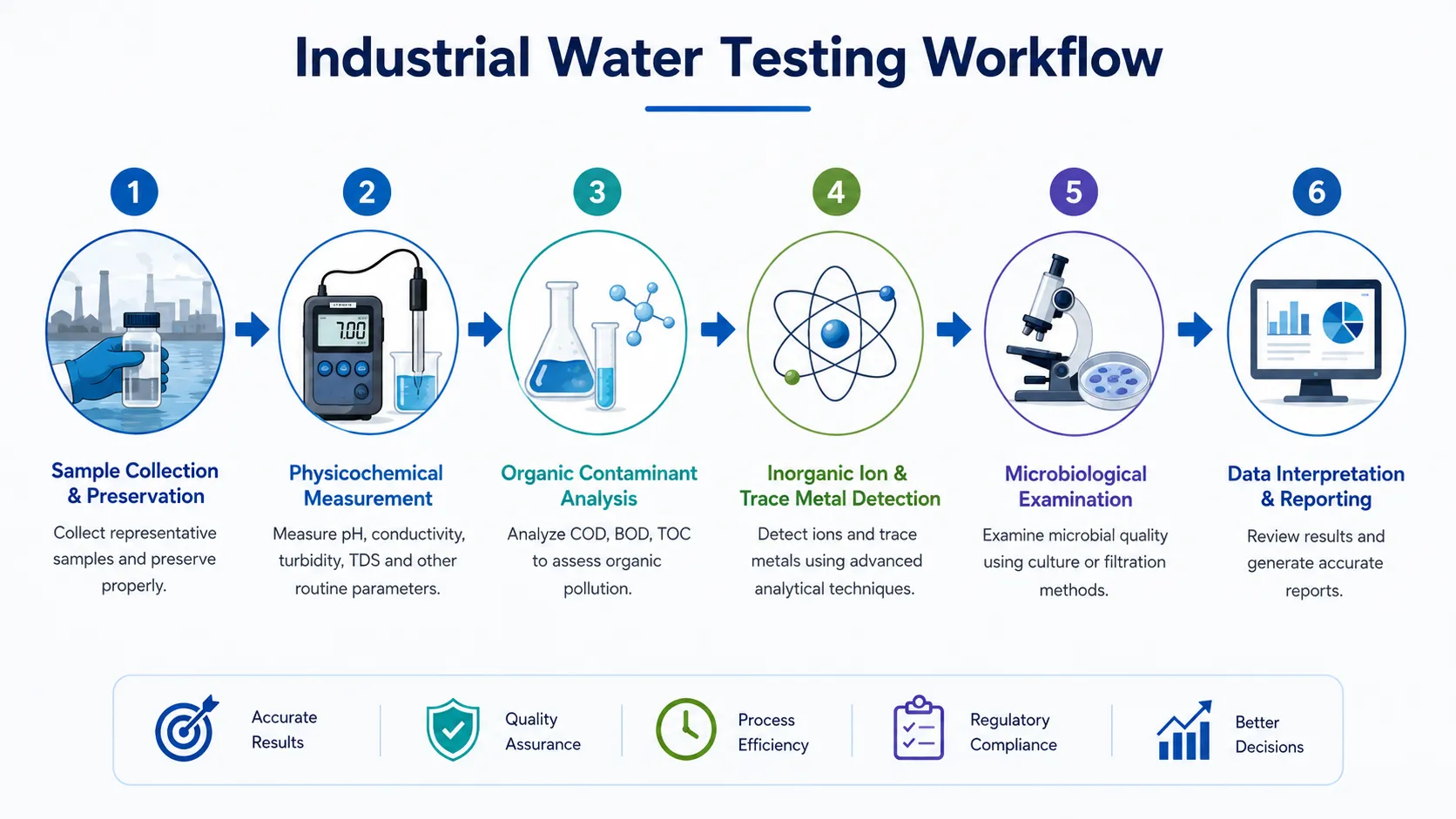
A practical industrial water laboratory workflow normally moves from representative sampling and sample preparation to routine physicochemical measurements, application-specific analytical testing, quality-control review, and reporting. The exact workflow should be defined around the required parameters and analytical methods.
Sample Collection and Preservation
Representative sampling is the foundation of reliable water analysis. Containers, preservation conditions, holding conditions, and sample handling should be selected for the specific parameter and analytical method. Quality-control samples such as blanks or duplicates may also be incorporated where required by the laboratory procedure.
- Typical equipment and supplies: automatic water samplers where needed, suitable sampling containers, coolers or controlled sample-storage equipment, and temperature-monitoring devices where applicable.
Physicochemical Parameter Measurement
Routine parameters such as pH, conductivity, turbidity, and TDS are commonly measured early in the workflow. Dedicated benchtop instruments or suitable multi-parameter systems can support fast routine testing, while spectrophotometric and gravimetric methods expand the range of measurable water-quality parameters.
Calibration and verification should follow the applicable analytical procedure, laboratory quality system, and instrument manufacturer’s instructions.
- Recommended equipment: benchtop pH meter, conductivity meter, turbidimeter, UV-Vis spectrophotometer, and analytical balance for gravimetric work.



Organic Contaminant Analysis
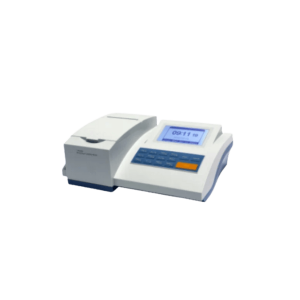
COD, BOD, and TOC provide different information about organic loading or contamination. COD commonly uses controlled digestion followed by an appropriate measurement step. BOD testing requires controlled incubation and dissolved oxygen measurement over the specified test period. TOC analyzers quantify organic carbon through instrument-specific oxidation and detection processes.
These tests are complementary rather than interchangeable, so the appropriate equipment depends on the laboratory’s required water-quality indicators.
- Recommended equipment: COD reactor, BOD incubator with dissolved oxygen measurement equipment, and TOC analyzer where TOC testing is required.


Inorganic Ion and Trace Metal Detection
Laboratories that need detailed ionic composition or trace-metal data require more specialized analytical equipment. Ion chromatography can separate and quantify selected anions or cations, while AAS and ICP techniques are commonly used for elemental analysis. Sample preparation or digestion may also be required depending on the target analyte and method.
- Recommended equipment: ion chromatograph, AAS, ICP-OES, and suitable sample-digestion equipment where required.


Microbiological Examination
Where microbial water quality must be monitored, laboratories may use membrane filtration, culture-based enumeration, or other validated microbiological procedures appropriate to the application. Incubation conditions, media, sample preparation, and enumeration procedures should follow the selected method.
- Recommended equipment: microbiological incubator, autoclave, membrane filtration apparatus, and colony counter.


Data Interpretation and Reporting
Analytical results should be reviewed against the laboratory’s quality-control criteria before reporting or use in process decisions. Laboratories with larger sample volumes or formal traceability requirements may use a Laboratory Information Management System (LIMS) to organize sample records, analytical results, instrument data, and reporting workflows.
- Recommended equipment: LIMS software and suitable data workstations where centralized laboratory data management is required.
Key Quality Control Tests for Industrial Water Analysis
The most important tests depend on the industrial process and water type. The following table maps common water-quality parameters to their main purpose and typical laboratory equipment.
| Quality Control Test | Purpose | Common Laboratory Equipment | Relevant Product Types / Applications |
|---|---|---|---|
| pH | Control corrosion and chemical dosing | Benchtop pH meter | All process waters, wastewater |
| Conductivity | Monitor ionic load and water purity | Conductivity meter | Boiler feedwater, cooling water, ultrapure water |
| Turbidity | Assess suspended solids and treatment efficiency | Turbidimeter | Filtration processes, effluent discharge |
| Total Hardness | Prevent scale formation | Spectrophotometer or titrator | Boiler water, cooling towers |
| Alkalinity | Determine buffering capacity | Auto-titrator | Source water, treated process water |
| COD | Estimate organic pollution quickly | COD reactor and spectrophotometer | Industrial effluent, food processing wastewater |
| BOD | Measure biodegradable organics | BOD incubator and DO meter | Municipal and industrial discharges |
| Heavy Metals (e.g., Pb, Cd, Cr) | Ensure toxic element compliance | AAS or ICP-OES | Electronics, metal finishing, pharmaceutical water |
| Silica | Prevent steam turbine deposits | Spectrophotometer | High-pressure boiler feedwater |
| TOC | Monitor organic contamination in pure water | TOC analyzer | Semiconductor rinse water, pharmaceutical WFI |
| Total Plate Count | Quantify microbial load | Incubator and colony counter | Food/beverage process water, pharmaceutical water |
Recommended Laboratory Equipment for Industrial Water Analysis Laboratories
A laboratory does not necessarily need every instrument in the following table. Routine process-water laboratories can often begin with core physicochemical testing equipment, while advanced analytical systems should be selected when the required parameters, sensitivity, sample volume, or analytical methods justify them.
| Laboratory Equipment | Main Application | Why It Matters |
|---|---|---|
| Benchtop pH Meter | pH measurement | Fundamental for corrosion control and treatment adjustments |
| Conductivity/TDS Meter | Dissolved ion/solid concentration | Quickly assesses water purity and salt load |
| Turbidimeter | Suspended solids measurement | Ensures filtration performance and discharge clarity |
| UV-Vis Spectrophotometer | Colorimetric analysis for various parameters | Versatile platform for method-dependent water analysis |
| COD Reactor | Chemical oxygen demand digestion | Supports routine COD analysis where organic loading must be monitored |
| BOD Incubator & DO Meter | Biochemical oxygen demand | Supports BOD testing for applicable wastewater monitoring programs |
| TOC Analyzer | Total organic carbon | Useful where organic carbon contamination requires dedicated monitoring |
| Ion Chromatograph | Anion and cation profiling | Provides detailed ionic composition when individual ion analysis is required |
| Atomic Absorption Spectrometer (AAS) | Trace metal analysis | Supports elemental analysis where specific metals must be quantified |
| Autoclave & Incubator | Microbiological cultures | Supports culture-based microbiological testing workflows |
| Analytical Balance | Gravimetric TDS, reagent preparation | Supports gravimetric measurements and accurate preparation of laboratory solutions |
| Laboratory Information Management System (LIMS) | Data management | Supports sample traceability, result management, and structured reporting |
Which Industrial Water Analysis Equipment Is Essential vs Advanced?
The most useful way to plan an industrial water laboratory is to separate routine equipment from instruments required only for specific analytical needs.
| Laboratory Level | Typical Testing Needs | Relevant Equipment Families |
|---|---|---|
| Core Routine Testing | pH, conductivity, turbidity, basic gravimetric or colorimetric measurements | pH meter, conductivity/TDS meter, turbidimeter, UV-Vis spectrophotometer, analytical balance |
| Wastewater / Organic Load Testing | COD, BOD, dissolved oxygen | COD reactor, spectrophotometer, BOD incubator, DO meter |
| High-Purity / Organic Carbon Monitoring | TOC and other application-specific purity parameters | TOC analyzer and supporting water-quality instruments |
| Ion and Elemental Analysis | Individual ions and trace metals | Ion chromatograph, AAS, ICP-OES, sample-preparation equipment |
| Microbiological Testing | Microbial enumeration or other culture-based water tests | Incubator, autoclave, membrane filtration apparatus, colony counter |
| High-Throughput / Structured Data Management | Large sample volumes, traceability, centralized reporting | Autosampling where applicable, LIMS, compatible data workstations |
This tiered approach helps prevent both under-equipping and unnecessary capital expenditure. A basic process-water laboratory may need only routine physicochemical instruments, while a laboratory responsible for wastewater, ultrapure water, metals, or microbiological analysis may require one or more specialized analytical systems.
How to Choose Laboratory Equipment for Industrial Water Analysis
Selecting laboratory equipment for industrial water analysis should begin with the tests the laboratory actually needs to perform. Define the water types, target parameters, expected concentration levels, required analytical methods, sample volume, reporting needs, and any applicable quality or compliance requirements before comparing instruments.
For routine process monitoring, ease of operation, calibration workflow, repeatability, and sample throughput may be the main priorities. Laboratories performing lower-level or more complex chemical analysis should also evaluate whether the selected analytical technique is suitable for the required sensitivity and sample matrix.
Consider the complete cost of ownership rather than purchase price alone. Relevant factors can include reagents and consumables, replacement electrodes or lamps, sample-preparation requirements, calibration materials, maintenance, service availability, operator training, and instrument downtime.
Data handling is another practical selection factor. Where results must be transferred into a LIMS or centralized reporting system, verify instrument communication and software compatibility before purchase rather than assuming that integration will be straightforward.
Finally, separate current requirements from possible future needs. Modular or expandable systems may be useful when the laboratory expects testing scope or sample throughput to grow, but advanced instrumentation should be justified by a real analytical requirement rather than purchased simply to create a more comprehensive equipment list.
For equipment selection, provide the supplier with at least the water type, parameters to be tested, expected sample volume, required analytical methods or sensitivity where known, and existing laboratory capabilities. This makes it easier to identify which instruments are essential and which are optional for the application.
Frequently Asked Questions
What are the essential tests for boiler feedwater quality?
Boiler feedwater requires rigorous monitoring of pH, conductivity, dissolved oxygen, silica, and total hardness. These parameters prevent scaling, corrosion, and carryover, ensuring efficient and safe steam generation.
How often should I calibrate my water analysis instruments?
Calibration frequency depends on instrument stability and usage. Benchtop pH meters may need daily calibration, while spectrophotometers might require weekly checks. Always follow the manufacturer’s guidelines and use certified reference standards.
Can one instrument measure multiple water quality parameters?
Multi-parameter meters can simultaneously measure pH, conductivity, turbidity, and dissolved oxygen. However, for advanced analyses like metals or TOC, dedicated instruments remain necessary for accuracy and detection limits.
What is the difference between COD and BOD testing equipment?
COD reactors and spectrophotometers provide a quick chemical oxidation estimate within hours, while BOD systems require an incubator and dissolved oxygen meter over a 5-day period. Both are complementary for wastewater characterization.
Is a TOC analyzer necessary for industrial water labs?
It is essential for facilities using ultrapure water or where organic contamination must be tightly controlled, such as pharmaceutical, semiconductor, and power generation plants. For general process water, it may be optional.
How do I choose between benchtop and portable water analyzers?
Choose benchtop instruments for fixed laboratory settings where precision and advanced features are needed. Portable analyzers are suitable for field sampling or on-site spot checks where immediate decisions are required.
Conclusion
The right laboratory equipment for industrial water analysis depends on the water type, required parameters, analytical methods, sample throughput, and level of data control—not on building the longest possible instrument list.
Routine laboratories can often start with pH, conductivity, turbidity, spectrophotometric, titration, and gravimetric capabilities. COD/BOD equipment becomes relevant when organic loading or wastewater is part of the testing scope, while TOC analyzers, ion chromatography, AAS/ICP-OES, and microbiological equipment should be selected when the application specifically requires those analyses.
By defining the required tests first and then mapping each test to the appropriate equipment family, laboratories can build a more practical, maintainable, and cost-conscious industrial water testing capability while retaining room for future expansion.