Wastewater Treatment Testing Methods and Laboratory Instruments Overview
Wastewater treatment testing combines physical, chemical, and biological measurements to monitor treatment performance and verify treated effluent quality. Common tests include biochemical oxygen demand (BOD), chemical oxygen demand (COD), total suspended solids (TSS), pH, dissolved oxygen (DO), turbidity, nutrients, microbiological indicators, and sludge characteristics.
The laboratory instruments required depend on the treatment process, sample type, required parameters, analytical workload, and reporting needs. Typical equipment ranges from pH, conductivity, DO, and turbidity meters to spectrophotometers, BOD incubators, COD reactors, balances, ovens, microbiology equipment, and advanced analytical instruments.
In practice, wastewater laboratories support two related functions: process control, where measurements help operators adjust treatment conditions, and final effluent testing, where results are used to verify discharge or reuse requirements.
Main Products and Applications in Wastewater Treatment
- Municipal treated wastewater for discharge or reuse
- Industrial effluent meeting trade or surface water limits
- Reclaimed water for irrigation, industrial, or groundwater recharge
- Sludge biosolids for agricultural land application
- Process control samples for plant optimization
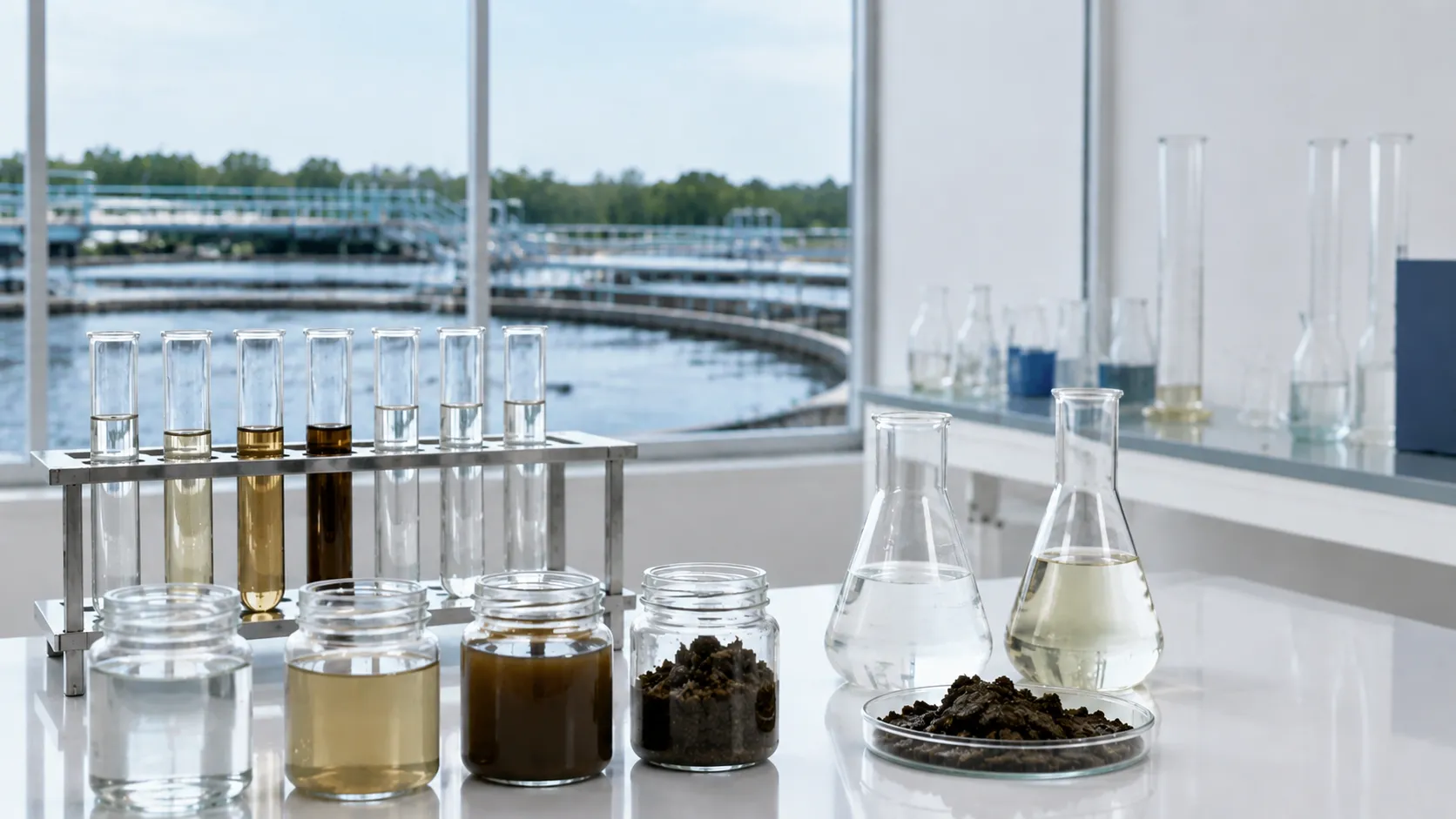
Different sample types place different demands on laboratory testing. Raw influent may contain high solids and variable pollutant loads, biological-process samples require close monitoring of operating conditions, and final effluent testing focuses on confirming treatment performance. Sludge analysis introduces another matrix with its own solids, digestion, and analytical requirements.
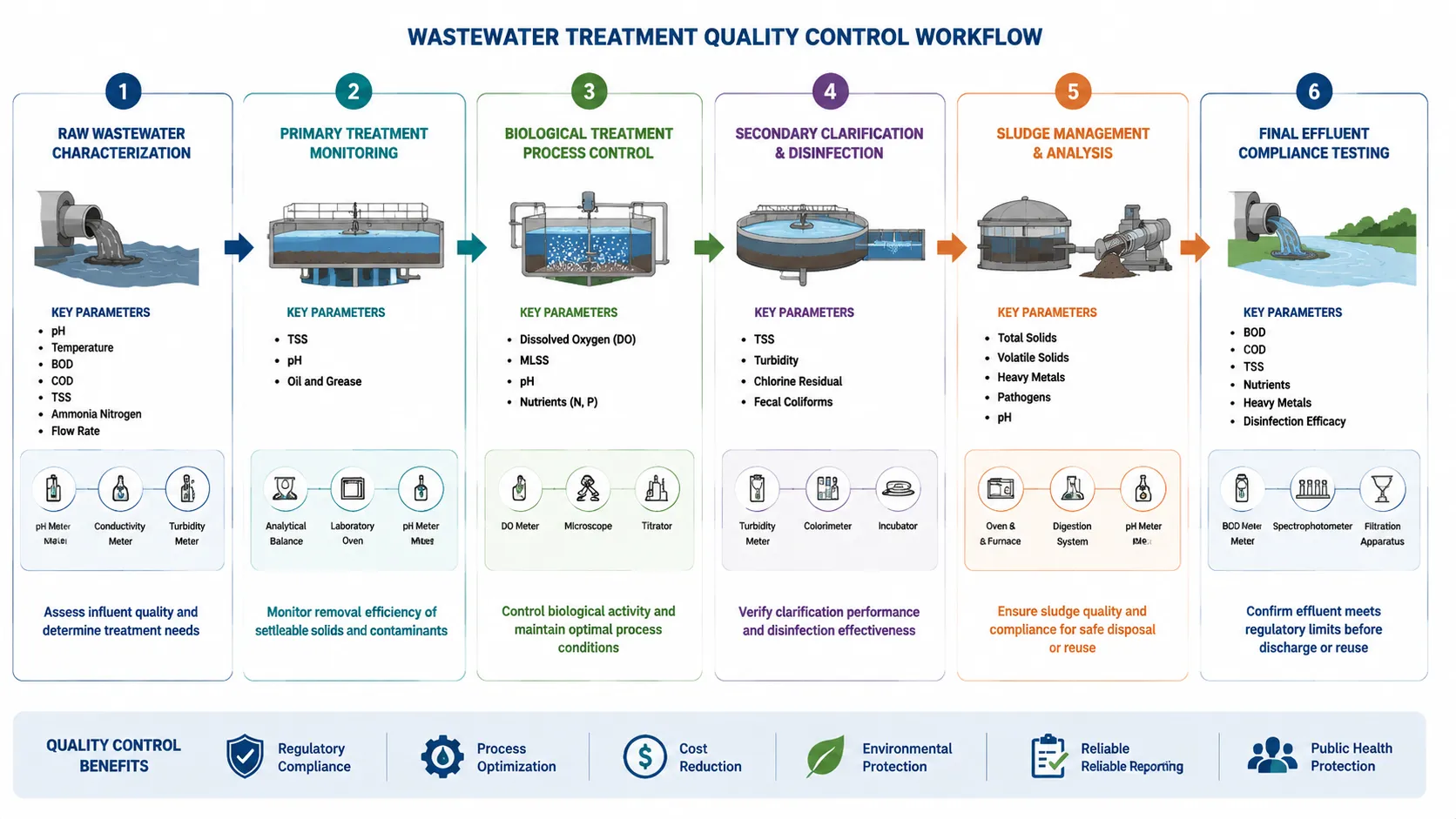
Wastewater Treatment Quality Control Workflow
Raw Wastewater Characterization
Before treatment begins, raw influent should be characterized to establish pollutant loads and treatment requirements. Measurements such as pH, temperature, BOD, COD, TSS, ammonia nitrogen, conductivity, and turbidity help operators understand incoming wastewater strength and variability.
Influent characterization is particularly important when wastewater composition changes significantly over time or when industrial discharges can create shock loads. The resulting data provide a baseline for evaluating removal efficiency and identifying unusual conditions before they affect downstream treatment stages.
Recommended laboratory equipment for this stage:
- pH Meter – Measures acidity and alkalinity conditions relevant to treatment processes.
- Conductivity Meter – Tracks changes in ionic content and dissolved salts.
- Turbidity Meter – Measures the optical effect of suspended and colloidal material.
- Spectrophotometer – Supports colorimetric analysis of selected nutrients and other wastewater parameters using appropriate methods.
- BOD Incubator – Provides controlled incubation conditions for BOD testing.
- COD Reactor – Provides controlled digestion for applicable COD test methods.


Primary Treatment Monitoring
Primary treatment removes settleable solids and floating material before biological treatment. Laboratory testing is used to compare influent and primary effluent conditions and determine whether clarification is reducing the solids load entering downstream processes.
TSS is a central measurement at this stage, while pH and other parameters may also be monitored according to the plant process. Where oil and grease or unusual solids are important characteristics of the influent, additional testing may be needed.
Recommended laboratory equipment for this stage:
- Analytical Balance – Supports gravimetric determination of suspended solids.
- Laboratory Oven – Provides controlled drying for gravimetric solids analysis.
- pH Meter – Monitors pH where chemical addition or process conditions require control.
- Oil and Grease Analyzer – Supports oil and grease measurement where this parameter is relevant.
- Sieve Shaker – Supports particle-size separation when solids characterization requires it.


Biological Treatment Process Control
Biological treatment depends on maintaining conditions that support microbial degradation of organic matter and, where applicable, nutrient removal. Common process-control parameters include dissolved oxygen (DO), mixed liquor suspended solids (MLSS), sludge settleability or sludge volume index (SVI), pH, alkalinity, and nutrient concentrations.
These measurements serve different purposes. DO helps operators assess aeration conditions, MLSS provides information about suspended biomass concentration, settleability testing helps identify clarification problems, and pH and alkalinity are important operating indicators for biological processes such as nitrification. Microscopic examination can provide additional information about activated-sludge characteristics when troubleshooting poor settling or biological instability.
Recommended laboratory equipment for this stage:
- Dissolved Oxygen Meter – Measures DO for aeration and biological process control.
- pH Meter – Monitors conditions affecting biological treatment.
- Spectrophotometer – Supports analysis of nutrients and other colorimetric parameters.
- Microscope – Supports examination of activated-sludge microorganisms and filamentous growth.
- Automatic Titrator – Supports alkalinity and other applicable titrimetric analyses.
- Conductivity Meter – Tracks changes in ionic content through the treatment process.

Secondary Clarification and Disinfection
After biological treatment, secondary clarification separates suspended biomass from the treated water. Testing helps determine whether solids are being retained effectively before the effluent proceeds to disinfection or further treatment.
TSS and turbidity can indicate solids carryover, while disinfection monitoring depends on the technology used by the plant. Where chlorine-based disinfection is used, residual measurements may form part of process control. Microbiological testing can be used to evaluate indicator organisms according to the facility’s applicable monitoring requirements.
Recommended laboratory equipment for this stage:
- Turbidity Meter – Measures effluent turbidity and helps track clarification performance.
- Portable Colorimeter – Supports colorimetric residual disinfectant measurements where applicable.
- Incubator – Provides controlled incubation for applicable microbiological methods.
- Membrane Filtration Apparatus – Supports membrane-filtration microbiological testing where the selected method requires it.
- UV-Vis Spectrophotometer – Supports applicable spectrophotometric water-quality analyses.


Sludge Management and Analysis
Primary and secondary sludge may require stabilization, conditioning, dewatering, and characterization before disposal or beneficial use. Laboratory analysis helps operators assess solids concentration, stabilization performance, and other characteristics relevant to the intended sludge-management route.
Common measurements include total solids, volatile solids, and pH. More advanced analysis may be required when sludge must be characterized for metals or other contaminants. Because sludge is a heterogeneous matrix, representative sampling and suitable sample preparation are important parts of reliable analysis.
Recommended laboratory equipment for this stage:
- Laboratory Oven and Muffle Furnace – Support total and volatile solids determinations.
- Analytical Balance – Provides mass measurements for gravimetric analysis.
- Microwave Digestion System – Supports sample preparation for applicable elemental analysis methods.
- Atomic Absorption Spectrometer – Supports determination of selected metals after suitable sample preparation.
- pH Meter – Measures sludge pH for process monitoring and conditioning work.


Final Effluent Compliance Testing
Final effluent testing verifies the quality of treated wastewater before discharge or reuse. The exact parameters, methods, sampling schedule, and reporting requirements depend on the facility and its applicable permit or regulatory framework.
Common wastewater parameters can include BOD, COD, TSS, ammonia, nitrate, phosphate, conductivity, microbiological indicators, and selected metals or toxicity endpoints where required. Final compliance testing should therefore be configured around the actual parameters and methods that the facility is required to report rather than around a universal instrument list.
Recommended laboratory equipment for this stage:
- BOD Testing Equipment – Supports biochemical oxygen demand determination using the applicable method.
- COD Analyzer or COD Reactor – Supports chemical oxygen demand testing using the selected method.
- Spectrophotometer – Supports nutrient and other applicable colorimetric analyses.
- TSS Filtration Apparatus – Supports gravimetric total suspended solids determination.
- Conductivity Meter – Measures electrical conductivity as an indicator of ionic content.
- Toxicity Testing Kit – Supports applicable toxicity screening or biomonitoring where required.

Common Quality Control Challenges in Wastewater Treatment
- Variable influent composition: Changes in organic load, solids, nutrients, or industrial inputs can alter treatment performance and analytical requirements.
- Sample preservation and analysis timing: Wastewater characteristics can change after collection, making appropriate handling and timely analysis important.
- Complex sample matrices: Industrial effluents, high-solids samples, and sludge can introduce analytical interferences or require additional preparation.
- Instrument calibration and maintenance: Plant laboratories need procedures that keep frequently used meters and analytical instruments ready for routine testing.
- Low-concentration analytes: Trace-level measurements may require more sensitive analytical techniques than routine process-control testing.
- Representative sampling: Heterogeneous wastewater and sludge can produce misleading results when samples do not adequately represent the process stream.
Key Quality Control Tests for Wastewater Treatment
| Quality Challenge | Quality Control Test | Recommended Laboratory Equipment | Application |
|---|---|---|---|
| Variability in organic load | BOD and COD analysis | BOD incubator, COD reactor | Track organic loading and treatment performance |
| Nutrient imbalance or incomplete removal | Ammonia, nitrate, phosphate tests | Spectrophotometer | Monitor biological nutrient-removal processes |
| Solids carryover | TSS and turbidity measurement | Analytical balance, filtration equipment, turbidity meter | Evaluate clarification and final effluent quality |
| Microbiological risk | Applicable indicator-organism testing | Incubator, membrane filtration apparatus | Evaluate microbiological quality and disinfection performance |
| Metal contamination | Elemental analysis | Atomic absorption spectrometer | Measure selected metals where monitoring is required |
| Process inhibition | Toxicity or respiration-based testing | Respirometer, applicable toxicity testing system | Investigate wastewater effects on biological treatment |
| pH fluctuations | pH measurement | pH meter | Monitor chemical and biological process conditions |
| Sludge stabilization | Total and volatile solids analysis | Laboratory oven, muffle furnace, analytical balance | Assess sludge solids and stabilization performance |
Laboratory Equipment Required for Wastewater Treatment Quality Control
A wastewater laboratory does not need every available analytical instrument. Equipment should be selected according to the parameters that must be measured, the purpose of the data, sample volume, matrix complexity, required turnaround time, and whether testing is performed for routine process control or formal reporting.
For day-to-day process monitoring, common instruments include pH, conductivity, DO, and turbidity meters, along with balances, ovens, spectrophotometers, and BOD/COD equipment. Laboratories handling more complex industrial wastewater, sludge, trace contaminants, or high sample volumes may require additional sample-preparation systems, elemental analysis, chromatography, TOC analysis, or automated analyzers.
| Testing Requirement | Laboratory Equipment | Why It Is Needed |
|---|---|---|
| Organic load monitoring | BOD incubator, COD reactor | Assess organic loading and treatment performance |
| Nutrient analysis | Spectrophotometer, ion chromatograph where applicable | Monitor nitrogen and phosphorus compounds |
| Solids determination | Analytical balance, oven, filtration unit | Measure suspended and other gravimetric solids parameters |
| pH and conductivity | pH meter, conductivity meter | Monitor chemical and biological process conditions |
| Metal analysis | Atomic absorption spectrometer | Measure selected metals in applicable wastewater or sludge samples |
| Microbiological testing | Incubator, autoclave, membrane filtration equipment | Support applicable microbiological sample preparation and analysis |
| Dissolved oxygen | DO meter | Monitor aeration and biological treatment conditions |
| Toxicity or inhibition assessment | Respirometer, applicable toxicity test system | Investigate potential inhibitory effects on biological treatment or effluent toxicity where required |
Together, these instrument groups create a testing infrastructure that can support routine operations, troubleshooting, and final effluent assessment. The most practical laboratory is not necessarily the one with the largest number of instruments; it is the one configured around the facility’s actual testing requirements and sample workload.
Basic Laboratory Setup for Wastewater Treatment Plants
The appropriate laboratory level depends on the parameters tested onsite and the analytical complexity required. A basic process-control laboratory may cover routine measurements, while facilities performing nutrient analysis, microbiology, metals, or more complex contaminant testing may require progressively more advanced equipment.
| Laboratory Level | Recommended Equipment | Suitable For |
|---|---|---|
| Basic QC Laboratory | pH meter, conductivity meter, turbidity meter, balance, oven, colorimeter, BOD incubator | Routine process control and basic wastewater quality monitoring |
| Advanced QC Laboratory | Above plus UV-Vis spectrophotometer, COD reactor, DO meter, microscope, automatic titrator | Broader process monitoring, nutrient analysis, and biological treatment control |
| Advanced Analysis Laboratory | Above plus atomic absorption spectrometer, gas chromatograph, ion chromatograph, automated discrete analyzer, TOC analyzer | Complex industrial wastewater, advanced analytical work, or laboratories with broader testing requirements |
The table should be treated as configuration guidance rather than a universal requirement. Some plants outsource specialized compliance or trace analysis while keeping rapid process-control tests onsite. Others require a more extensive internal laboratory because of sample volume, turnaround requirements, or wastewater complexity.
How to Choose Laboratory Equipment for Wastewater Treatment Testing
Selecting wastewater laboratory instruments starts with the tests the facility actually needs to perform. The most important questions are what samples will be tested, which parameters must be measured, how many samples are processed, how quickly results are needed, and whether the instrument will support routine process control or more demanding analytical work.
Define the Testing Scope
List the sample types first: raw wastewater, intermediate process samples, final effluent, and sludge may require different preparation and analytical approaches. Then identify the required parameters and separate routine process indicators from tests needed for final reporting.
Also consider expected concentration levels and whether the required method demands routine colorimetric or gravimetric testing, microbiological analysis, or more advanced instrumental analysis. Industrial wastewater laboratories, for example, may require capabilities that are unnecessary for a plant focused mainly on conventional municipal process control.
Evaluate Laboratory Workflow Requirements
Consider daily sample volume, turnaround time, operator expertise, available laboratory space, and the amount of sample preparation involved. A high-throughput laboratory may benefit from automation, while a smaller facility may be better served by reliable manual or multiparameter instruments.
Workflow should also account for calibration, quality-control checks, cleaning, consumables, and routine maintenance. An instrument that meets the analytical requirement but cannot be supported efficiently within the laboratory’s daily workflow may not be the most practical choice.
Separate Essential and Advanced Equipment
Prioritize equipment needed for frequent and operationally important measurements before adding advanced analytical systems. Basic meters, solids-analysis equipment, and routine BOD/COD or spectrophotometric capability may cover many day-to-day requirements, depending on the plant.
Advanced instruments become more relevant when the laboratory must analyze additional contaminants, work at lower concentrations, handle difficult matrices, increase sample throughput, or perform specialized testing that cannot be covered by the basic laboratory.
Compare Long-Term Equipment Support
Equipment selection should include more than the initial instrument purchase. Consider calibration and maintenance support, availability of consumables and accessories, operator training requirements, and the ability to keep the instrument operating reliably over time.
AELAB helps connect wastewater testing requirements with appropriate instrument categories. Providing the sample types, target parameters, expected testing volume, existing laboratory equipment, and analytical gaps makes it easier to define a practical laboratory configuration.
Who Needs Laboratory Testing Solutions for Wastewater Treatment?
- Municipal wastewater treatment plants
- Industrial effluent treatment facilities
- Environmental consulting and testing laboratories
- Food, beverage, and pharmaceutical manufacturers with onsite wastewater or pretreatment systems
- Regulatory and environmental monitoring laboratories
Frequently Asked Questions
What are the essential laboratory tests for wastewater treatment plants?
Essential wastewater tests commonly include BOD, COD, TSS, pH, dissolved oxygen, turbidity, and relevant nutrient measurements. Microbiological, metals, toxicity, or other analyses may also be required depending on the treatment process and applicable monitoring requirements. The essential onsite test list should therefore be based on both process-control needs and required final effluent testing.
How often should wastewater samples be tested?
Testing frequency depends on the parameter, treatment process, operating conditions, and applicable monitoring requirements. Process-control parameters such as pH and dissolved oxygen may be measured frequently or continuously, while laboratory compliance samples follow the facility’s required sampling and reporting schedule.
Can a small treatment plant operate with a basic laboratory setup?
Yes. A small plant can maintain a focused laboratory for routine measurements such as pH, turbidity, conductivity, solids, or other essential process parameters while using additional equipment according to its actual testing requirements. Specialized analyses can also be handled separately when maintaining advanced instrumentation onsite is not justified.
What factors influence the choice between laboratory and online instrumentation?
Online instruments are useful when operators need frequent or continuous process data, while laboratory instruments support manual verification, broader analytical methods, sample preparation, and tests that are not practical to perform continuously. Many wastewater facilities therefore use online monitoring for selected process parameters together with laboratory testing for verification and additional analysis.
Conclusion
An effective wastewater treatment laboratory should be designed around the treatment process and the decisions the test results need to support. Routine meters and wet-chemistry equipment can cover many day-to-day process-control needs, while solids analysis, microbiology, elemental analysis, chromatography, or other advanced techniques can be added where the sample matrix and required parameters justify them.
Before selecting instruments, define the sample types, required tests, expected sample volume, analytical complexity, and which measurements must be performed onsite. This test-driven approach helps create a laboratory that supports reliable treatment monitoring without adding unnecessary equipment.