Food Safety Analysis Laboratory Instruments Guide Overview
Food safety analysis laboratories use a combination of microbiological, chemical, and physical testing instruments to evaluate raw materials, production conditions, hygiene, finished products, packaging, and shelf-life stability. Core equipment commonly includes pH meters, moisture analyzers, balances, incubators, colony counters, and hygiene-monitoring tools, while advanced laboratories may require real-time PCR, ELISA, chromatography, mass spectrometry, and specialized packaging or environmental testing systems.
The appropriate laboratory configuration depends on the food products being tested, the hazards that must be controlled, the required test methods, sample throughput, and whether specialized analyses will be performed in-house or supported by an external laboratory.
In the food, beverage, and nutrition industry, ensuring product safety is not only a regulatory requirement but also a critical factor for consumer trust and brand reputation. Food safety analysis relies on rigorous quality control testing to detect and quantify microbiological, chemical, and physical hazards that can compromise raw materials, in-process products, and finished goods. A well-equipped laboratory with specialized instruments enables manufacturers to identify contaminants, verify hygiene standards, and maintain consistent product quality throughout the production cycle.
From farm-to-fork processing, laboratory testing plays a central role in monitoring critical control points, validating sanitation protocols, and supporting shelf-life studies. Effective food safety analysis requires a combination of rapid screening tools and confirmatory methods, ranging from portable devices for on-site checks to advanced analytical systems for trace-level detection. Selecting the right laboratory instruments based on testing scope, sample types, test methods, and throughput demands is essential for building a reliable quality control infrastructure.
Main Products and Applications
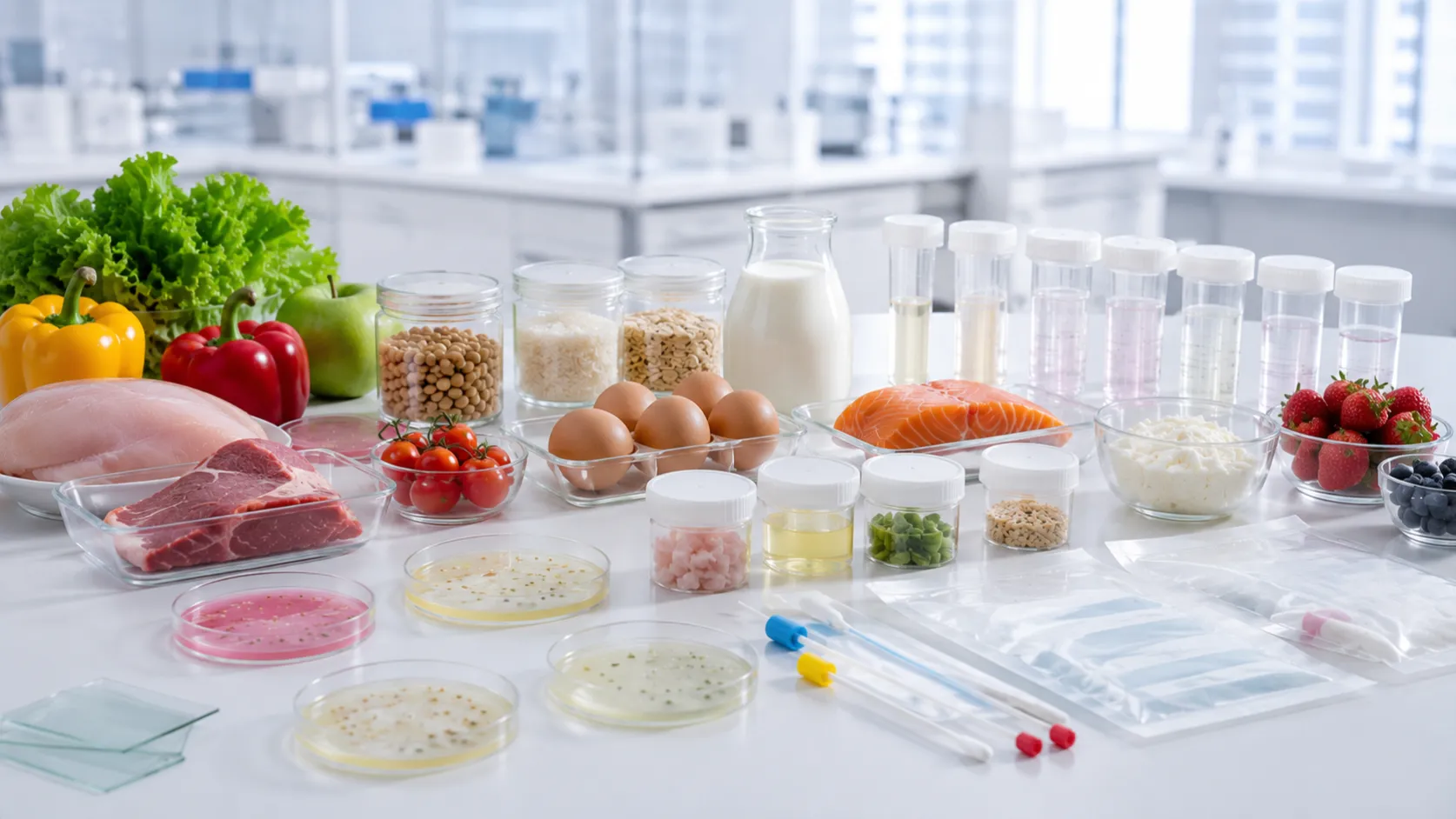
Food safety analysis covers a wide range of sample matrices, including:
- Dairy products – milk, cheese, yogurt, and infant formula, where testing may include microbiological hazards, composition parameters, and product stability.
- Meat and poultry – raw and processed products evaluated for microbial contamination, processing conditions, and relevant chemical residues.
- Beverages – water, juices, and soft drinks analyzed for chemical contaminants, pH, composition parameters, and microbial stability.
- Baked goods and cereals – flour, bread, and snacks tested for parameters such as mycotoxins, allergens, moisture content, and product stability.
- Prepared and packaged foods – ready-to-eat meals evaluated for microbiological safety, relevant composition parameters, packaging performance, and shelf-life stability.
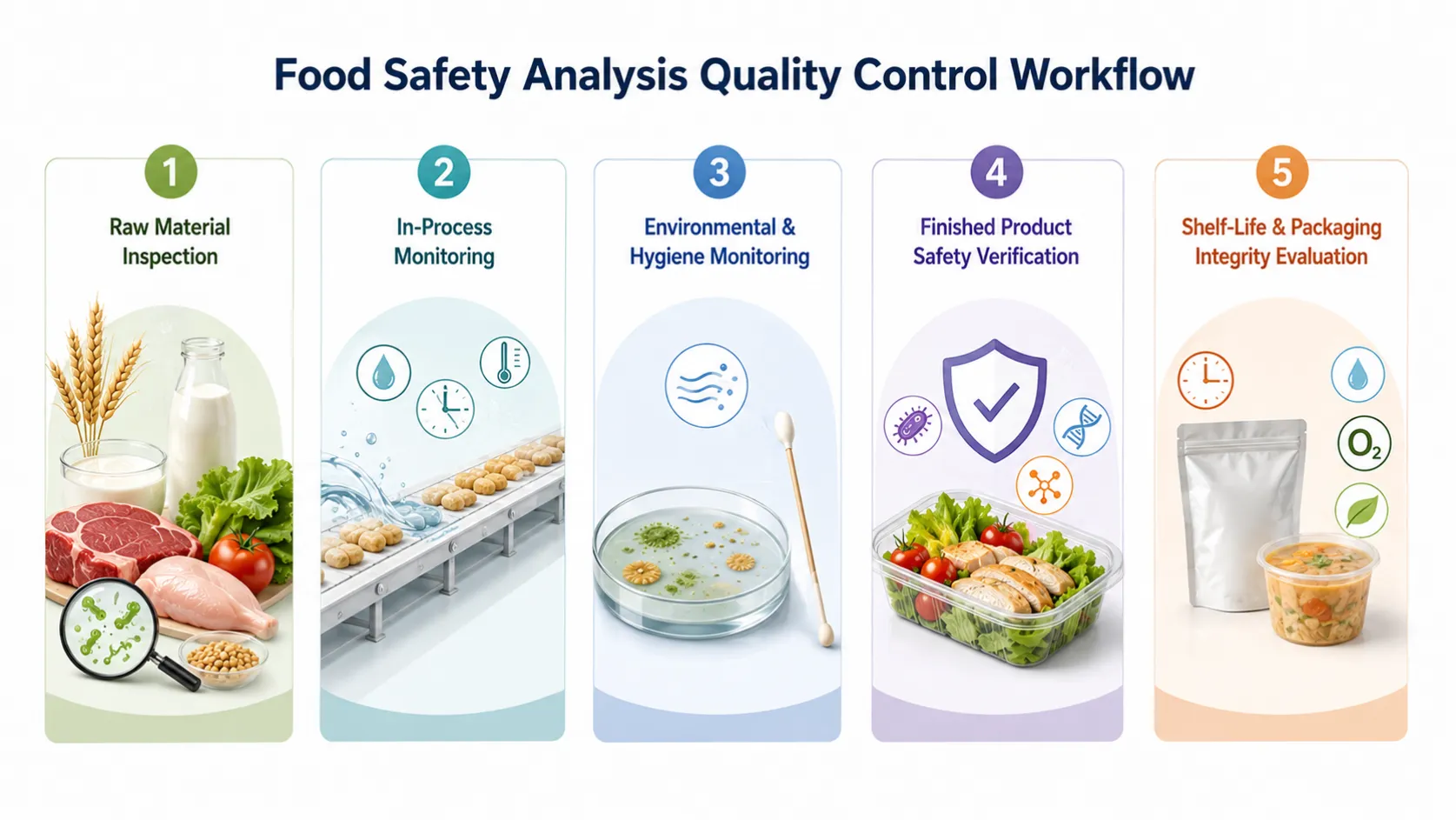
Food Safety Analysis Quality Control Workflow
Raw Material Reception and Inspection
Upon arrival, raw materials such as grains, dairy ingredients, and meat trimmings should be evaluated according to the facility’s incoming-material specifications before they enter production. Potential risks include microbial spoilage, chemical residues, and physical foreign matter. Depending on the material and test plan, incoming checks may include microbial enumeration, pH, moisture content, weighing and sample preparation, and visual inspection. These tests help manufacturers identify non-conforming lots before processing begins.
Recommended laboratory equipment for this stage:
- Analytical Balance – precisely weighs samples for microbial dilution and chemical analysis, supporting consistent sample preparation.
- Moisture Analyzer – determines water content quickly and helps assess ingredient consistency and storage stability.
- pH Meter – measures acidity or alkalinity for incoming-material and process-control checks where pH is a relevant quality parameter.
- Colony Counter – assists with counting colonies after incubation during culture-based microbial enumeration.
- Portable ATP Hygiene Monitor – provides rapid hygiene screening using ATP bioluminescence where the facility’s sanitation-monitoring program uses ATP testing.


In-Process Production Monitoring
During production, intermediate products, process water, equipment surfaces, and process conditions may require routine checks to confirm that the manufacturing process remains under control. Important parameters can include pH, temperature, composition, and hygiene indicators. Time-temperature monitoring, ATP swabbing, microbial testing, and product-specific measurements allow production and QC teams to identify deviations and take corrective action before affected material advances further through the process.
Recommended laboratory equipment for this stage:
- pH Meter – verifies acidity levels in applications such as fermented products and brines where pH is an important process parameter.
- Digital Thermometer – records core or surface temperatures for cooking, cooling, storage, and other temperature-controlled operations.
- ATP Hygiene Monitor – detects ATP residues on food-contact surfaces after cleaning as a rapid sanitation-verification tool.
- Portable Incubator – supports incubation of compatible microbiological tests when on-site incubation is required.
- Refractometer – measures Brix or soluble-solids concentration in beverages, syrups, and other applicable products for process and formulation control.
Environmental and Hygiene Monitoring
Regular monitoring of air, surfaces, and personnel hygiene in processing areas helps facilities identify contamination risks and evaluate sanitation controls. Depending on the facility and monitoring program, risks may include airborne microorganisms, yeast and mold, surface contamination, and allergen cross-contact. Air sampling, surface swabbing, hygiene screening, and microbiological testing can be incorporated into an environmental monitoring program based on the processing environment and product risk.
Recommended laboratory equipment for this stage:
- Air Sampler – collects airborne microorganisms onto suitable culture media for subsequent incubation and evaluation.
- Particle Counter – measures airborne particulate levels where particle monitoring is relevant to controlled production areas.
- Luminometer – works with compatible ATP swabs to provide rapid hygiene verification of equipment surfaces and other monitored areas.
- Culture Media and Incubator – support culture-based growth and enumeration of microorganisms selected for the facility’s monitoring program.
Finished Product Safety Verification
Before release, finished food products may undergo microbiological, chemical, physical, and allergen testing according to the product specification and applicable test plan. The required analyses vary significantly by food type, process, target hazard, and market. Culture methods, real-time PCR, ELISA, chromatography, and other analytical techniques can be used individually or in combination depending on whether the laboratory needs routine screening, quantitative analysis, or more advanced confirmation.
Recommended laboratory equipment for this stage:
- Incubator and Colony Counter – support culture-based enumeration such as total aerobic counts and yeast/mold counts where these tests are part of the product specification.
- Real-time PCR System – supports rapid molecular detection of selected target organisms when used with an appropriate validated method and sample-preparation workflow.
- ELISA Reader – measures assay responses for compatible immunoassay methods, including selected food-allergen testing applications.
- HPLC System – separates and quantifies compounds for compatible chemical analysis methods, with the exact application depending on the detector, sample preparation, and analytical method.
- Gas Chromatograph (GC) – analyzes suitable volatile and semi-volatile compounds and can support product-specific chemical characterization methods.
Shelf-Life and Packaging Integrity Testing
Shelf-life and packaging studies help determine how product quality and relevant safety parameters change under defined storage conditions. Depending on the food and packaging system, manufacturers may monitor microbial changes, oxidation, moisture changes, water activity, seal performance, and packaging barrier properties. Stability chambers and product-specific analytical instruments allow laboratories to compare samples under controlled conditions and support shelf-life evaluations.
Recommended laboratory equipment for this stage:
- Stability Chamber – controls temperature and humidity for defined storage studies and accelerated stability evaluations where appropriate.
- Moisture Analyzer – tracks changes in moisture content in applicable products during storage studies.
- Universal Tensile Testing Machine – measures mechanical properties such as seal strength and film performance using the appropriate fixture and test method.
- Oxygen Permeability Tester – evaluates oxygen transmission or barrier performance of applicable packaging materials.
- Water Activity Meter – measures water activity, an important parameter when evaluating the availability of water for microbial growth and product stability.
Common Quality Control Challenges in Food Safety
- Microbial cross-contamination – microorganisms can spread through shared equipment, surfaces, personnel, or the processing environment, making sanitation and environmental monitoring important parts of the control program.
- Inconsistent raw material quality – variations in moisture, pH, composition, or microbial condition can affect processing and finished-product consistency.
- Allergen cross-contact – shared lines and inadequate cleaning can create allergen-management risks that require appropriate process controls and verification.
- Chemical residue detection – some applications require sensitive analytical methods for pesticides, veterinary-drug residues, contaminants, additives, or cleaning-related residues.
- Shelf-life determination – product stability must be evaluated under storage conditions relevant to the product and packaging system.
- Rapid pathogen detection – conventional culture workflows can require substantial time, creating demand for appropriately validated rapid screening and molecular methods.
Key Quality Control Tests for Food Safety Analysis
| Quality Challenge | Quality Control Test | Recommended Laboratory Equipment | Application |
|---|---|---|---|
| Microbial spoilage | Aerobic plate count / total viable count | Colony Counter, Incubator | Assessment of overall microbiological condition using culture-based methods |
| Pathogen presence | PCR-based pathogen detection | Real-time PCR System | Targeted molecular detection of selected pathogens using an appropriate method |
| Allergen cross-contact | ELISA allergen test | ELISA Reader | Detection or quantification of selected allergen proteins using compatible assays |
| Acidification / fermentation | pH measurement | pH Meter | Monitoring acidity during processing and finished-product evaluation |
| Moisture-related stability | Moisture content analysis | Moisture Analyzer | Monitoring moisture content during processing, storage, and product evaluation |
| Chemical contamination | Heavy metal analysis | Atomic Absorption Spectrophotometer | Elemental analysis where the selected method and instrument configuration are suitable |
| Toxin contamination | Mycotoxin LC-MS/MS | Liquid Chromatograph Mass Spectrometer | Advanced quantitative analysis of selected mycotoxins using an appropriate analytical method |
| Packaging integrity | Seal strength testing | Universal Tensile Testing Machine | Evaluating mechanical seal performance using suitable fixtures and test procedures |
Laboratory Equipment Required for Food Safety Quality Control
A comprehensive food safety testing program may require equipment spanning microbiological, chemical, physical, environmental, and packaging analysis. The correct combination should be selected from the tests the facility actually performs rather than from a universal equipment list.
For routine microbiological work, laboratories may use incubators, colony counters, sterilization equipment, and sample-preparation tools. Rapid systems such as real-time PCR can support selected pathogen-detection workflows, while ELISA readers support compatible immunoassays. Chemical laboratories may require HPLC, GC, spectrophotometric, elemental-analysis, or mass-spectrometry systems depending on the compounds being measured and the analytical methods used.
Physical and product-stability instruments such as pH meters, moisture analyzers, refractometers, and water activity meters support routine quality control. Environmental monitoring tools such as air samplers and ATP hygiene systems can complement sanitation programs, while stability chambers and packaging test instruments support shelf-life and package-performance studies.
| Testing Requirement | Laboratory Equipment | Why Manufacturers Need It |
|---|---|---|
| Microbial enumeration | Incubator and Colony Counter | To support culture and enumeration of bacteria, yeasts, or molds included in the laboratory’s microbiological test program. |
| Pathogen identification | Real-time PCR System | For rapid targeted molecular detection when an appropriate PCR method is part of the laboratory workflow. |
| Allergen testing | ELISA Reader | To read compatible immunoassays used for selected allergen-detection or quantification applications. |
| Moisture content | Moisture Analyzer | For routine measurement of moisture content in applicable raw materials and finished products. |
| Acidity control | pH Meter | To monitor acidity during processing and finished-product quality control. |
| Chemical analysis | HPLC System | For quantitative analysis of compounds that are compatible with the selected chromatographic method and detector configuration. |
| Packaging seal integrity | Universal Tensile Testing Machine | To evaluate mechanical seal performance and related packaging properties using an appropriate test setup. |
| Air quality monitoring | Air Sampler and Particle Counter | For microbiological air sampling and particulate monitoring where these measurements form part of the environmental monitoring program. |
Together, these instrument groups can provide capabilities ranging from routine screening to advanced confirmatory analysis. The key purchasing decision is not to maximize the number of instruments, but to match each required test with a suitable method, instrument category, sample volume, and laboratory capability.
Basic Laboratory Setup for Food Manufacturers
The level of laboratory investment should reflect the tests that need to be performed in-house. Routine physical and microbiological QC can often begin with comparatively basic equipment, while pathogen identification, trace chemical analysis, and advanced contaminant profiling require more specialized instrumentation, sample preparation, trained personnel, and method control.
| Laboratory Level | Recommended Equipment | Suitable For |
|---|---|---|
| Basic QC Laboratory | pH Meter, Moisture Analyzer, Analytical Balance, Basic Incubator, Colony Counter, Autoclave | Routine physical measurements, sample preparation, sterilization, and basic culture-based microbiological work. |
| Advanced QC Laboratory | Real-time PCR, ELISA Reader, Spectrophotometer, HPLC, Laminar Flow Cabinet, Air Sampler | Facilities bringing selected pathogen, allergen, chemical, and environmental analyses into the in-house QC workflow. |
| Advanced Analysis Laboratory | LC-MS/MS, ICP-MS, Gas Chromatograph, Texture Analyzer, Stability Chambers | Laboratories requiring advanced contaminant analysis, elemental analysis, product characterization, or controlled stability studies. |
A facility does not necessarily need every instrument listed at a given level. The final configuration should be built from the actual product portfolio, required test methods, expected sample volume, staff capability, and analyses that will remain outsourced.
How to Choose Laboratory Equipment for Food Safety Analysis
Selecting laboratory equipment should begin with the testing requirement rather than the instrument itself. A practical sequence is to define the food matrices and hazards, identify the methods the laboratory must perform, determine the required workload and result type, and then select equipment capable of supporting those methods.
Define the Testing Scope
Begin by identifying the sample matrices, such as liquids, solids, powders, oils, or high-fat foods, and the relevant microbiological, chemical, physical, allergen, or packaging risks. Determine which measurements are routine screening tests and which require quantitative or confirmatory analysis. Where the facility follows defined regulatory, customer, or internal methods, equipment selection should be compatible with those methods rather than based only on instrument capability.
Evaluate Laboratory Workflow Requirements
Assess daily sample throughput, testing frequency, sample-preparation workload, and required turnaround time when comparing manual and automated systems. Consider personnel capability as well: advanced chromatography and mass-spectrometry systems require substantially different laboratory infrastructure and technical expertise from routine instruments such as balances, pH meters, and moisture analyzers.
Laboratory space, ventilation, utilities, contamination control, and data-management requirements should also be reviewed before purchase. For specialized analyses performed infrequently, manufacturers should compare the cost and operational complexity of in-house testing with the option of using a qualified external laboratory.
Compare Long-Term Equipment Support
Equipment selection should account for more than the initial purchase price. Calibration requirements, preventive maintenance, consumables, compatible accessories, spare-parts availability, staff training, and technical support all affect the long-term usability of an instrument.
AELAB can assist manufacturers by matching their sample types, required tests, expected testing volume, and laboratory capabilities with appropriate equipment categories, helping avoid both under-equipped laboratories and unnecessary instrument purchases.
Who Needs Laboratory Testing Solutions for This Industry?
- Food processing and manufacturing companies – facilities that perform incoming-material, process, hygiene, or finished-product quality control.
- Contract food testing laboratories – third-party laboratories providing microbiological, chemical, physical, or specialized analytical services.
- Quality assurance departments in retail and food service – teams responsible for supplier specifications, product verification, and quality monitoring.
- Regulatory and inspection laboratories – organizations conducting laboratory analysis as part of food-control and inspection activities.
- R&D and new product development teams – laboratories evaluating formulations, ingredients, packaging, and shelf-life during product development.
Frequently Asked Questions
What is the most essential instrument for a basic food safety laboratory?
A combination of a pH meter, moisture analyzer, incubator, colony counter, and autoclave forms the core for routine hygiene and composition tests. These instruments cover acidity, water content, microbial load, and sterilization needs, which are fundamental to food quality monitoring.
How can rapid methods improve food safety testing?
Rapid methods like real-time PCR and ATP bioluminescence deliver results in hours rather than days, allowing manufacturers to make faster product release decisions and reduce inventory costs. They also enable more frequent monitoring of critical control points, enhancing proactive risk management.
What is the difference between a water activity meter and a moisture analyzer?
A moisture analyzer measures the total water content in a sample, while a water activity meter quantifies the free water available for microbial growth. Water activity is a better predictor of shelf-life stability and microbial safety, especially in intermediate-moisture foods.
How do I choose between ELISA and PCR for allergen testing?
ELISA detects specific allergen proteins and is the standard for routine allergen screening and quantification in food facilities. PCR targets allergy-causing DNA and is sometimes used for confirmatory purposes, but ELISA remains the first choice for day-to-day allergen management because of its direct correlation to allergenic protein levels.
Conclusion
A food safety laboratory should be configured around the products being manufactured and the tests the facility actually needs to perform. Routine laboratories may focus on pH, moisture, weighing, hygiene monitoring, and culture-based microbiology, while facilities requiring pathogen identification, allergen analysis, trace chemical testing, or advanced contaminant profiling may need PCR, ELISA, chromatography, or mass-spectrometry capabilities.
The most practical approach is to map each raw material, process stage, finished product, and packaging requirement to its required test method before selecting equipment. This test-first approach helps manufacturers prioritize essential instruments, determine which advanced analyses belong in-house, and build laboratory capability that can expand as testing demands grow.
Laboratory Equipment Solutions for the Food Industry
AELAB supports food manufacturers in building tailored quality control laboratories by helping to match sample types, required tests, accuracy needs, and throughput with appropriate equipment categories. Whether a facility needs a basic setup for routine physical and microbiological testing or a more advanced laboratory for PCR and instrumental analysis, defining the testing workflow is the first step toward an efficient configuration.
For equipment planning, technical buyers and QC managers should prepare information about the products or samples being tested, required test methods, expected sample volume, existing laboratory equipment, analyses currently outsourced, and major quality-control challenges. These details make it easier to determine which instruments are essential now and which advanced capabilities may be added as laboratory requirements grow.