Paint Manufacturing Quality Control Equipment Overview
Paint manufacturing quality control equipment is used to verify liquid paint properties, pigment dispersion, appearance, film performance, and durability throughout production. A typical paint QC laboratory combines viscosity and density measurement, grind assessment, color and gloss measurement, standardized film preparation, thickness and adhesion testing, and—where required—accelerated environmental testing.
The right equipment depends on the paint type, substrate, required test methods, production volume, and customer or quality specifications. Rather than selecting instruments from a generic checklist, manufacturers should map each production stage and required test to the appropriate measurement method.
This guide provides a technical overview of the key equipment used in paint manufacturing quality control, from raw material inspection to finished product testing. It covers the main quality parameters, testing workflows, and practical considerations for architectural paints, industrial coatings, and automotive finishes.
What Is Paint Manufacturing Quality Control Equipment?
Paint manufacturing quality control equipment comprises laboratory instruments and testing devices used to evaluate liquid paint properties and dry film performance. These tools are used throughout production to verify that raw materials, mill base, let-down, and final packaged paint conform to defined specifications.
The equipment portfolio typically includes viscometers, grind gauges, color measurement devices, gloss meters, film preparation tools, thickness gauges, adhesion testers, and environmental chambers. The required combination depends on which properties must be controlled at each manufacturing stage and which test methods apply to the finished coating.
Main Quality Control Parameters for Paints and Coatings
Quality control in paint manufacturing focuses on parameters that affect processing, application, appearance, and finished coating performance. Liquid paint properties such as viscosity, density, and fineness of grind help manufacturers control mixing, dispersion, pumping, and application. Dry film properties such as color, gloss, thickness, adhesion, and durability help determine whether the applied coating meets its intended performance and appearance requirements.
- Viscosity: Controls flow and leveling; measured with viscometers or flow cups.
- Fineness of grind: Indicates pigment dispersion quality; assessed with a Hegman gauge.
- Color and gloss: Critical for appearance; measured with spectrophotometers and gloss meters.
- Density: Important for weight/volume control; determined using a pycnometer or density cup.
- Adhesion: Ensures coating bonds to substrate; tested via cross-cut or pull-off methods.
- Drying time: Affects handling and recoat intervals; measured with drying time recorders.
- Film thickness: Both wet and dry film thickness gauges are used.
- Durability: Accelerated weathering and corrosion resistance tests simulate environmental exposure under defined test conditions.
Paint Manufacturing Quality Control Workflow
In a typical paint plant, quality control is integrated at multiple stages rather than performed only on the finished batch. Incoming materials are checked before use, dispersion is monitored during mill-base preparation, let-down is verified against formulation targets, and finished paint is evaluated before release. For products with additional performance requirements, prepared coating panels may also undergo mechanical, corrosion, or weathering testing.
1. Incoming Raw Material Inspection
Before production, binders, pigments, solvents, additives, and other incoming materials are checked against applicable purchasing or quality requirements. The exact tests depend on the material and formulation, but may include properties such as pH, viscosity, moisture, or other specified characteristics.
Common laboratory equipment at this stage includes:
- Moisture balance
- pH meter
- Laboratory stirrer
- Viscometer or flow cup


2. Mill Base Dispersion Control
During pigment dispersion, the fineness of grind is monitored to determine whether the required level of dispersion has been reached. A Hegman gauge or grindometer provides a practical production-control measurement, while viscosity and temperature can also be monitored where relevant to the process.
Typical equipment includes:
- Hegman gauge / grindometer
- Viscometer
- Thermometer (for temperature control during dispersion)
3. Let-Down and Mixing Verification
After the mill base is combined with the remaining formulation components, QC checks help verify that the batch has reached its required formulation characteristics. Viscosity and density provide important batch-control information, while instrumental color measurement can be used when color matching is required.
Typical equipment includes:
- Viscometer (rotational or Zahn cup)
- Density cup / pycnometer
- Spectrophotometer for color matching

4. Finished Product Testing
Final batch testing combines liquid-paint measurements with evaluation of prepared coating films. For dry-film tests, consistent panel preparation is important because application method, film thickness, substrate, and curing conditions can influence the result.
Depending on the coating specification, finished-product testing may include:
- Drawdown bar / film applicator
- Spectrophotometer and gloss meter
- Wet and dry film thickness gauges
- Cross-cut adhesion tester
- Drying time recorder

5. Accelerated Weathering and Corrosion Testing (for specific coatings)
Industrial, automotive, marine, exterior, and other performance coatings may require additional evaluation of resistance to environmental exposure. Salt spray or corrosion chambers and accelerated weathering equipment are used under defined test methods to compare or qualify coating performance.
The required exposure method should be selected according to the coating specification or applicable test program rather than assuming that every paint requires the same environmental test. Existing specifications may reference standards such as ASTM B117, ISO 9227, or requirements associated with ISO 12944, depending on the application.
Typical equipment may include:
- Salt spray / corrosion test chamber
- QUV or xenon arc weathering tester
- Impact tester
- Mandrel bend tester
6. Batch Release and Record Keeping
After the required tests meet the applicable batch specifications, the product can proceed through the manufacturer’s release process. Recording instrument readings, test conditions, sample identification, operator observations, and batch information supports traceability and investigation of future quality issues.
Depending on the laboratory system, supporting resources may include:
- Data logging software
- Calibration standards
- Sample retention cabinets
Laboratory information management systems (LIMS) may also be integrated where centralized test records and batch tracking are required.
Key Quality Control Tests for Paint Manufacturing
The most useful way to plan a paint QC laboratory is to connect each quality requirement to its purpose, measurement method, and applicable product type.
| Quality Control Test | Purpose | Common Laboratory Equipment | Relevant Product Types / Applications |
|---|---|---|---|
| Viscosity measurement | Ensures proper flow, leveling, and application characteristics | Rotational viscometer, Krebs Stormer viscometer, Zahn cup, Ford cup | All paint types: architectural, automotive, industrial |
| Fineness of grind | Checks pigment dispersion quality and particle size | Hegman gauge (grindometer) | Pigmented coatings, inks, mill bases |
| Color measurement | Verifies color match against standard | Spectrophotometer, tristimulus colorimeter | Decorative, automotive, industrial coatings |
| Gloss evaluation | Determines surface shine level | Gloss meter (20°, 60°, 85° geometries) | Architectural, automotive OEM, furniture finishes |
| Density / specific gravity | Confirms weight/volume relationship and batch consistency | Density cup, pycnometer | All liquid paints |
| Dry film thickness | Measures coating thickness after curing | Digital coating thickness gauge (magnetic/eddy current) | All coated substrates |
| Adhesion testing | Assesses bond strength between coating and substrate | Cross-cut tester, pull-off adhesion tester | Metal, plastic, wood substrates |
| Drying / curing time | Determines set-to-touch, tack-free, hard dry times | Drying time recorder, BK drying recorder | Air-drying and stoving paints |
| Corrosion resistance | Evaluates protective performance against rust | Salt spray / fog chamber, cyclic corrosion tester | Protective coatings, marine, automotive |
| Accelerated weathering | Simulates UV and moisture degradation | QUV tester, xenon arc chamber | Exterior architectural, automotive, coil coatings |
Recommended Laboratory Equipment for Paint Manufacturing Quality Control Laboratories
The required instrument list should be based on the tests specified for the manufacturer’s actual paint portfolio. A basic production QC laboratory may focus on routine liquid-paint and appearance measurements, while laboratories supporting product development, qualification, or high-performance coatings may require additional mechanical and environmental testing.
| Laboratory Equipment | Main Application | Why It Matters |
|---|---|---|
| Rotational viscometer | Measuring dynamic viscosity of paints and coatings | Critical for formulation control and application behavior |
| Hegman grind gauge | Determining fineness of grind (dispersion) | Ensures pigment particle size meets spec; prevents surface defects |
| Spectrophotometer | Color measurement and batch matching | Essential for brand color consistency and reducing waste |
| Gloss meter | Gloss level measurement at different angles | Verifies aesthetic appearance as per customer requirements |
| Density cup / Pycnometer | Specific gravity and density determination | Used for formulation, weight/volume control, and batch consistency |
| Drawdown bars / Film applicators | Preparing uniform coating films for testing | Standardizes test panel preparation for repeatable results |
| Digital coating thickness gauge | Measuring dry film thickness on substrates | Validates that coating is applied at specified thickness |
| Cross-cut adhesion tester | Assessing paint adhesion on metal, plastic, wood | Important for coating durability and qualification |
| Drying time recorder | Evaluating drying stages under controlled conditions | Provides objective data on cure for production scheduling |
| Salt spray chamber | Corrosion resistance testing of protective coatings | Required for many industrial and automotive specifications |
| QUV / Xenon weathering tester | Accelerated UV and moisture exposure tests | Predicts long-term outdoor durability of coatings |
| pH meter | Measuring pH of raw materials and waterborne paints | Important for stability and compatibility |
Basic vs Advanced Paint Quality Control Laboratory Equipment
Not every paint manufacturer needs the same laboratory configuration. The appropriate level of equipment depends on the products being manufactured, the tests required for batch release, and whether the laboratory is responsible only for routine production QC or also for development and performance qualification.
A basic production QC laboratory commonly prioritizes routine measurements such as viscosity, fineness of grind, density, pH where applicable, standardized film preparation, color, gloss, drying behavior, and film thickness. These tests provide frequent feedback during manufacturing and final batch evaluation.
An advanced laboratory may add pull-off adhesion testing, mechanical coating tests, accelerated weathering, corrosion testing, additional instrumental color capabilities, and digital data integration when these are justified by product specifications or development requirements.
The key purchasing principle is to define the required tests first and then select instruments that support those methods. This helps avoid both under-equipping the laboratory and purchasing advanced equipment that is not required for the actual QC program.
How to Choose Laboratory Equipment for Paint Manufacturing Quality Control
Selecting paint QC equipment should begin with the product portfolio and the test methods used to approve each batch. Architectural paints may place greater emphasis on routine viscosity, color, gloss, density, and film application measurements, while protective, industrial, or automotive coatings can require additional mechanical and environmental performance testing.
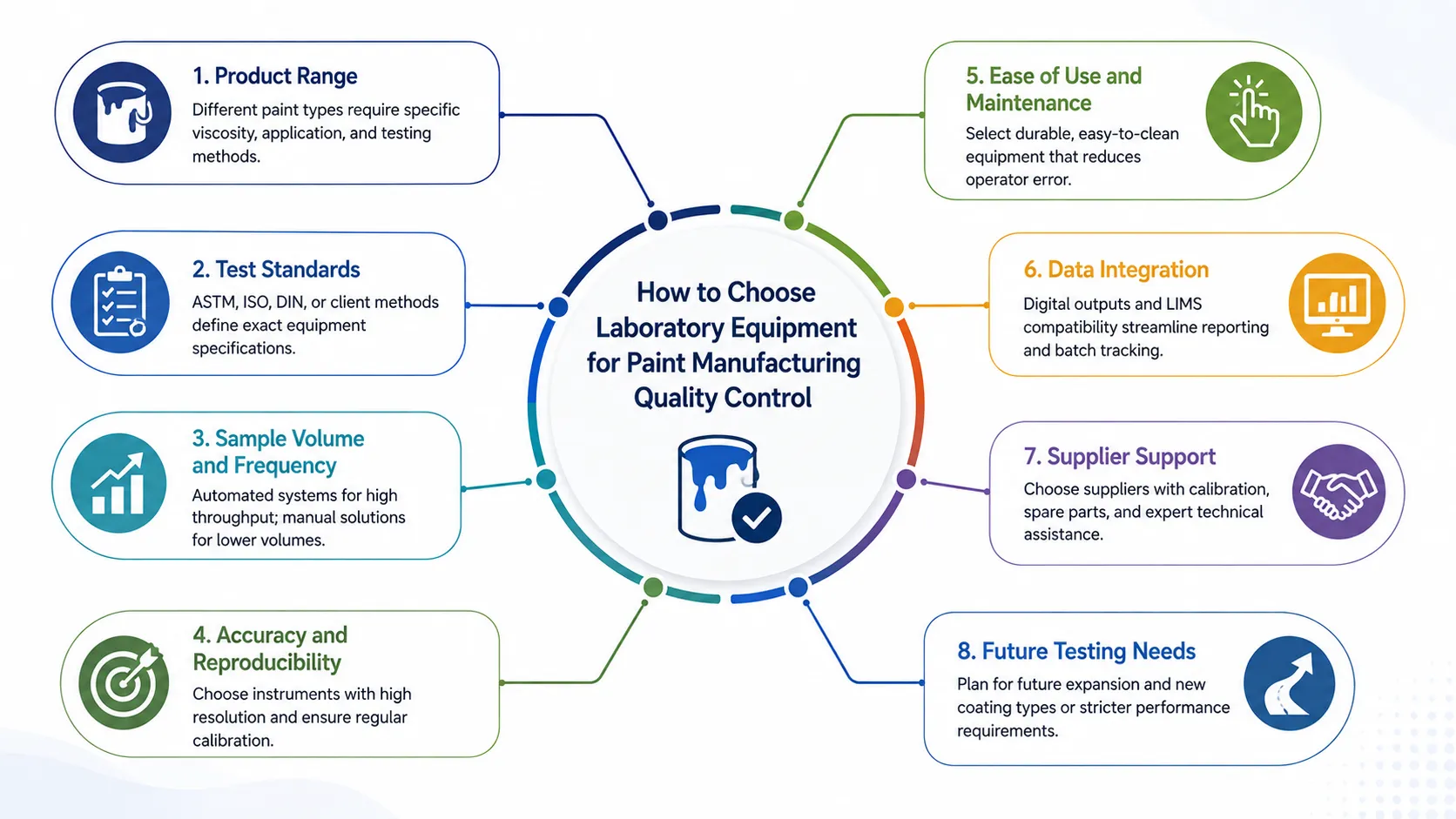
Consider the following factors when building or upgrading a paint QC laboratory:
- Product range: Waterborne, solventborne, high-solids, powder coatings – each may require specific viscosity and film application methods.
- Required test methods: ASTM, ISO, DIN, customer-specific, or internal methods can determine which instrument type or measurement geometry is appropriate.
- Substrate and coating system: Film thickness, adhesion, corrosion, and mechanical testing methods can depend on the substrate and coating configuration being evaluated.
- Sample volume and frequency: High-throughput labs may benefit from automated viscometers and color measurement systems, while smaller labs can use manual devices.
- Accuracy and reproducibility: Instruments should provide measurement capability appropriate to the laboratory’s test method and acceptance requirements.
- Calibration and verification: Consider how the instrument will be checked, calibrated, and documented as part of the laboratory’s quality system.
- Ease of use and maintenance: Look for equipment that is durable, easy to clean, and practical for routine operators to use consistently.
- Data integration: Instruments with digital outputs and compatibility with laboratory data systems can streamline reporting and batch tracking where such integration is required.
- Supplier support: Availability of technical support, spare parts, and calibration or service assistance should be considered when selecting laboratory equipment. AELAB supplies paint testing and laboratory instrument categories for different stages of paint quality control.
- Future testing needs: Plan for expansion if you expect to add new coating types, additional test methods, or more demanding performance evaluations.
A practical equipment-selection request should therefore identify the paint or coating type, required tests, applicable methods or standards, expected sample volume, and whether the laboratory is intended for routine production QC, R&D, qualification testing, or a combination of these functions.
Frequently Asked Questions
What is the most essential equipment for a paint quality control laboratory?
A basic paint QC lab should have a viscometer (flow cup or rotational), a Hegman gauge, a spectrophotometer for color, a gloss meter, a drying time recorder, and film application tools. The exact list extends based on coating types and test standards.
How often should paint quality control instruments be calibrated?
Calibration frequency depends on usage and the manufacturer’s recommendation, but typical intervals range from every 3 to 12 months. Critical instruments like spectrophotometers and gloss meters may need more frequent verification with calibration standards.
Can one viscometer work for all types of paints?
Not necessarily. For low- to medium-viscosity paints, flow cups (like Zahn or Ford) are common, while Krebs Stormer viscometers are standard for architectural paints. Rotational viscometers with different spindles can cover a wide range, but some highly thixotropic materials may require specific fixtures.
What is the difference between a Hegman gauge and a grind gauge?
There is no difference; the terms are used interchangeably. Both refer to the graduated block device that measures the fineness of grind or degree of dispersion in pigmented coatings.
How are accelerated weathering tests correlated with real outdoor exposure?
Accelerated tests like QUV or xenon arc use intensified UV light and moisture cycles to simulate years of outdoor exposure in weeks. While correlation factors exist, they are coating-specific and should be validated with natural exposure data.
Is salt spray testing mandatory for all industrial coatings?
It is not universally mandatory, but many industrial coating specifications (e.g., for steel structures or automotive components) require salt spray testing as per ISO 9227 or ASTM B117 to prove corrosion resistance. The requirement depends on the intended service environment.
Conclusion
Paint manufacturing quality control requires more than a list of laboratory instruments. An effective QC laboratory connects each raw material, production stage, and finished-coating requirement to a defined test method and suitable measurement instrument.
For routine production control, viscosity, dispersion, density, color, gloss, standardized film preparation, thickness, adhesion, and drying tests form the core of many paint QC programs. Environmental and mechanical performance equipment can then be added where the coating specification or development program requires it.
By defining the required tests, product types, substrates, sample throughput, and applicable methods before selecting equipment, manufacturers can build a laboratory that supports consistent batch decisions without unnecessary instrumentation.