Ink Manufacturing Quality Control Laboratory Setup Overview
Ink manufacturing quality control covers raw material verification, pigment dispersion, color and appearance, viscosity and rheology, adhesion, drying performance, resistance properties, and storage stability. A practical ink quality control laboratory therefore combines instruments for physical, optical, rheological, and performance testing, selected according to the ink type, substrate, production volume, and required QC checks.
The ink industry produces a wide range of printing inks used in packaging, publishing, labels, textiles, and industrial applications. Even small variations in raw materials, dispersion, or formulation can contribute to color inconsistency, poor transfer, adhesion problems, or other print defects. An effective ink quality control laboratory helps manufacturers identify these problems before finished batches reach customers.
Laboratory testing typically supports three main stages: incoming raw material inspection, in-process manufacturing control, and finished-product evaluation. The equipment required at each stage depends on the formulation and printing process rather than on a single universal laboratory configuration.
Main Ink Products and Their QC Priorities
Ink manufacturers produce formulations for different printing methods and substrates. Common product categories include:
- Offset lithographic inks for commercial printing, newspapers, and packaging, where color, viscosity, tack, and drying behavior are important QC considerations.
- Flexographic inks for flexible packaging, labels, and corrugated boxes, where viscosity, color, drying, and substrate adhesion are common control points.
- Gravure inks for high-volume packaging, magazines, and decorative prints, requiring consistent flow, color, drying, and print performance.
- Screen printing inks for textiles, signage, and electronic applications, where rheology, adhesion, drying or curing behavior, and resistance properties may be important.
- Digital inks for inkjet printing on paper, plastics, and textiles, where formulation consistency, particle characteristics, color, and application-specific performance require close control.
Because these ink systems behave differently, the QC laboratory should be configured around the products being manufactured and the properties that determine acceptable performance in their intended printing process.
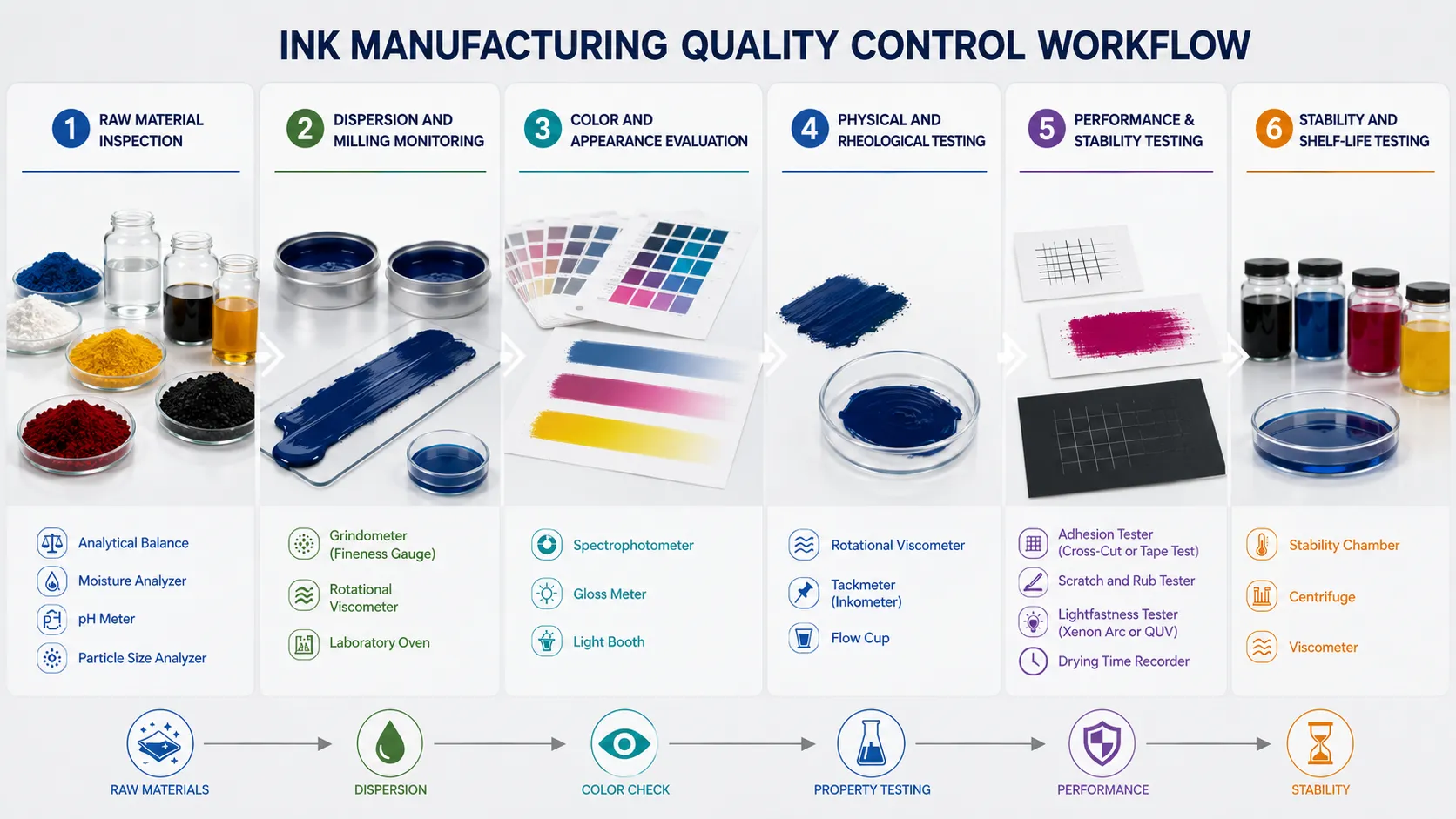
Ink Manufacturing Quality Control Workflow
Raw Material Inspection
Final ink consistency begins with pigments, resins, solvents, additives, and other formulation materials. Variations in pigment characteristics, moisture, resin properties, or aqueous-system pH can influence dispersion, color development, viscosity, and storage behavior.
Incoming QC should therefore focus on the properties that are relevant to each raw material and formulation. Moisture content, pH, particle characteristics, and accurate weighing are examples of measurements that can help identify unsuitable or inconsistent materials before production.
Recommended laboratory equipment for this stage:
- Analytical Balance – Supports accurate weighing of raw materials and samples during formulation and QC procedures.
- Moisture Analyzer – Determines moisture content where water level is an important incoming-material parameter.
- pH Meter – Measures acidity or alkalinity in aqueous raw materials and water-based ink systems.
- Particle Size Analyzer – Characterizes particle size distribution where pigment or dispersed-particle characteristics require more detailed evaluation.


Dispersion and Milling Monitoring
During dispersion or milling, pigment agglomerates are reduced and distributed through the ink vehicle. Inadequate dispersion can limit color development and contribute to defects such as streaking or inconsistent appearance.
Fineness of grind is a practical in-process measurement for evaluating dispersion. Viscosity can also be monitored because changes in formulation or processing conditions can affect milling and subsequent handling.
Recommended laboratory equipment for this stage:
- Grindometer (Fineness Gauge) – Evaluates fineness of grind and helps determine whether the required dispersion condition has been reached.
- Rotational Viscometer – Measures viscosity under defined test conditions for process and batch consistency checks.
- Laboratory Oven – Supports drying procedures such as non-volatile content determination when required by the manufacturer’s QC method.


Color and Appearance Evaluation
Color consistency is one of the most visible ink quality requirements. Manufacturers may need to compare production batches with customer references, internal standards, or established color targets. Variations in pigment loading, dispersion, or formulation can produce noticeable shade differences.
Instrumental color measurement provides objective data for batch comparison, while controlled visual assessment helps operators evaluate appearance under defined lighting conditions. Gloss may also be measured when surface appearance is part of the finished-print requirement.
Recommended laboratory equipment for this stage:
- Spectrophotometer – Provides objective color measurement for color matching and batch comparison.
- Gloss Meter – Measures surface gloss when gloss level is a controlled appearance parameter.
- Light Booth – Provides controlled lighting conditions for visual comparison of ink or printed samples.


Physical and Rheological Property Testing
Ink flow and transfer behavior depend strongly on formulation and printing process. Viscosity is therefore a routine QC parameter for many ink systems, but the appropriate measurement approach varies by ink type.
Low-viscosity flexographic and gravure inks may be checked quickly with a suitable flow cup under controlled conditions. Rotational viscometers provide a different form of viscosity measurement and may be more appropriate where more detailed or controlled viscosity evaluation is needed. Tack is particularly relevant to paste-type offset inks and their transfer behavior.
Recommended laboratory equipment for this stage:
- Rotational Viscometer – Measures viscosity under defined rotational test conditions for formulation and batch comparison.
- Tackmeter (Inkometer) – Measures tack characteristics of offset inks where tack control is required.
- Flow Cup – Provides rapid efflux-time checks for suitable low-viscosity ink systems such as many flexographic and gravure formulations.
Performance and End-Use Testing
Finished ink should be evaluated in relation to its intended substrate and application. A formulation that meets color and viscosity targets can still fail if the dried or cured ink film has inadequate adhesion, abrasion resistance, or drying performance.
The required performance tests depend on the end use. Packaging inks may require particular attention to rub and handling resistance, while products exposed to light may require lightfastness evaluation. Testing should reproduce the relevant application conditions as closely as the manufacturer’s QC procedure requires.
Recommended laboratory equipment for this stage:
- Adhesion Tester (Cross-Cut or Tape Test) – Supports assessment of dried ink-film adhesion to the selected substrate.
- Scratch and Rub Tester – Evaluates resistance of printed or coated surfaces to mechanical rubbing or abrasion.
- Lightfastness Tester (Xenon Arc or QUV) – Provides controlled exposure for evaluating color or material changes when light resistance is a required property.
- Drying Time Recorder – Measures drying or setting behavior under defined test conditions.
Stability and Shelf-Life Testing
Storage stability is important because inks can undergo settling, flocculation, phase changes, pH drift, or viscosity changes before use. Stability programs may combine real-time storage with accelerated conditions selected by the manufacturer.
Measurements made before and after storage can include viscosity, pH, visual condition, sedimentation, and redispersion behavior. The exact stability protocol should be based on the ink formulation and the manufacturer’s established acceptance requirements.
Recommended laboratory equipment for this stage:
- Stability Chamber – Maintains controlled storage conditions for stability studies.
- Centrifuge – Can support comparative assessment of sedimentation or separation tendency where appropriate to the internal test method.
- Viscometer – Tracks viscosity changes during stability studies.


Common Quality Control Challenges in Ink Manufacturing
- Maintaining consistent color between production batches despite raw material and process variation
- Achieving adequate pigment dispersion and avoiding defects associated with insufficient milling
- Controlling viscosity and other rheological properties for the intended printing process
- Maintaining adhesion on different substrates while meeting other film-performance requirements
- Balancing drying or setting behavior with production and printing conditions
- Controlling settling, flocculation, separation, or other changes that affect storage stability
Key Quality Control Tests for Ink Manufacturing
The following table connects common manufacturing problems with the corresponding QC test and laboratory equipment. The exact test method and acceptance criteria should be defined according to the ink type, application, customer requirements, and the manufacturer’s quality procedures.
| Quality Challenge | Quality Control Test | Recommended Laboratory Equipment | Purpose / Application |
|---|---|---|---|
| Color inconsistency | Instrumental color measurement | Spectrophotometer | Color matching and batch comparison |
| Poor dispersion | Fineness of grind | Grindometer | Monitoring pigment dispersion during milling |
| Incorrect viscosity | Viscosity or efflux-time measurement | Rotational Viscometer, Flow Cup | Controlling ink flow and production consistency |
| Tack variation in offset ink | Tack measurement | Inkometer | Evaluating tack characteristics of offset formulations |
| Adhesion failure | Adhesion assessment | Adhesion Tester | Checking ink-film bonding to the intended substrate |
| Poor rub resistance | Abrasion or rub test | Rub Tester | Assessing resistance to handling and mechanical rubbing |
| Color change under light exposure | Lightfastness testing | Lightfastness Tester | Evaluating light resistance where required by the application |
| Storage instability | Stability study | Stability Chamber | Monitoring changes during controlled storage |
Laboratory Equipment Required for Ink Quality Control
A well-equipped ink QC laboratory normally combines physical, optical, rheological, and performance-testing instruments. The most important equipment depends on the inks being manufactured, but color measurement, dispersion evaluation, and viscosity control are common priorities across many production environments.
Supporting equipment such as analytical balances, laboratory ovens, pH meters, moisture analyzers, and stability equipment can extend the laboratory from routine finished-product checks to incoming material verification and longer-term formulation evaluation.
| Testing Requirement | Laboratory Equipment | Why Manufacturers Use It |
|---|---|---|
| Color matching | Spectrophotometer | Provides objective color data for batch comparison and approval |
| Dispersion quality | Grindometer | Evaluates fineness of grind during pigment dispersion |
| Viscosity control | Rotational Viscometer | Provides controlled viscosity measurements for formulation and batch QC |
| Rapid low-viscosity checks | Flow Cup | Provides practical efflux-time checks for suitable flexographic and gravure inks |
| Tack assessment | Inkometer | Measures tack characteristics where offset ink tack is a required control parameter |
| Adhesion verification | Adhesion Tester | Evaluates bonding of the ink film to the intended substrate |
| Gloss measurement | Gloss Meter | Quantifies gloss when surface appearance is part of the product requirement |
| Stability testing | Stability Chamber | Provides controlled conditions for storage and stability evaluation |
| Drying performance | Drying Time Recorder | Measures drying or setting behavior under defined conditions |
These instruments form a practical foundation for ink manufacturing QC, but not every laboratory needs every instrument. The most useful configuration is the one that covers the critical quality parameters for the facility’s actual ink formulations, substrates, production stages, and release requirements.
Basic and Advanced Laboratory Setup for Ink Manufacturers
A basic laboratory should prioritize frequent production decisions, while advanced equipment should be added when the formulation, customer requirements, R&D work, or performance risks justify deeper testing.
| Laboratory Level | Recommended Equipment | Suitable For |
|---|---|---|
| Basic QC Laboratory | Grindometer, Flow Cup, pH Meter, Analytical Balance, Laboratory Oven | Small-scale producers focusing on routine dispersion and preliminary physical checks |
| Advanced QC Laboratory | Spectrophotometer, Rotational Viscometer, Gloss Meter, Adhesion Tester, Rub Tester, Light Booth | Manufacturers requiring more detailed color, viscosity, appearance, and performance control |
| Advanced Analysis Laboratory | Stability Chamber, Inkometer, Lightfastness Tester, Particle Size Analyzer, Centrifuge | Operations requiring broader stability, formulation, application, or R&D evaluation |
The table should be treated as configuration guidance rather than a fixed purchasing list. For example, a facility producing primarily low-viscosity flexographic inks may prioritize different rheology tools from a manufacturer focused on paste-type offset inks.
How to Choose Laboratory Equipment for Ink Quality Control
Define the Ink Types and Testing Scope
Start with the inks and substrates your facility actually handles. Identify which properties determine incoming-material acceptance, in-process adjustments, and final batch release. Common priorities include dispersion, color, viscosity, tack, adhesion, drying behavior, gloss, resistance, and stability.
The required measurement range, repeatability, sample characteristics, and test method should be established before selecting an instrument. Customer specifications and existing internal QC procedures should also be considered where they define how a test must be performed.
Match the Instrument to the QC Decision
Equipment selection should be based on the decision the measurement needs to support. A flow cup can provide a rapid production-floor or laboratory check for suitable low-viscosity inks, while a rotational viscometer is appropriate when viscosity needs to be measured under more controlled instrument conditions. Likewise, a grindometer supports routine dispersion monitoring, whereas a particle size analyzer provides more detailed particle-distribution information when that level of analysis is necessary.
This approach helps avoid both under-specifying essential QC tools and purchasing advanced equipment that does not support a real production or development requirement.
Evaluate Laboratory Workflow Requirements
Consider how often each test will be performed, the number of samples handled per shift, and the skill level of the laboratory team. High-throughput environments may place greater importance on measurement speed, repeatable sample handling, data management, and ease of operation.
Laboratory space and environmental conditions can also affect equipment planning. Instruments should be installed and operated under conditions appropriate to their measurement function and manufacturer instructions.
Compare Calibration, Maintenance, and Long-Term Support
Instrument selection should consider more than initial purchase price. Calibration requirements, routine maintenance, consumables, spare-part availability, operator training, and technical support all affect long-term laboratory operation.
Before purchasing, manufacturers should define the required tests first and then compare instrument categories against those needs. This produces a more practical QC laboratory than selecting equipment solely by instrument availability or feature count.
Who Needs Laboratory Testing Solutions for This Industry?
- Ink manufacturers producing offset, flexographic, gravure, screen, or digital inks
- Packaging and label converters with in-house ink preparation or quality control
- Raw material suppliers performing quality verification on pigments, resins, additives, or related materials
- Research and development teams developing or comparing ink formulations
- Third-party testing laboratories serving ink, printing, packaging, and related industries
Frequently Asked Questions
What are the most important tests in an ink quality control laboratory?
The priority tests depend on the ink type, but color, dispersion, and viscosity are common core QC requirements. Finished-product programs may also include adhesion, gloss, rub resistance, drying performance, tack, lightfastness, and storage stability when these properties are relevant to the application.
What equipment is essential for a basic ink QC laboratory?
A basic laboratory should cover the measurements used most frequently for production decisions. Depending on the ink system, this may include a grindometer for dispersion, a flow cup or viscometer for viscosity, a pH meter for water-based systems, an analytical balance for sample preparation, and supporting drying equipment. Color measurement becomes especially important where objective batch-to-batch color approval is required.
How can I test ink adhesion on different substrates?
Adhesion can be assessed on the intended printed substrate using an appropriate adhesion test procedure, such as a cross-cut or tape-based assessment where applicable. Sample preparation, ink-film condition, substrate, drying or curing, and the selected test procedure should remain controlled when comparing results.
Should I use a flow cup or a rotational viscometer for ink testing?
The choice depends on the ink and the measurement objective. A flow cup provides a rapid efflux-time measurement for suitable low-viscosity inks such as many flexographic and gravure formulations. A rotational viscometer provides controlled instrumental viscosity measurements and may be more appropriate when more detailed viscosity comparison is required.
How often should ink laboratory equipment be calibrated?
Calibration and verification intervals should follow the instrument manufacturer’s recommendations and the laboratory’s own quality procedures. Frequency may also depend on instrument use, measurement criticality, operating conditions, and the laboratory’s calibration program.
Can I use a single viscometer for all ink types?
Not necessarily. Ink formulations can differ substantially in viscosity and flow behavior, and different QC methods may require different measurement principles. Equipment should be selected according to the ink type, expected sample characteristics, measurement objective, and the test procedure used by the manufacturer.
Conclusion
An effective ink manufacturing quality control laboratory connects each production risk with an appropriate measurement. Raw materials require suitable incoming checks; milling requires dispersion monitoring; finished inks require color and rheological control; and application performance may require adhesion, drying, abrasion, lightfastness, or stability testing.
The most practical laboratory is therefore not necessarily the one with the largest instrument list. It is the one configured around the ink types being manufactured, the production decisions that QC data must support, the required test methods, and the volume of samples the laboratory must handle. Defining those requirements before selecting equipment helps manufacturers build a laboratory that supports consistent day-to-day quality control and future testing needs.
Laboratory Equipment Solutions for the Ink Industry
AELAB helps ink manufacturers connect sample types, manufacturing stages, and quality control requirements with suitable laboratory equipment categories. A useful equipment-selection discussion starts with the inks being produced, the required tests, expected sample volume, and existing QC procedures so that instrument categories can be matched to actual laboratory needs.