Laboratory Instruments for Adhesive Manufacturing: Overview
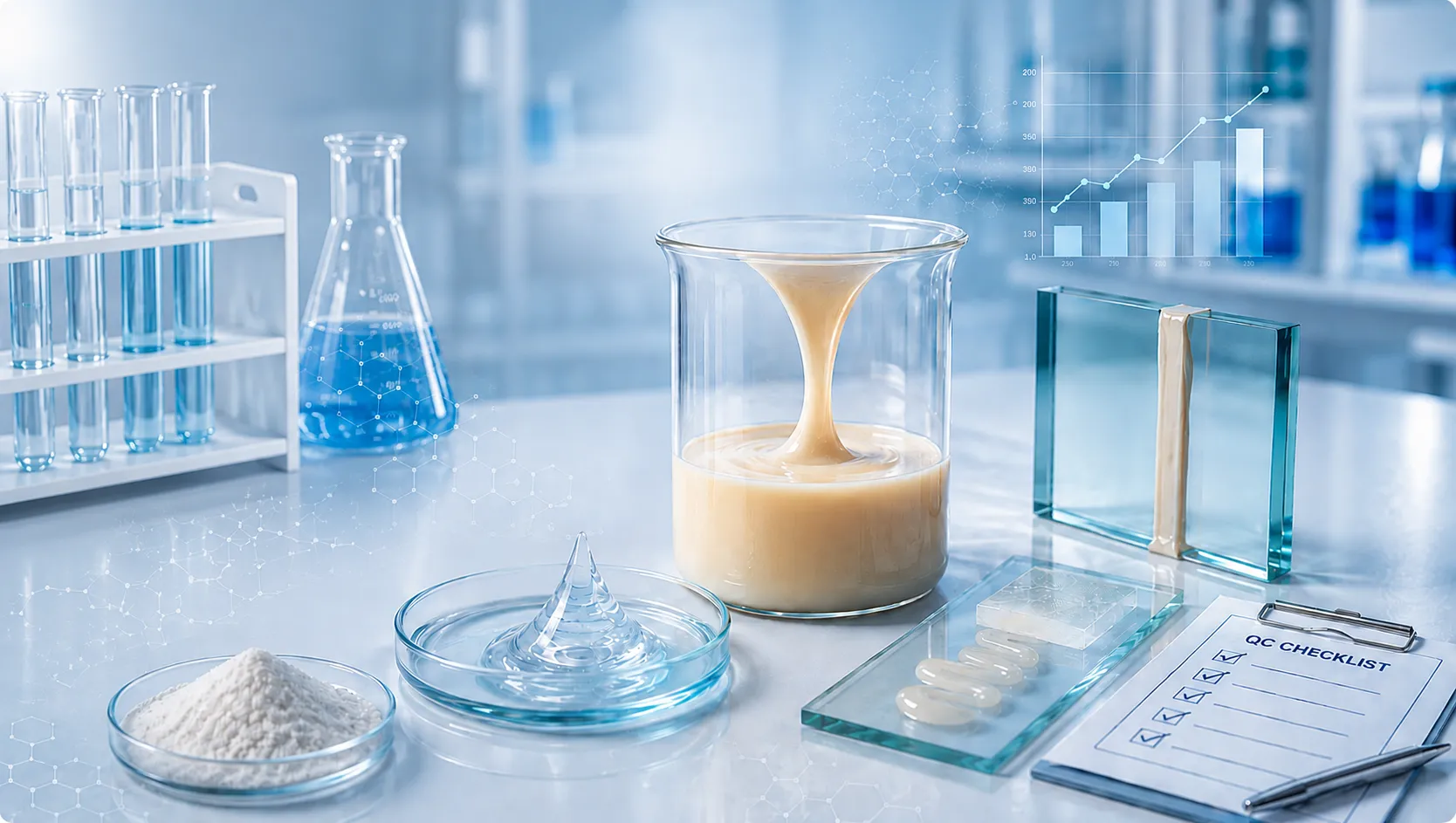
In adhesive manufacturing, laboratory testing supports raw-material verification, formulation control, process consistency, and final batch approval. Laboratory instruments for adhesive manufacturing are used to measure properties such as viscosity, moisture, dispersion, bond strength, cure behavior, thermal stability, density, and pot life.
For many routine QC laboratories, the core equipment includes a rotational viscometer, analytical balance, moisture-testing equipment, and mechanical testing capability. Additional instruments such as FTIR, rheometers, DSC, TGA, and environmental chambers become important when the formulation, application, or development program requires deeper chemical, rheological, thermal, or durability characterization.
Modern adhesive production spans multiple chemistries, including epoxies, polyurethanes, silicones, hot melts, and water-based systems. The appropriate laboratory configuration therefore depends on the adhesive chemistry, production stage, end-use application, required tests, and expected sample throughput.
What Laboratory Instruments Are Used in Adhesive Manufacturing?
Laboratory instruments for adhesive manufacturing are used to measure, verify, and document the properties of raw materials, intermediate mixtures, and finished adhesives. Common equipment includes viscometers, rheometers, universal testing machines, thermal analyzers, moisture-testing instruments, FTIR spectrometers, density instruments, and analytical balances.
The required equipment depends on what the manufacturer needs to control. Routine production QC may focus on viscosity, moisture, density, solids, and bond strength, while R&D and advanced troubleshooting may require detailed rheological, chemical, thermal, and environmental analysis.
Main Testing Requirements for Adhesive Manufacturing
Adhesive manufacturing requires multiple quality-control measurements rather than a single final test. Laboratories may need to verify raw-material identity and condition, monitor resin and hardener mixing, assess application behavior, measure bond strength after curing, and evaluate durability under relevant environmental conditions.
The main testing categories include:
- Rheological Testing: Viscosity, thixotropy, yield behavior, and flow characteristics that influence mixing and application.
- Mechanical Testing: Lap-shear, peel, tensile, and other strength measurements used to evaluate cured adhesive joints.
- Thermal Analysis: Glass transition behavior, cure characteristics, and thermal stability.
- Chemical Analysis: Raw-material identification, moisture determination, and formulation-related chemical checks.
- Physical Testing: Density, solids, dispersion quality, and pot life.
- Environmental Testing: Evaluation of bond durability after exposure to heat, humidity, water, salt spray, UV, or other application-relevant conditions.
For standardized adhesion testing, methods such as ISO 4587 and ASTM D1002 may be relevant depending on the substrate, joint configuration, and application. The applicable test method should be confirmed for the specific adhesive system and customer requirement.
Adhesive Quality Control Workflow
A structured QC workflow connects each production stage with the tests needed to detect formulation or processing deviations. The following sequence shows how common laboratory instruments fit into adhesive manufacturing from incoming-material inspection through final performance evaluation.
Raw Material Verification
Incoming resins, hardeners, fillers, solvents, and other formulation components should be checked against the manufacturer’s approved specifications and documentation. Liquid components may require viscosity testing, while moisture-sensitive materials may require direct moisture determination. FTIR can support chemical fingerprint comparison when raw-material identity verification is part of the laboratory procedure.
Important QC checks: Viscosity, moisture content, FTIR match, acid value, amine value.
Recommended laboratory equipment:
- Rotational viscometer
- Karl Fischer titrator
- FTIR spectrometer
- Analytical balance
- Moisture analyzer




Blending and Dispersion Control
After mixing, the adhesive should be checked for batch consistency and, where fillers or pigments are present, adequate dispersion. A grind gauge can reveal coarse particles or agglomerates in suitable filled systems. Viscosity testing helps confirm that the blend remains within the required processing and application condition, while density and solids measurements can provide additional batch-control information.
Important QC checks: Viscosity, grind, density, solid content.
Recommended laboratory equipment:
- Rotational viscometer with temperature control
- Grind gauge
- Density meter or pycnometer
- Halogen moisture analyzer or oven

Rheological Behavior Testing
Adhesive application performance can depend on how viscosity changes with shear, time, and temperature. This is especially important for products that must pump, dispense, coat, resist sagging, or recover viscosity after application.
A rotational viscometer is often sufficient for routine viscosity QC when the measurement method and conditions are well defined. A rheometer is more appropriate when the laboratory needs detailed flow curves, yield behavior, thixotropic recovery, or controlled shear and temperature studies.
Important QC checks: Viscosity curve, yield stress, thixotropic behavior.
Recommended laboratory equipment:
- Rheometer with temperature stage
- Rotational viscometer with multiple spindles
- Temperature-control accessories appropriate to the test method
Adhesion and Mechanical Strength Testing
Cured adhesive joints are tested to determine whether the bond provides the required mechanical performance. Depending on the product and application, the laboratory may measure lap-shear, peel, tensile, or related mechanical properties.
A universal testing machine equipped with suitable grips, fixtures, and load measurement capability is the central instrument for many of these tests. Consistent specimen preparation, bond-line geometry, cure conditions, and conditioning are important because these factors can materially affect the measured result.
Important QC checks: Lap-shear strength, peel strength, tensile strength, elongation at break where applicable.
Recommended laboratory equipment:
- Universal testing machine
- Climate chamber for conditioning
- Depth micrometer
- Bonding jigs and fixtures
Curing and Thermal Analysis
Thermal analysis helps laboratories investigate whether a reactive adhesive has reached the intended cure state and how the material behaves as temperature changes. Differential scanning calorimetry (DSC) can be used to study thermal transitions and cure-related behavior. Thermogravimetric analysis (TGA) can support evaluation of mass changes during heating and provide formulation or thermal-degradation information.
These instruments are particularly valuable for R&D, formulation comparison, troubleshooting, and advanced quality investigations. They may not be required for every routine production QC laboratory.
Important QC checks: Tg, degree of cure, onset temperature, residual weight.
Recommended laboratory equipment:
- Differential scanning calorimeter (DSC)
- Thermogravimetric analyzer (TGA)
- Ovens for aging tests

Final Product Performance Testing
Final adhesive qualification may extend beyond initial viscosity and bond-strength measurements. Depending on the intended service environment, bonded specimens can be conditioned or exposed to water, humidity, temperature, salt spray, UV, or other relevant stresses before mechanical performance is reassessed.
The objective is to determine whether the adhesive maintains acceptable performance after the environmental exposure defined for the product or application.
Important QC checks: Bond durability after environmental exposure, viscosity stability, pot life.
Recommended laboratory equipment:
- Environmental chamber
- Salt spray cabinet
- UV weathering tester
- Rotational viscometer
Key Quality Control Tests for Adhesive Manufacturing
| Quality Control Test | Purpose | Common Laboratory Equipment | Relevant Product Types / Applications |
|---|---|---|---|
| Viscosity Measurement | Control application flow and mixing consistency | Rotational viscometer, rheometer | Hot melts, epoxies, water-based adhesives, and other liquid or semi-liquid systems |
| Moisture Content | Control moisture where it can affect formulation, storage, or reaction behavior | Karl Fischer titrator, moisture analyzer | Moisture-sensitive adhesive systems and raw materials |
| FTIR Identification | Support raw-material identity verification and chemical comparison | FTIR spectrometer | Resins, hardeners, and other materials where fingerprint comparison is applicable |
| Lap-Shear Strength | Evaluate adhesive-joint performance under shear loading | Universal testing machine, bonding jigs | Structural adhesives and bonded assemblies |
| Peel Strength | Evaluate resistance to peeling forces in suitable bonded constructions | Universal testing machine, peel fixtures | Pressure-sensitive adhesives, laminates, and flexible bonded materials |
| Differential Scanning Calorimetry | Study thermal transitions and cure-related behavior | Differential scanning calorimeter | Thermoset and other reactive adhesive systems where thermal characterization is required |
| Grind / Fineness of Grind | Check dispersion and identify coarse agglomerates in suitable filled systems | Grind gauge (Hegman) | Filled adhesives, sealants, and pastes |
| Density | Support batch consistency and formulation control | Density meter, pycnometer | Liquid and semi-liquid adhesive formulations |
| Pot Life | Determine usable working time after components are mixed | Timing device, rotational viscometer where viscosity change is the defined endpoint | Two-component and other reactive systems |
| Thermal Stability (TGA) | Evaluate mass changes during heating and support thermal/formulation characterization | Thermogravimetric analyzer | Filled or high-temperature systems requiring advanced thermal analysis |
Recommended Laboratory Equipment for Adhesive Manufacturing
| Laboratory Equipment | Main Application | Why It Matters |
|---|---|---|
| Rotational Viscometer | Routine viscosity measurement of raw materials and adhesive blends | Provides a practical control point for flow behavior and batch consistency |
| Rheometer | Detailed rheological profiling | Supports analysis of shear-dependent flow, yield behavior, and thixotropy when single-point viscosity is insufficient |
| Karl Fischer Titrator | Moisture determination | Provides specific moisture measurement for materials and formulations where water content must be controlled |
| FTIR Spectrometer | Chemical identification and comparison | Supports raw-material fingerprinting, comparison, and troubleshooting |
| Universal Testing Machine | Lap-shear, peel, tensile, and related mechanical testing | Quantifies mechanical performance of adhesive joints using suitable fixtures and test methods |
| Differential Scanning Calorimeter (DSC) | Thermal transitions and cure analysis | Supports formulation development, cure investigation, and thermal characterization |
| Thermogravimetric Analyzer (TGA) | Thermal mass-loss and formulation-related analysis | Provides advanced information on material behavior during controlled heating |
| Grind Gauge | Fineness of grind in suitable filled or pigmented systems | Helps identify coarse particles and dispersion problems |
| Climate Chamber | Specimen conditioning and environmental exposure | Provides controlled conditions for reproducible testing and durability studies |
| Analytical Balance | Precise weighing of ingredients and test samples | Supports formulation preparation and quantitative laboratory procedures |
| Moisture Analyzer (Halogen) | Rapid moisture or solids-related process checks where the method is suitable | Provides a practical in-process measurement for appropriate formulations |
| Density Meter | Density measurement of liquids | Provides another measurable parameter for formulation and batch consistency |
Basic QC Laboratory vs Advanced Adhesive Testing Laboratory
Not every adhesive manufacturer requires the same level of instrumentation. Equipment should be selected according to the tests that actually control product quality rather than by building the largest possible instrument list.
A routine production QC laboratory may prioritize an analytical balance, rotational viscometer, appropriate moisture-testing equipment, density or solids measurement, and access to mechanical testing where bond strength is a release criterion. This configuration focuses on repeatable measurements that can identify production deviations quickly.
An advanced QC or R&D laboratory may add a rheometer, FTIR spectrometer, DSC, TGA, environmental chambers, and specialized mechanical fixtures. These instruments are more appropriate when the laboratory develops formulations, investigates failures, studies cure behavior, compares raw materials, or evaluates performance under multiple service conditions.
The decision to add advanced equipment should therefore be based on the adhesive chemistry, required methods, frequency of testing, troubleshooting needs, and whether the laboratory performs routine release testing or deeper material characterization.
How to Choose Laboratory Equipment for Adhesive Manufacturing
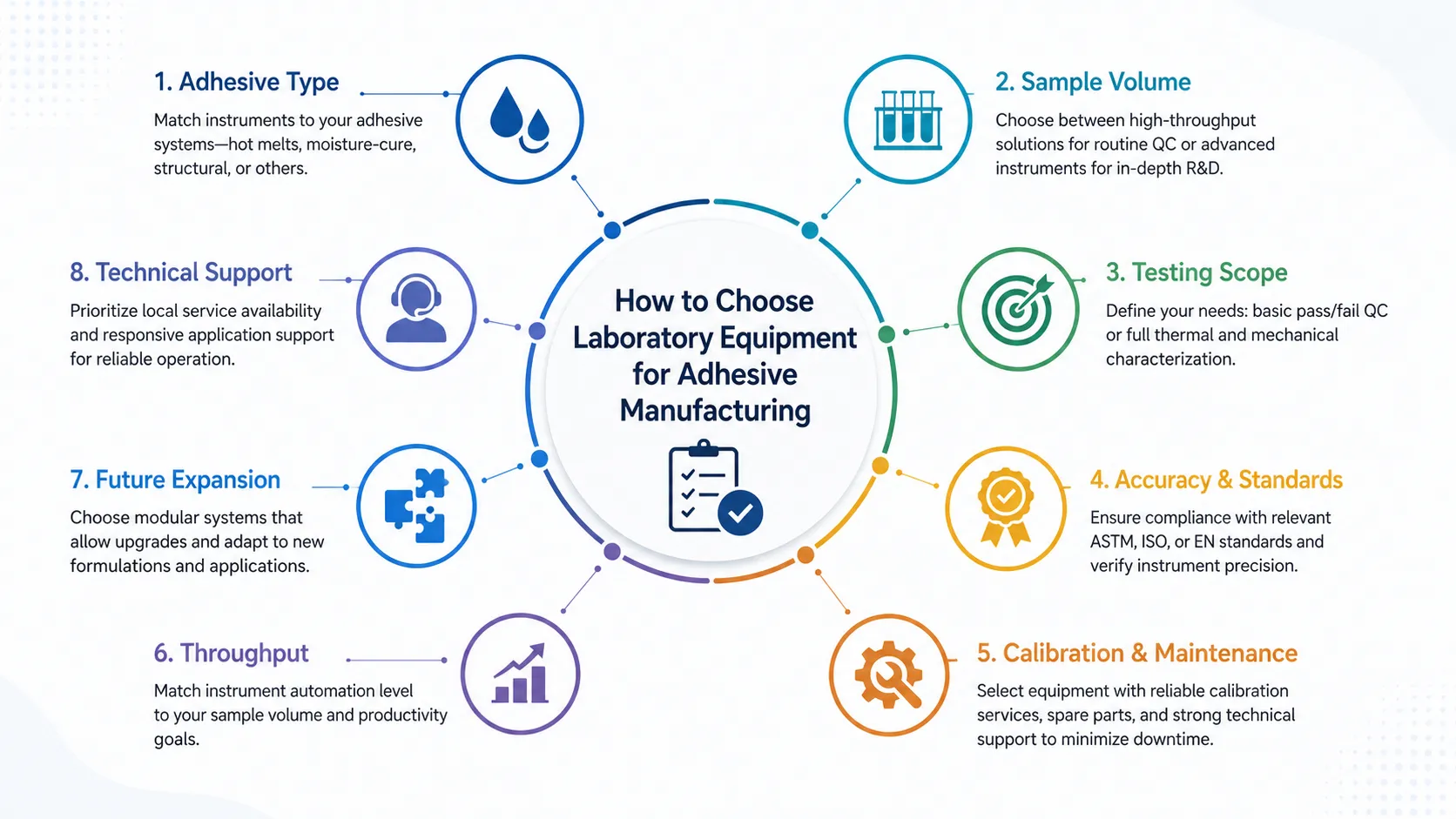
Selecting laboratory equipment starts with the adhesive systems being produced and the QC decisions the laboratory must make. Instead of selecting instruments by name alone, define the required test, sample condition, measurement method, throughput, and applicable standard first.
Consider these factors:
- Adhesive Type: Equipment requirements vary between hot melts, water-based adhesives, reactive two-component systems, moisture-sensitive formulations, and other adhesive chemistries.
- Routine QC vs Advanced Analysis: A rotational viscometer may be sufficient for a defined routine viscosity check, while a rheometer is justified when detailed shear-dependent or time-dependent behavior must be characterized.
- Sample Volume and Throughput: Frequent production measurements may favor faster, repeatable QC methods, while lower-volume R&D work may justify more flexible analytical instruments.
- Testing Scope: Determine whether the laboratory needs incoming inspection, in-process QC, finished-product release testing, formulation development, failure analysis, or a combination of these functions.
- Measurement Requirements: Confirm that the instrument is suitable for the expected sample properties, measurement conditions, required accuracy, and applicable test method before purchase.
- Standards and Customer Methods: Identify the ASTM, ISO, EN, customer, or internal methods that actually apply to the adhesive and substrate system, then select equipment and fixtures capable of supporting those methods.
- Calibration and Maintenance: Consider calibration requirements, service access, consumables, spare parts, and routine maintenance because instrument availability affects the reliability of the QC workflow.
- Sample Preparation and Fixtures: Mechanical test results depend on more than the testing machine. Suitable grips, bonding fixtures, specimen preparation, conditioning, and dimensional measurement should be considered as part of the laboratory setup.
- Future Expansion: Where future formulations or methods are expected, modular equipment can provide a practical path for adding fixtures, sensors, temperature control, or other capabilities later.
- Technical Support: Application and method support can be important for rheological, thermal, mechanical, and analytical instruments where correct method development affects the usefulness of the results.
Frequently Asked Questions
What are the most critical laboratory instruments for adhesive manufacturing?
For many adhesive QC laboratories, the most important instruments are a rotational viscometer for routine viscosity control, an analytical balance for accurate sample preparation, suitable moisture-testing equipment, and a universal testing machine when bond strength is a release requirement. FTIR, rheometers, DSC, TGA, and environmental chambers are added when more advanced chemical, rheological, thermal, or durability analysis is required.
Which instrument measures adhesive viscosity?
A rotational viscometer is commonly used for routine adhesive viscosity measurements. A rheometer is more appropriate when the laboratory needs detailed flow curves, controlled shear-rate testing, yield behavior, thixotropy, or other advanced rheological information. Temperature control should be selected according to the adhesive and test method.
How is adhesion strength tested in the laboratory?
Adhesion strength is typically evaluated with a universal testing machine and the fixture required for the selected joint and loading mode. Lap-shear and peel are common examples. Standards such as ASTM D1002, ASTM D3163, or ISO 4587 may apply to particular substrate and joint configurations, so the correct method should be confirmed for the adhesive application.
What is the role of thermal analysis in adhesive QC?
Thermal analysis is used when the laboratory needs information about cure behavior, thermal transitions, or material response during heating. DSC can support investigation of glass transition and cure-related behavior, while TGA measures mass change during controlled heating. These techniques are particularly useful in R&D, formulation comparison, and advanced troubleshooting.
What equipment is needed for raw material testing?
The required raw-material equipment depends on the materials being received and the properties that must be verified. Common instruments include a rotational viscometer for liquid components, a Karl Fischer titrator or other appropriate moisture method for moisture-sensitive materials, an FTIR spectrometer for chemical fingerprint comparison, and an analytical balance for quantitative laboratory procedures. Filled or pigmented systems may also require dispersion checks during formulation and blending.
How to choose a viscometer for adhesive testing?
Start with the adhesive’s expected viscosity, test temperature, sample volume, and required measurement method. A rotational viscometer is often suitable for repeatable routine QC measurements, while a rheometer is preferable when detailed shear-dependent or time-dependent behavior must be characterized. For heated products such as hot melts, the measurement system must also provide appropriate temperature control. If a standard such as ISO 2555 is specified for the product, confirm that the selected instrument and measurement configuration support the required method.
Conclusion
The right adhesive manufacturing laboratory is built around the tests that control product quality, not simply around the largest possible equipment list. Routine QC typically begins with reliable weighing, viscosity, moisture or solids-related measurements, and the mechanical tests required for product release. More advanced instruments such as FTIR, rheometers, DSC, TGA, and environmental chambers become valuable when manufacturers need formulation development, deeper material characterization, failure investigation, or durability studies.
Before selecting equipment, map each production stage to the required QC decision: identify what must be measured, why the measurement matters, which method applies, how frequently samples will be tested, and which instrument can perform that method reliably. This test-to-equipment approach helps create a laboratory configuration that supports both current production requirements and future adhesive development.