Laboratory Equipment for Pulp and Paper Mills Overview
Effective quality control in pulp and paper production depends on selecting appropriate laboratory equipment for pulp and paper mills. A typical mill laboratory may require equipment for pulp consistency and freeness testing, paper strength testing, grammage and thickness measurement, moisture analysis, optical testing, and basic chemical analysis.
The exact laboratory configuration depends on the raw materials, pulp type, paper or board grades, required test methods, sample volume, and customer quality specifications. Matching each quality-control requirement to the appropriate test and instrument helps mills monitor process stability, identify deviations, reduce avoidable waste, and maintain consistent finished-product quality.
What Is Laboratory Equipment for Pulp and Paper Mills?
Laboratory equipment for pulp and paper mills includes specialized instruments used to evaluate fibrous raw materials, pulp slurries, paper sheets, and board products. Depending on the production stage and product grade, laboratories may measure physical strength, optical properties, moisture, pulp drainage behavior, fiber concentration, and chemical properties.
Common instruments include tensile testers, burst testers, tear testers, moisture analyzers, freeness testers, brightness meters, consistency testing equipment, thickness gauges, balances, and pH meters. The purpose of the laboratory is not simply to collect test results: the data should help operators evaluate incoming materials, monitor the manufacturing process, verify finished products, and investigate quality deviations.
Main Testing Requirements for Pulp and Paper Mills
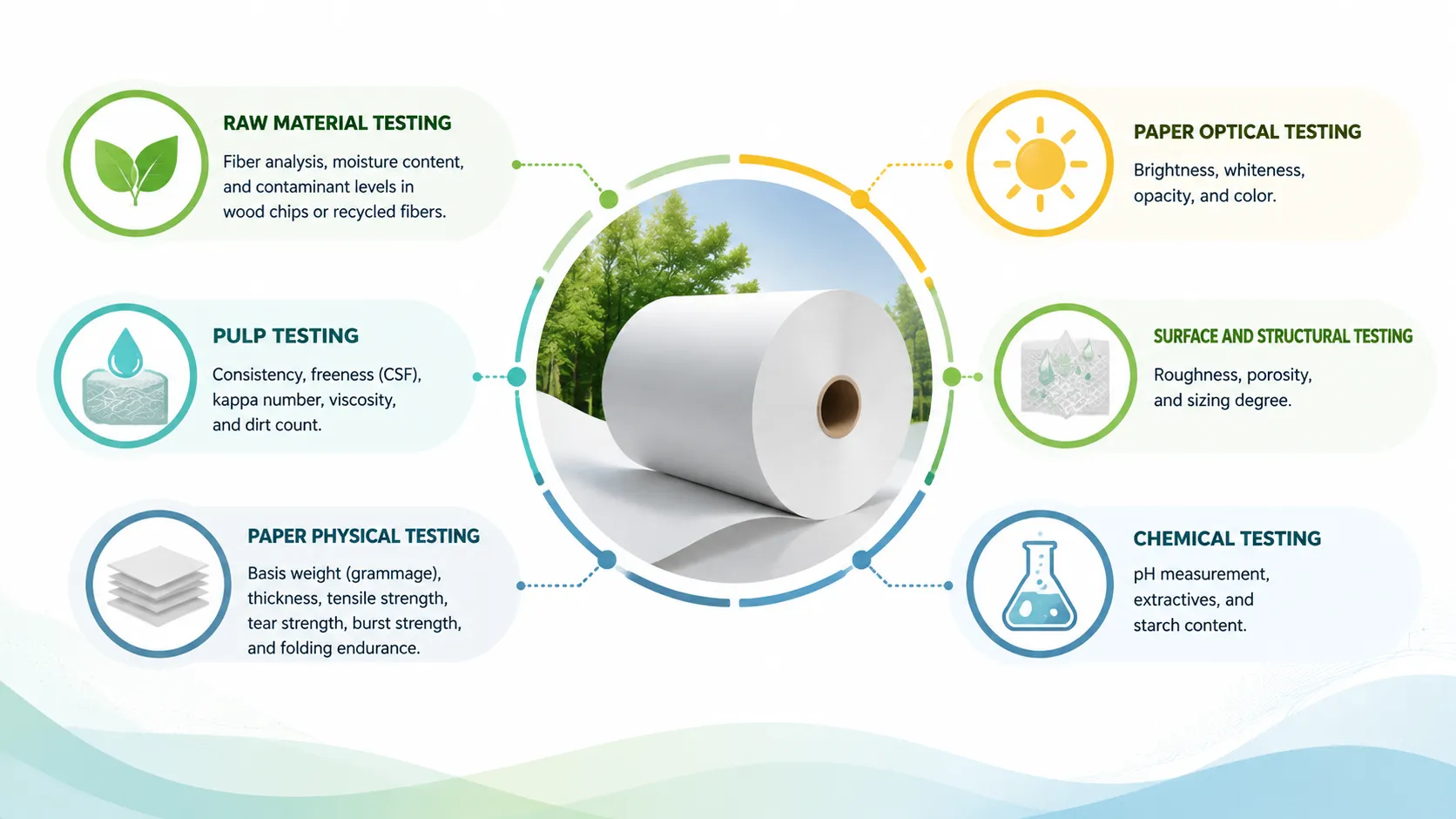
Quality control requirements vary by mill and product grade, but the main testing areas typically include:
- Raw Material Testing: Fiber characteristics, moisture content, and contaminants in materials such as wood chips or recycled fibers.
- Pulp Testing: Consistency, freeness (CSF), kappa number, viscosity, and dirt count where relevant to the pulp and process.
- Paper Physical Testing: Basis weight (grammage), thickness, tensile strength, tear strength, burst strength, and folding endurance.
- Paper Optical Testing: Brightness, whiteness, opacity, and color.
- Surface and Structural Testing: Roughness, porosity, and sizing degree where these properties affect the finished grade.
- Chemical Testing: pH measurement, extractives, starch content, and other application-specific chemical checks.
Each mill should define its test program according to its products, process-control requirements, customer specifications, and applicable test methods. Instruments should then be selected and calibrated for those required methods rather than purchasing equipment solely from a generic laboratory list.
Quality Control Workflow for Pulp and Paper Mills
A structured quality-control workflow helps ensure that laboratory results are representative, repeatable, and useful for production decisions. A typical paper testing laboratory moves through sample collection, identification, conditioning or preparation, testing, data analysis, and reporting. For physical paper testing, consistent sample conditioning is particularly important because changes in temperature and relative humidity can affect paper properties.
Sample Collection and Identification
Representative samples are collected from incoming materials, process streams, or finished production. Sampling location, production lot, collection time, and sample identity should be recorded so laboratory results can be traced back to the relevant process or product.
Recommended equipment and supplies:
- Sample bags and moisture-proof containers
- Automated sampling devices where appropriate
- Label printers or barcode scanners
Sample Conditioning
Paper and board samples are conditioned in a controlled environment before physical testing so moisture-related variation does not unnecessarily distort comparisons. Standards such as ISO 187 specify 23°C ± 1°C and 50% ± 2% relative humidity. Conditioning rooms or cabinets are therefore important where standardized paper testing is required.
Recommended equipment:
- Climate control chamber or conditioning cabinet
- Thermohygrometer for environmental monitoring
Physical and Optical Property Testing
This stage covers many of the routine tests used to evaluate finished paper and board. Samples may first be prepared with appropriate cutters and then evaluated for properties such as tensile strength, burst strength, tear resistance, thickness, grammage, brightness, or color.
The required instruments depend on the properties specified for the product grade. For example, tensile testing evaluates the behavior of a prepared strip under tensile loading, while burst and tear tests assess different failure modes and therefore require dedicated test equipment.
Recommended equipment:
- Automatic tensile tester
- Mullen burst tester
- Elmendorf tear tester
- Brightness and color tester
- Micrometer for thickness
- Grammage scale and cutter
Pulp and Chemical Testing
Pulp-process laboratories may need to monitor properties such as consistency and freeness in addition to chemical measurements such as pH, conductivity, or kappa number. The required tests depend on the pulp type and the process being controlled.
Recommended equipment:
- Consistency testing equipment
- Canadian Standard Freeness tester
- pH meter
- Conductivity meter
- Kappa number analyzer
- Laboratory balance
- Oven for moisture or solids determination


Data Recording and Compliance Reporting
Test results should be recorded in a consistent system so the laboratory can compare batches, identify trends, investigate deviations, and support internal or customer reporting. Depending on the laboratory, this may involve laboratory information management systems (LIMS), instrument software, or controlled spreadsheets. Statistical process control (SPC) can also help identify changes in process performance over time.
Recommended equipment:
- LIMS software
- Data acquisition interfaces for instruments
- Computers and printers
Key Quality Control Tests for Pulp and Paper
The following table makes the relationship between the quality requirement, test purpose, instrument, and application explicit.
| Quality Control Test | Purpose | Common Laboratory Equipment | Relevant Product Types / Applications |
|---|---|---|---|
| Moisture Content | Determines water content in pulp or paper | Moisture analyzer, oven, balance | Pulp, paper, board |
| Basis Weight (Grammage) | Measures mass per unit area | Analytical balance, grammage cutter | Paper, board |
| Thickness (Caliper) | Measures single sheet thickness | Micrometer or automatic thickness gauge | Paper, board |
| Tensile Strength | Evaluates breaking force and stretch | Tensile tester | Paper, board |
| Bursting Strength | Measures pressure required to rupture | Mullen burst tester | Paper, board, packaging |
| Tear Resistance | Assesses force to continue tearing | Elmendorf tear tester | Paper, board |
| Folding Endurance | Determines double folds before failure | Folding endurance tester (Schopper, MIT) | Paper, specialty papers |
| Brightness / Whiteness | Measures optical reflectance | Brightness tester, spectrophotometer | Bleached pulp, paper |
| Pulp Consistency | Determines fiber concentration | Consistency meter, centrifuge | Pulp slurry |
| Freeness (CSF) | Measures drainage rate of pulp | Canadian Standard Freeness tester | Mechanical and chemical pulps |
Recommended Laboratory Equipment for Pulp and Paper Mill Laboratories
Not every mill needs every instrument on the same priority level. Equipment should be selected according to the mill’s product grades and required QC tests. For many laboratories, routine physical-property, moisture, grammage, thickness, and basic pulp/process measurements form the core setup, while specialized optical, folding, or chemical analysis equipment is added where the product or process requires it.
| Laboratory Equipment | Main Application | Why It Matters |
|---|---|---|
| Tensile Tester | Measures tensile strength and elongation of paper strips | Supports strength evaluation for paper and board applications |
| Mullen Burst Tester | Tests resistance to bursting pressure | Provides burst-strength data for applicable paper, board, and packaging grades |
| Elmendorf Tear Tester | Evaluates tear resistance | Helps assess resistance to continued tearing during converting or use |
| Grammage Cutter and Balance | Measures basis weight | Supports sheet classification and routine process control |
| Thickness Micrometer | Measures sheet caliper | Provides thickness data used in product and process evaluation |
| Brightness Tester | Measures brightness | Supports optical quality control for applicable pulp and paper grades |
| Moisture Analyzer | Determines moisture content | Helps monitor moisture-related variation in pulp, paper, and board |
| Freeness Tester (CSF) | Measures pulp drainability | Provides pulp drainage information for process evaluation |
| Consistency Meter | Determines fiber concentration in pulp slurry | Supports stock preparation and process consistency control |
| Folding Endurance Tester | Assesses resistance to repeated folding | Useful where folding durability is an important product requirement |
| pH Meter | Measures pH of relevant samples or paper extracts | Supports chemical quality-control measurements where pH is specified |
| Oven / Forced Air Dryer | Determines solids or moisture by drying | Supports gravimetric moisture or solids determination |
Basic vs Application-Specific Pulp and Paper Laboratory Equipment
A practical equipment plan should separate instruments needed for frequent routine QC from equipment required only for particular pulp processes or paper grades.
Core routine equipment may include balances, grammage cutters, thickness gauges, moisture-testing equipment, tensile testers, and other physical-property instruments required by the mill’s finished-product specifications.
Application-specific equipment may include freeness and consistency equipment for pulp-process control, brightness or color instruments for optical requirements, folding endurance testers for grades where repeated folding matters, and additional chemical testing instruments where those measurements are part of the mill’s quality plan.
This approach helps buyers prioritize equipment according to actual test frequency and product requirements rather than treating a long equipment list as a universal laboratory specification.
How to Choose Laboratory Equipment for Pulp and Paper Mills
Start equipment selection with the tests the laboratory must perform, not with a list of available instruments. A useful selection process is to identify the product grades and process stages being controlled, define the required test methods, and then map each test to the appropriate instrument type.
Important selection factors include:
- Required tests: Identify which measurements are mandatory for incoming materials, pulp-process control, and finished products.
- Applicable test methods: Confirm that the selected instrument configuration is suitable for the ISO, TAPPI, customer, or internal methods the laboratory actually uses.
- Sample throughput: Consider how many samples must be tested per shift or day and whether manual or more automated operation is appropriate.
- Repeatability and measurement requirements: Select equipment according to the performance needed by the applicable method and internal QC procedure.
- Sample preparation: Include the cutters, balances, conditioning equipment, and other preparation tools required to obtain reliable test specimens.
- Data handling: For higher-throughput laboratories, consider whether instrument data export or integration with existing reporting systems is needed.
- Calibration and maintenance: Evaluate routine verification, calibration, service requirements, and access to appropriate spare parts.
- Future requirements: Consider whether product-grade changes or additional tests are likely to require expanded laboratory capability.
AELAB provides laboratory instruments for pulp and paper quality-control applications. When comparing equipment, buyers should provide the product or pulp type, required tests, applicable methods, and expected sample volume so the instrument selection can be matched to the actual laboratory workflow.
Frequently Asked Questions
What are the essential laboratory instruments for a paper mill laboratory?
A typical paper mill lab requires a tensile tester, burst tester, tear tester, grammage scale and cutter, thickness gauge, moisture analyzer, and brightness tester. Depending on the mill’s product range, a freeness tester, consistency meter, fold tester, and pH meter may also be essential.
How do I measure pulp consistency in the laboratory?
Pulp consistency is measured by taking a known volume or weight of pulp slurry, filtering it, drying the fibers, and weighing the dry mass. Automated consistency meters and laboratory centrifuges can speed up this process, providing rapid results for process adjustments.
What standard tests are used for paper strength evaluation?
Common strength tests include tensile strength (ISO 1924, TAPPI T494), bursting strength (ISO 2758, TAPPI T403), tear resistance (ISO 1974, TAPPI T414), and folding endurance (ISO 5626, TAPPI T511). Each test provides specific insights into paper performance under different stresses.
Why is sample conditioning important before paper testing?
Paper and board are hygroscopic materials; their physical properties change with moisture content. Conditioning samples at standard temperature and humidity (23°C, 50% RH) ensures reproducibility and comparability of test results across different laboratories and time periods.
How often should laboratory equipment be calibrated in a pulp and paper mill?
Calibration frequency depends on equipment usage, manufacturer recommendations, and internal quality procedures. High-usage devices like balances and tensile testers may require daily verification, while other instruments may be calibrated monthly or quarterly. Regular calibration traceable to national standards is critical.
Can one device measure multiple paper properties?
While some devices are multi-purpose (e.g., automated sheet testers can measure grammage, thickness, and smoothness in sequence), most specialized tests require dedicated instruments for accurate and standard-compliant results. For example, a tensile tester is not suitable for burst testing, and so on.
Conclusion
The right pulp and paper laboratory is defined by the tests the mill actually needs to perform. Core physical, moisture, grammage, and thickness measurements may form the basis of routine QC, while pulp-process, optical, folding, and chemical testing equipment should be selected according to the mill’s materials, processes, product grades, and applicable test methods.
Mapping each production or quality requirement to a defined test and then to the appropriate laboratory instrument creates a more practical equipment plan. It also helps mills prioritize routine equipment, plan for sample throughput and calibration, and expand laboratory capability as testing requirements change.