Packaging Performance Testing: Strength, Thickness and Barrier Analysis Overview
In the packaging, pulp, paper, printing and converting industries, packaging performance testing is critical for ensuring that materials and finished packages meet the rigorous demands of protection, handling and shelf life. From corrugated boxes to flexible films, the strength, thickness and barrier properties of packaging directly affect product safety and manufacturing efficiency. Laboratory testing provides objective data to control quality, optimize material usage and verify conformity to defined material and package specifications.
Whether developing new packaging structures or monitoring daily production, a systematic quality control workflow helps manufacturers connect packaging failure risks with the tests and instruments used to control them. This article covers mechanical strength, thickness and dimensional checks, barrier properties, seal integrity, laboratory setup and equipment-selection considerations for packaging quality control.
In practical terms: corrugated board and cartons typically require strength, compression and dimensional checks; flexible films and laminates commonly require tensile, thickness, barrier and seal testing; and finished packages may require leak, compression or integrity testing according to the package design and quality requirements.
Main Products and Applications
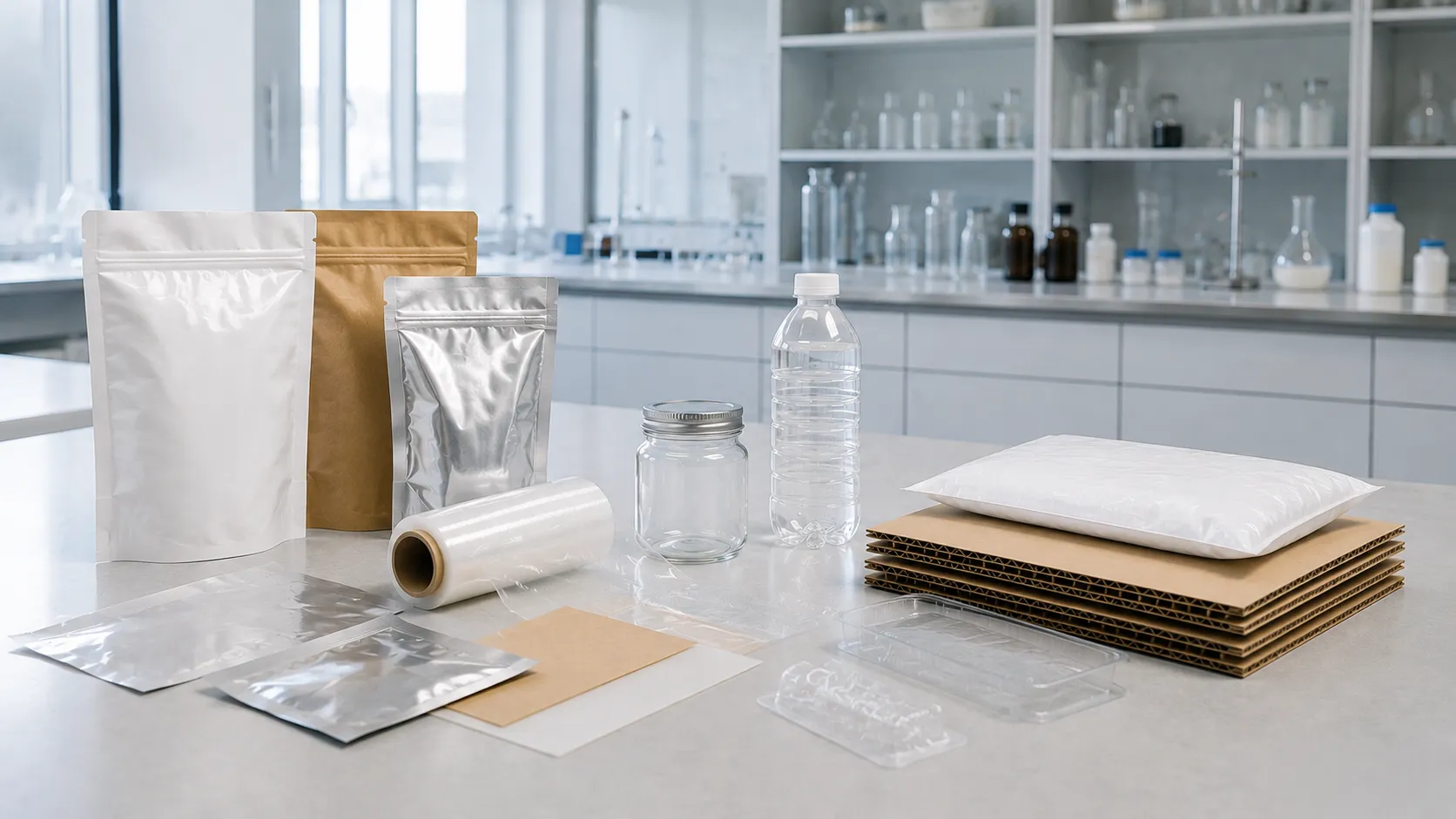
Packaging materials tested for performance include:
- Corrugated board and cartons – used for shipping containers and point-of-sale displays.
- Flexible packaging films – including polyethylene, polypropylene and multi-layer laminates for food, pharmaceutical and consumer goods.
- Paperboard cartons and folding boxes – for dry foods, cosmetics and healthcare products.
- Rigid plastic containers and bottles – for beverages, chemicals and personal care items.
- Labels, wraps and printing substrates – requiring adhesion and dimensional stability.
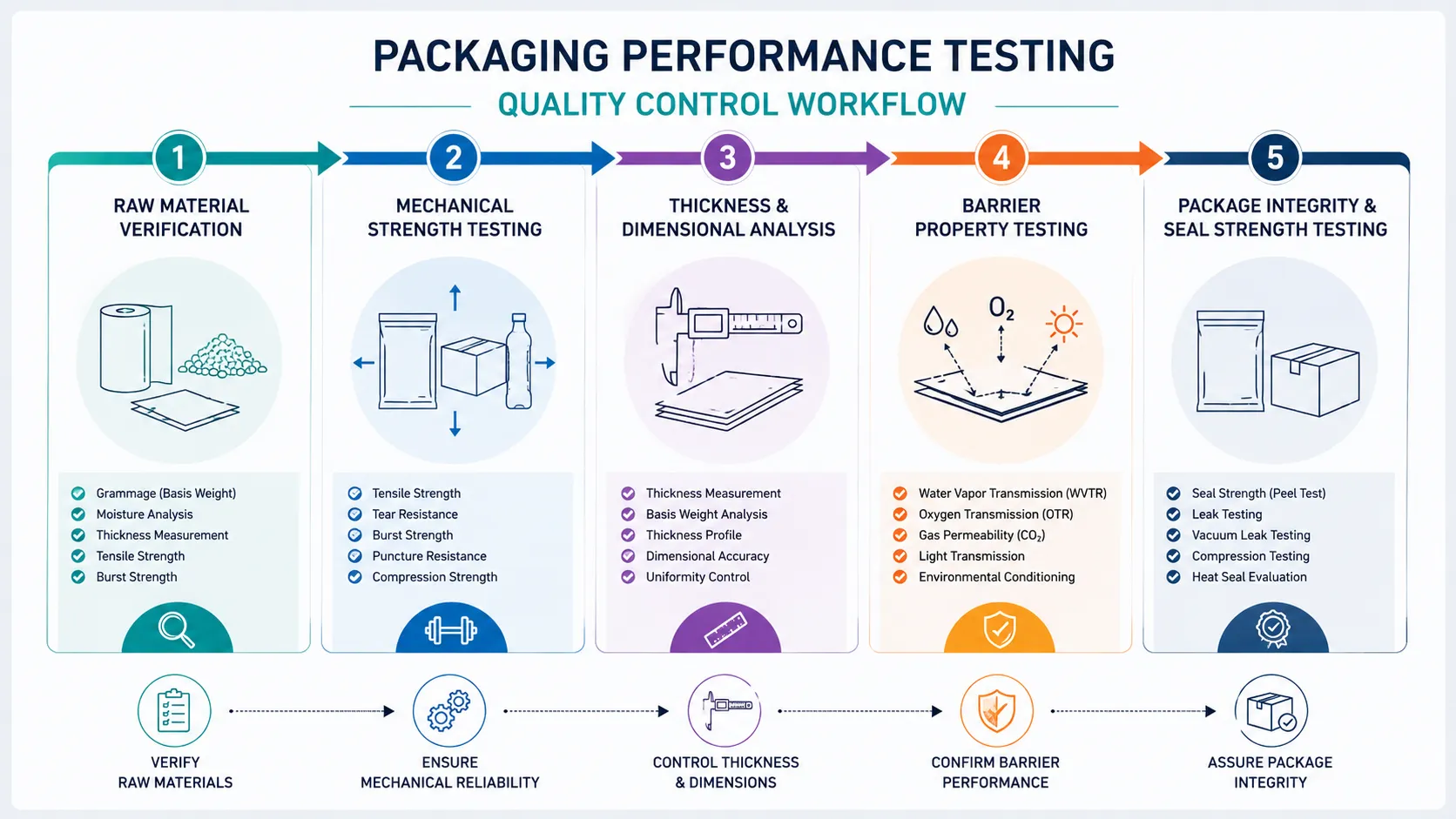
Packaging Performance Testing Quality Control Workflow
1. Raw Material Verification
Before manufacturing begins, incoming rolls, sheets or resin batches must be checked for conformance to specifications. Variations in grammage, moisture content or tensile strength can lead to poor converting performance or inconsistent end-product quality. Common defects include insufficient tear resistance, incorrect thickness or excessive moisture that causes curling or delamination.
Laboratory tests at this stage include grammage determination (basis weight), moisture analysis, tensile strength and thickness measurement. These results allow operators to reject non-conforming materials, adjust machine settings or blend batches for consistency. Early detection prevents downstream waste and ensures a stable manufacturing process.
Recommended laboratory equipment for this stage:
- Analytical Balance – Measures precise sample weight for grammage calculation, ensuring correct basis weight.
- Moisture Analyzer – Quantifies moisture content in paper, board or film, which affects processing and bonding.
- Thickness Gauge – Measures material thickness or caliper to verify conformance to specifications.
- Universal Testing Machine – Performs initial tensile strength tests on material samples to assess mechanical suitability.
- Burst Tester – Evaluates the bursting strength of paper or board to ensure resistance to pressure during converting.


2. Mechanical Strength Testing
Packaging must withstand forces during filling, handling, transport and storage. Mechanical tests quantify properties such as tensile strength, elongation, tear resistance and burst strength. Insufficient strength can lead to package rupture, tearing or collapse, compromising product protection and leading to customer complaints.
Testing includes tensile testing of films and paper, tear testing (Elmendorf tear for paper and board, trouser tear for films), burst testing for cartons and puncture resistance for rigid packaging. Results guide material selection, structural design and quality assurance decisions. Regular monitoring ensures that production parameters remain within acceptable limits.
Recommended laboratory equipment for this stage:
- Universal Testing Machine – Provides tensile, compression and peel strength data for a wide range of packaging materials.
- Tear Tester (Elmendorf) – Measures internal tearing resistance of paper, board and light-gauge films.
- Burst Tester – Determines bursting strength of paper, board and corrugated materials under hydrostatic pressure.
- Puncture Tester – Assesses resistance to penetration by a probe, simulating sharp object impact.
- Compression Tester – Evaluates crush resistance of finished boxes or containers to predict stacking performance.
3. Thickness and Dimensional Analysis
Uniform thickness is essential for reliable converting, printing registration and barrier performance. Variations can cause wrinkling, misfeeds in packaging lines, or uneven sealing. For multi-layer laminates, overall gauge uniformity is important, while layer-level construction may require additional analysis when the laminate design must be investigated in detail.
Testing involves direct thickness measurement using a micrometer or an automated thickness gauge, as well as basis weight analysis for indirect thickness assessment. For flexible films, the thickness gauge should be selected for the material range, required resolution and repeatability of the QC method. Dimensional checks for carton blanks or labels verify correct sizing after cutting and creasing. Data helps maintain tight process control and minimize material giveaway.
Recommended laboratory equipment for this stage:
- Thickness Gauge (Micrometer) – Measures absolute material thickness with high precision, essential for specification compliance.
- Analytical Balance – Determines basis weight by weighing a known area, which correlates to thickness for uniform materials.
- Profile Thickness Scanner – Automatically measures thickness across a sample to detect cross-web or cross-direction variations.
- Caliper Gauge – Checks thickness of rigid boards and sheets quickly during inline quality checks.
- Optical Measurement System – Verifies dimensional accuracy of carton and label dimensions, including cut and crease positions.
4. Barrier Property Testing
Many packaging applications require a barrier against moisture, oxygen, carbon dioxide or light to preserve product freshness, stability and safety. Inadequate barrier properties can shorten shelf life, cause spoilage or degrade product efficacy. Material substitutions or process changes must be validated through barrier testing.
Water vapor transmission rate (WVTR) and oxygen transmission rate (OTR) are the most common tests, conducted under controlled temperature and humidity. Light transmission can be measured using a spectrophotometer for photosensitive products. Test results guide laminate design, coating selection and quality assurance for high-barrier packaging. Regular testing ensures that production lots meet specified barrier levels.
Recommended laboratory equipment for this stage:
- Water Vapor Transmission Rate Tester (WVTR) – Measures moisture vapor permeability of films and finished packages.
- Oxygen Transmission Rate Tester (OTR) – Determines oxygen permeation rate through packaging materials.
- Gas Permeability Analyzer – Tests CO₂ or other gas transmission rates for specific product requirements.
- UV-Vis Spectrophotometer – Quantifies light transmission across the UV and visible spectrum to evaluate light barrier properties.
- Environmental Test Chamber – Maintains precise temperature and humidity conditions for conditioning and testing barrier samples.

5. Package Integrity and Seal Strength Testing
Finished packages must maintain seal integrity to prevent leakage, contamination or loss of function. Common failures include weak heat seals, pinholes or filling-line damage. For sterile or aseptic packaging applications, package-integrity requirements should be defined by the applicable product, process and quality system. Seal strength testing measures the force required to separate sealed layers, while leak testing detects hidden breaches.
Tests include seal strength (peel test) using a universal testing machine with appropriate grips, bubble leak testing for flexible pouches, or vacuum decay testing for rigid containers. Compression testing of filled cases ensures they can withstand stacking in warehouses. Test data supports seal parameter optimization and ongoing quality monitoring.
Recommended laboratory equipment for this stage:
- Universal Testing Machine (with peel fixtures) – Measures seal strength by separating films or closures at a controlled speed.
- Leak Tester (Bubble Test) – Submerges pressurized packages to detect leaks through visible bubble formation.
- Vacuum Leak Tester – Evaluates package integrity using a vacuum-based leak test method appropriate to the package and instrument configuration.
- Compression Tester – Applies top-load force to boxes, bottles or finished cases to simulate stacking conditions.
- Heat Seal Tester – Prepares standard seal samples for evaluating seal strength under defined time, temperature and pressure conditions.
Common Quality Control Challenges in Packaging Manufacturing
Manufacturers face a range of challenges that can compromise packaging performance and lead to rejected shipments or customer dissatisfaction. Understanding these issues helps focus laboratory testing on the most critical parameters:
- Variability in raw material properties from different suppliers or batches, leading to inconsistent converting and final product performance.
- Inadequate tensile or tear strength causing web breaks during printing, laminating or packaging machine operations.
- Poor thickness uniformity resulting in registration errors, wrinkling or uneven winding.
- Insufficient barrier properties allowing moisture or oxygen ingress, reducing product shelf life.
- Weak heat seals or package leaks that go undetected until after filling, leading to product waste and recalls.
- Stacking and transportation failures due to low compression resistance, damaging the packaged goods.
Key Quality Control Tests for Packaging Performance Testing
| Quality Challenge | Quality Control Test | Recommended Laboratory Equipment | Application |
|---|---|---|---|
| Raw material variability | Grammage, moisture, thickness, tensile strength | Analytical Balance, Moisture Analyzer, Thickness Gauge, Universal Testing Machine | Incoming material inspection |
| Web breaks during converting | Tensile strength, elongation, tear resistance | Universal Testing Machine, Tear Tester | Material qualification and process adjustment |
| Carton bursting during forming | Bursting strength | Burst Tester | Board grade selection and production monitoring |
| Thickness variation causing defects | Caliper / thickness measurement | Thickness Gauge, Profile Scanner | Process control and specification compliance |
| Moisture damage to packaged goods | Water vapor transmission rate (WVTR) | WVTR Tester | Barrier layer development and QA |
| Oxygen degradation of product | Oxygen transmission rate (OTR) | OTR Tester | High-barrier packaging verification |
| Light-induced spoilage or fading | Light transmission measurement | UV-Vis Spectrophotometer | Light-sensitive product packaging |
| Package leakage and seal failure | Seal strength, leak testing | Universal Testing Machine, Leak Tester | Finished package quality assurance |
Laboratory Equipment Required for Packaging Industry Quality Control
A comprehensive packaging testing laboratory integrates mechanical, dimensional and barrier test instruments to cover the full range of performance attributes. Core mechanical testers such as Universal Testing Machines and Burst Testers evaluate the strength and durability of materials, while thickness gauges and analytical balances ensure dimensional precision. For protective packaging, barrier testers for water vapor, oxygen and light transmission are essential for verifying functional performance.
Supporting equipment like environmental chambers, sample preparation tools and data management systems complete the workflow. The combination of these instrument categories allows manufacturers to correlate material properties with end-use performance, troubleshoot production issues and demonstrate compliance with industry standards. Below is a summary of typical testing requirements and the corresponding laboratory equipment.
| Testing Requirement | Laboratory Equipment | Why Manufacturers Need It |
|---|---|---|
| Tensile strength and elongation | Universal Testing Machine | Determines film and paper strength to avoid breakage during web processing and use. |
| Bursting strength | Burst Tester | Ensures cartons and board can withstand internal pressure without rupturing. |
| Tear resistance | Elmendorf Tear Tester | Measures resistance to tear propagation, critical for opened or handled packages. |
| Thickness / caliper | Thickness Gauge, Micrometer | Verifies material gauge to maintain converting consistency and barrier properties. |
| Moisture content | Moisture Analyzer | Controls moisture to reduce curling, dimensional instability and adhesion or converting issues. |
| Water vapor barrier | WVTR Tester | Confirms moisture barrier effectiveness for product shelf-life requirements. |
| Oxygen barrier | OTR Tester | Validates oxygen barrier for sensitive foods, pharmaceuticals or electronics. |
| Seal strength and package integrity | Universal Testing Machine (peel), Leak Tester | Measures seal strength and supports leak detection for finished-package integrity checks. |
These instruments, when deployed within a structured quality control framework, provide a complete picture of packaging performance from raw material to finished product. They enable data-driven decisions that improve productivity, reduce material costs and enhance customer satisfaction.
Basic Laboratory Setup for Packaging Manufacturers
The level of laboratory equipment investment depends on the packaging formats produced, the tests required for release or process control, expected sample volume and the depth of analysis needed. A phased approach allows manufacturers to start with high-frequency QC tests and add specialized barrier, dimensional or integrity instruments when the application justifies them.
| Laboratory Level | Recommended Equipment | Suitable For |
|---|---|---|
| Basic QC Laboratory | Thickness Gauge, Analytical Balance, Moisture Analyzer, Burst Tester, Universal Testing Machine (basic model) | Small-scale packaging converters needing to check incoming materials and basic strength properties. |
| Advanced QC Laboratory | All Basic equipment plus: Tear Tester, WVTR Tester, OTR Tester, Compression Tester, Environmental Chamber, Heat Seal Tester | Manufacturers of high-quality or barrier-sensitive packaging, serving food, pharma or industrial sectors. |
| Advanced Analysis Laboratory | All Advanced equipment plus: Profile Thickness Scanner, Optical Measurement System, Gas Permeability Analyzer, UV-Vis Spectrophotometer, Automatic sample preparation tools | R&D centers and large-scale producers requiring in-depth material characterization and new product development. |
How to Choose Laboratory Equipment for Packaging Performance Testing
Select packaging testing equipment by working from the package and failure mode back to the required test. Define the material or finished-package type, the property to measure, the expected sample volume, the measurement range and repeatability needed by your method, and the fixtures or sample preparation required. Then evaluate laboratory conditions, operator workflow, calibration and long-term service support.
Define the Testing Scope
Begin by listing the specific materials your facility handles—such as paper, film, board or laminates—and the performance attributes most critical for your products. Determine which properties must be measured: tensile strength, tear resistance, burst strength, thickness, WVTR, OTR, seal strength, etc. Consider the required measurement ranges and accuracies. For instance, a thin-film producer may prioritize thickness resolution and repeatability, while a corrugated plant may place more emphasis on board strength and case compression testing. Clarify whether testing is for raw material acceptance, process control or finished product release. This scope defines the instruments you need.
Evaluate Laboratory Workflow Requirements
Assess your expected testing volume and frequency. High-throughput QC labs may need automated or semi-automated equipment to keep pace with production, whereas R&D labs prioritize flexibility. Consider operator skill levels—some instruments require specialized training, while others offer intuitive interfaces. Evaluate laboratory space and environmental conditions; some barrier testers demand consistent temperature and humidity. Also plan for sample preparation: cutting, conditioning and fixturing can influence throughput. Choosing equipment that matches your workflow reduces bottlenecks and ensures reliable data.
Compare Long-Term Equipment Support
Beyond the initial purchase, consider calibration, maintenance, consumable availability and technical support. Instruments that are widely supported with spare parts and service networks minimize downtime. Verify that the equipment can be calibrated to traceable standards as required by your quality system. Training for operators and periodic maintenance contracts extend the useful life of the investment. Companies like AELAB can help match your testing requirements with appropriate instrument categories and provide guidance on building a sustainable laboratory program.
Who Needs Laboratory Testing Solutions for This Industry?
Laboratory testing solutions for packaging performance are essential for organizations involved in:
- Manufacturers of corrugated board, cartons and cases requiring burst, compression and dimensional checks.
- Producers of flexible packaging films and laminates needing tensile, thickness and barrier analysis.
- Quality control laboratories within packaging converting plants aiming to reduce waste and ensure consistent output.
- R&D departments developing new packaging structures or validating alternative materials.
- Food, pharmaceutical and consumer goods companies performing incoming packaging material verification to protect product integrity.
Frequently Asked Questions
What are the most critical tests for corrugated box quality?
The most critical tests include bursting strength to assess board’s ability to withstand pressure, compression strength to simulate stacking loads, and thickness measurements to ensure consistency. Additionally, edge crush testing (using a Universal Testing Machine with appropriate fixtures) is common for modern box designs.
How do I determine the right barrier testing equipment for my packaging?
Identify the primary external factors your product must be protected from: moisture, oxygen or light. For moisture-sensitive products, a WVTR Tester is essential; for oxygen-sensitive items, an OTR Tester. If both barriers are needed, simultaneous or sequential testing might be required. Consult your product stability data and customer requirements to set target transmission rates.
Can one Universal Testing Machine perform all mechanical tests?
A Universal Testing Machine can perform tensile, compression, peel and bending tests with appropriate fixtures and load cells. However, specialized tests like Elmendorf tear or burst require separate dedicated testers because they apply unique stress conditions. For a complete mechanical testing lab, a UTM is the workhorse, but complement it with specific testers for best accuracy.
How often should laboratory equipment be calibrated?
Calibration frequency depends on instrument type, usage intensity, manufacturer recommendations and your internal quality procedures. High-usage mechanical testers may require more frequent checks than occasional barrier testers. Always follow your quality system’s requirements and trace calibration to recognized standards. Establish a preventive maintenance schedule to ensure data reliability.
Conclusion
Effective packaging performance testing connects the package failure risk to the right measurement method and instrument. Mechanical strength, thickness and dimensional control, barrier testing, and seal or package-integrity checks should be selected according to the packaging format and the decisions the laboratory must make. A practical laboratory therefore starts with the tests used most often for incoming, in-process and finished-package control, then adds specialized instruments as product complexity and testing requirements increase.
Laboratory Equipment Solutions for Packaging Industry
AELAB assists packaging manufacturers in configuring laboratory equipment that aligns with their specific testing objectives. By analyzing your sample types—whether corrugated board, flexible film or rigid containers—and the required performance tests, we help identify suitable instrument categories such as Universal Testing Machines, Thickness Gauges, WVTR Testers, and others to build a cohesive quality control workflow. Our focus is on matching your accuracy needs, throughput expectations and budget without pushing unnecessary complexity.
If you are planning a new packaging testing laboratory or upgrading your current capabilities, we invite you to share your product range, required test methods, typical testing volumes and any existing challenges. This information allows us to recommend a practical equipment configuration that supports your quality goals. Contact us through our website to discuss your laboratory equipment needs.