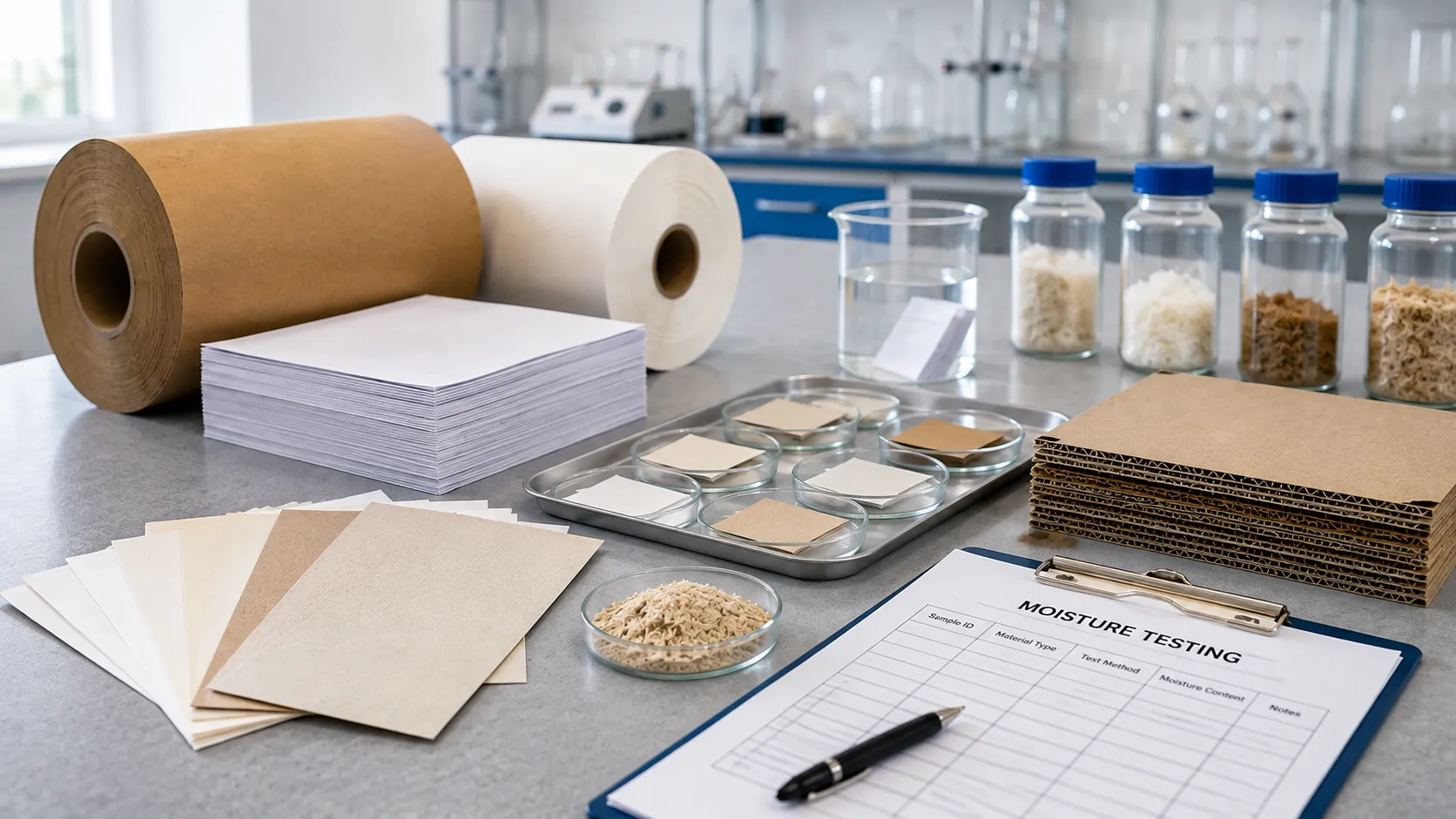
Paper Moisture Testing Equipment Guide Overview
Moisture content is a critical quality parameter throughout paper manufacturing and converting because it affects dimensional stability, strength, runnability, printing behavior, bonding, storage, and commercial weight. Paper manufacturers therefore need moisture testing at multiple stages, from incoming pulp and wet-sheet processing to finished rolls, converted products, and final shipment.
For most quality control laboratories, the core equipment includes a moisture analyzer for rapid routine checks, a laboratory oven and precision balance for gravimetric reference measurements, and suitable sample handling or conditioning equipment. Depending on the paper grade and testing objective, additional instruments such as handheld moisture meters, environmental chambers, or Karl Fischer titrators may also be appropriate.
The key is not simply choosing the fastest instrument. The measurement method must match the sample type, required accuracy, testing frequency, and purpose of the result. Reference measurements, process-control checks, and non-destructive screening can require different approaches.
Main Products and Applications
- Printing and writing papers – Moisture control supports sheet flatness, dimensional stability, and consistent printing performance.
- Corrugated board and containerboard – Moisture can influence compression performance, dimensional behavior, and adhesive bonding.
- Tissue and toweling – Moisture condition can affect handling and physical performance during production and use.
- Coated and specialty papers – Controlled moisture helps maintain dimensional and surface consistency during coating, drying, converting, and storage.
- Pulp sheets and market pulp – Moisture determination is important when evaluating dry-fiber content and commercial weight.
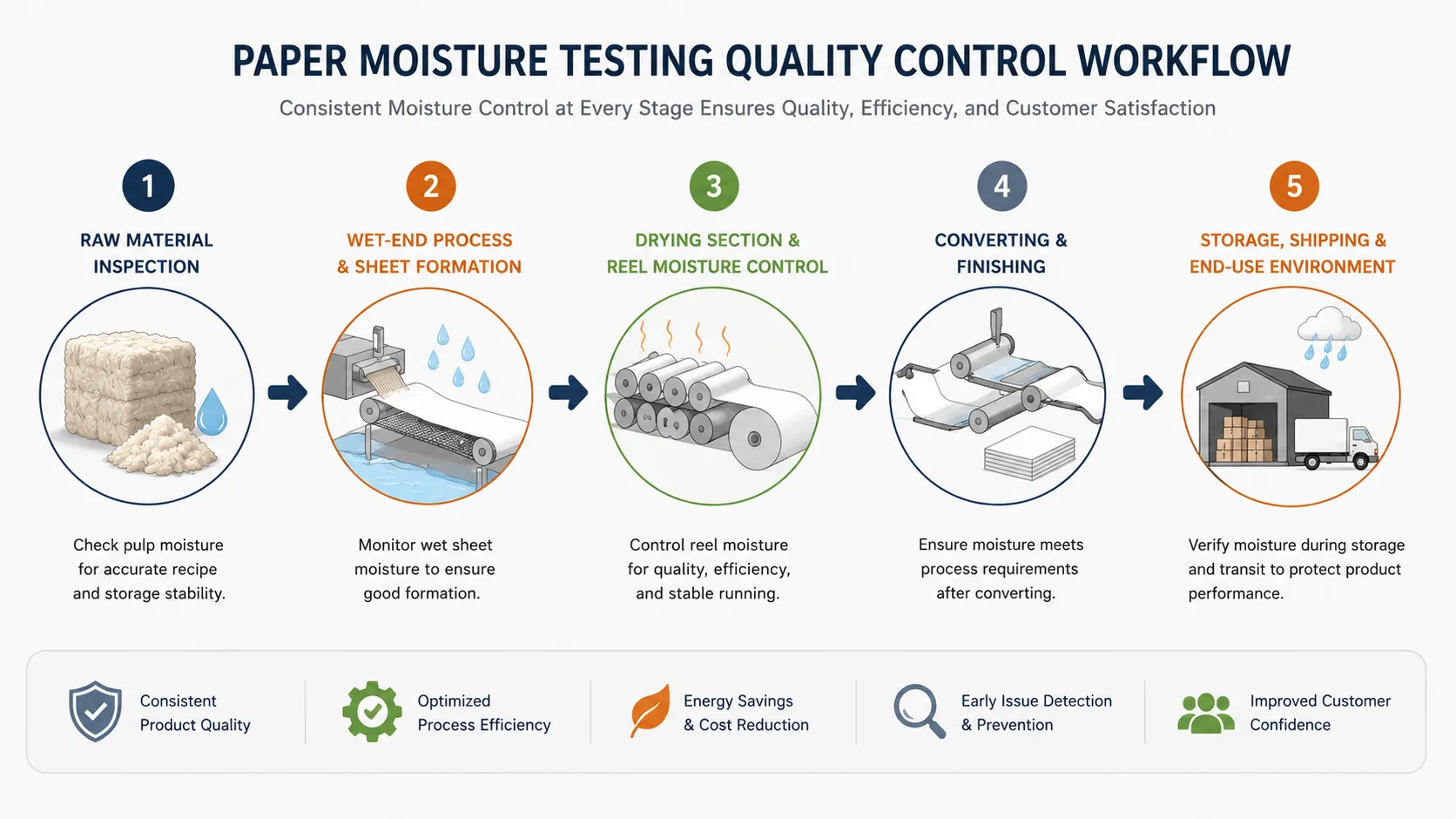
Paper Moisture Testing Quality Control Workflow
1. Incoming Raw Material Inspection (Pulp and Additives)
Before stock preparation, incoming pulp bales, pulp sheets, or recycled fiber materials may be checked for moisture so that the laboratory can distinguish total material weight from the amount of dry fiber entering the process. Significant variation in incoming moisture can complicate recipe control, stock preparation, storage assessment, and comparisons between material lots.
Testing at this stage provides a baseline for incoming quality control and can support adjustments to process calculations where dry-fiber content matters.
Recommended laboratory equipment for this stage:
- Moisture Analyzer (Halogen or Infrared) – Provides rapid moisture determination for routine incoming QC when the drying method is suitable for the sample.
- Analytical Balance – Supports gravimetric measurements and accurate recording of sample mass before and after drying.
- Forced-Air Laboratory Oven – Used for controlled oven-drying procedures when a gravimetric reference measurement is required.
- Sample Grinder or Cutter – Helps prepare representative specimens where sample reduction or size control is required for repeatable drying.


2. Wet-End Process and Sheet Formation
During sheet formation, water removal and moisture distribution begin to develop before the web enters the main drying section. Variations in drainage, furnish, formation, or operating conditions can contribute to non-uniform moisture later in the process.
Laboratory testing of appropriately collected wet-sheet samples can provide independent data for troubleshooting and comparison with process measurements. Because wet samples can change rapidly after collection, representative sampling, prompt testing, and controlled sample handling are important.
Recommended laboratory equipment for this stage:
- Rapid Moisture Analyzer – Provides fast feedback on collected samples when the selected thermal method is suitable for the moisture range and sample type.
- Analytical Balance with Suitable Readability – Measures sample mass accurately for gravimetric moisture calculations.
- Desiccator – Provides a controlled environment for cooling dried samples before final weighing when required by the laboratory method.
3. Drying Section and Reel Moisture Control
The drying section brings the sheet toward the moisture condition required for the particular paper grade and downstream operation. Both excessive drying and insufficient drying can create production or product-quality problems, while non-uniform moisture across or along the web can affect winding, dimensional behavior, and converting performance.
Laboratory measurements taken from representative reel samples provide an independent moisture value that can be compared with online process measurements. This makes laboratory testing useful for verification, troubleshooting, and investigation of moisture-profile problems.
Recommended laboratory equipment for this stage:
- Benchtop Moisture Analyzer – Provides rapid routine feedback for production and QC decisions.
- Forced-Air Oven with Precision Control – Supports controlled gravimetric drying procedures for reference or verification measurements.
- Microwave Moisture Analyzer – May be considered for applications where the technology is validated for the specific sheet, board, sample geometry, and required measurement purpose.
- Sample Bags or Sealed Containers – Help minimize moisture exchange between sampling and laboratory measurement.
4. Converting and Finishing Operations
After papermaking, rolls or sheets may undergo calendering, coating, sheeting, printing, laminating, corrugating, or other converting operations. Moisture can change during these processes and can influence dimensional stability, bonding, surface behavior, and downstream runnability.
Testing converted products helps determine whether processing or environmental exposure has shifted moisture away from the condition established during manufacturing. The most appropriate method depends on whether the laboratory needs a rapid total-loss-on-drying result, a water-specific measurement, or a non-destructive screening measurement.
Recommended laboratory equipment for this stage:
- Moisture Balance – Useful for routine thermal moisture checks when the drying method is appropriate for the material.
- Karl Fischer Titrator – Can be considered when water-specific determination is required and other volatile components could interfere with a thermal loss-on-drying measurement.
- Handheld Moisture Meter – Supports rapid non-destructive screening and comparison of locations on rolls, sheets, or stacks, subject to instrument calibration and material suitability.
- Conditioning Chamber – Provides controlled temperature and humidity conditions when samples must be equilibrated before testing.

5. Storage, Shipping, and End-Use Environment
Paper is hygroscopic, so its moisture condition can change when the surrounding relative humidity and temperature change. Moisture exchange during warehouse storage, transport, or customer handling can contribute to dimensional changes and may influence converting or printing performance.
For investigations involving environmental exposure, the laboratory can combine controlled conditioning with moisture measurements before and after exposure. This helps separate manufacturing moisture issues from changes that occur later in storage or transit.
Recommended laboratory equipment for this stage:
- Environmental Chamber or Humidity Cabinet – Exposes samples to controlled environmental conditions for conditioning or comparative studies.
- Moisture Analyzer – Measures moisture before and after controlled exposure when the selected method is suitable.
- Data Loggers with Humidity Sensors – Record environmental conditions during storage, conditioning, or transport studies.
- Precision Balance – Measures mass changes associated with moisture uptake or loss during controlled studies.

Common Quality Control Challenges in Paper Manufacturing
- Non-uniform reel moisture – Cross-direction or machine-direction variation can contribute to winding, converting, and dimensional-stability problems.
- Dimensional change – Moisture gain or loss can affect sheet dimensions and create registration or handling problems.
- Storage-related moisture gain – Exposure to humid environments can change paper condition after production.
- Excessive dryness – Over-dried material may become more susceptible to brittleness, static, or handling problems depending on the grade.
- Corrugated-board performance variation – Moisture condition can influence board behavior, bonding, and stacking performance.
- Variable incoming pulp moisture – Differences between incoming lots can complicate dry-fiber calculations and stock preparation control.
Key Quality Control Tests for Paper Moisture
| Quality Challenge | Quality Control Test | Recommended Laboratory Equipment | Application |
|---|---|---|---|
| Inconsistent moisture across reels | Gravimetric oven-dry measurement | Forced-Air Laboratory Oven, Analytical Balance | Comparing samples from different reel positions |
| Rapid moisture change during processing | Thermal moisture analysis | Moisture Analyzer | Fast in-process checks when the method is validated for the sample |
| Potential volatile interference in coated grades | Water-specific determination | Karl Fischer Titrator | Applications where thermal mass loss may not represent water alone |
| Curl and dimensional stability | Moisture measurement after conditioning | Conditioning Chamber, Moisture Analyzer | Comparing material under controlled environmental conditions |
| Storage-related moisture concerns | Moisture before and after environmental exposure | Environmental Chamber, Moisture Analyzer or Balance | Evaluating moisture uptake or loss during controlled conditioning |
| Performance variation in corrugated board | Sheet or board moisture measurement | Benchtop Moisture Analyzer | Routine moisture checks before or during converting |
| Printability or converting problems | Comparative moisture screening | Handheld Moisture Meter | Non-destructive spot checks across sheets, stacks, or rolls |
| Commercial dry-weight verification | Gravimetric dry-mass determination | Oven, Balance, Sample Cutter | Determining dry-mass basis where required by the applicable procedure |
Laboratory Equipment Required for Paper Quality Control
A paper moisture-testing laboratory usually benefits from combining rapid routine instruments with a controlled gravimetric method. The rapid instrument provides production feedback, while the oven-and-balance method can provide an independent reference or verification result when performed according to the applicable laboratory procedure.
Additional equipment should be selected according to the paper grade and the reason for testing. A handheld meter may be useful for non-destructive screening, a conditioning chamber may be required when environmental equilibration matters, and a water-specific analytical method may be justified for samples in which thermal mass loss cannot be assumed to represent water alone.
Physical-property testers may also be used alongside moisture measurements when a laboratory needs to investigate how moisture condition relates to tensile, compression, burst, dimensional, or other performance characteristics. Moisture testing should therefore be viewed as part of a broader quality-control system rather than as an isolated measurement.
| Testing Requirement | Laboratory Equipment | Why Manufacturers Need It |
|---|---|---|
| Reference gravimetric moisture determination | Forced-Air Laboratory Oven, Analytical Balance | Provides controlled mass-before-and-after-drying data for verification and reference work |
| Rapid process moisture checks | Moisture Analyzer (Halogen/IR) | Provides faster feedback for routine QC and process investigation |
| Water-specific analysis where thermal interference is a concern | Karl Fischer Titrator | Allows water-specific determination when justified by the sample and method |
| Non-destructive moisture screening | Handheld Moisture Meter | Supports rapid comparative checks on rolls, stacks, or sheets |
| Sample conditioning before testing | Conditioning Chamber | Provides controlled environmental conditions for repeatable conditioning procedures |
| Alternative rapid measurement applications | Microwave Moisture Analyzer | May provide an alternative approach where the technology is suitable and validated for the material |
| Dry-mass or commercial-weight evaluation | Sample Cutter, High-Precision Balance, Oven | Supports representative specimen preparation and gravimetric dry-mass determination |
| Environmental monitoring and traceability | Balance with Data Interface, Environmental Chamber with Recorder or Data Logger | Supports documented measurements and environmental records |
Together, these instruments provide a practical framework for moisture testing from pulp acceptance through finished-product evaluation. The appropriate laboratory configuration depends on whether the primary objective is rapid process control, reference measurement, environmental investigation, non-destructive screening, or water-specific analysis.
Basic Laboratory Setup for Paper Manufacturers
Not every paper manufacturer needs the same laboratory configuration. Equipment should be added according to sample types, production complexity, testing frequency, customer requirements, and the level of investigation the laboratory is expected to perform.
| Laboratory Level | Recommended Equipment | Suitable For |
|---|---|---|
| Basic QC Laboratory | Moisture analyzer, analytical balance, forced-air oven, desiccator, sample bags | Routine incoming, process, and outgoing moisture checks using rapid and gravimetric methods |
| Advanced QC Laboratory | All Basic equipment plus conditioning chamber, Karl Fischer titrator where justified, alternative rapid moisture measurement equipment, data management tools | Manufacturers handling multiple grades, coated or treated materials, controlled conditioning, or more demanding documentation requirements |
| Advanced Analysis Laboratory | All Advanced equipment plus environmental chambers, expanded sample handling, moisture-profile analysis tools, and additional reference-testing capacity | R&D centers and high-volume laboratories investigating process variation, environmental effects, and new paper grades |
How to Choose Laboratory Equipment for Paper Moisture Testing
Selecting paper moisture testing equipment starts with the measurement objective. A process-control instrument, a reference method, and a non-destructive screening meter can all measure moisture-related properties, but they do not necessarily provide interchangeable results.
Define the Sample and Testing Purpose
Begin by listing the materials that will actually be tested: pulp, wet sheets, finished paper, coated grades, paperboard, corrugated material, or other converted products. Then define what the result will be used for.
For rapid production decisions, testing speed may be the main priority. For reference or verification work, controlled sample preparation, drying, weighing, and repeatability become more important. Where coatings, solvents, additives, or other volatile components may contribute to thermal mass loss, the laboratory should determine whether a water-specific method is more appropriate.
The expected moisture range, sample size, sample heterogeneity, and required result quality should be evaluated using the applicable method and instrument documentation rather than assuming that one analyzer is suitable for every paper product.
Evaluate Laboratory Workflow Requirements
Testing frequency and sample throughput strongly influence instrument selection. A high-volume QC laboratory may benefit from rapid analyzers, stored test methods, data transfer, and standardized sample handling. A smaller converter performing periodic verification may place greater emphasis on a simple, repeatable workflow using fewer instruments.
Also consider how quickly samples can be transferred from production to the laboratory. Paper can exchange moisture with the surrounding air, so inconsistent sampling and handling can undermine even a capable instrument. Sealed sample containers, defined sampling locations, consistent specimen preparation, and controlled conditioning may therefore be as important as analyzer selection.
Operator training, available laboratory space, ventilation, environmental control, cleaning requirements, and data-recording procedures should also be considered before equipment is purchased.
Compare Measurement Method and Long-Term Support
Instrument selection should include more than initial purchase cost. Laboratories should consider calibration and verification procedures, service availability, consumables, replacement parts, software or data connectivity, operator training, and ongoing maintenance.
For rapid moisture analyzers, confirm that the heating method and test program can be developed for the intended samples. For balances and reference gravimetric work, consider weighing performance and calibration requirements. For environmental chambers, confirm that the required conditioning workflow can be supported. For specialized methods such as Karl Fischer titration, consider sample preparation, reagents, operator capability, and whether water-specific analysis is genuinely necessary.
Companies such as AELAB can help match testing requirements with appropriate instrument categories, but the final configuration should be based on the actual samples, measurement purpose, testing volume, and applicable laboratory procedure.
Who Needs Laboratory Testing Solutions for This Industry?
- Paper mills requiring laboratory verification of moisture during pulp handling, papermaking, drying, and reel production.
- Corrugated board plants monitoring liner, medium, and finished-board moisture as part of converting quality control.
- Paperboard and packaging converters investigating moisture-related dimensional, printing, bonding, or forming problems.
- Tissue and hygiene product manufacturers requiring consistent material condition during production and quality evaluation.
- Independent testing laboratories performing moisture and dry-mass measurements for pulp, paper, board, or converted products.
Frequently Asked Questions
What is the most accurate method for measuring paper moisture?
The gravimetric oven-dry method (drying in a forced-air oven at 105°C until constant weight) is the reference standard. It is used for calibration and dispute resolution, though it is too slow for process control.
How often should moisture analyzers be calibrated?
Calibration frequency depends on instrument usage intensity, manufacturer recommendations, and internal quality procedures. Most laboratories perform daily checks with a known moisture sample and schedule full calibration monthly or quarterly.
Can a handheld moisture meter replace a benchtop analyzer?
Handheld meters are convenient for quick surveys on rolls or stacks, but they typically lack the accuracy of a laboratory moisture analyzer. They are best used for trend monitoring, with benchtop instruments used for final release testing.
Why does coated paper require different moisture testing than uncoated?
Coatings often contain volatiles that are released during heating, causing thermal moisture analyzers to overestimate water content. Karl Fischer titration specifically measures water, eliminating this interference and providing more accurate results for coated grades.
Conclusion
Effective paper moisture testing requires both an appropriate measurement method and consistent sample handling. Rapid moisture analyzers can support routine production decisions, while oven-and-balance methods provide controlled gravimetric measurements for reference or verification work. Handheld meters, conditioning chambers, environmental chambers, and water-specific analytical methods can be added when the application requires them.
The best laboratory setup is therefore determined by the paper grades being produced, where samples are taken in the process, why moisture is being measured, how quickly results are needed, and the level of documentation or investigation required.
Laboratory Equipment Solutions for Paper Manufacturing
AELAB assists paper manufacturers and converters in identifying laboratory equipment based on sample type, testing purpose, workflow, and expected testing volume. A basic laboratory may focus on rapid moisture analysis plus gravimetric verification, while more advanced operations may require controlled conditioning, environmental testing, water-specific analysis, or expanded data management.
Before selecting equipment, define the materials to be tested, the production stages that require measurements, the role of each result in quality decisions, and whether the laboratory needs routine screening, reference testing, or advanced investigation. This test-to-instrument mapping helps avoid both under-equipped laboratories and unnecessary instrument purchases.