Laboratory Equipment for Heavy Metal Analysis in Water Overview
Heavy metal analysis in water requires a controlled workflow that protects sample integrity, prepares the sample correctly, measures target elements at the required concentration range, and verifies that the analytical results are reliable. Typical equipment includes sample preservation tools, digestion systems, ultrapure water systems, AAS, ICP-OES or ICP-MS, mercury analysis equipment, autosamplers, and laboratory quality-control tools.
The appropriate instrument depends on the target metals, required sensitivity, sample matrix, number of elements, sample throughput, and applicable analytical method. AAS can be practical for targeted routine measurements, ICP-OES is well suited to multi-element analysis across many water and wastewater applications, and ICP-MS is commonly selected when lower detection capability or broader trace-element analysis is required.
In the water, wastewater and environmental sector, metals such as lead, cadmium, mercury and arsenic are important targets for water-quality monitoring because elevated concentrations can create public-health and environmental concerns. Municipal water suppliers, industrial facilities, environmental laboratories and manufacturers therefore use laboratory analysis to evaluate water quality, verify treatment performance, investigate contamination, and support compliance with applicable requirements.
Accurate heavy metal analysis depends on controlling the complete analytical chain. Sampling, preservation, digestion, calibration, contamination control, instrumental measurement, and data validation can all affect the final result. A laboratory should therefore be configured around the required analytical method rather than selecting the detection instrument in isolation.
Main Products and Applications
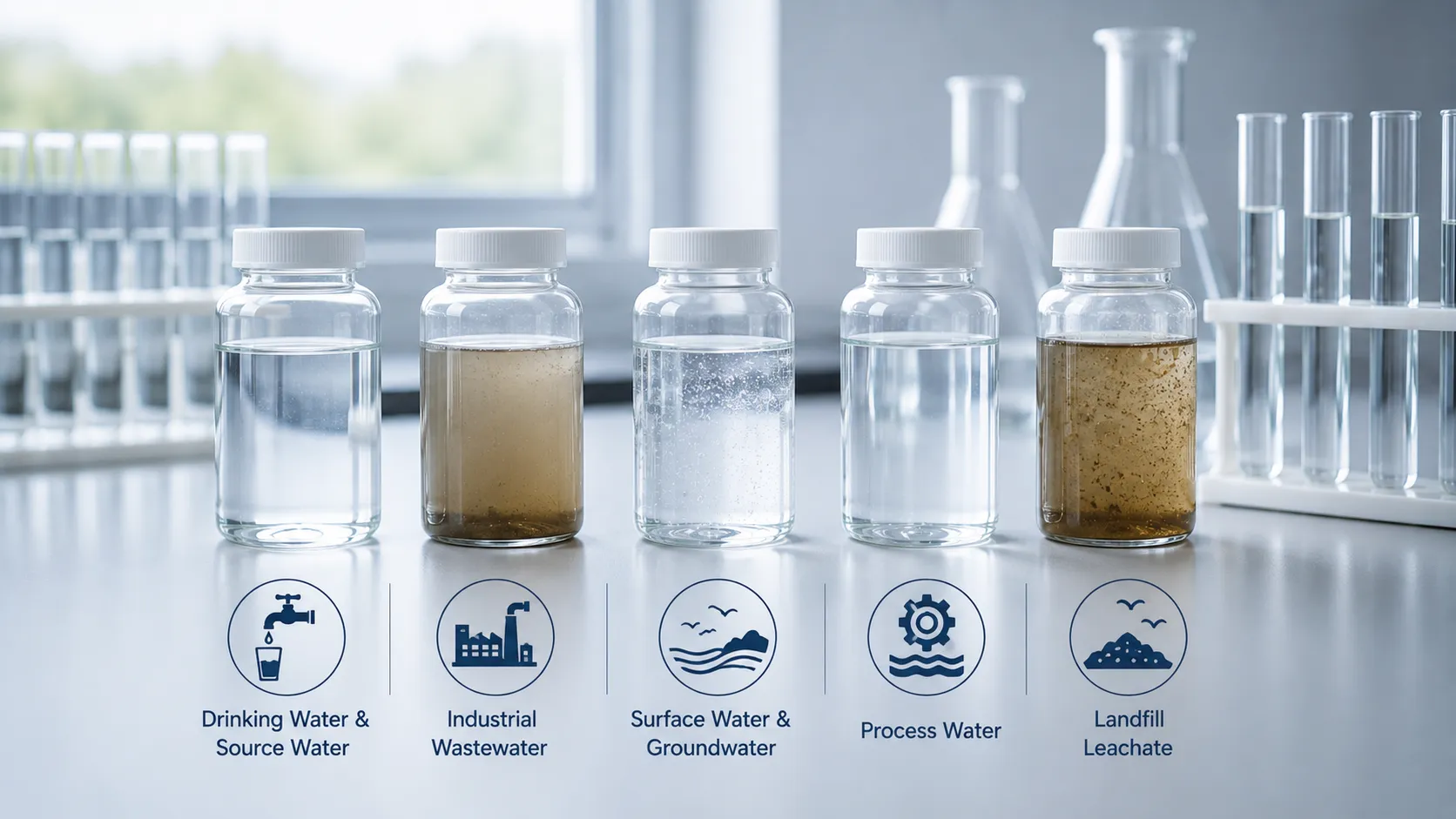
Heavy metal analysis in water spans a variety of sample types and application areas. Laboratories typically handle:
- Drinking water and source water – Monitoring metals relevant to public-water quality and treatment performance.
- Industrial wastewater and treated effluent – Evaluating metal concentrations before discharge or reuse.
- Surface water and groundwater – Supporting environmental monitoring, site assessment, and contamination investigations.
- Process water – Controlling water quality where dissolved or trace metals may affect manufacturing processes or products.
- Landfill leachate and other complex environmental waters – Assessing potential metal contamination in challenging sample matrices.
Heavy Metal Analysis in Water Quality Control Workflow
Sample Collection and Preservation
Reliable analysis begins before the sample reaches the laboratory. Poor sampling or preservation can change the measured metal concentration through contamination, adsorption onto container surfaces, precipitation, biological activity, or other chemical changes.
Sampling procedures should therefore follow the analytical method and applicable monitoring protocol. Suitable containers, clean sampling practices, preservation conditions, transport controls, and holding-time requirements should be defined for the specific analysis. Acidification is commonly used in metals analysis when required by the selected method, while field measurements can provide additional information about sample condition.
An important distinction is also whether the laboratory needs to determine dissolved metals, total metals, or another method-defined fraction. Filtration, preservation, and digestion requirements can differ, so these decisions should be made before sample preparation begins.
Recommended laboratory equipment for this stage:
- pH Meter – Checks sample pH and can help verify preservation conditions where pH control is part of the analytical procedure.
- Conductivity Meter – Provides a rapid indication of ionic content and can help identify changes in sample matrix between sampling locations.
- Sample Coolers and Portable Refrigerators – Support controlled sample transport and storage when cooling is required by the selected procedure.
- Automatic Samplers – Collect representative samples at defined intervals or create composite samples where the monitoring plan requires time-based sampling.


Sample Preparation and Digestion
Sample preparation depends on what the laboratory intends to measure. Clear water samples intended for dissolved-metal analysis may require a different preparation route from turbid wastewater or environmental samples in which metals associated with suspended material must also be evaluated.
When digestion is required, acids and controlled heating are used to break down the sample matrix and bring the target metals into a form suitable for instrumental measurement. Incomplete preparation can produce poor recovery, while contaminated reagents, vessels, or laboratory water can increase blank values and create false high results.
Consistency is particularly important. Digestion temperature, reagent quality, vessel cleanliness, sample volume, dilution, and preparation of blanks and control samples should be managed as part of the analytical method.
Recommended laboratory equipment for this stage:
- Microwave Digestion System – Provides controlled closed-vessel acid digestion for demanding samples and helps laboratories standardize digestion conditions.
- Hot Block Digestion System – Provides controlled heating for open-vessel digestion procedures and can be practical for routine sample preparation.
- Fume Hood – Provides appropriate containment when handling corrosive acids and digestion fumes.
- Analytical Balance – Supports accurate preparation of standards, reference materials, and reagents where gravimetric preparation is required.
- Water Purification System – Supplies high-purity water for blanks, standards, reagent preparation, and sample dilution to reduce contamination risk.


Instrumental Analysis and Detection
The analytical instrument should be selected according to the target elements, required reporting level, sample matrix, number of samples, and number of elements that must be measured.
Atomic Absorption Spectrophotometry (AAS) is commonly used when a laboratory needs targeted elemental analysis and does not require broad simultaneous multi-element measurement. Different atomization or accessory configurations may be selected according to the element and required sensitivity.
ICP-OES is particularly useful when many elements must be measured in the same sample. It can provide efficient multi-element analysis for environmental water, wastewater, and process-water laboratories.
ICP-MS is typically considered when trace or ultra-trace measurement capability is required, when a broad multi-element panel must be measured at low concentrations, or when the analytical method requires mass-spectrometric detection.
Mercury can require dedicated sample-introduction or mercury-analysis techniques depending on the method. Arsenic and some other elements may also require additional interference-control or sample-introduction considerations.
Regardless of instrument type, laboratories must control calibration, blanks, interference, drift, carryover, and sample dilution. Quality-control samples are analyzed alongside routine samples to demonstrate that the measurement system remained under control.
Recommended laboratory equipment for this stage:
- Atomic Absorption Spectrophotometer (AAS) – Suitable for targeted elemental measurements when sequential analysis is acceptable.
- Inductively Coupled Plasma Optical Emission Spectrometer (ICP-OES) – Supports simultaneous or rapid multi-element analysis for routine environmental and industrial water applications.
- Inductively Coupled Plasma Mass Spectrometer (ICP-MS) – Provides high-sensitivity multi-element analysis when lower concentration measurements or advanced trace analysis are required.
- Autosampler – Automates sample introduction, improves throughput, and supports consistent analysis of larger sample batches.
- Data Station with Analysis Software – Manages calibration, signal processing, calculations, QC review, and analytical result reporting.


Data Validation and Quality Assurance
Instrument output should not be treated as a final report until the analytical batch has passed its quality-control checks. Laboratories typically use method-defined combinations of calibration standards, blanks, control samples, spikes, duplicates, reference materials, or continuing calibration checks to evaluate analytical performance.
These controls help answer several questions: Was contamination introduced? Did the instrument remain stable? Was the matrix affecting recovery? Was the calibration still valid? Did duplicate measurements show acceptable reproducibility?
Acceptance criteria should come from the laboratory’s validated method, quality system, or applicable analytical requirement rather than from a universal rule. Results that fail the relevant criteria require investigation and may require corrective action, additional preparation, dilution, or re-analysis.
Recommended laboratory equipment for this stage:
- Certified Reference Materials – Provide materials with assigned values that can be used to evaluate analytical accuracy where appropriate.
- Laboratory Information Management System (LIMS) – Supports sample traceability, result management, QC review, and reporting workflows.
- Pipettes and Dilutors – Support accurate preparation of calibration solutions, QC samples, spikes, and sample dilutions.
- UV-Vis Spectrophotometer – Can support complementary colorimetric water tests when these are part of the laboratory’s analytical scope.


Common Quality Control Challenges in Heavy Metal Analysis
Laboratories frequently encounter obstacles that can compromise data reliability. Key issues include:
- Matrix interference – Dissolved salts, acids, organic material, and other matrix components can suppress, enhance, or interfere with analytical signals.
- Background contamination – Reagents, containers, laboratory water, digestion vessels, sampling equipment, and the laboratory environment can introduce trace metals.
- Instrument drift – Sensitivity can change during long analytical runs, making ongoing calibration verification important.
- Incomplete digestion or preparation – Poor recovery from particulate or complex samples can underestimate the metal content being measured.
- Low target concentrations – Some applications require analytical capability well below the concentration range handled comfortably by basic instrumentation.
- Carryover – A high-concentration sample can contaminate the sample-introduction pathway and affect the following measurement.
- High sample throughput – Laboratories must balance sensitivity and method requirements with preparation time, instrument run time, staffing, and automation.
Key Quality Control Tests for Heavy Metal Analysis in Water
| Quality Challenge | Quality Control Approach | Recommended Laboratory Equipment | Application |
|---|---|---|---|
| Incomplete metal recovery from particulate material | Method-appropriate digestion and comparison of relevant sample fractions | Microwave Digestion System, ICP-OES | Supports reliable measurement of samples containing suspended solids or complex matrices. |
| Low-level mercury measurement | Method-specific mercury analysis such as cold-vapor techniques | Cold Vapor AAS or dedicated mercury analyzer | Provides a dedicated analytical route where mercury requires greater sensitivity or specialized sample introduction. |
| Matrix interference in high-salt water | Matrix matching, standard addition, dilution, or instrument-based interference control as appropriate | ICP-MS with suitable interference-control capability | Helps manage signal effects and spectral or polyatomic interference in difficult matrices. |
| Cross-contamination between samples | Carryover blanks and controlled rinse procedures | Autosampler with rinse capability, ICP-OES | Checks whether the sample-introduction system retains material from a previous sample. |
| Arsenic speciation | Separation or species-specific sample-introduction techniques where required | Hydride Generation AAS, LC system coupled to ICP-MS | Supports applications that require information about individual arsenic species rather than only total arsenic. |
| Calibration accuracy across the working range | Multi-level calibration and independent or continuing verification according to the analytical method | ICP-OES with autosampler and appropriate reference materials | Confirms that instrument response remains suitable for the concentrations being reported. |
Laboratory Equipment Required for Water and Wastewater Quality Control
A heavy metal testing laboratory requires more than a single elemental analyzer. The complete system normally includes sample handling and preservation tools, digestion or preparation equipment, high-purity water, elemental analysis instrumentation, volumetric tools, contamination-control infrastructure, and data-management capability.
The appropriate configuration depends on whether the laboratory performs routine screening, multi-element wastewater analysis, low-level drinking-water analysis, environmental monitoring, or advanced investigations such as speciation.
| Testing Requirement | Laboratory Equipment | Why the Laboratory Needs It |
|---|---|---|
| Routine targeted analysis of selected metals | Flame Atomic Absorption Spectrophotometer (FAAS) | Provides a practical option when the laboratory analyzes a limited number of elements and sequential measurement is acceptable. |
| Low-level multi-element analysis | ICP-MS | Provides high-sensitivity multi-element measurement for applications with demanding reporting levels. |
| Routine simultaneous multi-element analysis | ICP-OES | Improves productivity when many elements must be determined across larger sample batches. |
| Sensitive mercury determination | Cold Vapor Atomic Fluorescence Spectrometer or dedicated mercury analyzer | Provides a specialized analytical route for laboratories with demanding mercury measurement requirements. |
| Controlled sample acid digestion | Microwave Digestion System | Provides controlled digestion conditions for complex or particulate-containing samples where digestion is required. |
| Preparation of low-contamination blanks and standards | Water Purification System | Reduces the risk that laboratory water contributes metals to blanks, standards, or diluted samples. |
| Field sample collection and preservation | Portable Samplers and pH/Conductivity Meters | Supports representative sampling, field measurements, and sample-condition checks before laboratory analysis. |
Together, these instruments create an analytical chain from sampling to validated result. Buyers should therefore evaluate the complete workflow rather than allocating the entire laboratory budget to the final detection instrument.
Basic Laboratory Setup for Water Quality Manufacturers
The appropriate laboratory level depends on the required sensitivity, number of target elements, sample matrix, throughput, and analytical methods. A basic laboratory may be sufficient for routine targeted testing, while laboratories handling demanding trace analysis or complex environmental samples may require substantially more infrastructure.
| Laboratory Level | Recommended Equipment | Suitable For |
|---|---|---|
| Basic QC Laboratory | pH Meter, Conductivity Meter, Portable Turbidity Meter, Basic FAAS, Hot Block Digester, Analytical Balance, Water Purifier | Routine targeted testing where required reporting levels and sample matrices are compatible with the selected methods. |
| Advanced QC Laboratory | ICP-OES, Microwave Digestion System, Autosampler, Hydride Generation System, Laboratory Fume Hood, LIMS Starter | Higher-throughput laboratories requiring broader multi-element analysis and more controlled sample preparation. |
| Advanced Analysis Laboratory | ICP-MS, Cold Vapor Mercury Analyzer, Automated Sample Prep, High-Purity Reagent System, Fully Integrated LIMS, Dedicated Clean Room Equipment | Laboratories performing demanding trace analysis, specialized environmental investigations, or advanced analytical workflows. |
How to Choose Laboratory Equipment for Heavy Metal Analysis in Water
Selecting equipment should begin with the analytical requirement rather than a preferred instrument model. The most important questions are which metals must be measured, at what reporting level, in which matrices, by which method, and at what daily sample volume.
Define the Target Metals and Required Sensitivity
Start by listing the elements that must be reported and the concentration range the laboratory needs to measure. A laboratory analyzing only a few metals at routine concentrations may not need the same instrumentation as a facility responsible for broad trace-element screening.
AAS can be a practical choice for targeted measurements. ICP-OES becomes attractive when multi-element productivity is important. ICP-MS is generally considered when lower concentration capability, broad trace-element coverage, or a method requiring mass-spectrometric detection justifies the additional complexity.
Mercury, arsenic, and other analytically challenging elements should be considered individually because the preferred technique may depend on the required method and concentration range.
Evaluate the Sample Matrix
Drinking water, groundwater, industrial wastewater, landfill leachate, and high-salinity process water can place very different demands on an analytical system.
Complex samples may require more extensive digestion, dilution, interference correction, cleaning, or matrix-specific QC. A laboratory processing difficult matrices should evaluate the complete sample-introduction and preparation system rather than comparing instruments only by nominal sensitivity.
Match the Instrument to Sample Throughput
Sample volume affects both instrument selection and laboratory layout. A low-volume laboratory performing a small elemental panel may accept sequential analysis, while a high-throughput laboratory can benefit from multi-element instrumentation, autosamplers, standardized digestion batches, automated dilution, and integrated data handling.
Consider the complete turnaround time:
- Sample receipt and registration
- Preservation checks and filtration where applicable
- Digestion or other sample preparation
- Calibration and QC preparation
- Instrument run time
- Rinsing and carryover control
- Data review and reporting
The fastest analyzer does not necessarily create the fastest laboratory if sample preparation or data review remains the main bottleneck.
Plan for Contamination Control
As target concentrations decrease, contamination control becomes increasingly important. Laboratory water, acids, vessels, pipette tips, storage containers, sample tubes, and the working environment can all contribute background metals.
Equipment planning may therefore need to include a suitable water purification system, clean sample-preparation areas, appropriate fume extraction, dedicated vessels, high-quality volumetric equipment, and procedures for monitoring blank contamination.
Consider Laboratory Infrastructure and Operating Requirements
Instrument selection should account for more than purchase price. Depending on the technology, the laboratory may need appropriate gases, ventilation, electrical supply, cooling, environmental control, exhaust arrangements, high-purity reagents, waste handling, and sufficient bench or floor space.
These requirements should be evaluated before installation so that the laboratory layout supports safe operation and stable analytical performance.
Compare Long-Term Equipment Support
The cost of heavy metal analysis continues after instrument installation. Laboratories should evaluate:
- Availability of installation and application support
- Operator training requirements
- Preventive maintenance
- Calibration and qualification needs
- Availability of consumables and replacement parts
- Routine consumable costs
- Expected sample throughput and instrument utilization
- Software, data-management, and reporting requirements
A more advanced instrument is justified when its analytical capability or productivity is genuinely required. For routine targeted analysis, a simpler system can sometimes provide a more practical laboratory solution.
Who Needs Laboratory Testing Solutions for This Industry?
- Municipal water treatment laboratories performing routine water-quality and treatment-process monitoring.
- Industrial manufacturers monitoring process water, wastewater treatment, or discharged effluent.
- Environmental testing and consulting laboratories conducting site assessments, groundwater investigations, and remediation monitoring.
- Government and regulatory laboratories responsible for environmental or public-water surveillance.
- Bottled water and beverage producers monitoring incoming water and finished-product water quality.
- Central analytical laboratories handling trace-element testing for multiple facilities, customers, or environmental programs.
Frequently Asked Questions
What laboratory equipment is needed for heavy metal analysis in water?
A typical laboratory needs equipment for sample handling and preparation plus an elemental analyzer. Common requirements include pH and conductivity meters, digestion equipment, a water purification system, analytical balances and pipettes, and an AAS, ICP-OES, or ICP-MS. The final configuration depends on the target metals, required sensitivity, sample matrix, analytical method, and sample throughput.
What is the best instrument for low-level mercury analysis in water?
A dedicated mercury analyzer or a system using an appropriate cold-vapor technique is commonly considered when sensitive mercury measurement is required. The correct configuration should be selected according to the analytical method, required reporting level, sample matrix, and laboratory throughput rather than a universal detection-limit claim.
What is the difference between AAS, ICP-OES, and ICP-MS for water analysis?
AAS is generally suited to targeted elemental analysis when a limited number of metals are measured. ICP-OES is useful for routine multi-element analysis and higher sample throughput. ICP-MS is generally selected when lower concentration measurements, broad trace-element coverage, or a method requiring mass-spectrometric detection is needed.
Can one instrument analyze all heavy metals in water?
No single configuration is ideal for every water matrix, element, and reporting requirement. ICP-OES and ICP-MS can cover broad multi-element panels, while some applications—particularly mercury analysis or speciation work—may use dedicated accessories, sample-introduction techniques, separation systems, or specialized analyzers.
How often should an atomic absorption spectrophotometer be recalibrated?
Calibration and verification frequency should follow the laboratory’s analytical method, validated procedure, instrument performance, and quality-control requirements. Laboratories commonly use calibration standards and continuing checks during an analytical batch, but a universal fixed interval should not be applied to every method.
What are the key factors in preventing sample contamination?
Contamination control starts with clean sampling containers and continues through transport, preparation, dilution, and instrumental analysis. High-purity water and reagents, properly cleaned vessels, suitable laboratory practices, controlled preparation areas, and routine blank measurements help laboratories identify and reduce background contamination.
When should a laboratory choose ICP-MS instead of ICP-OES?
ICP-MS is generally considered when the required reporting levels are below the practical capability of the laboratory’s ICP-OES method, when broad trace-element measurement is needed, or when the selected analytical method requires mass-spectrometric detection. ICP-OES can be a more practical choice when routine multi-element analysis at less demanding concentration levels is the main requirement.
Conclusion
Heavy metal analysis in water is a complete laboratory workflow rather than a single instrumental measurement. Reliable results depend on representative sampling, correct preservation, method-appropriate sample preparation, contamination control, suitable elemental analysis, and documented quality assurance.
For laboratories choosing equipment, the central decision is to match the analytical system to the target metals, required sensitivity, sample matrix, and workload. AAS can provide an efficient route for targeted analysis, ICP-OES supports productive multi-element testing, and ICP-MS provides additional capability for demanding trace analysis. Digestion systems, high-purity water, autosampling, volumetric equipment, and data-management tools complete the analytical chain.
Planning the laboratory around the full workflow helps avoid both under-specifying the system and investing in analytical capability that the application does not require.