Perfume Manufacturing Quality Control and Testing Methods Overview
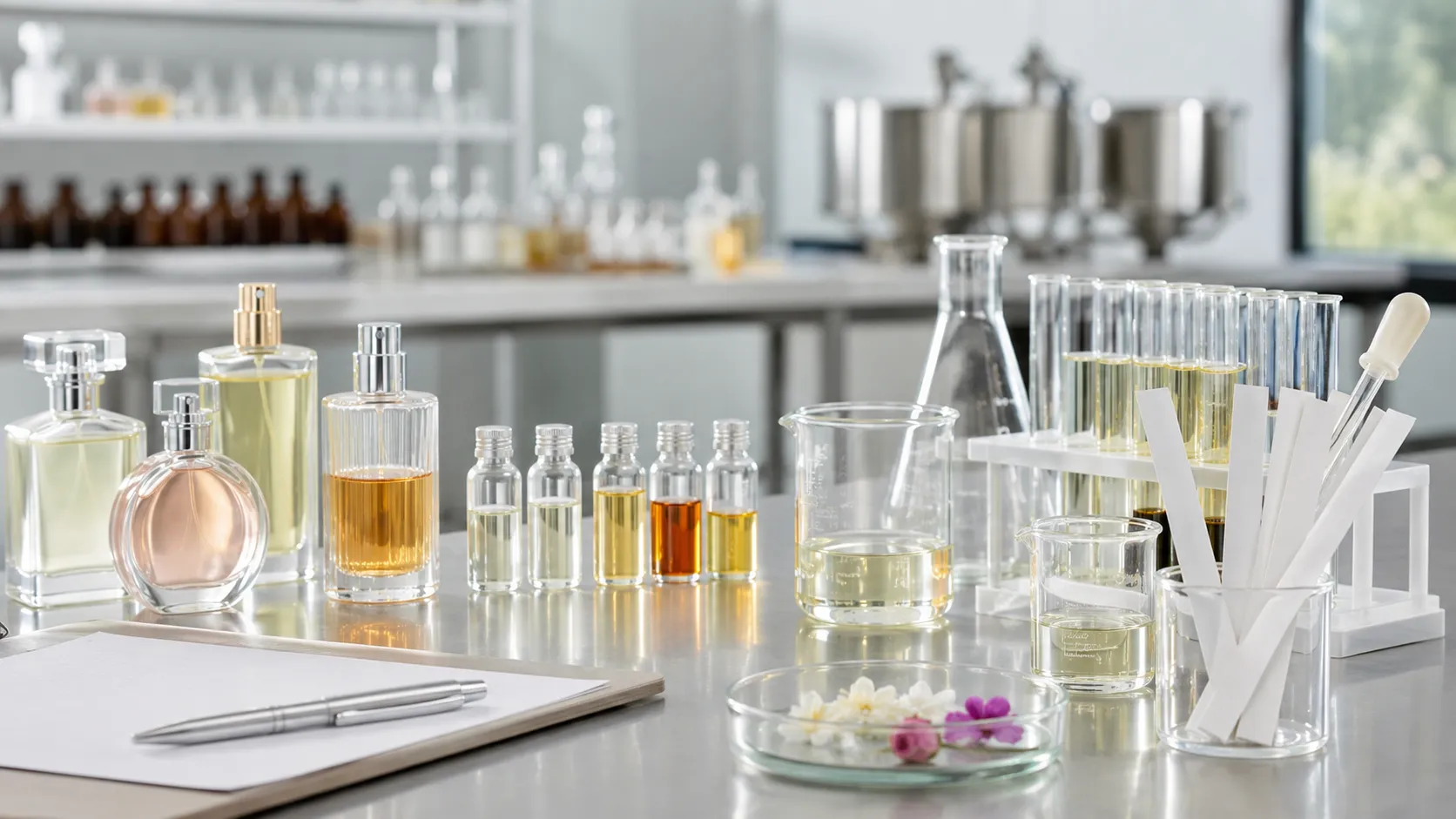
Perfume manufacturing quality control combines sensory evaluation with physical, chemical and stability testing to confirm that raw materials, in-process blends and finished fragrances meet defined internal specifications. Key QC requirements typically include raw-material identity and purity, fragrance composition, alcohol content, density, refractive index, color, clarity, stability and packaging integrity. Depending on the formulation, microbiological quality may also require evaluation.
The main laboratory equipment used for these checks includes refractometers, density and alcohol meters, analytical balances, spectrophotometers, gas chromatographs, titrators, turbidity meters and stability chambers. More advanced laboratories may also use GC-MS, GC-FID, particle analysis and packaging test equipment. Sensory evaluation remains important because instrumental measurements cannot replace assessment of the intended fragrance character.
A practical perfume QC program therefore connects each production stage with a defined test purpose and suitable instrument: incoming materials are verified before use, blends are checked during production, maturation is monitored for unwanted change, filtration is verified for clarity, and finished bottles are evaluated for composition, appearance, stability and package performance.
Main Products and Applications
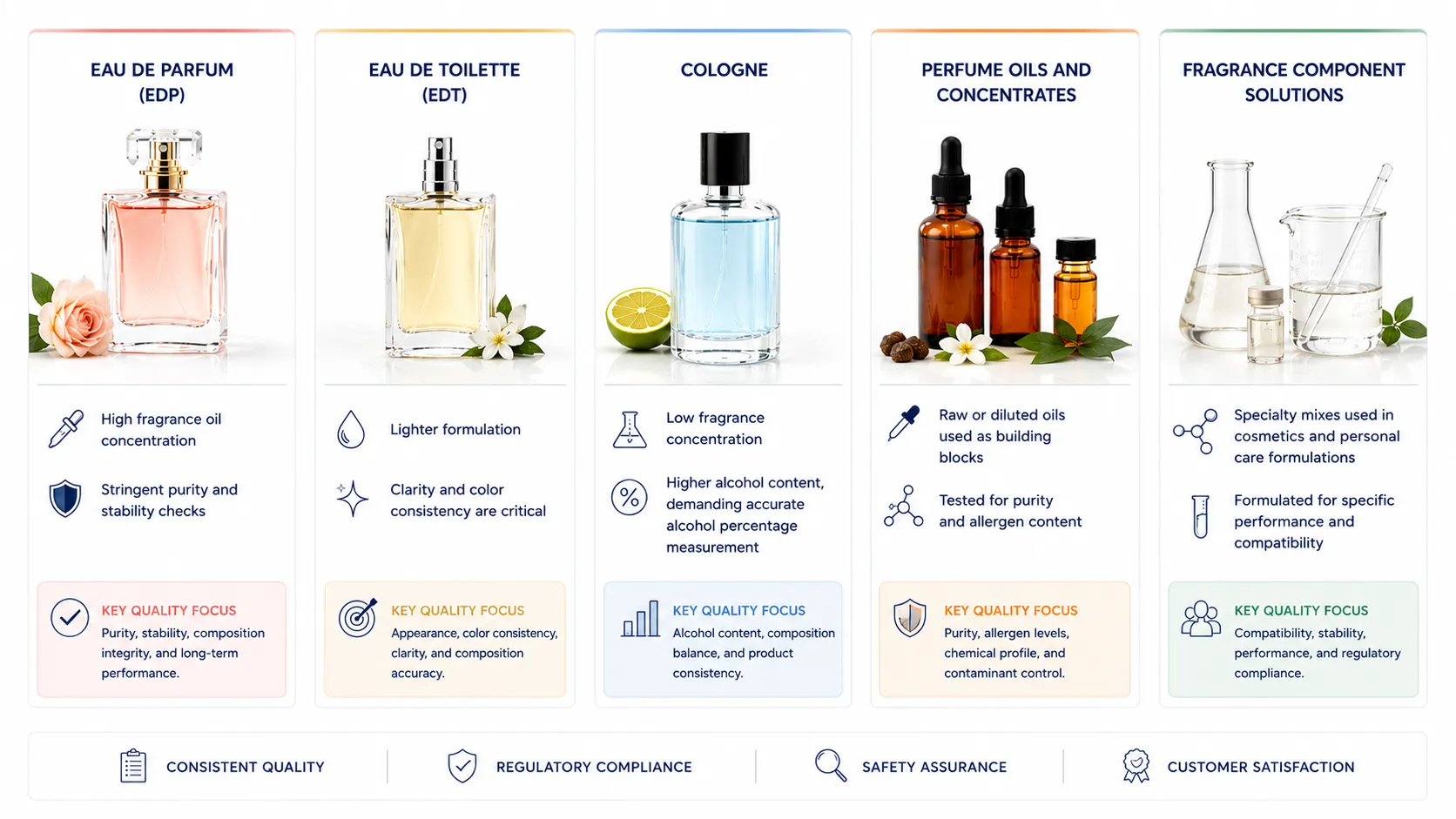
Perfume quality control applies to a range of fragrance products, with testing priorities changing according to formulation and product type:
- Eau de Parfum (EDP): Higher fragrance concentration makes raw-material quality, composition consistency, clarity and stability important QC considerations.
- Eau de Toilette (EDT): A lighter fragrance formulation where composition, alcohol content, clarity and color consistency may be monitored.
- Cologne: Higher alcohol content makes alcohol concentration, density and formulation consistency important routine checks.
- Perfume Oils and Concentrates: Raw or diluted fragrance materials that may require identity, purity, composition and stability evaluation before formulation.
- Fragrance Component Solutions: Specialty fragrance mixtures used in cosmetics and personal care formulations, where testing should be matched to the composition and intended application.
Perfume Manufacturing Quality Control Workflow
Perfume QC is most effective when testing is assigned to specific control points rather than performed only on the finished bottle. Incoming inspection helps prevent unsuitable materials from entering production, in-process checks identify blending problems early, and final and stability testing confirm that the fragrance and its packaging remain consistent with the manufacturer’s specifications.
Raw Material Inspection
Before production begins, incoming materials—including essential oils, aroma chemicals, alcohol and water—should be checked against the manufacturer’s approved specifications and supplier documentation. Variation, degradation, contamination or misidentification at this stage can affect fragrance character, appearance and finished-product consistency.
Routine checks can include physical properties such as refractive index and density, while instrumental chemical profiling may be used when more detailed identity or composition information is required. GC-MS is particularly useful when a laboratory needs to separate volatile components and investigate unexpected compounds or differences from an established reference profile.
Recommended laboratory equipment for this stage:
- Refractometer – Measures refractive index as a useful physical-property check for suitable liquid raw materials.
- Density Meter – Measures density or specific gravity for comparison with approved raw-material specifications.
- Gas Chromatograph–Mass Spectrometer (GC-MS) – Separates volatile components and supports identification of compounds when detailed composition or adulteration investigation is required.
- Analytical Balance – Provides accurate weighing for sample preparation, formulation checks and preparation of standards or test solutions.
- Moisture Analyzer – Can support moisture evaluation for suitable raw materials where water content is a defined QC parameter.


In-Process Blending Control
During blending, controlled dosing of fragrance concentrate, alcohol, water and other formulation components is essential for batch consistency. Incorrect proportions or incomplete mixing can change fragrance intensity, appearance, solubility and finished-product performance.
In-process QC should focus on parameters that can identify a deviation while the batch can still be corrected. Depending on the formulation, these checks may include density, alcohol concentration, color, homogeneity and sensory comparison with an approved reference. pH or conductivity may also be useful where they are meaningful for the specific formulation or process water rather than being treated as universal perfume tests.
Recommended laboratory equipment for this stage:
- Alcohol Meter (Hydrometer or Digital Density Meter) – Supports determination of alcohol concentration when ethanol content is a controlled formulation parameter.
- Spectrophotometer – Provides objective color measurement for comparison between batches or against an approved reference.
- pH Meter – Used where pH is a meaningful and validated control parameter for the specific formulation.
- Conductivity Meter – Useful for monitoring process water or aqueous components where ionic quality is part of the manufacturer’s specification.
- Portable Viscometer – Can be used for more viscous fragrance oils or concentrates when flow behavior is relevant to processing or handling.


Maturation and Maceration Monitoring
After blending, some perfume manufacturing processes include a controlled maturation or maceration period before filtration and filling. The purpose is to allow the formulation to reach the intended finished condition while monitoring for undesirable changes such as discoloration, sediment formation or changes in fragrance character.
QC samples taken at defined process intervals can be compared for color, odor and, where required, chemical composition. Analytical testing is most useful when the manufacturer has established reference data or internal acceptance criteria against which the maturation trend can be evaluated.
Recommended laboratory equipment for this stage:
- UV-Vis Spectrophotometer – Supports objective monitoring of color or absorbance changes during controlled studies.
- Automated Titrator – Can measure defined titration-based chemical parameters where these are part of the formulation’s validated QC method.
- Gas Chromatograph (GC) – Compares volatile-component profiles over time when chemical composition monitoring is required.
- Stability Chamber – Provides controlled environmental conditions for stability studies and comparison of samples stored under defined conditions.
- Refrigerated Circulator – Provides controlled cooling where the manufacturing or testing procedure requires a maintained low temperature.

Filtration and Clarification Check
After maturation, perfume may be chilled and filtered to remove precipitated or insoluble material before filling. The objective is to achieve the required appearance and clarity without introducing unnecessary variation into the fragrance.
Post-filtration QC can combine visual inspection under controlled conditions with instrumental clarity measurements. Turbidity measurement provides an objective indication of haze, while particle analysis may be justified when residual particle size or count is a defined quality requirement. Refractive index can also be compared before and after processing as part of a broader consistency check.
Recommended laboratory equipment for this stage:
- Turbidity Meter – Quantifies haze or cloudiness and supports objective evaluation of filtration performance.
- Laser Particle Counter – Measures residual particles when particle count and size are defined QC requirements.
- Refractometer – Provides a physical-property comparison before and after processing where refractive index is part of the product specification.
- Laboratory Oven/Gravity Convection Oven – Can support suitable residue or drying procedures when these are included in the laboratory’s established test method.


Finished Product Verification
Before batch release, finished perfume should be compared with its approved product specification or master reference. The final QC plan may include olfactory comparison, alcohol content, relative density, color, refractive index, clarity and chemical-profile comparison. Microbiological testing should be included where it is relevant to the formulation, particularly when water content or other formulation characteristics make microbiological control an identified risk.
Instrumental results and trained sensory evaluation provide different types of information. Density and refractive-index measurements offer rapid physical-property checks, spectrophotometry supports objective color comparison, and GC-FID can provide a chromatographic profile for monitoring selected fragrance components or batch consistency. Sensory evaluation then determines whether the overall fragrance character remains consistent with the intended reference.
Recommended laboratory equipment for this stage:
- Digital Density Meter – Measures relative density for comparison with the finished-product specification and can support alcohol-related QC methods where appropriate.
- Refractometer – Measures refractive index as an additional physical consistency check.
- Gas Chromatograph with Flame Ionization Detector (GC-FID) – Supports quantitative or comparative analysis of volatile fragrance components using an established analytical method.
- Spectrophotometer/Colorimeter – Provides objective color measurement for batch and stability comparisons.
- Microbiological Testing Kit (Incubator, Filtration Apparatus) – Supports microbiological evaluation when required by the formulation’s risk assessment and QC program.
Packaging and Stability Testing
Packaging components—including bottles, closures and sprayers—must remain compatible with the perfume and maintain acceptable performance throughout storage, distribution and use. Potential failure modes include leakage, evaporation, changes in appearance or fragrance, closure problems and spray-system malfunction.
Stability studies store filled products under defined conditions and evaluate them at planned intervals. Depending on the study design, observations may include mass change, color, odor, clarity, fragrance profile, leakage and spray performance. Accelerated conditions can help compare product and packaging behavior, but shelf-life decisions should follow the manufacturer’s validated stability program rather than a single accelerated test result.
Recommended laboratory equipment for this stage:
- Stability Chamber (Climate Chamber) – Maintains controlled environmental conditions for product and packaging stability studies.
- Analytical Balance (High Precision) – Detects small mass changes that can be tracked during package and evaporation studies.
- Force Tester / Torque Tester – Evaluates relevant closure or dispensing-system forces using defined packaging test procedures.
- Leak Tester (Vacuum Decay or Pressure Decay) – Supports package-integrity evaluation for suitable container and closure systems.
- Light Fastness Tester – Supports controlled light-exposure studies when light stability is part of the evaluation program.
- Drop Tester / Impact Tester – Evaluates package resistance to defined handling or impact conditions.

Common Quality Control Challenges in Perfume Manufacturing
- Batch-to-batch fragrance variation: Raw-material variability, dosing errors or process differences can change the finished scent profile.
- Discoloration during storage: Changes in formulation, oxidation, light exposure or packaging interaction can affect appearance.
- Cloudiness or sediment: Insoluble components or precipitation during maturation, cooling or storage can reduce product clarity.
- Alcohol-content variation: Incorrect formulation or processing can cause the finished product to deviate from its established alcohol specification.
- Microbiological risk in susceptible formulations: Water-containing or lower-alcohol formulations may require greater microbiological control depending on their composition and risk assessment.
- Packaging defects: Leakage, closure problems, evaporation or faulty sprayers can cause product loss and consumer complaints even when the fragrance itself meets specification.
Key Quality Control Tests for Perfume Manufacturing
The following table summarizes the main test-to-equipment relationships. The exact QC plan should be based on the formulation, manufacturing process, internal specifications and validated test methods.
| Quality Challenge | Quality Control Test | Recommended Laboratory Equipment | Application |
|---|---|---|---|
| Raw material purity and identity | Refractive index and density measurement | Refractometer, Density Meter | Comparison of incoming oils and solvents with approved specifications |
| Adulteration or unexpected volatile components | GC-MS volatile compound profiling | Gas Chromatograph–Mass Spectrometer | Detailed investigation of raw-material composition and unexpected compounds |
| Olfactory batch variation | Sensory evaluation plus chromatographic comparison | GC-FID, Sensory panel setup | Comparison of fragrance character and chemical profile between batches |
| Color stability | Spectrophotometric color measurement | Spectrophotometer, Colorimeter | Objective monitoring of color during production and stability studies |
| Alcohol content accuracy | Alcohol concentration determination | Digital Density Meter, Hydrometer | Verification against the manufacturer’s formulation and finished-product specification |
| Clarity and filtration efficiency | Turbidity or particle analysis | Turbidity Meter, Laser Particle Counter | Evaluation of haze and residual particles after filtration |
| Chemical stability | Defined titration or chromatographic stability testing | Automated Titrator, Potentiometric Titrator, GC | Monitoring selected chemical changes using established QC methods |
| Packaging integrity | Leak and mechanical packaging testing | Leak Tester, Force Tester | Evaluation of container, closure and dispensing-system performance |
Laboratory Equipment Required for Perfume Quality Control
A perfume QC laboratory does not need every available analytical instrument. The appropriate configuration depends on the products manufactured, the tests performed in-house, production volume, required analytical depth and which analyses are outsourced.
For routine physical QC, density meters, refractometers, alcohol meters, balances and color-measurement equipment can cover many frequent production checks. Laboratories that need detailed fragrance fingerprints, component identification or quantitative volatile analysis may require GC-FID or GC-MS. Stability chambers and packaging test equipment become more important when stability and container-compatibility studies are performed internally.
Microbiological facilities should likewise be selected according to formulation risk and the laboratory’s actual testing scope rather than assumed to be mandatory for every perfume product.
| Testing Requirement | Laboratory Equipment | Why Manufacturers Need It |
|---|---|---|
| Physical property verification | Refractometer, Density Meter | Compare raw materials and finished products with established physical-property specifications |
| Fragrance composition profiling | GC-MS, GC-FID | Investigate volatile composition, compare chromatographic profiles and support advanced consistency analysis |
| Color monitoring | Spectrophotometer, Colorimeter | Provide objective batch and stability comparisons instead of relying only on visual judgment |
| Alcohol content determination | Digital Density Meter, Alcohol Meter | Verify alcohol concentration using the laboratory’s established method |
| Clarity assessment | Turbidity Meter, Laser Particle Counter | Evaluate haze and, where required, residual particle levels after filtration |
| Chemical and environmental stability analysis | Automated Titrator, Stability Chamber | Monitor defined chemical parameters and store samples under controlled study conditions |
| Microbiological quality | Incubator, Laminar Flow Cabinet, Microbiological Filtration System | Support microbiological testing when required for susceptible formulations or the manufacturer’s QC program |
| Packaging performance | Leak Tester, Torque Tester, Drop Tester | Evaluate package integrity, closure performance and resistance to defined handling conditions |
Together, these instruments create a test system that links routine production control with more advanced troubleshooting and stability evaluation. The most efficient laboratory is therefore not necessarily the one with the greatest number of instruments, but the one in which each instrument corresponds to a defined sample type, test method and quality decision.
Basic Laboratory Setup for Perfume Manufacturers
Laboratory configuration should reflect the analyses that need to be performed internally. A smaller manufacturer may focus on routine physical and formulation checks, while a larger fragrance producer or contract laboratory may need chromatographic analysis, advanced stability evaluation and more extensive contamination investigation.
| Laboratory Level | Recommended Equipment | Suitable For |
|---|---|---|
| Basic QC Laboratory | Refractometer, Density Meter, Alcohol Meter, pH Meter, Analytical Balance | Routine incoming, blending and finished-product physical checks where these parameters are part of the product specification |
| Advanced QC Laboratory | All of the above plus Spectrophotometer, Turbidity Meter, Viscometer, Stability Chamber, GC-FID, Force Tester | Manufacturers performing broader physical, chromatographic, stability and packaging QC internally |
| Advanced Analysis Laboratory | All of the above plus GC-MS, Laser Particle Counter, Automated Titrator, Microbiological Testing Suite | Organizations requiring deeper composition investigation, advanced troubleshooting or an expanded internal testing scope |
The table is a planning framework rather than a universal purchasing list. A manufacturer should first define its required tests and then decide which analyses justify dedicated in-house equipment and which can be handled by qualified external laboratories.
How to Choose Laboratory Equipment for Perfume Quality Control
Selecting laboratory instruments for perfume testing starts with the test requirement rather than the instrument itself. The laboratory should map each sample type and quality risk to a defined measurement, determine how often that measurement is required, and then select equipment that can support the established method and daily workload.
Define the Testing Scope
Start by listing the materials and products that will enter the laboratory: essential oils, aroma chemicals, alcohol, water, fragrance concentrates, in-process blends and finished perfumes. Then identify which parameters must be measured for each sample type, such as density, refractive index, alcohol concentration, color, clarity, fragrance profile or stability.
Measurement range, required precision and method compatibility should be defined from the actual QC procedure rather than assumed from a generic perfume-testing specification. This prevents both under-specifying an instrument and purchasing analytical capability that the laboratory will not use.
Separate Routine QC from Advanced Analysis
Not every quality question requires advanced chromatography. Routine physical measurements such as density, refractive index and color can provide fast production-control information when appropriate specifications have been established.
GC-FID or GC-MS becomes more relevant when the laboratory needs detailed volatile-component information, chromatographic fingerprint comparison, component quantification or investigation of unexpected compounds. Separating routine release testing from advanced troubleshooting helps manufacturers allocate laboratory investment more efficiently.
Evaluate Laboratory Workflow Requirements
Testing frequency and sample throughput affect instrument selection. A production QC laboratory processing many routine samples may prioritize rapid measurement, repeatable sample handling and straightforward data management. An R&D or analytical laboratory may place greater emphasis on method flexibility and detailed analytical information.
Operator experience, available bench space, ventilation, utilities, gas supply and sample-preparation requirements should also be considered. Advanced analytical instruments can require more supporting infrastructure than routine benchtop QC equipment.
Consider Calibration, Maintenance and Long-Term Support
Instrument selection should account for the complete operating lifecycle. Calibration requirements, preventive maintenance, consumables, spare parts, software support, operator training and technical service all influence laboratory uptime and long-term ownership cost.
Manufacturers should therefore compare not only instrument capability but also whether the equipment can be maintained and supported within the laboratory’s operating environment.
Match Equipment Investment to the Quality Decision
A useful final question is: what production or release decision will this instrument support? If a measurement is performed frequently and directly affects incoming acceptance, batch adjustment or product release, in-house equipment may provide strong operational value. If a specialized analysis is required only occasionally, outsourcing may be more practical until testing volume or response-time requirements justify bringing the method in-house.
AELAB can assist manufacturers in identifying equipment categories according to sample type, required tests, expected testing volume and laboratory level without assuming that every perfume QC laboratory requires the same configuration.
Who Needs Laboratory Testing Solutions for This Industry?
- Perfume and fragrance manufacturers that need incoming-material, production and finished-product quality control.
- Fragrance houses developing new compositions and comparing raw materials, concentrates and finished fragrance profiles.
- Contract manufacturers and fillers responsible for maintaining defined QC procedures across multiple customer products.
- Cosmetic and personal care manufacturers evaluating fragrances or fragranced formulations as part of a broader product QC program.
- Quality control and analytical laboratories providing physical, chemical, stability or microbiological testing services.
- Laboratory and quality teams planning new perfume QC facilities or deciding which tests should be performed internally.
Frequently Asked Questions
What is the most important instrument in a perfume QC lab?
There is no single instrument that covers every perfume QC requirement. For routine laboratories, density meters, refractometers, balances and alcohol measurement equipment can support frequent physical checks. GC-FID or GC-MS becomes particularly important when detailed fragrance composition, chromatographic fingerprinting or investigation of unexpected volatile compounds is required. The best instrument priority therefore depends on the laboratory’s actual test scope.
How often should perfume quality control tests be performed?
Testing frequency should follow the manufacturer’s QC plan, product risk, production process and established specifications. Incoming materials may be checked before release to production, in-process measurements can be performed at defined batch control points, and finished products are typically evaluated before release. Stability testing follows a planned study schedule, while calibration and maintenance should follow the applicable laboratory procedures and instrument requirements.
Can sensory evaluation replace instrumental testing?
No. Sensory evaluation is important for assessing overall fragrance character, but it does not provide the same quantitative or compositional information as instrumental testing. Physical and analytical instruments provide objective measurements that complement trained sensory assessment, so the two approaches serve different but related QC purposes.
What equipment is needed to test perfume stability?
A stability program commonly requires controlled sample storage plus instruments for the parameters being monitored. A stability chamber can maintain defined environmental conditions, while spectrophotometers or colorimeters can monitor appearance, analytical balances can track mass changes, and GC can compare fragrance profiles when chromatographic analysis is part of the study. Packaging tools such as leak, force or torque testers may also be used when container performance is included in the stability program.
Conclusion
Effective perfume manufacturing quality control depends on matching each production risk with the appropriate test rather than purchasing instruments as an isolated equipment list. Routine physical measurements can support incoming inspection, blending and final release, while chromatography, stability equipment, particle analysis, microbiology and packaging testing can be added when the formulation, production scale or analytical requirements justify them.
For manufacturers planning a new laboratory or expanding an existing QC facility, the most useful starting point is to define the products being manufactured, the samples that must be tested, the required quality decisions, expected sample volume and which analyses need to remain in-house. That framework makes it easier to build a laboratory configuration that supports consistent perfume production without unnecessary analytical complexity.