Cosmetic Stability Testing Overview
Cosmetic stability testing evaluates whether a formulation maintains its intended physical, chemical, and microbiological quality during storage and use. The main test groups typically include controlled environmental exposure, appearance and physical-property evaluation, pH and viscosity monitoring, chemical analysis where required, and microbiological assessment for relevant products.
Core laboratory equipment may include stability chambers, pH meters, viscometers, centrifuges, analytical balances, and environmental data loggers. More comprehensive laboratories may also use climate cabinets, microscopes, color measurement instruments, HPLC systems, incubators, and autoclaves depending on the formulation, testing protocol, and whether specialized analyses are performed in-house.
Laboratory equipment plays a central role in this quality control chain by providing objective, reproducible data on changes observed during a stability study. The appropriate equipment configuration depends on the cosmetic product type, expected failure modes, required test methods, sample throughput, packaging system, and the scope of testing performed internally.
Main Products and Applications
- Skincare emulsions (creams, lotions, serums) requiring evaluation for phase separation, viscosity change, pH drift, color change, and other signs of instability.
- Color cosmetics (foundations, lipsticks, mascaras) where pigment settling, oil separation, color change, or texture changes may affect product quality.
- Hair care products (shampoos, conditioners, styling gels) where viscosity, appearance, pH, and formulation homogeneity may need to be monitored.
- Sun protection products where formulation stability, dispersion, physical changes, and relevant chemical characteristics may require evaluation according to the defined test program.
- Personal care liquids (toners, micellar waters) evaluated for characteristics such as clarity, appearance, pH drift, and microbiological quality.
Cosmetic Stability Testing Quality Control Workflow
A practical stability program links each stage of testing to a specific question: Is the formulation reproducible? How does it respond to controlled environmental stress? Which physical properties change? Do important chemical components remain within the defined specification? Does microbiological quality remain acceptable? The required instruments should be selected around these questions rather than as a generic equipment list.
Formulation Development and Sample Preparation
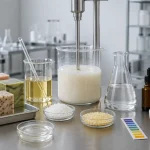
During early-stage R&D, formulators create and compare candidate formulations. At this point, potential problems may include poor emulsion formation, ingredient incompatibility, precipitation, unexpected viscosity, or changes in pH and appearance. Preparing consistent, representative samples is critical because differences in weighing, mixing, or homogenization can make later stability results difficult to compare.
Laboratory homogenizers and high-shear mixing equipment can support controlled sample preparation, while analytical balances help maintain consistent formulation quantities. pH meters, conductivity meters where relevant, and viscometers provide baseline measurements that can later be compared with results obtained after storage.
Recommended laboratory equipment for this stage:
- Analytical Balance – Supports accurate weighing of raw materials, samples, and formulation ingredients for reproducible preparation.
- Laboratory Homogenizer – Helps create uniform emulsions and dispersions during formulation and sample preparation.
- pH Meter – Establishes baseline pH and allows subsequent pH changes to be tracked during the study.
- Conductivity Meter – Provides an additional measurement for relevant water-based or ionic formulations when conductivity is part of the test protocol.
- Viscometer – Establishes baseline viscosity for comparison with measurements taken after storage or environmental exposure.


Accelerated Stability Storage
Accelerated stability studies expose samples to controlled environmental conditions selected to reveal potential formulation or packaging-related changes within a practical development period. Depending on the test program, this may involve elevated temperature, controlled humidity, temperature cycling, freeze-thaw exposure, or other defined storage conditions.
These studies can help identify failure modes such as phase separation, viscosity change, precipitation, discoloration, or odor change and can support comparison between formulations. However, accelerated storage should not be treated as an automatic mathematical conversion to a specific real-time shelf-life unless that relationship has been appropriately established for the product and protocol.
Stability chambers and climate cabinets provide controlled environments for these studies, while data loggers support verification and traceability of actual storage conditions.
Recommended laboratory equipment for this stage:
- Stability Chamber – Provides controlled environmental storage for accelerated or longer-term stability studies.
- Climate Cabinet – Supports programmable environmental conditions or cycling when required by the stability protocol.
- Data Logger – Records environmental conditions so storage history can be reviewed alongside sample results.

Physical Property Evaluation
At defined intervals, stored samples are compared with their initial condition and applicable acceptance criteria. Evaluation may include appearance, phase separation, sedimentation, creaming, texture, viscosity, pH, color, and visible structural changes.
A centrifuge can be used as a screening tool to apply additional separation stress to emulsions or suspensions. Viscometers quantify changes in flow behavior or consistency, while pH meters reveal shifts that may indicate formulation change. Microscopy can help examine droplets, particles, crystals, or other visible structural features. Suspected microbial contamination requires appropriate microbiological methods rather than microscopy alone.
Recommended laboratory equipment for this stage:
- Centrifuge – Provides a rapid physical stress screening method for emulsions and suspensions that may be prone to separation.
- Viscometer – Measures viscosity changes that can indicate changes in product structure or consistency.
- pH Meter – Detects pH drift during storage and supports comparison with the formulation’s defined specification.
- Microscope – Supports examination of particle, droplet, or crystal changes where microscopic evaluation is relevant.
- Colorimeter or Spectrophotometer – Provides objective measurements for monitoring color change when color stability is important.


Chemical and Analytical Testing
Physical appearance alone cannot confirm that chemically important formulation components remain unchanged. When a stability program requires quantitative analysis of active ingredients, preservatives, UV filters, degradation markers, or other target compounds, an appropriate analytical method is needed.
HPLC may be used when a validated chromatographic method is available for the target analyte, while UV-Vis spectrophotometry can support suitable absorbance-based measurements. The appropriate analytical technique depends on the compound, formulation matrix, required selectivity, and test method rather than on product type alone.
Microbiological stability is a separate part of the overall assessment. Where microbiological examination or preservative efficacy testing is performed in-house, suitable microbiology equipment, controlled procedures, and trained personnel are required.
Recommended laboratory equipment for this stage:
- HPLC System – Supports separation and quantitative analysis of suitable target compounds when chromatographic testing is part of the stability program.
- UV-Vis Spectrophotometer – Supports suitable absorbance-based quantitative or comparative measurements.
- Incubator – Provides controlled incubation conditions for relevant microbiological procedures.
- Autoclave – Supports sterilization of suitable microbiological media, materials, and laboratory items.
- Analytical Balance – Supports accurate sample, standard, reagent, and media preparation.


Real-Time Shelf-Life Monitoring
Real-time stability studies store the final product under defined conditions appropriate to the product and study protocol. Samples are evaluated at scheduled intervals using the physical, chemical, and microbiological tests relevant to the formulation.
The purpose is to establish how the packaged product behaves over time under the selected storage conditions and to compare real-time observations with earlier development and accelerated-study findings. Storage conditions, sampling intervals, study duration, acceptance criteria, and analytical methods should be defined for the specific product rather than assumed to be universal.
For laboratories managing many formulations or batches, structured data management can help track sample locations, pull dates, results, deviations, and trends throughout the study.
Recommended laboratory equipment for this stage:
- Stability Chamber – Provides controlled storage conditions for longer-term stability monitoring.
- Data Management Software – Helps track sample schedules, results, and trends across multiple stability studies.
- Viscometer, pH Meter, Centrifuge – Core instruments that can be reused at defined intervals to compare physical properties with baseline results.

Common Quality Control Challenges in Cosmetic Manufacturing
- Ingredient interactions that contribute to emulsion instability, precipitation, crystallization, or other visible changes.
- Inadequate microbiological control or preservation in formulations susceptible to contamination.
- Color or odor changes associated with light, oxygen, ingredients, packaging, or storage conditions.
- Viscosity drift that changes product texture, dispensing, or application characteristics.
- Phase separation or other physical instability during temperature cycling, transportation, or storage.
- Difficulty selecting accelerated conditions that reveal meaningful failure modes without creating changes that are not representative of normal product behavior.
- Inconsistent sample preparation or measurement procedures that make results difficult to compare across batches or time points.
Key Quality Control Tests for Cosmetic Stability Testing
| Quality Challenge | Quality Control Test | Recommended Laboratory Equipment | Application |
|---|---|---|---|
| Emulsion separation | Centrifuge testing | Centrifuge | Provides rapid screening for separation tendency in creams, lotions, and other multiphase formulations |
| Viscosity changes | Viscosity measurement | Viscometer | Tracks changes in product consistency during defined storage conditions |
| pH drift | pH determination | pH Meter | Compares pH with the initial value and defined formulation specification |
| Color change | Colorimetry or spectrophotometry | Colorimeter or Spectrophotometer | Provides objective comparison of color during the stability study |
| Active or target compound change | Chromatographic analysis where applicable | HPLC System | Quantifies suitable target compounds when a validated analytical method is available |
| Microbiological risk | Relevant microbiological testing or preservative efficacy testing | Incubator, Autoclave | Supports controlled microbiological laboratory procedures when testing is performed in-house |
| Crystal or particle changes | Microscopy | Microscope | Examines visible microscopic changes such as crystallization or particle structure |
| Package-related weight change | Gravimetric monitoring | Analytical Balance | Tracks product or package weight change when this is part of the stability protocol |
Laboratory Equipment Required for Cosmetic Quality Control
A cosmetic stability laboratory usually combines four equipment groups: environmental control, physical characterization, chemical analysis, and microbiological testing. The exact configuration should reflect the products being manufactured and the tests that the laboratory actually performs.
For many manufacturers, stability chambers, pH meters, viscometers, centrifuges, and analytical balances form the core stability-testing setup. Climate cabinets, color measurement instruments, microscopes, HPLC systems, and microbiology equipment become relevant when the stability program requires more specialized environmental, analytical, or microbiological evaluation.
| Testing Requirement | Laboratory Equipment | Why Manufacturers Need It |
|---|---|---|
| Controlled environmental exposure | Stability Chamber or Climate Cabinet | To maintain defined storage or stress conditions reproducibly |
| Viscosity monitoring | Viscometer | To identify changes in consistency that may affect product quality and use |
| pH stability monitoring | pH Meter | To compare formulation pH across stability-study intervals |
| Centrifugal stress screening | Centrifuge | To provide rapid screening for separation tendency in suitable formulations |
| Target compound quantification | HPLC System | To perform suitable chromatographic analysis when required by the analytical method |
| Color consistency verification | Colorimeter or Spectrophotometer | To objectively compare color between initial and stored samples |
| Microbiological testing | Incubator and Autoclave | To support relevant microbiological procedures when performed in-house |
| Precise sample and reagent weighing | Analytical Balance | To support reproducible formulation, sample, reagent, and media preparation |
The most useful laboratory configuration is therefore not necessarily the one with the largest number of instruments. It is the configuration that covers the defined product risks, test methods, sample volume, and decision points while producing measurements that can be compared reliably throughout the stability program.
Basic Laboratory Setup for Cosmetic Manufacturers
| Laboratory Level | Recommended Equipment | Suitable For |
|---|---|---|
| Basic QC Laboratory | Stability Chamber, pH Meter, Viscometer, Centrifuge, Analytical Balance | Manufacturers performing core physical stability checks and controlled storage in-house |
| Advanced QC Laboratory | Above plus Climate Cabinet, Colorimeter, Microscope, Incubator, Autoclave | Laboratories requiring broader environmental, physical, visual, and microbiological testing capabilities |
| Advanced Analysis Laboratory | Above plus HPLC System, UV-Vis Spectrophotometer, Data Management Software | Manufacturers or R&D laboratories performing more extensive analytical testing and multi-study data management |
A basic laboratory may be sufficient when the main requirement is routine environmental storage and physical-property monitoring and specialized chemical or microbiological analyses are outsourced. Advanced equipment becomes more justified when those methods are required frequently, sample throughput is high enough to support in-house operation, and trained personnel are available.
How to Choose Laboratory Equipment for Cosmetic Stability Testing
Selecting the right equipment requires matching each instrument to a defined test, sample type, expected workload, and decision requirement. This prevents both under-specifying instruments that cannot handle the application and purchasing advanced equipment that the laboratory does not need.
Define the Testing Scope
Start by identifying the formulations being tested, such as emulsions, gels, anhydrous products, suspensions, or water-based liquids, and the instability risks relevant to each product. Then map each required test to the instrument needed to generate the measurement.
For example:
- Controlled stability storage → Stability Chamber or Climate Cabinet
- Viscosity change → Viscometer
- pH drift → pH Meter
- Separation screening → Centrifuge
- Color change → Colorimeter or Spectrophotometer
- Microscopic structural change → Microscope
- Suitable target compound analysis → HPLC System or another method appropriate to the analyte
- In-house microbiological procedures → Appropriate microbiology laboratory equipment, including incubator and autoclave where required
This test-to-instrument mapping should be completed before comparing individual equipment models.
Evaluate Measurement and Workflow Requirements
Instrument selection should reflect the actual samples and workload. For a viscometer, the laboratory should consider the range of product consistencies being tested and whether the selected system is appropriate for both low-viscosity liquids and thicker formulations. For environmental chambers, usable capacity, required environmental control, sample loading, monitoring, and study duration should be considered.
A laboratory handling many batches or stability pulls also benefits from consistent sample identification, documented methods, environmental records, and organized result tracking. Higher sample throughput may justify greater automation or dedicated equipment, while an R&D laboratory may place more value on flexibility across different formulation types.
Decide What to Test In-House
Not every manufacturer needs every analytical instrument. Routine pH, viscosity, centrifugation, weighing, and controlled storage may be practical to maintain internally, while specialized chemical or microbiological methods may be outsourced when testing frequency is low or the required expertise and infrastructure are not available.
HPLC, for example, is most useful when the laboratory has a defined analytical requirement, suitable methods, trained operators, and enough testing demand to justify in-house analysis. Equipment purchasing decisions should therefore consider both analytical need and the operational resources required to generate reliable results.
Compare Calibration, Maintenance, and Long-Term Support
Measurement reliability depends on more than initial instrument capability. Consider how instruments will be checked or calibrated, how environmental conditions will be monitored, whether required accessories and consumables are readily available, and whether technical service and operator training can be supported over the equipment’s working life.
For a scalable laboratory, prioritize the equipment needed for routine decisions first, then add specialized analytical capability as product complexity, testing volume, or internal testing requirements increase.
Who Needs Laboratory Testing Solutions for This Industry?
- Cosmetic contract manufacturers performing stability testing across multiple client formulations.
- Brand-owned R&D centers developing skincare, hair care, personal care, and color cosmetic products.
- QC departments monitoring batch consistency and product behavior during stability studies.
- Quality and regulatory teams requiring organized stability data to support product documentation.
- Independent testing laboratories providing outsourced cosmetic stability, analytical, or microbiological testing services.
Frequently Asked Questions
What is the most important instrument for cosmetic stability testing?
A stability chamber is one of the core instruments because it provides controlled environmental storage for stability studies. However, a complete stability assessment normally also requires measurement instruments such as a pH meter and viscometer, with additional physical, chemical, or microbiological equipment selected according to the product and test protocol.
How long does accelerated stability testing typically take?
There is no single accelerated stability duration that applies to every cosmetic product. The study duration, storage conditions, sampling intervals, and acceptance criteria should be defined for the formulation, packaging system, development objective, and applicable requirements. Accelerated studies can reveal instability earlier, but their results should not automatically be converted into a specific real-time shelf-life without appropriate supporting evidence.
Can a centrifuge test replace long-term stability studies?
No. Centrifuge testing is a useful rapid screening technique for detecting separation tendency in suitable emulsions and suspensions, but it does not reproduce all time-dependent physical, chemical, packaging-related, or microbiological changes. It should therefore complement rather than replace an appropriate stability study.
Do I need microbiological testing equipment for all cosmetics?
The required microbiological testing capability depends on the product, formulation, test program, and how the manufacturer organizes testing. Products with microbiological risk may require relevant microbiological evaluation, but a manufacturer does not necessarily need to maintain every microbiology instrument in-house if suitable testing is outsourced.
Conclusion
An effective cosmetic stability testing laboratory connects product risks to defined tests and then connects each test to the equipment required to generate useful, reproducible data. Stability chambers provide controlled storage, while pH meters, viscometers, centrifuges, balances, and other physical measurement instruments track formulation changes. Chemical and microbiological equipment can be added when the testing program requires those capabilities in-house.
For equipment planning, manufacturers should begin with the product types, required tests, sample throughput, measurement needs, and existing laboratory capabilities. This test-driven approach helps create a laboratory configuration that supports formulation development, routine quality control, and longer-term stability monitoring without adding unnecessary complexity.
Laboratory Equipment Solutions for Cosmetic Stability Testing
AELAB supports cosmetic manufacturers in planning laboratory equipment configurations around their stability-testing workflow. Relevant equipment categories may include controlled environmental chambers, physical-property measurement instruments, sample-preparation equipment, analytical systems, and microbiology laboratory equipment.
When evaluating a laboratory configuration, useful project information includes the products or samples being tested, required test methods, expected testing volume, current laboratory infrastructure, and the main stability or quality-control challenges. These details help determine which equipment categories should form the core laboratory and which advanced capabilities may be added as testing requirements expand.