Pharmaceutical Quality Control Laboratory Equipment Overview
Pharmaceutical quality control laboratory equipment supports the testing of raw materials, in-process samples, finished dosage forms, stability samples, and controlled manufacturing environments. Depending on the products and methods involved, a pharmaceutical QC laboratory may require analytical instruments such as HPLC, UV-Vis, and FTIR; physical testing equipment such as dissolution, disintegration, hardness, and friability testers; moisture and basic measurement instruments; microbiology equipment; and stability or environmental monitoring systems.
The appropriate laboratory configuration depends on the dosage forms being manufactured, required analytical methods, sample throughput, applicable pharmacopoeial or regulatory expectations, and whether the laboratory supports routine release testing, stability studies, microbiological testing, or specialized investigations.
For manufacturers, R&D teams, and QC managers, the most useful approach is to map each production stage to the required quality control test and then to the instrument needed to perform that test. This guide follows that workflow from incoming raw materials through finished-product testing, stability studies, and environmental monitoring.
What Is Pharmaceutical Quality Control Laboratory Equipment?
Pharmaceutical quality control laboratory equipment refers to the instruments, apparatus, and supporting tools used to evaluate drug substances, excipients, intermediates, packaging materials, and finished pharmaceutical products for relevant quality attributes such as identity, purity, potency, physical performance, microbiological quality, and stability.
The equipment required varies significantly by product type. A laboratory supporting solid oral dosage forms may emphasize HPLC, dissolution, disintegration, hardness, friability, moisture, and weighing equipment. Laboratories supporting sterile products may also require dedicated microbiological and contamination-control capabilities. Liquid and semisolid products can introduce additional requirements such as pH and viscosity measurement.
In regulated pharmaceutical environments, instrument selection must also consider qualification, calibration, maintenance, data integrity, method suitability, user access, and documentation requirements. These considerations apply not only to sophisticated analytical systems but also to routine instruments whose measurements affect product quality decisions.
Main Sample Types Tested in Pharmaceutical QC Laboratories
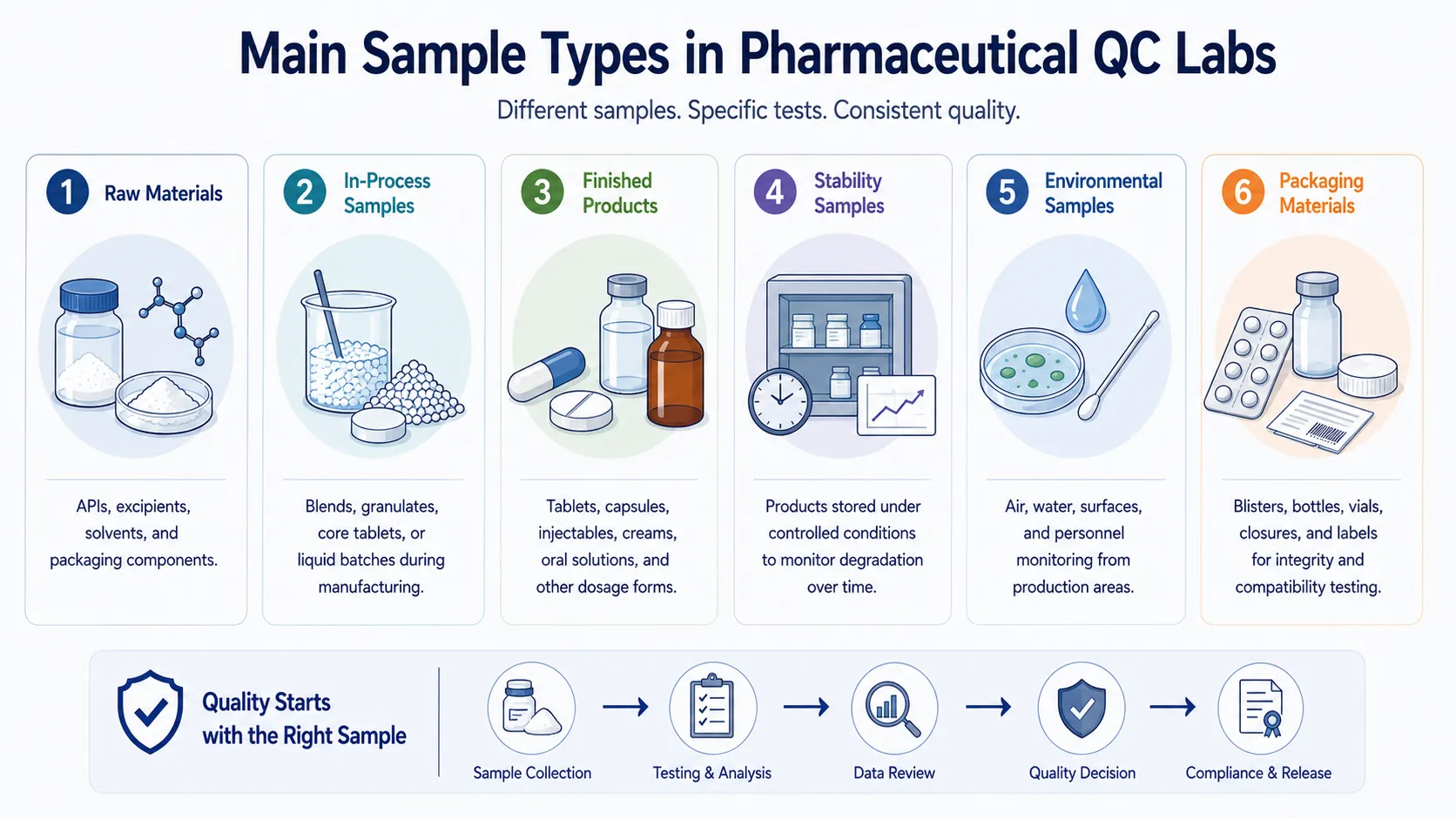
Pharmaceutical QC laboratories handle different sample types across the manufacturing and product lifecycle. Identifying the sample type is an important first step because it determines the relevant tests, methods, and equipment.
- Raw materials: Active pharmaceutical ingredients (APIs), excipients, solvents, and other incoming materials.
- In-process samples: Blends, granulates, core tablets, bulk liquids, and other samples collected during manufacturing.
- Finished products: Tablets, capsules, injectables, creams, oral solutions, and other final dosage forms.
- Stability samples: Products stored under defined conditions and tested at scheduled intervals to evaluate quality changes over time.
- Environmental samples: Air, water, surfaces, and other samples used in environmental or contamination-control programs.
- Packaging materials: Blisters, bottles, vials, closures, labels, and other packaging components evaluated according to applicable specifications.
Pharmaceutical Quality Control Workflow: From Raw Materials to Finished Products
A pharmaceutical QC workflow can be understood as a sequence of sample type → required test → analytical or physical method → laboratory equipment. The exact tests and acceptance criteria depend on the material, dosage form, approved specification, analytical method, and applicable quality requirements.
1. Raw Material Identity and Purity Testing
Incoming APIs and excipients are evaluated against defined specifications before they are accepted for manufacturing use. Depending on the material and method, testing may include identity confirmation, assay or purity determination, moisture analysis, and other chemical or physical characteristics.
Infrared spectroscopy can support material identification, chromatographic techniques can be used for assay or impurity analysis, and Karl Fischer titration or other appropriate methods may be used when water content is a critical quality attribute.
Typical QC checks: Identity, assay or purity, moisture or water content, and other material-specific tests defined by the applicable specification.
- FTIR spectrophotometer
- Analytical balance
- Karl Fischer titrator
- Melting point apparatus
- Inductively coupled plasma optical emission spectrometer (ICP-OES), where elemental analysis is required



2. In-Process Manufacturing Control
In-process testing helps determine whether manufacturing remains within established process and product requirements before the batch reaches final release testing. The relevant measurements depend heavily on dosage form and production process.
For solid dosage forms, laboratories may evaluate blend or dosage-unit characteristics, granule moisture, tablet weight, dimensions, hardness, or other physical properties. Liquid and semisolid processes may require measurements such as pH, viscosity, or homogeneity where these are relevant to the formulation and process.
Typical QC checks: Blend or content-related measurements, moisture content, particle characteristics, weight or dimensions, pH, viscosity, disintegration, or hardness where applicable.
- UV-Vis spectrophotometer
- Moisture analyzer
- Balances (precision and analytical)
- Disintegration tester
- Tablet hardness tester
- Particle size analyzer


3. Finished Product Release Testing
Finished-product testing verifies whether a batch meets its approved release specification before disposition. The required test set varies by dosage form and product.
For tablets and capsules, testing can include assay, content uniformity, dissolution or disintegration, and relevant physical properties. Sterile products require additional microbiological and particulate-control testing as specified for the product. Liquids and semisolids may require pH, viscosity, assay, microbial quality, or other formulation-specific tests.
Typical QC checks: Assay, content uniformity, dissolution, disintegration, hardness, friability, sterility, bacterial endotoxins, particulate testing, pH, and microbial limits as applicable to the product.
- High-performance liquid chromatograph (HPLC)
- Dissolution apparatus
- Disintegration tester
- Tablet hardness and friability testers
- Sterility test isolator
- Endotoxin testing system (LAL)
- Microbial air sampler


4. Stability Study Management
Stability studies evaluate how pharmaceutical product quality changes over time under defined storage conditions. The study design, storage conditions, test intervals, and analytical requirements depend on the product and the applicable stability program.
The laboratory equipment used for stability work therefore includes both controlled storage equipment and the analytical instruments needed to evaluate stability-related quality attributes. Stability-indicating analytical methods are particularly important when degradation products or changes in assay must be distinguished from the original product components.
Typical QC checks: Assay, related substances, dissolution, moisture, pH, appearance, and microbiological attributes where applicable at defined stability pull points.
- Stability chambers with environmental monitoring
- HPLC with an appropriate detector for the analytical method
- Dissolution apparatus
- Karl Fischer titrator
- pH meter


5. Environmental and Utility Monitoring
Pharmaceutical manufacturing and testing operations may require monitoring of controlled environments and critical utility systems. The scope depends on the facility, process, product risk, and contamination-control program.
Environmental monitoring can include non-viable particle counting, viable air or surface sampling, and incubation of microbiological samples. Pharmaceutical water systems may require measurements such as conductivity, total organic carbon (TOC), and microbiological testing according to the applicable water specification.
Typical QC checks: Non-viable particles, viable air and surface monitoring, water conductivity, TOC, and bioburden where applicable.
- Portable particle counter
- Microbial air sampler
- Total organic carbon (TOC) analyzer
- Conductivity meter
- Incubators for microbial plates


Key Quality Control Tests for Pharmaceutical Products
The following table shows common test-to-equipment relationships. The exact test set should always be determined from the product specification and applicable analytical methods.
| Quality Control Test | Purpose | Common Laboratory Equipment | Relevant Product Types / Applications |
|---|---|---|---|
| Assay (Potency) | Quantify the active ingredient | HPLC, UV-Vis spectrophotometer, titration system | Drug substances and many finished dosage forms |
| Content Uniformity | Evaluate consistency of active ingredient between dosage units | HPLC, UV-Vis spectrophotometer where method-suitable | Applicable unit-dose pharmaceutical products |
| Dissolution Testing | Evaluate drug release under defined in vitro conditions | Dissolution apparatus appropriate to the method | Products for which dissolution testing is specified |
| Disintegration | Measure how a dosage form disintegrates under defined test conditions | Disintegration tester | Tablets, capsules, and other applicable dosage forms |
| Hardness / Friability | Assess relevant physical strength and resistance to handling | Tablet hardness tester, friabilator | Applicable tablet products |
| Sterility Testing | Evaluate compliance with sterility requirements | Sterility testing system, membrane filtration equipment where method-applicable, incubators | Sterile pharmaceutical products |
| Bacterial Endotoxins | Detect or quantify bacterial endotoxins where required | LAL test equipment, endotoxin detection system | Applicable parenteral products and pharmaceutical water applications |
| Microbial Limits | Evaluate specified microbiological quality attributes | Autoclave, incubators, colony counter, and supporting microbiology equipment | Applicable non-sterile products and raw materials |
| Water Content (Moisture) | Determine water or moisture where it affects material or product quality | Karl Fischer titrator, moisture analyzer where method-suitable | APIs, excipients, granules, and finished products as applicable |
| pH Measurement | Determine acidity or alkalinity | pH meter | Liquids, solutions, pharmaceutical water, and other applicable samples |
Recommended Laboratory Equipment for Pharmaceutical QC Laboratories
There is no single universal equipment list for every pharmaceutical QC laboratory. A suitable configuration should be built from the actual products, analytical methods, sample types, and testing responsibilities of the facility.
| Laboratory Equipment | Main Application | Why It Matters |
|---|---|---|
| High-Performance Liquid Chromatograph (HPLC) | Assay, content uniformity, related substances and other chromatographic methods | Supports quantitative and separation-based testing for many pharmaceutical materials and products |
| Dissolution Apparatus | In vitro drug-release testing | Required when the applicable product specification or analytical method includes dissolution testing |
| UV-Vis Spectrophotometer | Identity, assay, dissolution sample analysis, and other spectrophotometric methods | Useful for routine quantitative or qualitative methods where UV-Vis analysis is suitable |
| Karl Fischer Titrator | Water content determination | Provides specific water determination for materials and products where moisture control is important |
| Analytical Balance | Precision weighing of samples and standards | Supports accurate sample and standard preparation across many analytical methods |
| Disintegration Tester | Dosage-form disintegration testing | Supports products and methods that include a defined disintegration requirement |
| Tablet Hardness / Friability Tester | Physical integrity assessment | Helps evaluate tablet mechanical properties relevant to manufacturing and handling |
| Sterility Test Isolator | Controlled sterility testing | Can provide a controlled environment for sterility-testing operations where this approach is selected |
| LAL / Endotoxin Detection System | Bacterial endotoxins testing | Supports endotoxin testing for products or water systems where the test is required |
| Stability Chamber | Controlled storage of stability samples | Maintains defined environmental conditions for stability programs |
| TOC Analyzer | Total organic carbon measurement in pharmaceutical water systems | Supports water-quality monitoring where TOC is part of the applicable specification |
| Microbial Air Sampler + Particle Counter | Environmental monitoring | Supports viable and non-viable monitoring programs in controlled manufacturing environments |
Essential vs Advanced Pharmaceutical QC Laboratory Equipment
A new laboratory does not necessarily need every analytical technology at the same time. Equipment should be prioritized according to the tests that must actually be performed in-house.
| Laboratory Need | Typical Equipment Families | Selection Logic |
|---|---|---|
| Routine sample preparation and basic measurements | Analytical balances, pH meters, basic sample-preparation equipment | Needed broadly across many routine QC workflows |
| Routine chemical analysis | HPLC, UV-Vis, titration equipment | Select according to approved or intended analytical methods and required sensitivity |
| Solid dosage-form physical testing | Dissolution, disintegration, hardness, friability equipment | Relevant when tablets, capsules, or other applicable dosage forms are part of the product portfolio |
| Moisture and water determination | Karl Fischer titrator, moisture analyzer | Choose according to the material, required method, expected water level, and sample characteristics |
| Microbiological QC | Incubators, autoclave, sterility or microbial-testing equipment | Required when microbiological testing is performed in-house |
| Stability program | Stability chambers plus stability-indicating analytical capability | Required when the laboratory manages stability storage and testing internally |
| Environmental and pharmaceutical water monitoring | Particle counters, microbial air samplers, conductivity meters, TOC analyzers | Depends on facility monitoring responsibilities and applicable utility specifications |
| Advanced elemental or specialized analysis | ICP-OES and other method-specific analytical platforms | Justified when product specifications, investigations, or analytical methods require the capability |
How to Choose Laboratory Equipment for Pharmaceutical QC
Selecting pharmaceutical quality control laboratory equipment should begin with the testing matrix rather than with a list of instruments. Map each raw material, intermediate, and finished product to its required tests, analytical methods, expected sample volume, and laboratory responsibility. This reveals which instruments are essential for routine work and which capabilities are only needed for specific products or advanced investigations.
Method requirements and analytical performance should be considered first. The selected instrument must be suitable for the analytical method and the concentrations or quality attributes being measured. Avoid choosing an advanced platform solely because it offers greater theoretical performance if the routine methods do not require that capability.
Sample volume and throughput determine how much automation is justified. Laboratories processing large numbers of repetitive samples may benefit from autosamplers, automated data handling, or higher-throughput systems, while lower-volume laboratories may prioritize flexibility and ease of maintenance.
Qualification, calibration, and maintenance should be evaluated before purchase. Consider how the equipment will be qualified for intended use, how routine calibration or performance checks will be managed, and whether suitable service, spare parts, consumables, and technical support are available.
Data integrity and software requirements should be matched to the laboratory’s regulated workflow. Where electronic records are used for regulated activities, evaluate user access controls, audit trails, data retention, backup, review workflows, and other controls required by the applicable quality system rather than assuming that one software designation makes an instrument universally compliant.
Future expansion also matters. A laboratory expecting new dosage forms, higher sample volumes, or additional analytical methods should consider whether an instrument platform can support those foreseeable requirements without unnecessary overinvestment at the initial stage.
For equipment planning, a useful RFQ or supplier discussion should therefore include the product types, sample types, required tests, analytical methods, expected sample throughput, and any applicable qualification or data-management requirements.
Frequently Asked Questions
What equipment is essential for a basic pharmaceutical QC lab?
The essential equipment depends on the products and tests performed in-house. A laboratory supporting routine pharmaceutical chemical analysis may require HPLC, UV-Vis, analytical balances, pH measurement, and appropriate moisture-testing equipment. Solid dosage-form laboratories may additionally need dissolution, disintegration, hardness, and friability equipment. Microbiology, sterility, endotoxin, stability, and environmental-monitoring equipment should be added when those testing responsibilities apply.
How do I choose between HPLC and UHPLC for routine QC testing?
Choose according to the analytical method, required chromatographic performance, sample throughput, existing methods, and laboratory infrastructure. Conventional HPLC remains suitable for many routine pharmaceutical methods. UHPLC can provide faster separations and may reduce solvent consumption for suitable methods, but method compatibility and transfer requirements should be evaluated before changing platforms.
What are the critical calibration requirements for pharmaceutical QC equipment?
Calibration and performance-check requirements should be defined according to the instrument, intended use, applicable method, manufacturer guidance, laboratory procedures, and quality system. Balances, chromatographic systems, dissolution equipment, pH meters, and other instruments that affect reportable QC results should have documented qualification, calibration, maintenance, and performance-control procedures appropriate to their use.
Can the same dissolution tester be used for different dosage forms?
Potentially, if the system supports the apparatus and operating conditions required by the relevant dissolution methods. The laboratory should verify that the configuration, vessels, accessories, operating parameters, and qualification status are appropriate for each method before using one system across different products.
What role does environmental monitoring equipment play in QC?
Environmental monitoring equipment helps laboratories and manufacturing facilities evaluate controlled environments and utility systems. Depending on the facility program, this can include non-viable particle counting, viable air or surface monitoring, incubation of microbiological samples, and testing of pharmaceutical water systems using instruments such as conductivity or TOC analyzers.
How important is data integrity software in pharma QC instruments?
Data integrity is important whenever instrument data contribute to regulated pharmaceutical quality decisions. The required controls depend on the laboratory’s electronic records and quality system, but commonly evaluated capabilities include controlled user access, audit trails, secure data retention, backup, review workflows, and protection against unauthorized alteration or deletion of records.
Conclusion
Pharmaceutical quality control laboratory equipment should be selected from the testing requirements of the actual product portfolio rather than from a universal instrument checklist. Raw-material identification, chemical analysis, dosage-form performance testing, microbiology, stability studies, environmental monitoring, and pharmaceutical water testing each create different equipment needs.
A practical laboratory plan maps sample → required test → method → instrument → throughput and compliance requirements. This approach helps distinguish core routine equipment from specialized or advanced systems and makes it easier to prioritize investment when establishing or upgrading a pharmaceutical QC laboratory.
The final equipment configuration should then be evaluated for method suitability, qualification and calibration needs, maintenance support, data management, future testing requirements, and compatibility with the laboratory’s quality system.