Pharmaceutical Microbiology Laboratory Equipment Overview
Pharmaceutical microbiology laboratories need equipment for aseptic sample handling, microbial enumeration, incubation, sterilization, filtration, environmental monitoring, endotoxin testing, water-quality monitoring, and, where required, microorganism identification. The exact laboratory configuration depends on the products manufactured, required test methods, sample volume, contamination-control strategy, and applicable quality requirements.
In pharmaceutical and biopharmaceutical manufacturing, microbiology quality control supports product quality and patient safety by detecting and controlling microbial contamination. Raw materials, water systems, production environments, in-process samples, and finished dosage forms may all require microbiological testing depending on the product and manufacturing process.
Effective microbial quality control therefore relies on a coordinated set of instruments rather than a single testing system. Basic laboratories may focus on aseptic handling, incubation, sterilization, filtration, and colony enumeration, while sterile-product and higher-throughput facilities may also require sterility testing systems, environmental monitoring equipment, endotoxin analyzers, TOC instruments, and microbial identification platforms.
This guide explains the main pharmaceutical microbiology testing stages, the laboratory equipment associated with each stage, and practical factors to consider when building or upgrading a microbiology QC laboratory.
Main Products and Applications
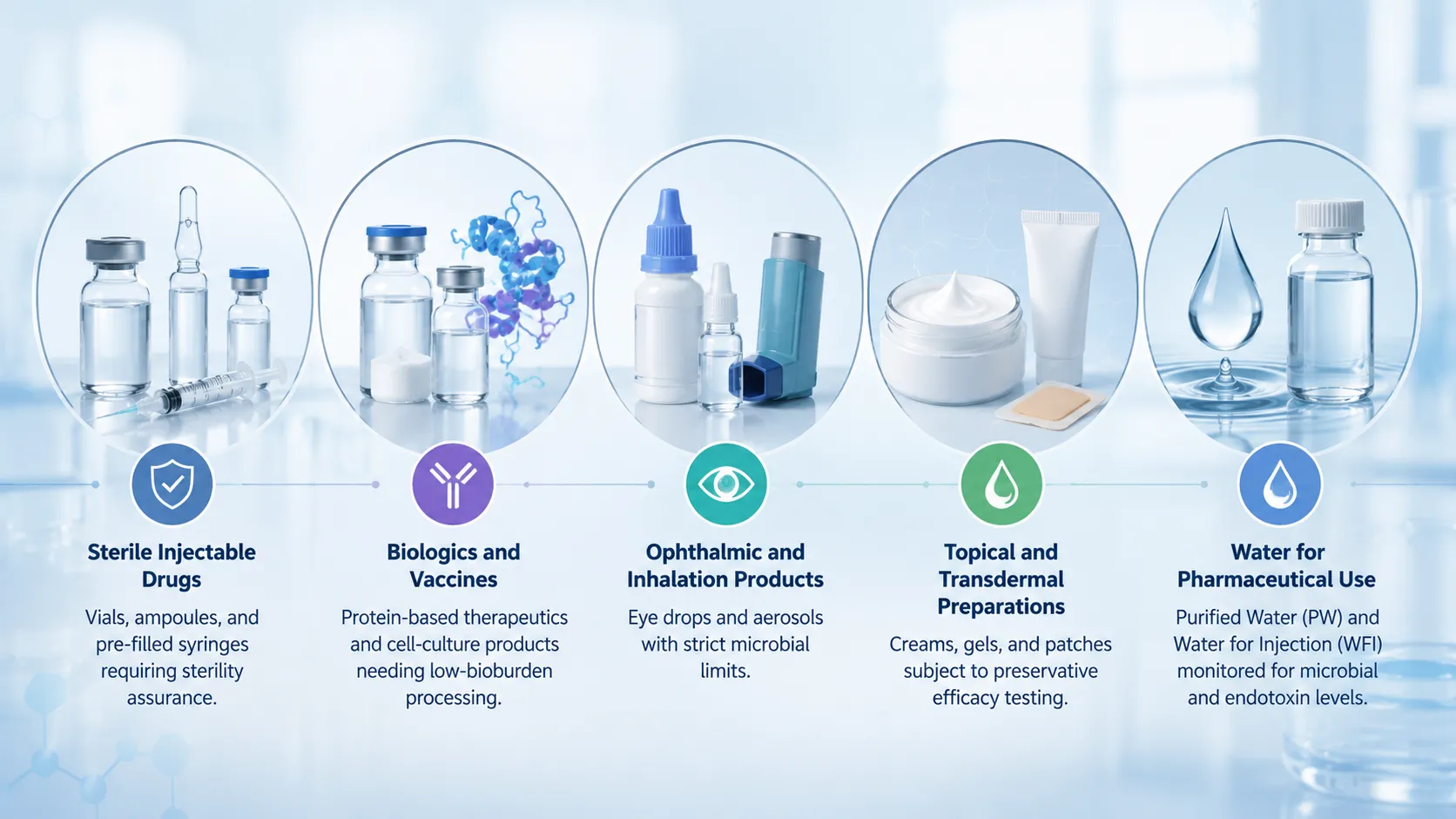
- Sterile injectable drugs – vials, ampoules, and pre-filled syringes requiring strong contamination control and sterility assurance
- Biologics and vaccines – protein-based therapeutics and cell-culture products requiring controlled microbial conditions
- Ophthalmic and inhalation products – products requiring microbiological quality control appropriate to their formulation and intended use
- Topical and transdermal preparations – creams, gels, and patches that may require microbial limits and preservative-effectiveness testing
- Water for pharmaceutical use – Purified Water (PW) and Water for Injection (WFI) monitored as part of the facility’s water-quality control program
Pharmaceutical Microbiology Quality Control Workflow
Raw Material and Excipient Bioburden Screening
Incoming active pharmaceutical ingredients and excipients can introduce bacteria, molds, yeasts, or spores into the manufacturing process. Bioburden and microbial enumeration testing help manufacturers assess the microbial load of applicable incoming materials before they enter downstream processing.
The required method depends on the material, expected microbial level, product characteristics, and applicable test procedure. Traditional culture-based methods remain important, while validated rapid microbiological methods may be considered when faster results or higher sample throughput are required.
Recommended laboratory equipment for this stage:
- Laminar Airflow Cabinet – Provides a controlled clean work area for microbiological sample preparation where appropriate
- Analytical Balance – Accurately weighs samples and materials used to prepare test portions and dilutions
- Colony Counter – Supports consistent enumeration of bacterial and fungal colonies on agar plates
- Incubator – Maintains controlled incubation conditions for microbial recovery and growth
- Autoclave – Sterilizes suitable media, laboratory materials, and microbiological waste


In-Process and Environmental Microbial Monitoring
Cleanrooms and other controlled manufacturing areas require microbiological monitoring according to the facility’s contamination-control and environmental-monitoring program. Air, surfaces, personnel, and equipment can all become potential contamination sources, particularly during aseptic operations.
Active air sampling can collect airborne microorganisms onto suitable culture media, while contact plates and swabs are commonly used for surface monitoring. Results are most useful when evaluated as trends rather than isolated measurements because recurring organisms, locations, or shifts in counts can help identify developing contamination-control problems.
Microbial identification may be used to characterize recovered isolates and support contamination investigations. Non-viable particle counters can complement viable monitoring by providing additional information about cleanroom environmental conditions.
Recommended laboratory equipment for this stage:
- Active Air Sampler – Collects airborne microorganisms onto suitable culture media for subsequent incubation and enumeration
- Contact Agar Plates (RODAC) – Supports microbiological sampling of suitable cleanroom surfaces
- Microbial Identification System – Helps identify recovered isolates using appropriate identification technologies
- Particle Counter – Measures non-viable airborne particles as part of cleanroom environmental control and classification activities
- Laboratory Incubator – Provides controlled incubation conditions for environmental monitoring samples


Bacterial Endotoxin Testing (LAL/BET)
Bacterial endotoxins originate from gram-negative bacteria and are an important quality concern for applicable pharmaceutical products, materials, and pharmaceutical water. Bacterial Endotoxins Testing (BET) using LAL-based methods may be performed using gel-clot, turbidimetric, or chromogenic approaches depending on the validated test method and laboratory requirements.
Instrument-based kinetic methods can provide quantitative results and improve sample processing and data handling. When selecting an endotoxin testing system, laboratories should consider the required method, sensitivity, sample throughput, interference testing, software and data-integrity requirements, and compatibility with the laboratory’s validated procedures.
Recommended laboratory equipment for this stage:
- Endotoxin Test System (Kinetic Turbidimetric/Chromogenic) – Supports quantitative bacterial endotoxin testing using applicable kinetic methods
- Test Tube Heater/Dry Block – Maintains controlled reaction temperature for applicable endotoxin test procedures
- Analytical Balance – Supports accurate preparation of samples and dilutions
- Water Purification System – Provides suitable laboratory water for applicable reagent and sample-preparation requirements

Sterility Testing of Finished Products
Products required to be sterile need an appropriate sterility assurance strategy, with sterility testing performed according to the applicable validated or compendial procedure. Sterility testing is designed to detect viable contaminating microorganisms in the tested product and must be performed under carefully controlled aseptic conditions to minimize the risk of laboratory-introduced contamination.
Membrane filtration is commonly used for suitable filterable products, while direct inoculation may be appropriate for other product types. The choice depends on product characteristics and the applicable method. Sterility testing systems, isolators, filtration equipment, and controlled incubators should therefore be selected as an integrated workflow rather than as independent instruments.
Recommended laboratory equipment for this stage:
- Sterility Test Isolator – Provides a controlled environment designed to reduce contamination risk during sterility testing
- Membrane Filtration System – Supports sterility testing of suitable filterable products by capturing microorganisms on a membrane
- Sterility Test Canister – Provides a closed or controlled filtration format for compatible sterility-testing workflows
- Incubator – Maintains the incubation conditions required by the applicable sterility test procedure
- Sterility Test Pump – Provides controlled fluid transfer or filtration for compatible sterility test systems

Microbial Limits Testing of Non-Sterile Products
Non-sterile pharmaceutical products still require appropriate microbiological quality control. Depending on the product and applicable specification, testing can include microbial enumeration and testing for specified microorganisms. The objective is to demonstrate that the product’s microbiological quality is suitable for its intended use and established acceptance criteria.
Sample preparation is especially important because product viscosity, solubility, antimicrobial activity, and preservatives can influence microbial recovery. Depending on the sample, laboratories may use dilution, homogenization, neutralization, plating, or membrane-filtration approaches before incubation and enumeration.
Recommended laboratory equipment for this stage:
- Membrane Filtration System – Supports microbial recovery and enumeration for compatible samples
- Automated Spiral Plater – Automates controlled sample deposition onto agar plates for applicable enumeration workflows
- Colony Counter – Supports consistent counting of colonies recovered during microbial enumeration
- Incubator – Provides controlled incubation conditions appropriate to the test method
- Stomacher (Laboratory Homogenizer) – Helps prepare homogeneous suspensions from compatible solid or semi-solid samples
Water System Monitoring and Disinfection Validation
Pharmaceutical water systems can become important sources of microbiological contamination if they are not adequately designed, operated, monitored, and maintained. Purified Water and WFI systems therefore require routine quality monitoring appropriate to their intended use and the facility’s established control strategy.
Microbial water testing commonly involves collecting representative samples, recovering microorganisms using an appropriate culture method, incubating under defined conditions, and enumerating recovered colonies. The selected sample volume, culture medium, incubation conditions, and acceptance criteria should follow the applicable validated or compendial procedure rather than a single universal laboratory setting.
TOC and conductivity instruments complement microbiological testing by monitoring other important water-quality attributes. They do not replace microbial enumeration or endotoxin testing where those tests are required.
Recommended laboratory equipment for this stage:
- Membrane Filtration Manifold – Supports filtration of water samples for microbial enumeration
- TOC Analyzer – Measures total organic carbon as a chemical water-quality attribute
- Conductivity Meter – Measures ionic conductivity as part of pharmaceutical water quality monitoring
- Laboratory Incubator – Provides controlled incubation conditions for recovered water microorganisms
- Colony Counter – Supports enumeration of colonies recovered from water samples


Common Quality Control Challenges in Pharmaceuticals & Biopharma
- Controlling microbial contamination in aseptic processing areas where personnel, airflow, equipment, materials, and cleaning practices can influence contamination risk
- Recovering slow-growing, stressed, or difficult-to-culture microorganisms using suitable sampling and incubation conditions
- Managing endotoxin risks associated with applicable raw materials, processes, products, and pharmaceutical water systems
- Demonstrating consistent performance of cleaning, disinfection, sterilization, and contamination-control procedures
- Reducing false-positive sterility test results caused by laboratory handling or the test environment
- Validating rapid microbiological methods before using them as alternatives to established methods
- Maintaining traceable records, calibration status, method control, and data integrity across microbiological testing workflows
Key Quality Control Tests for Pharmaceutical Microbiology
| Quality Challenge | Quality Control Test | Recommended Laboratory Equipment | Application |
|---|---|---|---|
| Raw material microbial load | Bioburden / microbial enumeration | Membrane filtration system, incubator, colony counter | Applicable incoming excipients and APIs |
| Environmental contamination | Active air and surface monitoring | Air sampler, contact plates, microbial identification system | Cleanrooms and controlled environments |
| Endotoxin in water/products | Bacterial Endotoxins Test (BET/LAL) | Kinetic endotoxin test system, controlled heating equipment | Applicable pharmaceutical water, materials, and products |
| Sterility assurance | Sterility Test | Sterility test isolator, membrane filtration system, incubator | Products requiring sterility testing |
| Non-sterile product microbiological quality | Microbial Limits Testing | Filtration/plating equipment, colony counter, incubator | Applicable oral, topical, and other non-sterile products |
| Water system microbial control | Water microbial enumeration | Membrane filtration manifold, incubator, colony counter | Purified Water and WFI systems |
| Preservative performance | Antimicrobial Effectiveness Testing | Incubator, colony counter, sample-preparation equipment | Applicable preserved and multi-dose products |
| Microorganism identification | Microbial identification | Microbial identification system | Environmental, water, process, or product isolates |
Laboratory Equipment Required for Pharmaceuticals & Biopharma Quality Control
A pharmaceutical microbiology laboratory typically combines core microbiology equipment with specialized systems selected according to the facility’s products and testing responsibilities. Core equipment commonly includes controlled work areas, incubators, sterilization equipment, sample-preparation tools, filtration systems, and colony-counting equipment. Specialized laboratories may additionally require sterility test isolators, endotoxin systems, environmental monitoring instruments, water-quality analyzers, automated enumeration systems, and microbial identification platforms.
The most useful purchasing approach is therefore to map each required test to its sample type, expected workload, contamination-control requirements, data requirements, and instrument category before selecting individual equipment.
| Testing Requirement | Laboratory Equipment | Why Manufacturers Need It |
|---|---|---|
| Aseptic sample handling | Laminar Airflow Cabinet / Biosafety Cabinet / Isolator, as appropriate | Provides a controlled work environment appropriate to the microbiological procedure and sample risk |
| Microbial enumeration | Colony Counter | Supports consistent and traceable enumeration for bioburden, microbial limits, environmental, and water testing |
| Sterilization of media and waste | Autoclave | Provides controlled moist-heat sterilization for compatible laboratory materials and microbiological waste |
| Controlled microbial growth | Incubator | Maintains defined incubation conditions for culture-based microbiological methods |
| Endotoxin quantification | Kinetic Chromogenic/Turbidimetric Reader | Supports quantitative endotoxin measurement for applicable samples and validated methods |
| Airborne viable monitoring | Active Air Sampler | Collects viable airborne contamination for environmental monitoring |
| Water system quality | TOC Analyzer / Conductivity Meter | Measures important chemical attributes used in pharmaceutical water monitoring |
| Microbial identification | Microbial Identification System | Helps characterize recovered isolates for trending and investigation |
These instruments work as a coordinated laboratory system. Equipment should be selected according to the tests actually performed rather than simply purchasing the most advanced available technology. For a lower-throughput laboratory, dependable manual filtration, incubation, and colony-counting equipment may be sufficient. Automation becomes more valuable as sample volume, turnaround requirements, data-management needs, or testing complexity increase.
Basic Laboratory Setup for Pharmaceutical Manufacturers
| Laboratory Level | Recommended Equipment | Suitable For |
|---|---|---|
| Basic QC Laboratory | Laminar airflow cabinet or other suitable controlled work area, autoclave, incubators, analytical balance, colony counter, membrane filtration system, water purification system, pH meter | Facilities performing routine bioburden, water, and microbial limits testing where these methods are applicable |
| Advanced QC Laboratory | All applicable Basic QC equipment plus kinetic endotoxin test system, sterility test isolator, active air sampler, particle counter, automated colony counter, TOC analyzer, spiral plater | Facilities with sterile-product, aseptic-processing, environmental-monitoring, or higher-throughput testing requirements |
| Advanced Analysis Laboratory | All applicable Advanced QC equipment plus microbial identification system, validated rapid microbiological systems where justified, automated testing platforms, environmental monitoring data systems, and LIMS connectivity | Higher-throughput pharmaceutical and biopharmaceutical laboratories requiring advanced identification, automation, rapid methods, or integrated data management |
The appropriate laboratory level is determined by testing obligations rather than company size alone. A smaller sterile-product manufacturer may need specialized sterility and environmental monitoring equipment, while a larger non-sterile facility may prioritize high-throughput microbial enumeration instead.
How to Choose Laboratory Equipment for Pharmaceutical Microbiology
Selecting pharmaceutical microbiology laboratory equipment starts with the required test methods and sample workload. The best system is one that can perform the laboratory’s validated methods reliably, fit the contamination-control strategy, handle expected throughput, and support calibration, maintenance, traceability, and data-integrity requirements.
Define the Testing Scope
Start by cataloging the sample types the laboratory will handle: raw materials, in-process samples, pharmaceutical water, environmental monitoring samples, and finished products. Then map each sample type to the required tests, such as bioburden, microbial limits, sterility, bacterial endotoxins, environmental monitoring, or microbial identification.
This mapping determines which equipment is essential. A facility performing only routine non-sterile microbial enumeration has different needs from an aseptic manufacturer performing sterility testing, environmental monitoring, endotoxin testing, and isolate identification.
Detection requirements and method suitability should be defined from the applicable procedure rather than assumed from a generic instrument specification. Laboratories should also determine whether established compendial methods will be used or whether an alternative or rapid method requires validation for the intended application.
Evaluate Laboratory Workflow Requirements
Daily sample volume, testing frequency, turnaround expectations, and shift patterns determine how much capacity and automation the laboratory needs. High-volume water monitoring, for example, may justify multi-place filtration equipment, larger incubation capacity, and automated colony counting. Lower-throughput laboratories may achieve the required performance with simpler manual systems.
Also consider operator training, available laboratory space, contamination-control zoning, instrument footprint, utilities, consumables, cleaning requirements, and sample flow. Equipment that performs well analytically but does not fit the physical or operational workflow can create bottlenecks and unnecessary handling.
Compare Long-Term Equipment Support
Equipment selection should include the full operating lifecycle, not only the initial purchase. Calibration, preventive maintenance, spare parts, consumables, service availability, user training, software support, and qualification requirements can all affect long-term laboratory performance and cost.
For computerized or automated systems, assess the data-management and integrity functions required by the facility’s quality system. Requirements such as user access control, audit trails, electronic records, interfaces, and system validation should be defined before purchase rather than assumed to be available.
Companies like AELAB can assist in matching testing scope, workflow requirements, and support considerations with suitable instrument categories. Providing product types, required tests, sample volume, existing equipment, and the main laboratory bottlenecks makes equipment recommendations more specific and useful.
Who Needs Laboratory Testing Solutions for This Industry?
- Pharmaceutical manufacturing quality control laboratories performing microbiological testing of raw materials, process samples, water, environments, or finished products
- Biopharmaceutical companies requiring contamination control and microbiological monitoring for biologics, vaccines, or other sensitive manufacturing processes
- Contract testing organizations (CTOs) providing outsourced sterility, endotoxin, microbial limits, water, environmental monitoring, or identification services
- Medical device manufacturers with microbiological testing requirements associated with sterile or controlled products
- Pharmaceutical water system operators monitoring PW and WFI generation and distribution systems as part of routine quality control
Frequently Asked Questions
What is the most critical equipment for a pharmaceutical microbiology laboratory?
There is no single most critical instrument for every pharmaceutical microbiology laboratory. Core equipment typically includes a suitable controlled work area, incubators, sterilization equipment, sample-preparation tools, and microbial enumeration equipment. Sterile-product laboratories may additionally require sterility testing, environmental monitoring, and endotoxin-testing systems.
How does endotoxin testing differ from sterility testing?
Endotoxin testing detects bacterial endotoxins using an appropriate BET method, while sterility testing is designed to detect viable contaminating microorganisms. The tests therefore measure different contamination risks and require different laboratory methods and equipment.
Can rapid microbiological methods replace traditional compendial tests?
Rapid or alternative microbiological methods may be used when they are suitable for the intended application and appropriately validated. Technologies can reduce time to result or improve automation, but adoption depends on the test purpose, product, validation strategy, quality system, and applicable requirements.
What are the key considerations for environmental monitoring equipment selection?
Environmental monitoring equipment should be selected according to the sampling location, monitoring method, cleanroom or controlled-area requirements, expected sampling volume, collection performance, cleaning and sterilization needs, portability, data handling, and compatibility with the site’s environmental-monitoring program. The equipment should support reliable trending and investigation of environmental results.
Conclusion
A pharmaceutical microbiology laboratory should be designed around the tests the facility actually needs to perform. Core microbiology equipment supports aseptic handling, sample preparation, sterilization, incubation, filtration, and microbial enumeration, while specialized systems add capabilities for sterility testing, bacterial endotoxins, environmental monitoring, water analysis, rapid methods, automation, and microbial identification.
The most effective equipment-selection process is to map each sample type and QC requirement to the applicable method, expected throughput, required instrument category, and long-term support needs. This approach helps avoid both under-equipped laboratories that create testing bottlenecks and unnecessarily complex systems that add cost without improving the required QC workflow.
Laboratory Equipment Solutions for Pharmaceuticals & Biopharma
AELAB supports pharmaceutical and biopharmaceutical laboratories evaluating equipment for microbiological quality control. Equipment recommendations can be structured around the facility’s sample types, required test methods, workload, existing laboratory setup, contamination-control needs, and desired level of automation.
For a basic laboratory, priorities may include reliable aseptic handling, sterilization, incubation, membrane filtration, and colony enumeration. Sterile-product or higher-throughput laboratories may additionally require endotoxin testing, sterility testing, environmental monitoring, pharmaceutical water analysis, automated counting, or microbial identification systems.
Providing your product types, required microbiological tests, expected sample volumes, current equipment, and main laboratory challenges makes it possible to identify a more practical laboratory configuration without over-specifying unnecessary instrumentation.