Essential Laboratory Equipment for Molecular Biology Laboratories Overview
Setting up a molecular biology laboratory requires equipment that supports accurate liquid handling, nucleic acid extraction, quantification, amplification, separation, analysis, and sample storage. For a basic DNA-focused workflow, the core equipment typically includes micropipettes, a microcentrifuge, vortex mixer, thermal cycler, gel electrophoresis system, and a suitable instrument for nucleic acid quantification. More advanced laboratories may also require real-time PCR, fluorometric quantification, automated extraction, gel documentation, sequencing, or fragment-analysis systems.
The right configuration depends on the samples being processed, the techniques performed, expected throughput, contamination-control requirements, and the level of analytical sensitivity needed. This guide explains how essential laboratory equipment for molecular biology laboratories fits into the workflow from DNA/RNA extraction through PCR and genetic analysis, with practical quality-control and equipment-selection considerations for R&D teams, QC managers, lab planners, and technical buyers.
What Is Molecular Biology Laboratory Equipment?
Molecular biology laboratory equipment includes the instruments, apparatus, and supporting tools used to isolate, manipulate, quantify, amplify, separate, store, and analyze nucleic acids and, in many workflows, proteins.
These tools support techniques such as DNA/RNA extraction, spectrophotometric or fluorometric quantification, polymerase chain reaction (PCR), real-time PCR (qPCR), gel electrophoresis, cloning, genotyping, and sequencing. Equipment requirements therefore range from basic liquid-handling and sample-preparation instruments to specialized analytical and automated platforms.
A practical way to plan the laboratory is to map each workflow step to its purpose and required equipment:
| Workflow Stage | Main Purpose | Typical Equipment |
|---|---|---|
| Sample Preparation | Prepare samples and isolate DNA/RNA | Micropipettes, microcentrifuge, vortex mixer, heating block or water bath |
| Quantification and Quality Assessment | Assess nucleic acid concentration, purity, or integrity | UV-Vis spectrophotometer, fluorometer, electrophoresis system |
| PCR Amplification | Amplify target DNA sequences | Thermal cycler or real-time PCR system |
| Fragment Separation | Separate and evaluate nucleic acid fragments | Gel electrophoresis and gel documentation systems |
| Genetic Analysis | Sequence, genotype, or characterize amplified material | Sequencing, fragment-analysis, or application-specific detection systems |
| Sample Storage | Maintain samples and temperature-sensitive reagents | Appropriate laboratory refrigerators and freezers |
Common Laboratory Applications of Molecular Biology Equipment
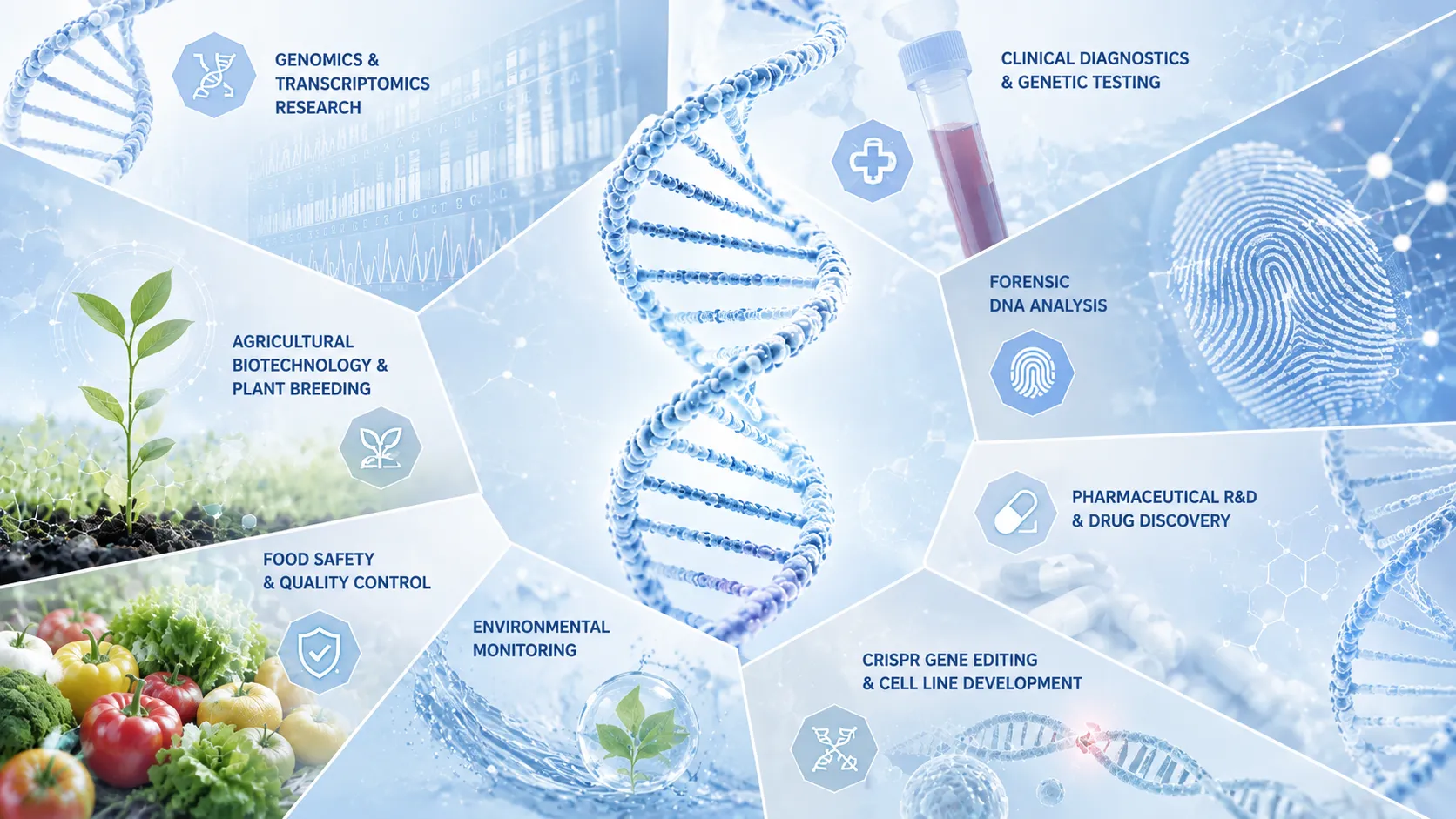
Molecular biology equipment supports research, analytical, diagnostic, and biotechnology workflows across many fields. Common applications include:
- Genomics and transcriptomics research
- Clinical diagnostics and genetic testing
- Forensic DNA analysis
- Pharmaceutical R&D and drug discovery
- Agricultural biotechnology and plant breeding
- Food safety and environmental monitoring
- CRISPR gene editing and cell line development
The exact equipment configuration varies by application. A laboratory performing routine endpoint PCR may need a relatively compact setup, while a laboratory working with low-concentration samples, quantitative assays, high sample volumes, or sequencing workflows may require additional analytical and automation equipment.
Molecular Biology Laboratory Testing Workflow: From DNA Extraction to Genetic Analysis
A molecular biology workflow consists of connected stages, and the quality of one stage can directly affect the next. Equipment selection should therefore follow the workflow rather than treating each instrument as an isolated purchase.
1. Sample Preparation and DNA/RNA Extraction
The workflow begins with sample preparation, lysis, and nucleic acid isolation. Consistent pipetting, adequate mixing, appropriate temperature control, and contamination prevention are important because poor extraction quality can affect quantification, amplification, and downstream analysis.
Important QC checks: sample condition, liquid-handling consistency, extraction yield, and controls appropriate to the workflow for identifying contamination or extraction problems.
- Recommended laboratory equipment: micropipettes, microcentrifuge, vortex mixer, heating block or water bath, biosafety cabinet when required by the sample and risk assessment, and an appropriate extraction system such as spin-column or magnetic bead-based processing.


For laboratories processing larger batches, an automated nucleic acid extractor may improve workflow consistency and reduce repetitive manual handling. For lower-throughput laboratories, manual extraction may remain practical when it meets the application and sample-volume requirements.
2. Nucleic Acid Quantification and Quality Assessment
Before amplification or sequencing, laboratories often need to assess nucleic acid concentration and sample quality. UV-Vis spectrophotometry can provide rapid absorbance-based concentration and purity information, while fluorometric methods can provide greater sensitivity and target specificity for low-concentration samples.
Absorbance ratios such as A260/A280 are commonly used as indicators of nucleic acid purity, but they should be interpreted in the context of sample type, concentration, extraction method, and downstream application rather than treated as universal pass/fail criteria.
Important QC checks: concentration, purity indicators appropriate to the method, and nucleic acid integrity when required by the downstream workflow.
- Recommended laboratory equipment: UV-Vis spectrophotometer, fluorometer, gel electrophoresis system, and microvolume spectrometer when small sample volumes are important.


Selection logic: a UV-Vis system is useful when rapid absorbance-based concentration and purity assessment is required. A fluorometer becomes more important when samples are dilute or when greater analytical sensitivity or nucleic-acid-specific quantification is needed.
3. PCR Amplification and Thermal Cycling
Polymerase chain reaction (PCR) amplifies selected DNA regions through controlled temperature cycling. A conventional thermal cycler is suitable for endpoint amplification, while a real-time PCR system adds fluorescence monitoring for quantitative and other fluorescence-based assays.
Important QC checks: appropriate positive and negative controls, contamination monitoring, reaction consistency, and instrument performance verification according to the laboratory’s procedures.
- Recommended laboratory equipment: thermal cycler (conventional or gradient where required), real-time PCR system for quantitative applications, PCR tube strips or plates, and a dedicated PCR workstation or separated preparation area where contamination control requires it.

For laboratories performing only endpoint PCR, a conventional thermal cycler may be sufficient. A real-time PCR platform is justified when the workflow requires quantitative detection, fluorescence-based monitoring, or other qPCR-specific analysis.
4. Gel Electrophoresis for Size Separation
After PCR or nucleic acid extraction, gel electrophoresis can be used to separate DNA fragments according to size and evaluate amplification products or sample integrity. The electrophoresis system provides separation, while a gel documentation system enables standardized image capture and record keeping.
Important QC checks: gel preparation, sample loading, expected marker or ladder migration, and the presence or absence of expected and unexpected bands.
- Recommended laboratory equipment: gel electrophoresis tank, power supply, gel documentation system with an appropriate illumination method, and compatible gel combs and trays.

The required visualization method should be selected according to the stain or detection chemistry used in the laboratory.
5. Sequencing and Genotyping Analysis
Genetic analysis may involve Sanger sequencing, next-generation sequencing workflows, fragment analysis, or application-specific genotyping methods. These workflows generally require careful sample preparation and normalization before the analytical stage.
Important QC checks: sample concentration, sample quality, preparation consistency, appropriate controls, and quality metrics defined by the specific sequencing or genotyping platform and method.
- Recommended laboratory equipment: DNA sequencer or access to sequencing services where sequencing is performed, real-time PCR system for compatible genotyping assays, fragment analyzer where required, and appropriate data-analysis software.
Sequencing equipment is not essential for every molecular biology laboratory. Laboratories that mainly perform extraction, conventional PCR, or routine electrophoresis can often operate without an in-house sequencing platform and add specialized analytical capability only when sample volume, turnaround requirements, and application scope justify it.
Key Quality Control Tests for Molecular Biology Laboratories
Quality control should be matched to the method and downstream application. The following table shows common test-to-equipment relationships within molecular biology workflows.
| Quality Control Test | Purpose | Common Laboratory Equipment | Relevant Product Types/Applications |
|---|---|---|---|
| Nucleic Acid Purity Assessment | Assess absorbance-based indicators of sample purity | UV-Vis Spectrophotometer | DNA/RNA samples before applicable downstream processing |
| Fluorometric Quantification | Measure nucleic acid concentration with higher sensitivity and target-specific assays | Fluorometer | qPCR, sequencing library preparation, low-yield extractions |
| PCR Performance Assessment | Evaluate amplification performance using appropriate controls and assay parameters | Thermal Cycler or Real-time PCR System | Amplification, gene-expression, genotyping, and quantitative assays |
| Gel Electrophoresis Integrity Check | Assess nucleic acid integrity or fragment patterns | Gel Electrophoresis System | Genomic DNA, RNA, PCR products |
| Restriction Enzyme Digestion Check | Evaluate expected fragment patterns after digestion | Gel Electrophoresis System, Incubator | Cloning and plasmid verification workflows |
| qPCR Melt Curve Analysis | Evaluate amplification characteristics in compatible qPCR assays | Real-time PCR System | Applicable genotyping, gene-expression, and detection assays |
| Sanger Sequencing Read Assessment | Evaluate sequencing output and base-call quality | Capillary DNA Sequencer | Mutation analysis, plasmid verification, genotyping |
| Thermal Cycler Performance Verification | Confirm temperature performance and consistency according to laboratory requirements | Temperature Validation System | PCR workflows requiring documented instrument verification |
Recommended Laboratory Equipment for Molecular Biology Laboratories
A well-equipped molecular biology laboratory does not necessarily need every available instrument. Equipment should be selected according to the workflow, sample volume, analytical requirements, contamination risk, and whether specialized analyses will be performed in-house.
| Laboratory Equipment | Main Application | Why It Matters |
|---|---|---|
| Adjustable Volume Micropipettes | Precise liquid handling | Supports consistent reagent and sample dispensing across extraction, PCR, and analytical workflows |
| Microcentrifuge | Rapid pelleting and phase separation | Widely used in DNA/RNA extraction, clean-up, and sample preparation |
| Vortex Mixer | Rapid sample and reagent mixing | Supports consistent preparation during extraction and assay setup |
| Heating Block or Water Bath | Controlled sample incubation | Supports temperature-dependent extraction and preparation steps |
| Thermal Cycler (PCR Machine) | DNA amplification by PCR | Core instrument for endpoint PCR applications such as cloning and genotyping workflows |
| Real-Time PCR System | Quantitative and fluorescence-monitored PCR | Required when the application depends on real-time fluorescence detection or quantitative PCR analysis |
| UV-Vis Spectrophotometer | Absorbance-based nucleic acid concentration and purity assessment | Provides rapid concentration and purity indicators for suitable samples |
| Fluorometer | Sensitive DNA/RNA quantification | Useful for dilute samples and workflows requiring sensitive or target-specific quantification |
| Gel Electrophoresis System | Separate nucleic acids by size | Supports integrity assessment and evaluation of amplification or digestion products |
| Gel Documentation System | Visualize and document gels | Provides controlled image capture and improves consistency of gel records |
| -80°C Ultra-low Freezer | Low-temperature storage of appropriate samples and reagents | Supports workflows that require ultra-low-temperature preservation |
| Biosafety Cabinet (Class II) | Contained handling of biological materials where required | May provide personnel, product, and environmental protection when the sample and procedure require this level of containment |
| Incubated Shaker | Controlled growth of microbial cultures | Supports cloning and other workflows that require cultured microorganisms |
| Automated Nucleic Acid Extractor | Higher-throughput DNA/RNA extraction | Can reduce repetitive manual handling and improve workflow consistency for larger sample batches |
Basic vs Advanced Molecular Biology Laboratory Setup
The most economical laboratory configuration is usually the one that matches the actual methods being performed rather than purchasing advanced equipment before it is needed.
Basic Molecular Biology Laboratory
A basic laboratory focused on DNA/RNA preparation, endpoint PCR, and gel analysis commonly prioritizes:
- Adjustable volume micropipettes
- Microcentrifuge
- Vortex mixer
- Heating block or water bath
- Conventional thermal cycler
- Gel electrophoresis system
- Nucleic acid quantification equipment appropriate to the application
- Suitable cold-storage equipment
Advanced or Higher-Throughput Laboratory
Additional equipment becomes relevant when the laboratory expands into quantitative analysis, sensitive low-concentration samples, automated preparation, high sample volumes, or specialized genetic analysis. Depending on the workflow, this may include:
- Real-time PCR system
- Fluorometer
- Automated nucleic acid extractor
- Gel documentation system
- Fragment-analysis equipment
- Sequencing equipment or other application-specific analytical platforms
This basic-versus-advanced distinction helps laboratories prioritize instruments that are essential for current work while planning space, workflow, and budget for future capabilities.
How to Choose Laboratory Equipment for Molecular Biology Laboratories
Selecting molecular biology equipment requires more than comparing instrument features. The laboratory should first define its workflow, sample types, expected throughput, analytical requirements, contamination-control strategy, and future expansion plans.
- Define the workflow first: Map the sequence from sample receipt and extraction through quantification, PCR, electrophoresis, analysis, and storage. This prevents purchasing instruments that do not solve a real workflow requirement.
- Match capacity to sample throughput: Consider the expected number of samples per batch and per day. Higher-throughput laboratories may benefit from automated extraction, multi-channel liquid handling, or plate-based workflows.
- Consider sample concentration and quality: The appropriate quantification method depends on sample concentration, matrix, available volume, and downstream requirements. Dilute or limited samples may require more sensitive quantification methods.
- Choose PCR capability by application: A conventional thermal cycler can support endpoint PCR, while quantitative or fluorescence-monitored assays require a compatible real-time PCR platform.
- Plan contamination control: PCR laboratories should consider physical workflow separation, dedicated equipment where appropriate, cleaning procedures, and controls designed to reduce or detect contamination.
- Evaluate reproducibility requirements: Consider the consistency, verification, calibration, and quality-control needs of the methods being performed rather than selecting equipment only by purchase price.
- Review maintenance and serviceability: Check routine maintenance requirements, calibration or performance-verification needs, availability of consumables and spare parts, and access to technical support.
- Check footprint and utilities: Confirm bench space, ventilation, electrical requirements, clearance, environmental conditions, and service access before installation.
- Consider workflow compatibility: Tubes, plates, rotors, consumables, extraction formats, and downstream instruments should work together without creating unnecessary manual transfer steps.
- Plan for future expansion: If qPCR, automated extraction, sequencing, or higher sample throughput is expected later, laboratory layout and supporting infrastructure should allow those capabilities to be added without major disruption.
- Assess training and technical support: Installation, application guidance, user training, maintenance support, and troubleshooting become increasingly important as instrument complexity increases.
For buyers comparing several instruments, the most useful purchasing brief includes the sample type, methods to be performed, expected samples per day or batch, required workflow stages, available laboratory space, and any method-specific performance requirements. This information makes it easier to determine whether a basic instrument is sufficient or a more advanced configuration is justified.
Frequently Asked Questions
What is the most essential equipment for a basic molecular biology lab?
For a basic DNA extraction, endpoint PCR, and gel-analysis workflow, the core equipment usually includes adjustable volume micropipettes, a microcentrifuge, vortex mixer, thermal cycler, gel electrophoresis system, and suitable nucleic acid quantification equipment. Heating equipment and appropriate sample storage are also commonly required. Additional instruments such as a fluorometer, real-time PCR system, automated extractor, or gel documentation system depend on the application.
Can a UV-Vis spectrophotometer replace a fluorometer for DNA quantification?
Not for every application. A UV-Vis spectrophotometer provides rapid absorbance-based concentration and purity information, while a fluorometer can provide greater sensitivity and target-specific quantification with compatible assays. For dilute samples or workflows where sensitive DNA/RNA quantification is important, fluorometric measurement may be preferable.
How often should thermal cyclers be calibrated?
The appropriate calibration or performance-verification interval depends on the instrument, laboratory quality system, workload, manufacturer guidance, and method requirements. Laboratories should establish and document an interval appropriate to their use rather than relying on a universal schedule. Additional verification may be appropriate when performance problems are suspected or after relevant service work.
What biosafety level is required for molecular biology work with human DNA?
The required containment level cannot be determined from the presence of human DNA alone. Laboratories should assess the original specimen, whether viable or potentially infectious biological material is present, the procedures being performed, and applicable institutional biosafety requirements. A Class II biosafety cabinet may be appropriate for procedures involving biological hazards, but the requirement should follow the laboratory’s risk assessment and safety procedures.
Is a gel documentation system necessary, or can I use a smartphone camera?
A gel documentation system is preferable when the laboratory needs controlled illumination, compatible optical filtering, consistent image capture, analysis capability, or standardized records. A smartphone image may be adequate for informal observation in some workflows, but it does not provide the same controlled imaging environment as dedicated documentation equipment.
How do I choose between a standard thermal cycler and a real-time PCR system?
Choose according to the assay. A standard thermal cycler is suitable for endpoint PCR workflows where amplification products are evaluated after cycling. A real-time PCR system is required when the method depends on fluorescence monitoring during amplification, quantitative PCR, or other compatible real-time detection functions. Laboratories performing both types of work should evaluate sample throughput and assay requirements before deciding whether one or both platforms are needed.
Conclusion
The essential equipment for a molecular biology laboratory should be determined by the complete testing workflow. Micropipettes, centrifugation and mixing equipment, thermal cycling, electrophoresis, nucleic acid quantification, and suitable sample storage form the foundation of many laboratories, while qPCR, fluorometric analysis, automated extraction, gel documentation, and sequencing systems become important for more specialized or higher-throughput applications.
The most effective purchasing approach is to map sample type → workflow stage → test or procedure → required instrument → capacity and quality requirements. This helps laboratories distinguish genuinely essential equipment from advanced capabilities that can be added as testing volume and application scope expand.