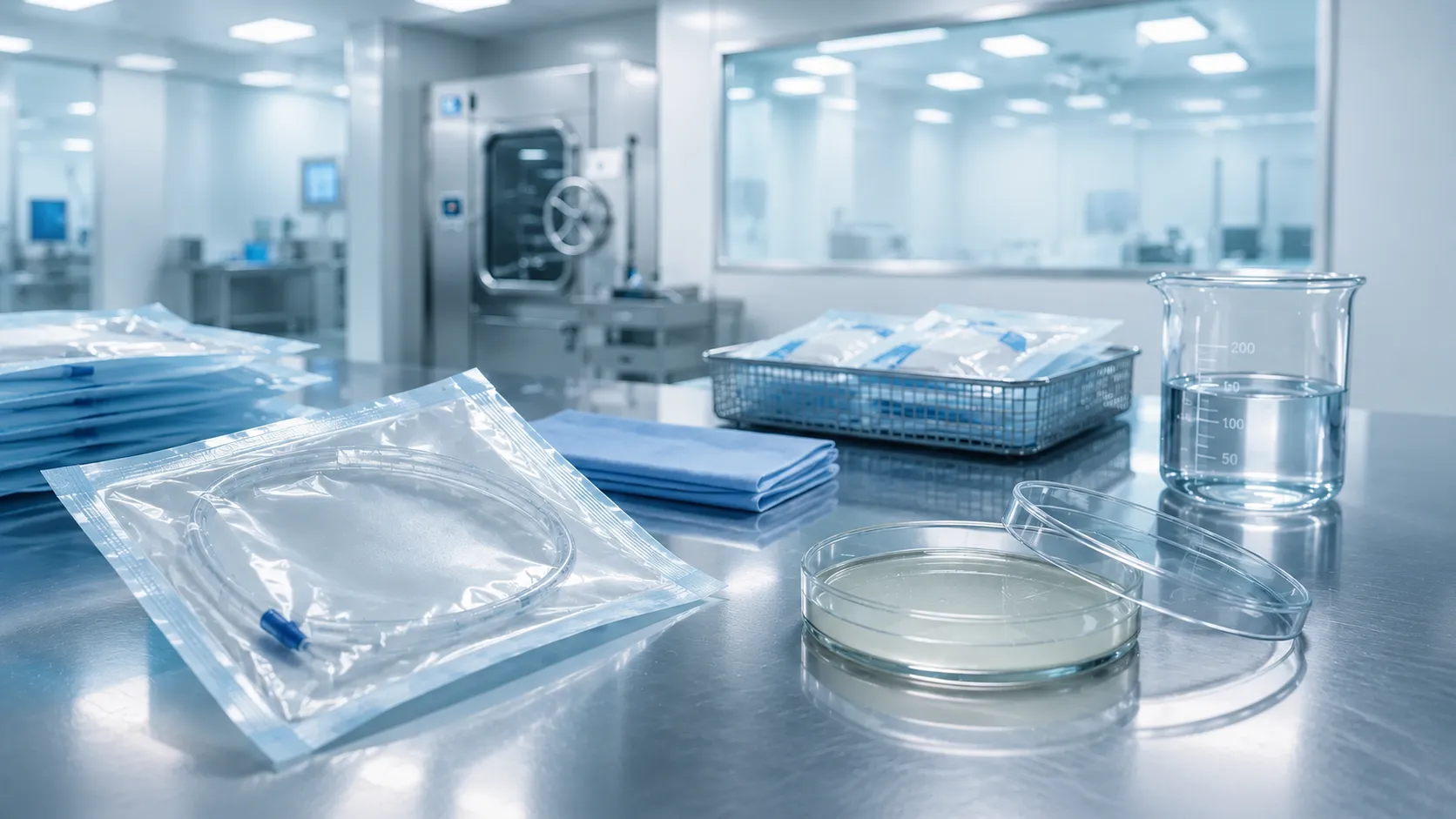
Sterility Testing Laboratory Equipment for Medical Devices Overview
Selecting the right sterility testing equipment for medical devices is essential for reliable microbiological testing and contamination control. Laboratories typically need a controlled aseptic processing environment, a suitable sterility test system, microbiological incubators, environmental monitoring equipment, sterilization support equipment, and documented procedures for equipment qualification, calibration, and maintenance.
For manufacturers and contract testing laboratories, equipment selection should follow the device type, sterility test method, sample throughput, aseptic-processing strategy, and applicable quality requirements. Small rinsable devices may suit membrane filtration workflows, while large or non-filterable devices may require direct inoculation and larger aseptic handling areas. This guide explains the main testing workflow, QC activities, laboratory equipment, and practical selection factors for medical device sterility testing.
What Is Sterility Testing for Medical Devices?
Sterility testing is a microbiological quality-control test used to determine whether viable contaminating microorganisms can be detected in tested samples from a sterilized product batch. For medical devices, the laboratory method must be appropriate for the device, its materials, its sterilization process, and any characteristics that could interfere with microbial recovery.
Two important approaches are membrane filtration and direct inoculation. Membrane filtration can be suitable when microorganisms can be recovered from the device into a filterable liquid. Direct inoculation is used when the sample or recovered test material is better introduced directly into culture media. Both approaches depend on strict aseptic technique, suitable culture media, controlled incubation, and an environment designed to minimize adventitious contamination.
Main Testing Requirements for Medical Device Sterility Testing
A medical device sterility testing laboratory should control the complete testing process rather than relying on the sterility test instrument alone. Important laboratory controls include:
- Aseptic processing environment: A qualified clean-air workstation, biological safety cabinet, or sterility test isolator appropriate to the laboratory’s validated testing strategy.
- Validated or demonstrated test methods: The laboratory should establish that the selected procedure and culture media are suitable for the device being tested.
- Trained operators: Personnel should be trained in aseptic manipulation, contamination control, and the laboratory’s approved sterility testing procedures.
- Environmental monitoring: Viable and non-viable monitoring may be used to assess the controlled testing environment according to the laboratory’s monitoring program.
- Equipment qualification and maintenance: Critical equipment such as incubators, autoclaves, air samplers, particle counters, and aseptic processing systems requires documented control appropriate to its use.
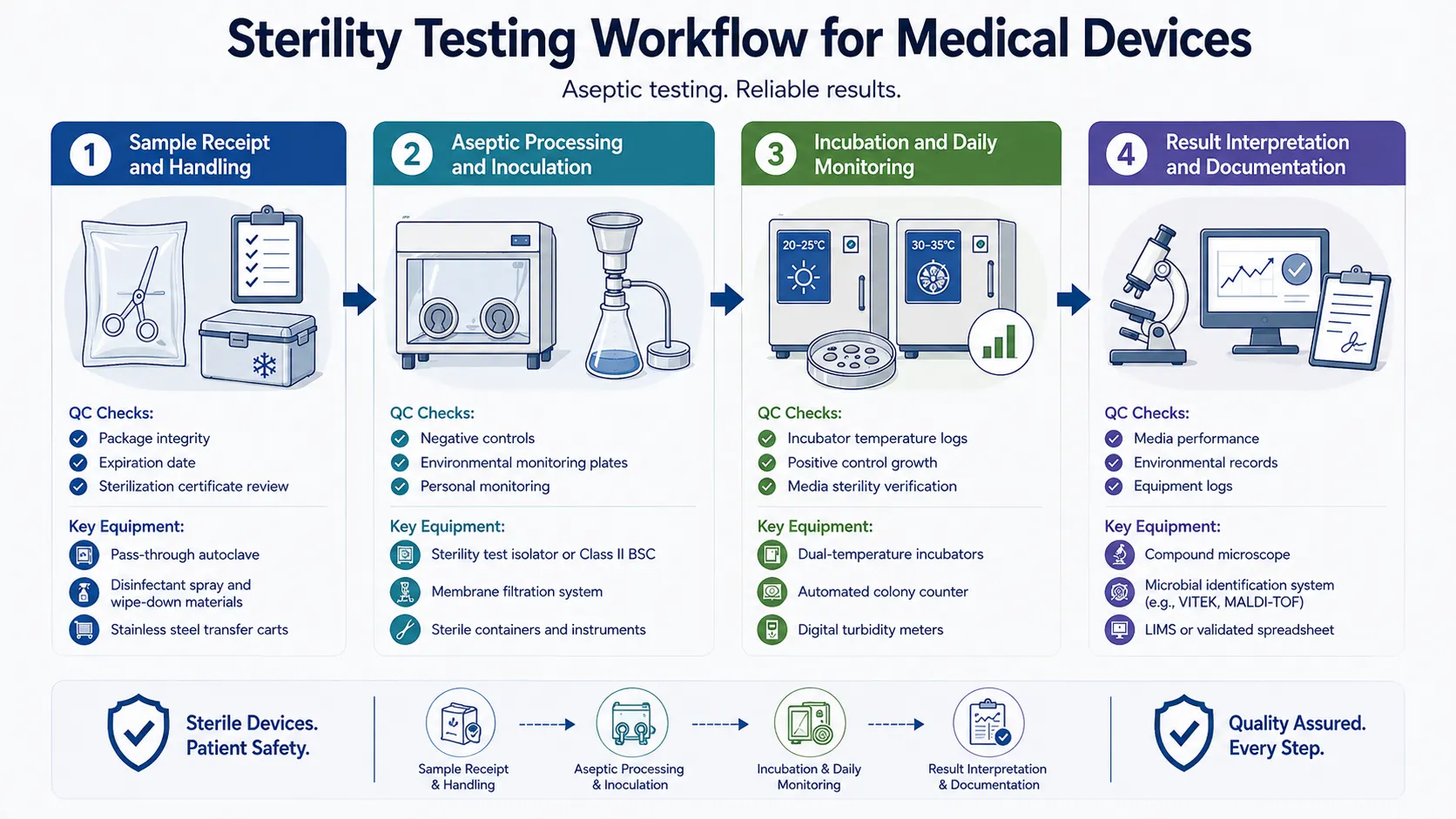
Sterility Testing Workflow for Medical Devices
Sample Receipt and Handling
Medical devices normally arrive in their sealed packaging and should be handled in a way that protects sample identity and integrity before testing. The laboratory may document package condition, sample identification, relevant sterilization information, and storage or transport conditions before transferring the samples into the controlled testing area.
Typical equipment and supplies for this stage include:
- Pass-through autoclave
- Disinfectant spray and wipe-down materials
- Stainless steel transfer carts
Aseptic Processing and Inoculation
The sterility test is performed under controlled aseptic conditions to minimize contamination introduced by the laboratory environment or operator.
For membrane filtration workflows, microorganisms recovered into a suitable liquid are retained on a membrane and subsequently exposed to the required culture media. For direct inoculation, the test article, a representative portion, or recovered test material is introduced directly into culture media as appropriate to the validated method.
The required workspace must also accommodate the physical size of the medical device and the manipulations needed to open, rinse, cut, transfer, or immerse it without compromising aseptic control.
Typical equipment includes:
- Sterility test isolator or Class II Biological Safety Cabinet
- Membrane filtration manifold or sterility test canisters
- Sterile containers and instruments


Incubation and Daily Monitoring
After inoculation, the culture media are incubated under the conditions specified by the laboratory’s applicable sterility test procedure. Where multiple media or incubation conditions are required, separate controlled incubation capacity may be necessary.
During the incubation period, laboratories monitor the cultures for evidence of microbial growth while maintaining appropriate temperature records and media controls. The incubator configuration should therefore be selected according to the required temperature conditions, test volume, vessel size, and expected sample throughput.
Typical equipment includes:
- Dual-temperature microbiological incubators
- Automated colony counter
- Digital turbidity meters

Result Interpretation and Documentation
At the end of the specified incubation period, results are evaluated according to the applicable procedure. Observed microbial growth requires investigation to determine whether it is associated with the test article, laboratory environment, test procedure, materials, or another potential contamination source.
Useful investigation records can include media performance information, environmental monitoring results, equipment logs, operator records, and microbial identification data.
Supporting equipment may include:
- Compound microscope
- Microbial identification system (e.g., VITEK, MALDI-TOF)
- LIMS or validated spreadsheet

Key Quality Control Tests for Sterility Testing of Medical Devices
The following table connects the main sterility-testing and contamination-control activities with their purpose and commonly associated laboratory equipment.
| Quality Control Test | Purpose | Common Laboratory Equipment | Relevant Product Types / Applications |
|---|---|---|---|
| Membrane Filtration Method | Recover and detect microorganisms from suitable filterable test preparations | Filtration manifold, vacuum pump, sterile membrane filters | Rinsable devices and suitable liquid extracts or eluates |
| Direct Inoculation Method | Test samples that are introduced directly into culture media | Large culture vessels, sterile transfer cabinet | Devices or samples not suited to membrane filtration |
| Growth Promotion Test | Confirm that culture media can support growth of appropriate test microorganisms | Incubators, control strains, turbidity reader | Culture media used for microbiological testing |
| Bacteriostasis/Fungistasis (Method Suitability) | Assess whether the test article interferes with detection of microbial contamination | Sterility testing setup and appropriate microbial test cultures | Method suitability assessment, including devices with potentially inhibitory characteristics |
| Environmental Monitoring – Viable Air | Assess viable airborne microbial contamination in the testing environment | Active microbial air sampler, settle plates | Aseptic work areas and controlled laboratory environments |
| Environmental Monitoring – Non-viable Particles | Monitor airborne particle levels where required by the environmental control program | Optical particle counter | Controlled areas and aseptic processing environments |
| Surface Monitoring | Assess microbial contamination on selected surfaces and operator contact areas | Contact plates (RODAC), sterile swabs | Work surfaces, equipment, gloves |
| Negative Control | Help detect contamination associated with media, reagents, or the testing process | Test-specific sterile media, vessels, and supporting equipment | Applicable sterility testing workflows |
| Positive / Growth Controls | Demonstrate expected microbial growth under defined control conditions | Appropriate control cultures and incubation equipment | Media and method-control activities |
| Isolator / Controlled Workspace Integrity Testing | Verify critical containment and airflow-control functions according to the equipment qualification program | Glove integrity tester, particle counter, applicable integrity-testing equipment | Sterility test isolators and controlled aseptic workspaces |
Recommended Laboratory Equipment for Sterility Testing Laboratories
Equipment should be selected as a system. The aseptic workspace controls sample manipulation, the sterility test apparatus supports microbial recovery and inoculation, incubators maintain required culture conditions, and environmental monitoring equipment helps demonstrate that the testing environment remains controlled.
| Laboratory Equipment | Main Application | Why It Matters |
|---|---|---|
| Sterility Test Isolator | Controlled environment for aseptic test manipulations | Reduces exposure of the test process to the surrounding laboratory environment |
| Membrane Filtration System | Recover microorganisms from suitable filterable liquids or device eluates | Supports membrane filtration sterility testing workflows |
| Dual-Temperature Incubators | Provide separate controlled incubation conditions when required | Allows laboratories to maintain the incubation conditions specified by their test procedure |
| Active Viable Air Sampler | Collect airborne microorganisms for environmental monitoring | Supports assessment of microbiological conditions in controlled testing areas |
| Optical Particle Counter | Measures non-viable airborne particles | Supports clean-area qualification and monitoring programs where applicable |
| Autoclave | Sterilizes suitable media, reusable materials, and laboratory waste | Supports contamination control and microbiological laboratory operations |
| Media Preparation Vessels | Prepare and dispense culture media | Supports controlled and repeatable media preparation |
| pH Meter | Measure and adjust media pH where required | Helps maintain defined media preparation conditions |
| Automated Colony Counter | Enumerates colonies on environmental or microbiological plates | Can improve consistency and efficiency when plate counts are part of the laboratory workflow |
| Glove Integrity Tester | Evaluates glove integrity on compatible isolator systems | Supports verification of a critical physical barrier in isolator workflows |
| Refrigerated Centrifuge | Sample preparation or concentration in applicable microbiological workflows | Useful when a validated recovery or investigation method requires centrifugation |
| Microscope with Camera | Supports examination during microbial investigations | Provides visual documentation and supplementary information during investigations |
Essential vs. Application-Dependent Sterility Testing Equipment
Not every sterility testing laboratory requires the same equipment configuration. The core system should be based on the actual test method and contamination-control strategy, while additional instruments should be justified by sample type, throughput, environmental monitoring, and investigation needs.
| Equipment Group | Typical Role | Selection Consideration |
|---|---|---|
| Aseptic processing system | Provides the controlled workspace for test manipulations | Device dimensions, manipulation requirements, contamination-control strategy, and laboratory layout |
| Sterility test / filtration system | Supports microbial recovery and transfer into culture media | Compatibility with the selected test method, device eluate, sample volume, and throughput |
| Microbiological incubators | Maintain controlled culture conditions | Required incubation conditions, vessel capacity, monitoring, and sample throughput |
| Environmental monitoring equipment | Monitors the microbiological and particulate condition of controlled areas | Laboratory monitoring program, sampling locations, frequency, and data-management requirements |
| Autoclave and media-preparation equipment | Supports preparation and contamination control | Media volume, load size, workflow segregation, and laboratory capacity |
| Microbial investigation equipment | Supports examination and identification following detected growth | Whether identification is performed in-house or by an external laboratory |
How to Choose Laboratory Equipment for Sterility Testing
When building or upgrading a sterility testing laboratory, equipment selection should begin with the test workflow rather than an isolated instrument specification.
- Test method compatibility: Determine whether the laboratory will use membrane filtration, direct inoculation, or multiple validated approaches. The test method drives filtration equipment, culture vessels, workspace requirements, and supporting accessories.
- Medical device size and handling: Large implants or instruments may require more working space and larger transfer systems than small catheters or components. Confirm that the aseptic workspace can accommodate the complete manipulation sequence.
- Throughput and sample volume: Estimate the number of samples, filtration units, culture vessels, and incubation positions required during normal and peak workloads. Higher-throughput laboratories may benefit from additional filtration stations and incubation capacity.
- Contamination-control strategy: Evaluate whether a cabinet-based workflow or a closed isolator-based approach is appropriate for the laboratory’s process, facility, and qualification strategy.
- Qualification, calibration, and maintenance: Critical equipment should support the laboratory’s documentation and maintenance program. Consider access to qualification support, calibration, preventive maintenance, consumables, and spare parts.
- Data and monitoring requirements: Determine how incubator temperatures, environmental monitoring results, equipment status, and test records will be captured, reviewed, and retained.
- Footprint and ergonomics: Equipment must fit the laboratory layout while providing adequate space for aseptic manipulations, cleaning, maintenance, sample transfer, and operator movement.
- Future expansion: Laboratories expecting higher sample volumes or additional device types should consider whether filtration, incubation, monitoring, and data-management capacity can be expanded without redesigning the entire workflow.
Leading laboratory equipment suppliers, such as AELAB, can support the selection of equipment used across sterility testing and microbiological laboratory workflows. Final equipment selection should be based on the device type, test method, expected throughput, laboratory contamination-control strategy, and applicable quality requirements.
Frequently Asked Questions
What is the best method for sterility testing of medical devices?
The appropriate method depends on the device and the validated test procedure. Membrane filtration is useful when microorganisms can be recovered into a suitable filterable liquid, while direct inoculation can be used when the sample is better introduced directly into culture media. Method suitability should be established for the specific device and test conditions.
Does sterility testing require a full cleanroom?
Sterility testing requires a controlled aseptic environment capable of minimizing contamination introduced during test manipulation. The appropriate facility configuration depends on the laboratory’s contamination-control strategy, aseptic processing system, qualification approach, and applicable requirements. A sterility test isolator can provide a highly controlled local environment, while cabinet-based workflows depend more directly on the surrounding room conditions.
What equipment is mandatory for a sterility test lab?
The exact equipment depends on the test method and laboratory configuration. Core functions normally include an aseptic processing workspace, suitable sterility testing apparatus, controlled microbiological incubation, sterilization or sterile-supply support, and environmental monitoring appropriate to the laboratory’s contamination-control program. Additional equipment may be needed for media preparation, microbial identification, investigations, and data management.
How often should sterility test isolators be validated?
Qualification and requalification frequency should be established through the laboratory’s quality system, equipment requirements, risk assessment, usage, and applicable regulatory or pharmacopeial expectations. Initial qualification and documented periodic requalification should be supported by routine checks and monitoring appropriate to the isolator design and testing process.
Can sterility testing be automated?
Parts of the workflow can be automated or semi-automated, including some filtration, monitoring, data capture, and colony-counting activities. The practical level of automation depends on device geometry, sample preparation, aseptic manipulations, test volume, and the laboratory’s validated procedure.
What is the difference between a BSC and a sterility test isolator?
A Class II biological safety cabinet uses controlled HEPA-filtered airflow and is designed to provide defined protection functions during laboratory work. A sterility test isolator uses a physical barrier and glove-port system to separate aseptic manipulations more completely from the surrounding room. The appropriate choice depends on the test process, contamination-control strategy, device handling requirements, facility design, and qualification approach.
Conclusion
A reliable medical device sterility testing laboratory is built around the complete testing workflow rather than a single instrument. The aseptic processing system must support the device and test method, the filtration or inoculation setup must enable suitable microbial recovery, incubators must maintain the required culture conditions, and environmental monitoring must support control of the testing environment.
For equipment planning, start with the device types and validated test methods, then determine sample throughput, aseptic workspace requirements, incubation capacity, environmental monitoring needs, and investigation capability. This approach creates a laboratory configuration that is easier to qualify, operate, maintain, and expand as testing demand changes.