Laboratory Equipment for Medical Device Testing: Overview
Medical device manufacturers use laboratory testing to verify materials, components, manufacturing processes, finished-device performance, cleanliness, packaging, and other quality characteristics relevant to the device. The exact testing program depends on the device type, materials, intended use, manufacturing process, risk profile, and applicable quality or regulatory requirements.
For most medical device quality control laboratories, the main equipment groups include mechanical testing instruments, material identification equipment, dimensional inspection systems, cleanliness and particle monitoring equipment, microbiology equipment, packaging test systems, environmental chambers, and, for active devices, electrical safety test equipment.
A well-planned laboratory connects each quality requirement to a defined test method and suitable instrument. This helps manufacturers verify incoming materials, detect manufacturing deviations, evaluate finished products, support process validation, and generate consistent quality-control data.
What Is Laboratory Equipment for Medical Device Testing?
Laboratory equipment for medical device testing includes the instruments, apparatus, and analytical systems used to evaluate physical, mechanical, chemical, microbiological, packaging, cleanliness, and electrical characteristics of medical devices and their materials.
The required equipment varies substantially between products. A laboratory testing polymer tubing or wound-care materials may focus heavily on mechanical and material characterization, while a sterile-device laboratory may require additional microbiological, environmental-monitoring, and packaging-integrity capabilities. Active medical devices may also require dedicated electrical safety and performance testing systems.
Main Testing Requirements for Medical Devices
Medical device testing can be broadly categorized into:
- Mechanical and Physical Testing: Tensile strength, compression, hardness, fatigue, dimensional characteristics, and other performance properties relevant to the device.
- Chemical and Material Analysis: Material identification, contamination investigation, extractables and leachables studies where applicable, residual analysis, and degradation-product evaluation.
- Microbiological and Biological Evaluation: Depending on the device and test program, this may include sterility, bioburden, endotoxin, cytotoxicity, and other biological evaluations.
- Packaging Validation: Seal strength, package integrity, dye penetration or other leak-testing methods, and environmental or aging studies where applicable.
- Electrical Safety and Performance: For applicable active medical devices, testing may include leakage current, insulation-related measurements, grounding, and other electrical safety or performance evaluations.
- Surface and Cleanliness Analysis: Particulate contamination, surface condition, and cleanliness verification according to the device and manufacturing process.
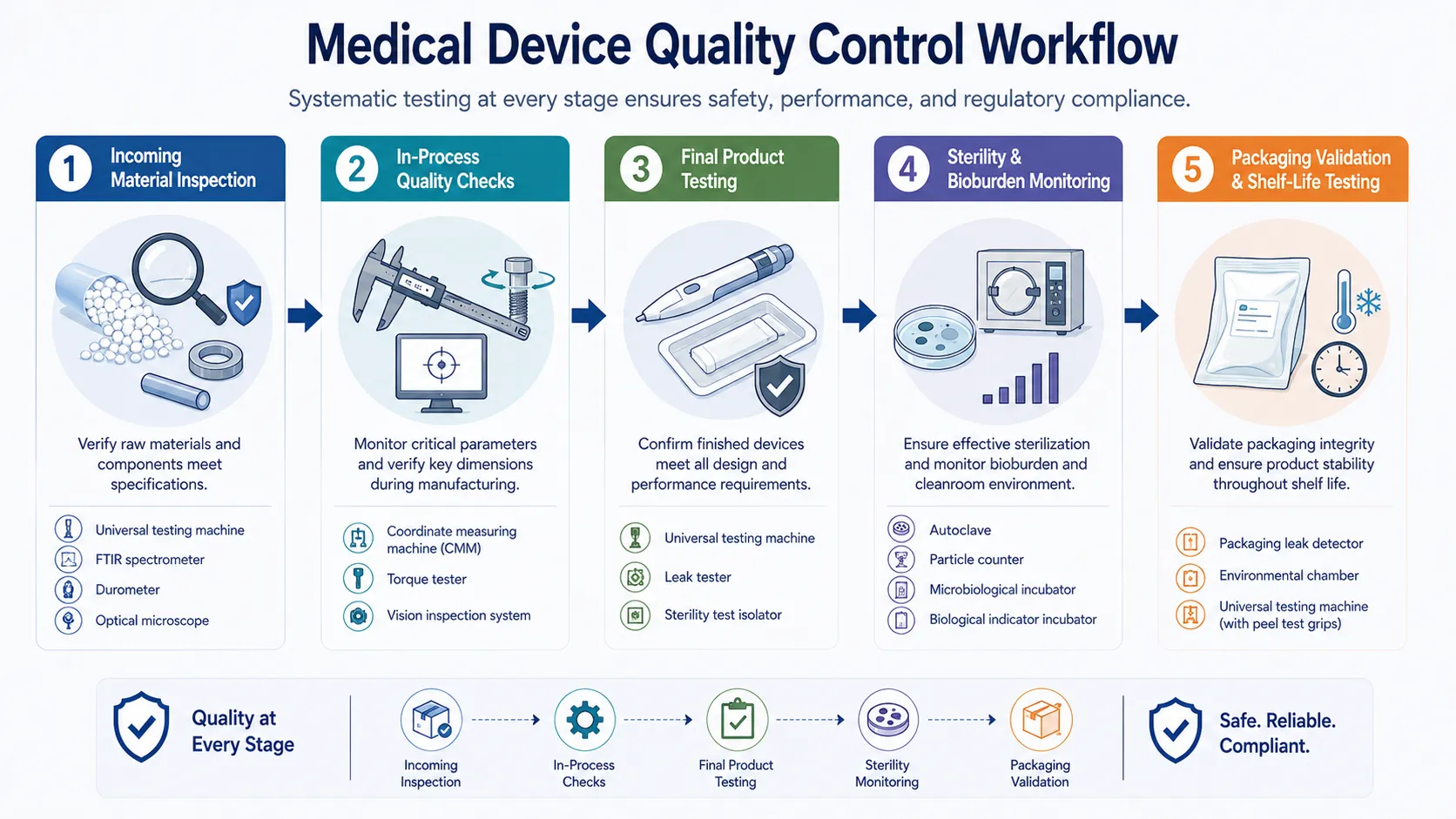
Medical Device Quality Control Workflow
A practical equipment plan starts by mapping instruments to the stages at which quality decisions are made. Incoming inspection, in-process control, finished-device testing, microbiological monitoring, and packaging validation can require different measurement capabilities.
1. Incoming Material Inspection
Raw materials, components, and packaging materials should be checked against defined specifications before use. Depending on the material, this may include identity verification, mechanical-property testing, dimensional inspection, hardness measurement, and visual examination.
For example, FTIR can support polymer identification, a universal testing machine can evaluate mechanical properties, a durometer can measure hardness for suitable materials, and microscopy can support visual or surface inspection.
- Universal testing machine
- FTIR spectrometer
- Durometer
- Optical microscope


2. In-Process Quality Checks
In-process testing helps identify manufacturing deviations before they affect a larger quantity of finished devices. The required measurements depend on the product and process but may include dimensional inspection, torque verification, bond or joint strength, and visual inspection.
A coordinate measuring machine can support complex dimensional inspection, torque testers can verify applicable fastening or rotational requirements, and vision systems can support repeatable inspection of defined visual or dimensional features.
- Coordinate measuring machine (CMM)
- Torque tester
- Vision inspection system
3. Final Product Testing
Finished-device testing verifies that defined product requirements have been met before release. Depending on the device, this may include mechanical performance, dimensional characteristics, functional testing, packaging integrity, labeling inspection, cleanliness, or microbiological testing.
The equipment must therefore be selected around the actual release tests rather than around a generic medical-device equipment list.
- Universal testing machine
- Leak tester (vacuum decay or pressure decay)
- Sterility test isolator
4. Sterility and Bioburden Monitoring
For sterile medical devices, microbiological control can include pre-sterilization bioburden evaluation, sterilization-process monitoring, environmental monitoring, and sterility testing as applicable to the validated process and product requirements.
Typical laboratory equipment can include microbiological incubators, particle counters for controlled-environment monitoring, and equipment used to support biological-indicator handling or microbiological test workflows. Autoclaves are also commonly used for laboratory media, glassware, or waste treatment, depending on laboratory procedures.
- Autoclave
- Particle counter
- Microbiological incubator
- Biological indicator incubator


5. Packaging Validation and Shelf-Life Testing
Packaging for sterile and other protected medical devices must maintain the required package performance through handling, storage, and distribution. Depending on the packaging system and validation plan, testing may include seal-strength measurements, package-integrity testing, dye penetration, environmental conditioning, and accelerated aging studies.
Universal testing machines fitted with suitable peel fixtures can evaluate seal strength, leak-detection systems can assess package integrity using the selected method, and environmental chambers can provide controlled temperature and humidity conditions for aging or conditioning studies.
- Packaging leak detector
- Environmental chamber
- Universal testing machine (with peel test grips)
Key Quality Control Tests for Medical Devices
The table below maps common medical-device testing needs to their purpose and typical laboratory equipment. Actual test methods and instrument configurations should be selected according to the device, material, applicable method, and quality requirements.
| Quality Control Test | Purpose | Common Laboratory Equipment | Relevant Product Types / Applications |
|---|---|---|---|
| Tensile / Elongation Test | Measures breaking force and deformation or elongation of materials or components | Universal testing machine, extensometer | Tubing, sutures, catheters, wound dressings |
| FTIR Material Identification | Supports polymer or material identification and contamination investigation | FTIR spectrometer with ATR accessory | Polymers, plastics, coatings, adhesives |
| Particulate Matter Testing | Evaluates particulate contamination on applicable device surfaces or in fluids | Particle counter, filtration apparatus, microscope | Fluid-contact devices, implants, surgical instruments, cleanliness studies |
| Sterility Test | Evaluates finished sterile products according to the applicable sterility test method | Sterility test isolator, membrane filtration system | Sterile implants, surgical kits, syringes |
| Bioburden Determination | Measures viable microorganisms associated with a product before sterilization or at another defined process stage | Microbiological incubator, colony counter | Applicable materials, components, and pre-sterilized devices |
| Packaging Seal Integrity | Evaluates package seals or package integrity according to the selected method | Vacuum leak tester, dye penetration equipment | Pouch packaging, tray lids, blister packs |
| pH and Conductivity | Can support evaluation of aqueous residues or cleaning-process samples where these measurements are part of the validated method | pH meter, conductivity meter | Cleaning studies, process water, applicable reprocessed-device workflows |
| TOC Analysis | Measures total organic carbon where TOC is selected as an indicator for water quality, extracts, or cleaning studies | TOC analyzer | Water systems, extracts, cleaning validation |
| Leakage Current Test | Evaluates electrical leakage where required for applicable active medical devices | Electrical safety analyzer, insulation tester | Applicable electrically powered medical equipment |
| Cytotoxicity Screening | Supports biological evaluation of potential cytotoxic effects of device materials or extracts | Laminar flow hood, cell culture incubator, microplate reader | Applicable patient-contacting devices and materials |
Recommended Laboratory Equipment for Medical Device Testing Laboratories
Not every medical-device laboratory needs every instrument below. Equipment should be selected according to the tests performed in-house, device portfolio, sample volume, required methods, and which testing activities are outsourced.
| Laboratory Equipment | Main Application | Why It Matters |
|---|---|---|
| Universal Testing Machine | Tensile, compression, peel, and flexural tests with suitable fixtures | Provides a flexible platform for mechanical testing across many materials and device components |
| FTIR Spectrometer | Material identification and contamination investigation | Useful for verifying polymers and other compatible materials against established references or specifications |
| Particle Counter / Liquid Particle Counter | Controlled-environment monitoring or liquid particulate testing, depending on instrument type | Supports cleanliness and particulate-monitoring programs where these measurements are required |
| Autoclave / Sterilizer | Sterilization of laboratory media, glassware, or waste as applicable | Supports microbiology laboratory operations and controlled laboratory procedures |
| Sterility Test Isolator | Controlled environment for sterility testing | Helps control the test environment and reduce contamination risk during sterility-test operations |
| TOC Analyzer | Total organic carbon measurement in applicable water, extract, or cleaning samples | Useful where TOC is included in the laboratory’s water-quality or cleaning-validation method |
| Microbiological Incubator | Cultivation of microorganisms for applicable microbiological tests | Provides controlled incubation conditions required by the selected microbiological method |
| Environmental Chamber | Accelerated aging and controlled temperature/humidity exposure | Provides defined environmental conditions for aging, conditioning, or stability-related studies |
| Leak Tester (Pressure/Vacuum Decay) | Package or component leak testing using applicable pressure- or vacuum-based methods | Provides quantitative or non-destructive integrity testing where the selected method supports it |
| Coordinate Measuring Machine (CMM) | Dimensional inspection of complex components | Supports verification of defined dimensional tolerances and complex geometries |
| Electrical Safety Analyzer | Applicable electrical safety measurements such as leakage current, insulation-related tests, and protective-earth measurements | Supports electrical safety testing for relevant active medical equipment when required by the applicable test program |
Essential vs Specialized Medical Device Testing Equipment
The most useful way to plan a medical device QC laboratory is to separate frequently used core instruments from specialized systems required only for particular products or test programs.
Core Equipment for a General QC Laboratory
A general laboratory may prioritize instruments that support multiple products and routine inspections, such as:
- Universal testing machine for mechanical tests with appropriate fixtures and load cells
- Optical microscope for visual and surface inspection
- Dimensional measurement equipment appropriate to component tolerances
- FTIR spectrometer when polymer or material identity verification is routinely required
- Basic environmental or microbiological equipment when these tests are performed in-house
Specialized Equipment
More specialized systems should be justified by the actual device portfolio and test scope. Examples include sterility test isolators, liquid particle counters, TOC analyzers, package leak-testing systems, CMMs, cell-culture equipment, and electrical safety analyzers.
For laboratories with low sample volumes or occasional specialized tests, outsourcing some analyses may be more practical than maintaining equipment, qualified methods, trained personnel, calibration, and controlled laboratory infrastructure in-house.
How to Choose Laboratory Equipment for Medical Device Testing
Start with the required test rather than the instrument. Map each material, component, process control, and finished-device requirement to the test method used to make the quality decision. Then determine whether the laboratory will perform that test internally or use a qualified external laboratory.
For mechanical testing, consider the expected force range, sample geometry, required grips or fixtures, deformation measurement, test speed, and whether different load cells are needed. A universal testing machine can cover many tensile, compression, peel, and flexural applications, but specialized fatigue or dynamic testing may require a different system.
For analytical, microbiological, packaging, and electrical equipment, confirm that the instrument type is suitable for the selected method and sample. Consider detection or measurement needs, sample preparation, throughput, data handling, environmental requirements, operator training, and the laboratory infrastructure needed to operate the system consistently.
Sample volume is another important purchasing factor. Automated or semi-automated systems can improve repeatability and throughput when many samples are tested, while simpler instruments may be appropriate for low-volume R&D or occasional QC measurements.
Equipment lifecycle support should also be considered before purchase. Evaluate calibration requirements, preventive maintenance, availability of consumables and accessories, spare parts, technical support, and whether the supplier can support installation and qualification activities required by your quality system.
Finally, plan for future products. Modular equipment with suitable accessories, fixtures, or expandable measurement capabilities can sometimes support additional tests without replacing the complete system.
Frequently Asked Questions
What laboratory equipment is essential for medical device testing?
The essential equipment depends on the device and tests performed in-house. Common systems include a universal testing machine for mechanical testing, FTIR for material identification, dimensional inspection equipment, microscopes, and appropriate environmental or microbiological equipment. Specialized laboratories may also require particle counters, sterility test systems, TOC analyzers, package leak testers, environmental chambers, or electrical safety analyzers.
Why is material testing important for medical devices?
Material testing helps verify that incoming materials and components match defined specifications and are suitable for the intended manufacturing and device requirements. Depending on the material and application, testing may include identity verification, mechanical properties, dimensional characteristics, surface inspection, and additional chemical or biological evaluation.
Which equipment is needed for sterility testing?
Sterility testing may require a sterility test isolator or another suitable controlled test environment, membrane filtration equipment when the selected method uses filtration, appropriate culture media, and microbiological incubators. The exact laboratory configuration should follow the validated test method and applicable quality requirements.
How often should medical device testing equipment be calibrated?
There is no single calibration interval appropriate for every instrument. Calibration and verification frequencies should be established through the laboratory’s quality system based on factors such as instrument use, measurement criticality, manufacturer guidance, historical performance, applicable procedures, and test requirements.
What standards apply to medical device testing laboratory equipment?
The applicable references depend on the device, market, material, packaging system, and test being performed. Examples that may be relevant include ISO 13485 for medical-device quality management systems, the ISO 10993 series for biological evaluation, ISO 11607 for packaging of terminally sterilized medical devices, applicable USP microbiological chapters such as <61>, <62>, and <71>, relevant ASTM material or packaging test methods, and the IEC 60601 series for applicable medical electrical equipment. Always confirm the specific standard, method, edition, and regulatory applicability for the device being tested.
Can one universal testing machine handle all medical device mechanical tests?
No. A universal testing machine can support many tensile, compression, peel, and flexural tests when equipped with suitable load cells, grips, and fixtures. However, the required force range, sample geometry, deformation measurement, test speed, fatigue conditions, and test method determine whether a particular machine is suitable. High-cycle fatigue, dynamic, or other specialized mechanical tests may require dedicated equipment.
Conclusion
Selecting laboratory equipment for medical device testing should begin with the device requirements and test methods, not with a generic instrument list. Map each incoming-material, in-process, finished-device, microbiological, packaging, cleanliness, and electrical requirement to the measurement that must be performed and then to the equipment capable of supporting that method.
For a basic laboratory, prioritize versatile instruments used frequently across the device portfolio. Add specialized analytical, microbiological, packaging, or electrical systems when the testing volume, method requirements, and need for in-house control justify them. Equipment selection should also account for fixtures and accessories, sample throughput, calibration and maintenance, qualification requirements, operator training, and long-term technical support.