Specialty Chemical Manufacturing Laboratory Equipment Overview
The production of specialty chemicals demands precise control over synthesis, formulation, and final product performance. For manufacturers and quality control teams, selecting the right specialty chemical manufacturing laboratory equipment supports consistent batch quality, reliable testing, and efficient production decisions. From incoming raw-material inspection to final product release, each QC stage requires instruments matched to the product, test method, sample characteristics, and required level of analysis.
Unlike commodity chemicals, specialty chemicals are typically designed to deliver a specific function—whether as adhesives, coatings, surfactants, polymer additives, electronic chemicals, or pharmaceutical intermediates. This functional focus makes QC especially important because composition alone may not determine whether the finished material performs as intended.
In practical terms, a specialty chemical QC laboratory commonly needs equipment for identity and purity testing, moisture determination, viscosity and pH measurement, physical-property testing, and stability evaluation. HPLC or GC, FTIR, Karl Fischer titration, viscometers, pH meters, balances, spectrophotometers, particle size analyzers, and stability equipment are among the main instrument families. The exact configuration depends on the chemicals produced and the tests required for batch release.
This guide explains how those instruments fit into the manufacturing workflow and how to choose an appropriate laboratory configuration without assuming that every specialty chemical plant needs the same equipment.
What Is Specialty Chemical Manufacturing?
Specialty chemical manufacturing refers to the production of high-value chemicals that are created primarily for a specific performance or function. Unlike bulk chemicals produced in very large volumes, specialty chemicals are often manufactured in smaller batches and formulated for defined customer or application requirements. Common categories include adhesives, sealants, coatings, electronic chemicals, polymer additives, surfactants, cosmetic ingredients, and pharmaceutical intermediates.
Manufacturing may involve multi-step synthesis, blending, formulation, purification, or other controlled processing. Quality control therefore needs to confirm both chemical attributes and, where relevant, application performance.
The laboratory requirements vary considerably by product. A solvent-based intermediate may depend heavily on chromatographic purity and moisture analysis, while an adhesive may require viscosity and mechanical-performance testing in addition to chemical analysis. The laboratory should therefore be configured around the product’s critical quality attributes and approved test methods rather than around a fixed list of instruments.
Main Product Types in Specialty Chemical Manufacturing
The diversity of specialty chemicals means that QC laboratories must handle a wide range of sample types and testing requirements. Common product categories and typical QC priorities include:
- Adhesives and Sealants – viscosity, cure behavior, adhesion or mechanical performance, and thermal stability may be important depending on the formulation and application.
- Coatings and Paints – common checks include color, viscosity, film properties, gloss, abrasion resistance, and stability.
- Surfactants and Emulsifiers – may require purity, surface or interfacial properties, foaming behavior, and formulation-stability testing.
- Polymer Additives – testing may focus on composition, thermal behavior, particle or dispersion characteristics, and application performance.
- Pharmaceutical Intermediates – typically require tightly controlled identity, assay, impurity, residual-solvent, and other specification-based testing.
- Agrochemical Formulations – may require active ingredient analysis, particle size, suspension or emulsion stability, and physical-property testing.
- Electronic Chemicals – may require high-purity analysis and sensitive detection of trace contaminants according to the applicable product specification.
Many core instruments can support several of these product groups, but application-specific equipment should be selected only after the required tests and methods are defined.
Quality Control Workflow for Specialty Chemical Manufacturing
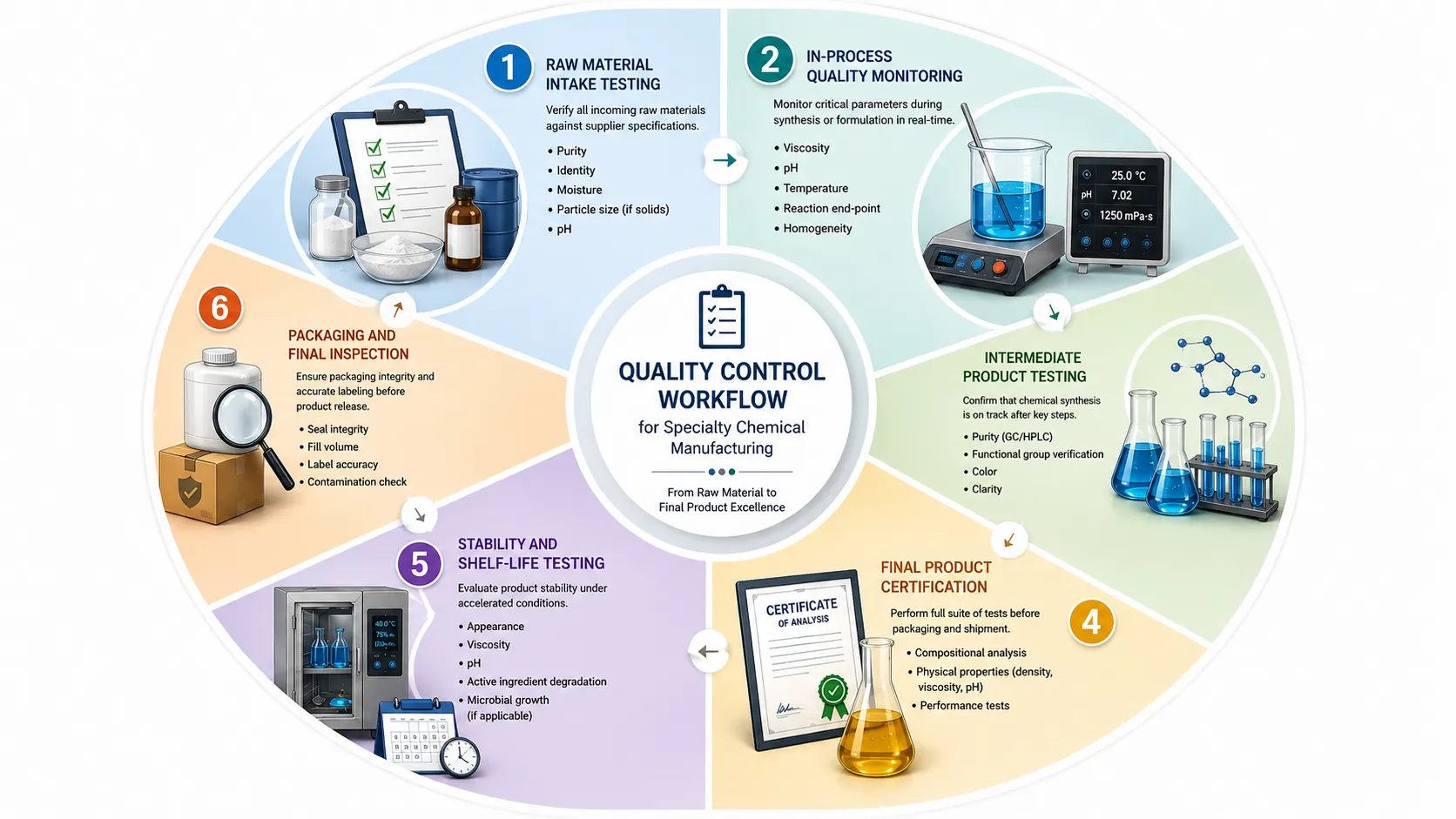
A typical specialty chemical QC workflow moves from incoming material verification through process monitoring, intermediate analysis, final product release, stability evaluation, and packaging inspection. Mapping each stage to its required tests helps prevent both under-equipped laboratories and unnecessary instrument purchases.
1. Raw Material Intake Testing
Before production begins, incoming raw materials are checked against the applicable purchasing or material specifications. The purpose is to confirm that the material received is suitable for use before it enters the manufacturing process.
Depending on the material, testing may include identity confirmation by FTIR or refractive index, purity or assay by GC or HPLC, water determination by Karl Fischer titration, pH, and particle size for solid materials.
Important QC checks: purity or assay, identity, moisture, particle size where relevant, and pH for applicable materials.
Recommended laboratory equipment:
- Fourier Transform Infrared Spectrometer (FTIR)
- Gas Chromatograph (GC) or High-Performance Liquid Chromatograph (HPLC)
- Karl Fischer Titrator
- Analytical Balance
- Particle Size Analyzer


2. In-Process Quality Monitoring
During synthesis or formulation, rapid measurements can help operators detect process deviations before an entire batch is completed. The most useful measurements are those that provide actionable information quickly enough to support production decisions.
Temperature, pH, viscosity, refractive index, or a spectroscopic response may be monitored depending on the reaction or formulation. The required instrument should be selected around the actual process parameter rather than simply duplicating final-release testing.
Important QC checks: viscosity, pH, temperature, reaction progress or end-point where applicable, and homogeneity.
Recommended laboratory equipment:
- Rotational Viscometer
- pH Meter
- Refractometer
- Thermometer / Temperature Probe
- Process Spectrophotometer (if online)


3. Intermediate Product Testing
After key reaction or formulation steps, intermediate testing can confirm whether the process is progressing as expected before additional processing or valuable raw materials are committed.
This stage may require more detailed compositional analysis than routine in-process monitoring. Chromatography can be used where separation and quantification of components are required, while spectroscopic or physical measurements may provide faster confirmation for other products.
Important QC checks: purity or composition by the applicable method, functional group or identity verification where relevant, color, and clarity.
Recommended laboratory equipment:
- GC or HPLC system with appropriate detectors
- UV-Vis Spectrophotometer
- Colorimeter
- Water Bath / Circulator for sample prep


4. Final Product Certification
Before packaging and shipment, the finished specialty chemical is tested against its defined product or batch-release specification. The required tests vary substantially by product because specialty chemicals are sold for their functional performance as well as their composition.
Routine release testing may include assay, impurity analysis, density, viscosity, pH, color, or other physical properties. Application-specific tests can then be added where they are part of the product specification—for example, mechanical testing for certain adhesives or gloss measurement for coatings.
Important QC checks: specification-defined compositional analysis, relevant physical properties, and application-performance tests where required.
Recommended laboratory equipment:
- GC-MS or HPLC-MS for trace analysis
- Density Meter
- Viscometer
- Tensile Tester (for adhesives/films)
- Gloss Meter (for coatings)


Advanced mass-spectrometric systems are not automatically required for routine QC. They are most relevant when the laboratory needs additional sensitivity or identification capability that cannot be provided adequately by the routine release method.
5. Stability and Shelf-Life Testing
Stability testing evaluates whether important product attributes change during storage. The storage conditions, test intervals, and acceptance criteria should follow the product’s applicable stability program rather than a universal schedule.
After storage or controlled environmental exposure, samples may be retested for appearance, viscosity, pH, assay or degradation, and other product-specific quality attributes.
Important QC checks: appearance, viscosity, pH, active ingredient or component stability where applicable, and microbial condition for products where microbiological quality is relevant.
Recommended laboratory equipment:
- Stability Chamber / Oven
- Viscometer
- pH Meter
- HPLC for degradation analysis
- Microbiological testing equipment (if required)


6. Packaging and Final Inspection
Packaging inspection helps confirm that the released material is filled and contained correctly before shipment. The exact checks depend on the chemical, container type, and packaging specification.
For products where package integrity is a defined requirement, an appropriate leak or integrity test may be used. Fill quantity can also be checked gravimetrically where that approach is suitable.
Important QC checks: seal or package integrity where required, fill quantity, label accuracy, and visible contamination.
Recommended laboratory equipment:
- Leak Tester (vacuum decay)
- Analytical Balance (for fill weight)
- Inspection light table
Key Quality Control Tests for Specialty Chemicals
The most useful way to plan a specialty chemical laboratory is to connect each quality attribute to its test purpose and instrument. Not every test applies to every product.
| Quality Control Test | Purpose | Common Laboratory Equipment | Relevant Product Types / Applications |
|---|---|---|---|
| Purity / Assay | Quantify the main component or other specified analytes | HPLC, GC, Titrator | Many specialty chemicals, including intermediates and formulated products |
| Viscosity Measurement | Control flow behavior, processing consistency, and application performance | Rotational Viscometer, Capillary Viscometer | Adhesives, coatings, surfactants |
| pH Determination | Monitor acidity or alkalinity where it affects formulation or process control | pH Meter | Aqueous formulations, surfactants, coatings |
| Moisture Content | Measure water where it can affect reaction behavior, stability, or specification compliance | Karl Fischer Titrator, Moisture Analyzer | Raw materials, solvents, powder additives |
| Particle Size Analysis | Control particle distribution where it influences dispersion, stability, processing, or appearance | Laser Particle Size Analyzer, Sieve Shaker | Pigments, fillers, agrochemicals, powder coatings |
| Density / Specific Gravity | Check formulation or batch consistency | Density Meter, Pycnometer | Liquid chemicals, coating formulations |
| Color Measurement | Evaluate color consistency against the applicable specification | Spectrophotometer, Colorimeter | Coatings, dyes, cosmetic ingredients |
| Refractive Index | Provide a rapid identity or consistency check for suitable liquids | Refractometer | Solvents, essential oils, surfactants |
| Surface Tension | Evaluate wetting, surface, or interfacial behavior | Tensiometer | Surfactants, coatings, ink formulations |
| Accelerated Stability | Evaluate product changes under defined controlled storage conditions | Stability Chamber, Oven | Products with defined stability or shelf-life evaluation requirements |
Recommended Laboratory Equipment for Specialty Chemical QC Laboratories
A practical equipment list should distinguish between instruments used across many products and instruments justified by a specific application or analytical requirement.
| Laboratory Equipment | Main Application | Why It Matters |
|---|---|---|
| HPLC System | Separation and quantitative analysis of suitable compounds | Useful for assay, purity, and impurity analysis when the target compounds and method are suited to liquid chromatography. |
| Gas Chromatograph (GC) | Analysis of suitable volatile compounds | Commonly applied to solvents, volatile components, residual materials, and other compounds compatible with GC analysis. |
| Karl Fischer Titrator | Water content determination | Provides targeted moisture measurement where water content is a critical raw-material, process, or product attribute. |
| UV-Vis Spectrophotometer | Absorbance-based concentration or optical analysis | Can provide rapid routine measurements when a validated or otherwise suitable spectrophotometric method exists. |
| Rotational Viscometer | Viscosity and flow-related measurement | Useful where flow behavior affects mixing, pumping, filling, formulation consistency, or end-use application. |
| pH Meter | Acidity/alkalinity testing | Supports routine control of applicable aqueous raw materials, intermediates, and formulations. |
| Analytical Balance | Precise mass determination | Supports quantitative sample preparation, standard preparation, gravimetric work, and other routine laboratory measurements. |
| Refractometer | Refractive index measurement | Provides a rapid measurement for suitable liquids when refractive index is part of the identity or quality specification. |
| Laser Particle Size Analyzer | Particle size distribution of suitable powders and dispersions | Important when particle distribution affects dispersion, stability, processing, or product performance. |
| Stability Chamber | Controlled environmental storage | Provides controlled conditions for products with defined stability or environmental exposure studies. |
| Tensiometer | Surface and interfacial tension measurement | Relevant when surface or interfacial behavior is a critical property of surfactants, emulsifiers, coatings, or wetting agents. |
| Density Meter | Density or specific-gravity measurement | Provides a rapid physical-property check for suitable liquids and formulations. |
Essential vs Advanced Equipment for a Specialty Chemical QC Lab
There is no universal equipment list for every specialty chemical plant. A basic routine laboratory should first cover the tests that appear most frequently in incoming inspection, process control, and batch-release specifications. Depending on the product portfolio, this may include an analytical balance, pH meter, viscometer, moisture-testing equipment, and the chromatographic or spectroscopic system required by the laboratory’s core analytical methods.
More specialized equipment should be added when a defined testing requirement justifies it. Particle size analyzers are important when particle distribution is a critical attribute. Tensiometers are relevant when surface or interfacial behavior must be controlled. Stability chambers support defined storage studies, while GC-MS or LC-MS-type systems may be appropriate when greater analytical sensitivity or compound-identification capability is required.
This approach helps manufacturers avoid two common laboratory-planning problems: purchasing advanced instruments that are rarely used, or relying on basic instruments for tests that require greater analytical capability.
How to Choose Laboratory Equipment for Specialty Chemical Manufacturing
Selecting the right instruments begins with the test requirements, not the equipment catalogue. Map each product to its raw-material, in-process, final-release, and stability tests, then identify which methods and instrument families are needed to perform those tests.
1. Start with the product and required test. Define what must be measured—such as identity, assay, moisture, viscosity, particle size, or surface properties—and why the result is needed.
2. Match the analytical technique to the sample. Volatility, thermal stability, solubility, viscosity, concentration, particle form, and sample matrix can all affect which analytical approach is practical. For example, GC and HPLC serve different classes of analytical problems and should not be treated as interchangeable simply because both can be used for purity analysis.
3. Separate routine QC from advanced investigation. A production laboratory may need rapid and repeatable routine measurements, while trace impurity identification or troubleshooting can require more advanced analytical capability. Decide whether those advanced analyses must be performed in-house before investing in additional systems.
4. Consider sample volume and throughput. R&D and pilot-scale work often values flexibility, while routine manufacturing QC may place greater emphasis on repeatable workflows, autosampling, efficient sample preparation, and data handling.
5. Check sample compatibility and maintenance needs. Specialty chemical samples may be viscous, corrosive, reactive, particulate, or difficult to clean. Wetted materials, sample introduction, cleaning requirements, consumables, calibration, and spare-part availability should therefore be considered before purchase.
6. Review method and quality-system requirements. Instrument accuracy, calibration, qualification, documentation, software, and data-management requirements should match the laboratory’s actual methods and applicable quality system. Requirements can differ substantially between industrial chemical QC and regulated pharmaceutical-related work.
7. Plan for future methods without overbuying. Modular or expandable systems can be useful when future analytical requirements are reasonably foreseeable. However, expansion capability should support a realistic testing need rather than becoming a reason to purchase unnecessary functionality.
AELAB equipment selection should therefore be based on the product type, required tests, sample characteristics, expected throughput, and analytical methods that the laboratory actually intends to run.
Frequently Asked Questions
What are the most essential laboratory instruments for specialty chemical manufacturing?
There is no single universal equipment list, but most laboratories need instruments covering their core identity, composition, moisture, and physical-property tests. Depending on the product portfolio, this can include HPLC or GC, a Karl Fischer titrator, viscometer, pH meter, analytical balance, and spectrophotometer. Application-specific instruments should be added only when the required QC tests justify them.
How do I ensure my laboratory equipment is compliant with industry regulations?
Start with the requirements that actually apply to the product, test method, market, and laboratory quality system. Equipment should support the required calibration, documentation, qualification, and data-control procedures. Where pharmaceutical-related work is involved, applicable pharmacopoeial or regulated quality requirements should be identified before the instrument configuration and validation approach are finalized.
Can I use the same laboratory equipment for both R&D and QC?
Yes, many benchtop instruments can support both R&D and QC when their performance and documentation meet the intended method requirements. Routine QC laboratories may place greater emphasis on automation, robustness, controlled methods, data integrity, and consistent sample throughput. Shared equipment also requires appropriate scheduling, method control, and maintenance.
What maintenance is required for viscosity measurement instruments in a specialty chemical lab?
Routine maintenance generally includes cleaning the measuring system after samples, checking the condition and alignment of the applicable measuring components, performing calibration or verification according to the laboratory procedure, and maintaining any associated temperature-control equipment. Samples that polymerize, cure, or leave persistent residues may require more intensive cleaning procedures.
How do I choose between a GC and an HPLC for purity testing?
The choice depends mainly on the analytes, sample matrix, and analytical method. GC is generally suited to compounds that can be analyzed in the gas phase under the selected method conditions, while HPLC is widely used for compounds better handled in the liquid phase. Specialty chemical laboratories may need both when their raw materials and finished products cover different chemical classes. More advanced detection may be justified when routine detectors cannot provide the required sensitivity or identification capability.
Why is moisture testing so critical in specialty chemical manufacturing?
Water content can affect reaction behavior, storage stability, formulation properties, and product consistency in moisture-sensitive systems. The importance and acceptable level depend on the specific chemical and its specification. Karl Fischer titration is widely used when selective water determination is required.
Conclusion
Building a specialty chemical QC laboratory is primarily an exercise in matching product → quality attribute → test method → laboratory equipment. The correct configuration depends on what the plant manufactures and which measurements are required at raw-material intake, during production, for batch release, and during stability evaluation.
Core instruments may cover chromatography, moisture, viscosity, pH, weighing, and optical analysis, while particle size, surface tension, environmental testing, mechanical testing, or advanced analytical systems should be added where the product specification and application require them.
This test-driven approach gives manufacturers a more practical basis for laboratory investment: prioritize instruments that support recurring QC decisions, confirm that they are compatible with the actual samples and methods, and add advanced capability when a defined analytical need justifies it.