IVD Manufacturing Quality Control Laboratory Equipment Overview
The in vitro diagnostics (IVD) industry produces reagents, calibrators, controls, assay kits, and other diagnostic products used to detect diseases, monitor conditions, and support treatment decisions. Manufacturing these products requires quality control from incoming raw materials through formulation, final product release, stability studies, and packaging inspection.
For an IVD manufacturing QC laboratory, the main equipment typically supports five areas: raw material verification, in-process formulation control, finished-product performance testing, stability evaluation, and packaging integrity testing. Common instrument families include analytical balances, pH and conductivity meters, spectrophotometers, moisture analyzers, microplate readers, chromatographic systems, real-time PCR systems, incubators, stability chambers, and packaging testers. The exact laboratory configuration depends on the IVD product type, test methods, sample throughput, and internal quality requirements.
For quality control managers, laboratory managers, and production engineers, equipment selection should therefore begin with the tests required at each manufacturing stage rather than with a generic instrument list. This article maps common IVD manufacturing QC requirements to the laboratory equipment used to perform them.
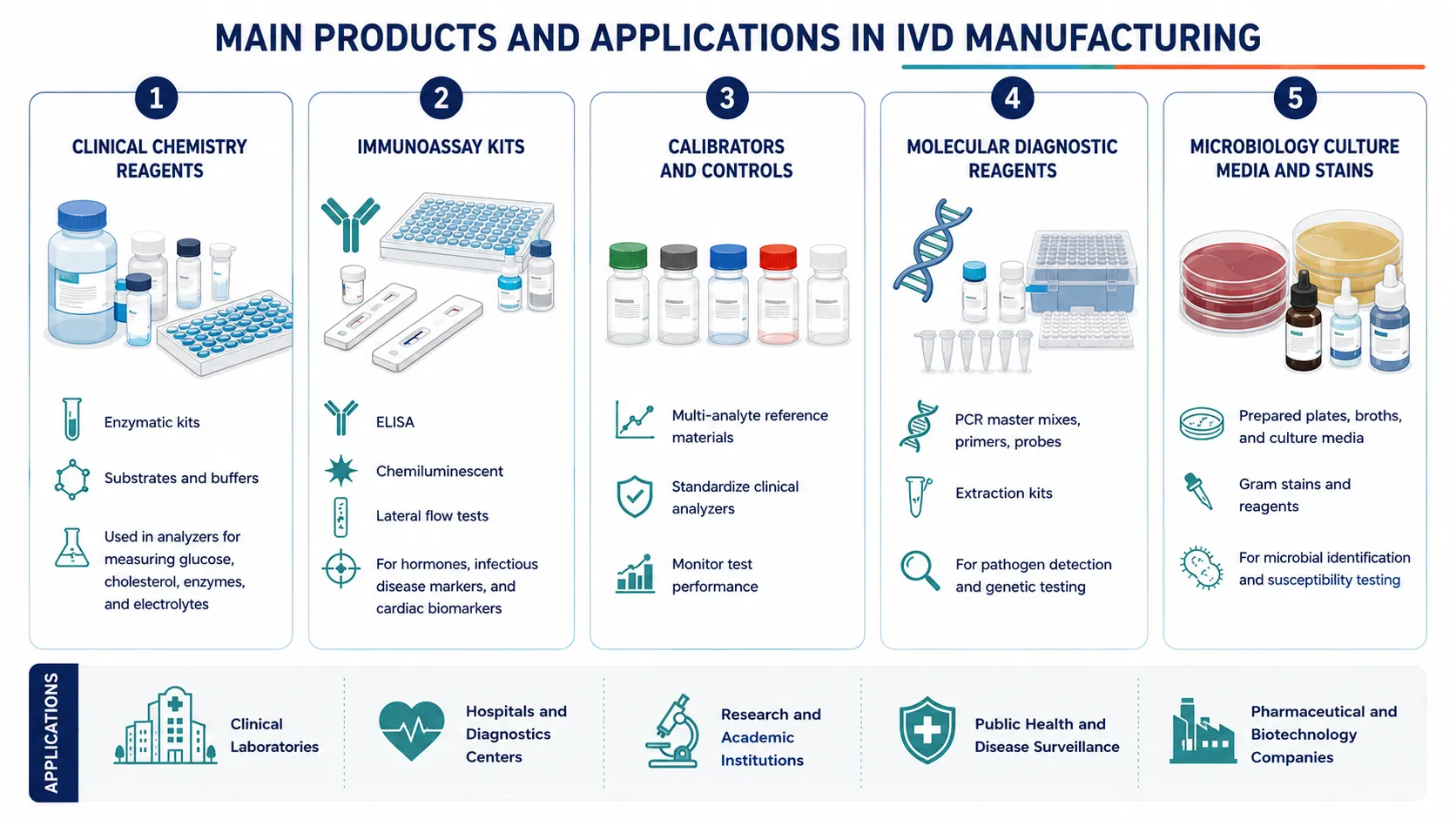
Main Products and Applications in IVD Manufacturing
IVD products span a wide range of formats and applications, and their QC requirements vary according to formulation, detection principle, packaging, and intended performance. Common IVD product categories include:
- Clinical Chemistry Reagents – Enzymatic kits, substrates, and buffers for analyzers measuring glucose, cholesterol, enzymes, and electrolytes.
- Immunoassay Kits – ELISA, chemiluminescent, and lateral flow tests for hormones, infectious disease markers, and cardiac biomarkers.
- Calibrators and Controls – Multi-analyte reference materials used to standardize clinical analyzers and monitor test performance.
- Molecular Diagnostic Reagents – PCR master mixes, primers, probes, and extraction kits for pathogen detection and genetic testing.
- Microbiology Culture Media and Stains – Prepared plates, broths, and Gram stains for microbial identification and susceptibility testing.
Quality Control Workflow in IVD Manufacturing
The most useful way to plan an IVD QC laboratory is to connect each manufacturing stage with its quality risk, required test, and appropriate instrument. Equipment needs can differ significantly between a liquid clinical chemistry reagent, an ELISA kit, a molecular diagnostic reagent, and a packaged lateral-flow device.
1. Raw Material Inspection and Verification
Every IVD product begins with incoming raw materials such as chemicals, biological materials, antibodies, enzymes, and plastics. Variation in identity, purity, moisture, pH, or other material properties can affect downstream formulation and finished-product performance. Manufacturers therefore review supplier documentation and perform the incoming tests defined by their own specifications and quality procedures.
Typical checks may include visual examination, pH measurement, moisture analysis, spectrophotometric testing, and material-specific performance checks. Results determine whether materials are accepted for production, investigated, or rejected.
Recommended laboratory equipment for this stage:
- Analytical Balance – For precise weighing of incoming chemicals and preparation of QC samples.
- pH Meter – Measures the pH of applicable liquid raw materials and prepared solutions.
- UV-Vis Spectrophotometer – Supports absorbance-based identity, concentration, or purity checks where an appropriate method is available.
- Moisture Analyzer – Provides rapid moisture-content measurement for suitable powdered or solid materials.
- Karl Fischer Titrator – Used when a validated Karl Fischer method is required for more specific water determination.



2. In-Process Quality Control During Formulation
During formulation, components are weighed, dissolved, mixed, and adjusted under controlled processing conditions. Errors in weighing, mixing, concentration, temperature, or formulation conditions can contribute to precipitation, inconsistent reagent properties, or reduced biological activity.
For liquid reagents and controls, in-process parameters may include pH, osmolality, conductivity, refractive properties, or viscosity depending on the formulation. Rapid in-process measurements allow production teams to compare a batch with defined process specifications before it proceeds to filling or further processing.
Recommended laboratory equipment for this stage:
- Benchtop pH Meter – Measures formulation pH during batch preparation and adjustment.
- Osmometer – Measures osmolality when this parameter is relevant to calibrators, controls, or other formulated solutions.
- Conductivity Meter – Measures conductivity for applicable buffers and reagent solutions.
- Refractometer – Provides rapid refractive-index or concentration-related measurements when supported by the formulation method.
- Viscometer – Measures viscosity of coating solutions, gels, or other formulations where flow properties are controlled.


3. Final Product Testing and Release
Before an IVD product is released, finished lots are tested against defined specifications. The required tests depend strongly on the product type. Immunoassay kits may require signal and functional-performance testing with defined samples or controls, while molecular diagnostic reagents may require amplification-performance testing. Calibrators and controls require methods appropriate to their assigned values and intended use.
This stage can be equipment-intensive because chemical analysis, functional assay testing, molecular testing, and microbiological procedures may all be required within the same manufacturing operation. Lot-release decisions should be based on approved test methods and predefined acceptance criteria.
Recommended laboratory equipment for this stage:
- Microplate Reader – Measures absorbance, fluorescence, or other supported plate-based signals for applicable immunoassay and enzyme methods.
- HPLC System – Separates and quantifies analytes when chromatographic analysis is part of the approved QC method.
- Real-Time PCR System – Evaluates amplification performance of applicable molecular diagnostic reagents.
- Laminar Flow Cabinet – Provides a controlled clean-air work area for suitable aseptic sample-handling procedures.
- Incubator – Maintains controlled temperatures for applicable reactions, cultures, and microbiological tests.
- Spectrophotometer (UV-Vis) – Supports concentration, absorbance, and purity-related measurements for suitable nucleic acid, protein, or chemical reagent methods.


4. Stability and Accelerated Aging Studies
IVD products must maintain acceptable performance throughout their claimed storage period. Stability programs expose products to defined storage conditions and evaluate them at scheduled intervals. Depending on the product, manufacturers may monitor physical appearance, pH, chemical properties, assay response, or other functional performance indicators.
Stability results support decisions about formulation, packaging, storage conditions, and shelf-life claims. The laboratory therefore needs equipment capable of maintaining controlled storage environments as well as the analytical instruments required to test samples at each stability interval.
Recommended laboratory equipment for this stage:
- Stability Chamber – Maintains controlled temperature and, where required, humidity for defined stability study conditions.
- Refrigerated Incubator – Provides controlled low-temperature conditions for applicable products and study protocols.
- Spectrophotometer – Monitors absorbance or concentration-related changes when these are part of the stability test method.
- pH Meter – Tracks pH changes in applicable liquid formulations during stability studies.
- Water Activity Meter – Measures water activity where it is a relevant stability or microbiological-control parameter.

5. Packaging Integrity and Labeling Verification
Packaging protects IVD reagents from leakage, contamination, evaporation, moisture ingress, and other environmental exposure. Packaging QC can therefore be an important part of final product release. The exact tests depend on whether the product uses bottles, vials, flexible pouches, cartridges, cassettes, or other packaging systems.
Label verification is equally important because lot identification, product identification, barcode information, and other controlled label data must match the released product. Packaging and labeling tests should be selected according to the actual container-closure and labeling system.
Recommended laboratory equipment for this stage:
- Leak Tester – Evaluates package or container leakage using a test method suitable for the packaging format.
- Tensile Tester – Measures seal or material strength for applicable flexible packaging tests.
- Barcode Verifier – Checks barcode readability and print quality according to the manufacturer’s verification procedure.
- Label Inspection System – Supports automated inspection for missing, misaligned, or incorrect labels.
- Torque Meter – Measures closure torque for applicable bottles or capped containers.
Common Quality Control Challenges in IVD Manufacturing
IVD manufacturers face recurring QC challenges that can affect product consistency and diagnostic performance:
- Lot-to-lot variability – Differences in raw materials, formulation, processing, or biological components can create inconsistent assay performance.
- Microbial contamination – Applicable liquid reagents, buffers, and culture products require appropriate contamination-control and microbiological testing procedures.
- Reagent stability issues – Biological and chemical reagents can change during storage, making stability evaluation an important part of product lifecycle control.
- Matrix effects – Serum, plasma, urine, or other sample matrices can influence analytical response and assay performance.
- Calibrator value assignment – The methods and measurement traceability used for calibrator values directly affect how those materials support diagnostic systems.
- Packaging failures – Leakage, inadequate seals, evaporation, or moisture ingress can affect reagent condition before use.
Key Quality Control Tests for IVD Manufacturing
The following table provides a practical test-to-equipment map. The exact method and instrument configuration should always be determined by the product specification and approved QC procedure.
| Quality Challenge | Quality Control Test | Recommended Laboratory Equipment | Application |
|---|---|---|---|
| Lot-to-lot variability | Concentration verification | Spectrophotometer, HPLC | Assay reagents, calibrators |
| Microbial contamination | Bioburden testing | Laminar flow cabinet, incubator, media | Liquid reagents, buffers |
| Reagent stability | Accelerated stability study | Stability chamber, pH meter, spectrophotometer | Enzyme kits, controls |
| Matrix effects | Recovery and linearity studies | Microplate reader, automated analyzer | Immunoassays, clinical chemistry |
| Calibrator value assignment | Reference method comparison | HPLC, reference spectrophotometer | Calibrators, controls |
| Packaging failures | Seal integrity test | Leak tester, tensile tester | Reagent bottles, pouches |
| Labeling errors | Barcode verification | Barcode verifier, label inspection system | Kits, vials |
| Raw material purity | Identity and purity assay | UV-Vis spectrophotometer, FTIR | Incoming chemicals |
Laboratory Equipment Required for IVD Manufacturing Quality Control
Building an IVD QC laboratory requires a combination of routine analytical instruments and product-specific testing systems. Core instruments such as analytical balances, pH meters, and spectrophotometers support many incoming-material and formulation tests. Manufacturers of immunoassays or molecular diagnostic reagents may additionally require microplate readers, real-time PCR systems, electrophoresis equipment, or other method-specific analytical systems.
Environmental and stability equipment such as incubators and stability chambers supports controlled test and storage conditions. Packaging laboratories may require leak, tensile, and torque testing equipment, while microbiological work requires an appropriate combination of controlled work areas, incubation equipment, sterilization capability, media, and defined microbiological methods.
The most appropriate laboratory should therefore be configured around the manufacturer’s actual product portfolio rather than around a universal equipment list.
| Testing Requirement | Laboratory Equipment | Why Manufacturers Need It |
|---|---|---|
| Raw material identity | UV-Vis Spectrophotometer | Supports applicable absorbance-based identity or purity checks before production use |
| pH and ionic strength | pH Meter, Conductivity Meter | Checks reagent and buffer properties against defined formulation specifications |
| Moisture content | Moisture Analyzer, Karl Fischer Titrator | Measures moisture or water content where it is a controlled raw-material parameter |
| Immunoassay performance | Microplate Reader | Quantifies plate-based assay signals for applicable immunoassay and enzyme methods |
| Molecular reagent performance | Real-Time PCR System | Evaluates amplification performance for applicable molecular diagnostic reagents |
| Nucleic acid concentration and purity checks | Spectrophotometer | Supports absorbance-based nucleic acid concentration and purity assessment where appropriate |
| Product stability | Stability Chamber | Maintains defined environmental conditions for stability studies |
| Packaging integrity | Leak Tester, Tensile Tester | Supports package leakage and seal-strength evaluation for applicable packaging formats |
| Microbiological testing | Laminar Flow Cabinet, Incubator | Supports controlled sample handling and incubation for applicable microbiological procedures |
Together, these instruments support testing from incoming raw material inspection through formulation, finished-product evaluation, stability studies, and packaging release. The final equipment list should be derived from the manufacturer’s approved methods, product risks, expected sample volume, and required measurement performance.
Basic Laboratory Setup for IVD Manufacturers
A useful way to budget an IVD laboratory is to separate broadly applicable routine instruments from product-specific or advanced analytical systems. A smaller reagent manufacturer may perform most routine QC with core analytical equipment, while a manufacturer handling multiple assay technologies may require dedicated molecular, chromatographic, microbiological, and automation capabilities.
| Laboratory Level | Recommended Equipment | Suitable For |
|---|---|---|
| Basic QC Laboratory | Analytical balance, pH meter, spectrophotometer, moisture analyzer, incubator | Small IVD kit manufacturers, reagent formulators |
| Advanced QC Laboratory | Microplate reader, HPLC, stability chamber, laminar flow cabinet, leak tester | Mid-size diagnostic companies, contract manufacturers |
| Advanced Analysis Laboratory | Real-time PCR, flow cytometer, LC-MS, automated liquid handler, environmental monitoring system | Large IVD manufacturers, reference labs, R&D centers |
These levels are planning examples rather than fixed laboratory requirements. Equipment should be added only when the product portfolio and test methods justify it.
How to Choose Laboratory Equipment for IVD Manufacturing
Selecting IVD manufacturing laboratory equipment starts with the test method, not the instrument name. Buyers should define what must be measured, the sample type, required measurement performance, expected workload, documentation needs, and laboratory infrastructure before comparing equipment.
Define the Testing Scope
Map required tests from incoming materials through finished-product release and stability studies. Identify which tests are common across the facility and which are specific to clinical chemistry reagents, immunoassays, calibrators, controls, molecular reagents, or microbiology products.
For each test, define the sample type and the measurement required. This prevents buying an advanced instrument for a test that can be handled by a routine system while also reducing the risk of selecting equipment that cannot support the actual QC method.
Match the Instrument to the Test Method
The same general QC objective can require different instruments depending on the method. Concentration measurements, for example, may use spectrophotometric, chromatographic, or assay-based approaches depending on the analyte and product. Moisture testing may use a rapid moisture analyzer for one material and Karl Fischer titration for another.
Before purchasing, confirm that the proposed instrument type is compatible with the laboratory’s approved or planned method, sample characteristics, measurement requirements, and data-reporting needs.
Evaluate Laboratory Workflow Requirements
Consider daily sample volume, batch frequency, number of operators, and turnaround requirements. A high-throughput operation may justify automated plate processing or liquid handling, while a lower-volume manufacturer may achieve adequate throughput with manual or semi-automated systems.
Laboratory space, utilities, environmental conditions, sample segregation, and contamination-control requirements should also be considered before large or specialized systems are purchased.
Consider Calibration, Maintenance, and Documentation
Equipment selection should account for how instruments will be qualified, checked, calibrated, maintained, and documented within the manufacturer’s quality system. Buyers should evaluate preventive maintenance requirements, availability of service and spare parts, operator training, software or data-handling needs where applicable, and the ongoing availability of consumables.
Consumables such as cuvettes, chromatographic columns, microplates, electrodes, and reagents can materially affect operating cost and laboratory continuity, so purchase price alone should not determine instrument selection.
Plan for Current Needs Before Advanced Expansion
A basic laboratory should first cover tests required for current products. Advanced analytical systems such as HPLC, LC-MS, flow cytometry, automated liquid handling, or additional molecular platforms should be justified by specific methods, product development needs, throughput, or analytical problems.
This staged approach helps avoid both under-equipping a QC laboratory and purchasing sophisticated instruments that are not required by the actual testing workflow.
Who Needs Laboratory Testing Solutions for This Industry?
- IVD Kit Manufacturers – Companies producing ELISA, clinical chemistry, or molecular diagnostic kits require QC capabilities appropriate to their product and assay technologies.
- Diagnostic Reagent Formulators – Manufacturers of calibrators, controls, and bulk reagents need analytical equipment for incoming materials, formulation, and finished-product testing.
- Contract Development and Manufacturing Organizations (CDMOs) – Firms providing outsourced IVD production and testing services may require flexible equipment capable of supporting multiple products and methods.
- Hospital and Reference Laboratories – Facilities developing laboratory-developed tests (LDTs) may require equipment for reagent preparation, method development, verification, and internal quality activities.
- Medical Device Startups – Diagnostic companies moving from R&D toward manufacturing need laboratory capabilities that can expand with their product portfolio and QC workload.
Frequently Asked Questions
What is the most critical laboratory equipment for an IVD QC startup?
For a small startup, an analytical balance, UV-Vis spectrophotometer, pH meter, and microplate reader typically form the core. These instruments cover raw material verification, concentration checks, and basic immunoassay readouts. A benchtop incubator and laminar flow cabinet may also be needed if sterility testing is required.
How often should IVD laboratory equipment be calibrated?
Calibration frequency depends on the instrument type, usage intensity, manufacturer recommendations, and internal quality procedures. High-accuracy devices like analytical balances and spectrophotometers may require weekly or monthly checks, while pH meters often need daily calibration. Always follow your quality management system’s guidelines and applicable laboratory requirements.
Can the same laboratory equipment be used for different IVD product types?
Yes, many instruments such as spectrophotometers, balances, and pH meters are versatile and used across clinical chemistry, immunoassay, and molecular diagnostics. However, specialized products like PCR reagents demand dedicated equipment to avoid cross-contamination. Risk assessment should guide whether shared equipment is acceptable.
What regulatory standards affect IVD laboratory equipment selection?
ISO 13485 and FDA 21 CFR Part 820 require equipment that is appropriate for the intended use, properly maintained, and calibrated. In the EU, IVDR (2017/746) emphasizes performance evaluation, which indirectly imposes stricter accuracy and traceability on laboratory instruments. Select equipment that supports documentation of these requirements.
Conclusion
Laboratory equipment for IVD manufacturing should be selected by mapping each product and manufacturing stage to its required QC tests. Incoming materials may require weighing, pH, moisture, and identity testing; formulation requires control of relevant chemical and physical parameters; finished products require method-specific functional and analytical testing; and stability and packaging programs add environmental and integrity-testing requirements.
For buyers, the practical priority is to establish the required test methods and sample throughput first, then select equipment with suitable measurement capability, workflow capacity, maintenance support, and documentation. This approach creates a QC laboratory that supports current production requirements while leaving a clear path for future analytical expansion.
Laboratory Equipment Solutions for IVD Manufacturing
AELAB supports IVD manufacturers by connecting their specific sample types, required quality control tests, and accuracy requirements with suitable laboratory equipment categories. Whether you are validating raw materials, developing new assay formulations, or setting up a stability program, the right instruments can streamline your workflow and reduce out-of-specification events.
If you are planning a new QC laboratory or upgrading your current testing capabilities, share details about the products or samples you test, the test methods you follow, expected testing volumes, and your main quality challenges. This information helps AELAB recommend a practical laboratory equipment configuration tailored to your manufacturing process.