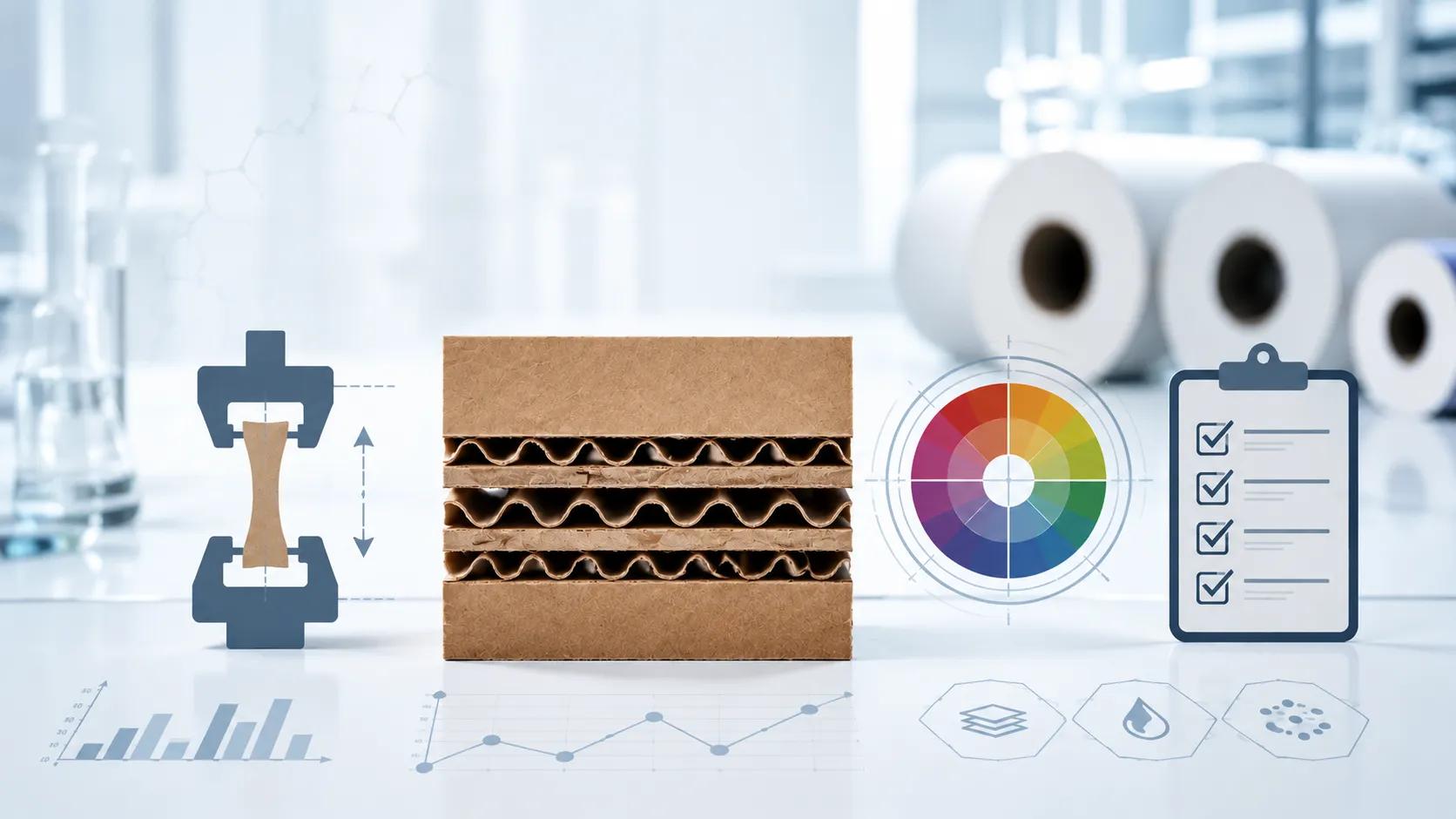
Paper, Packaging & Printing Quality Control Equipment Overview
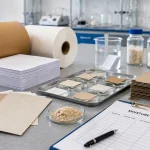
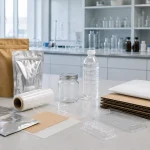
Quality control in paper, packaging, and printing depends on repeatable testing of material properties that affect converting, printing, handling, transport, and final product performance. Reliable paper packaging printing quality control equipment helps laboratories verify incoming materials, monitor production, investigate variation, and confirm finished-product specifications.
For most laboratories, the main testing groups include physical and dimensional properties, mechanical strength, surface and absorption behavior, optical and color properties, and printing or converting performance. The equipment required depends on whether the laboratory handles paper, paperboard, corrugated board, flexible films, printed packaging, or a combination of these materials.
Typical instrument families include balances and thickness gauges, tensile and tear testers, burst and compression testers, Cobb and surface testers, spectrophotometers and gloss meters, rub testers, sample-preparation equipment, and controlled conditioning equipment.
What Is Paper, Packaging & Printing Quality Control?
Paper, packaging, and printing quality control is the systematic inspection and testing of raw materials, semi-finished materials, and finished products against defined specifications or test methods. Depending on the operation, samples may include pulp, paper, board, inks, coated sheets, corrugated blanks, printed cartons, labels, films, laminates, or flexible pouches.
The objective is to identify material or process variation before it becomes a converting, printing, filling, transportation, or end-use problem. Common measurements include grammage, caliper, tensile strength, tear resistance, bursting strength, compressive strength, surface roughness, air permeability, brightness, opacity, gloss, and color consistency.
Test methods may be defined by organizations such as ISO, TAPPI, ASTM, and DIN. Laboratories should select instruments according to the specific method, material type, measurement range, sample throughput, and customer or internal quality requirements.
Main Applications in Paper, Packaging & Printing Industries
Paper Mills
Paper mills use laboratory testing to monitor properties such as basis weight, moisture, formation, thickness, and strength. These measurements help identify variation before rolls or sheets move to converting or customer shipment.
The laboratory therefore needs efficient sample preparation, dimensional measurement, and mechanical testing appropriate to the grades being produced.
Corrugated & Carton Converting Plants
Corrugated and carton converters evaluate board and finished packaging for properties related to compression, bursting, water absorption, and structural performance. Edge crush, flat crush, and box compression testing may be relevant depending on the material and specification.
Compression testers, burst testers, Cobb testers, thickness gauges, and specimen-preparation tools are common equipment families for these laboratories.
Flexible Packaging & Film Producers
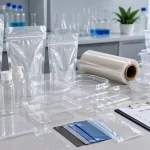
Flexible packaging laboratories may evaluate tensile properties, puncture resistance, coefficient of friction, heat-seal performance, optical appearance, and package integrity. More specialized applications may also require barrier-property analysis.
The appropriate equipment therefore depends heavily on film structure, laminate construction, converting process, and final package requirements.
Commercial Printing Operations
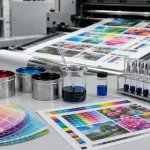
Printing quality control focuses on repeatable color reproduction and the durability of the printed surface. Spectrophotometers, densitometers, gloss meters, and rub testers can help laboratories evaluate color, optical properties, ink adhesion, and resistance to rubbing or scuffing.
Typical Quality Control Workflow for Paper and Packaging
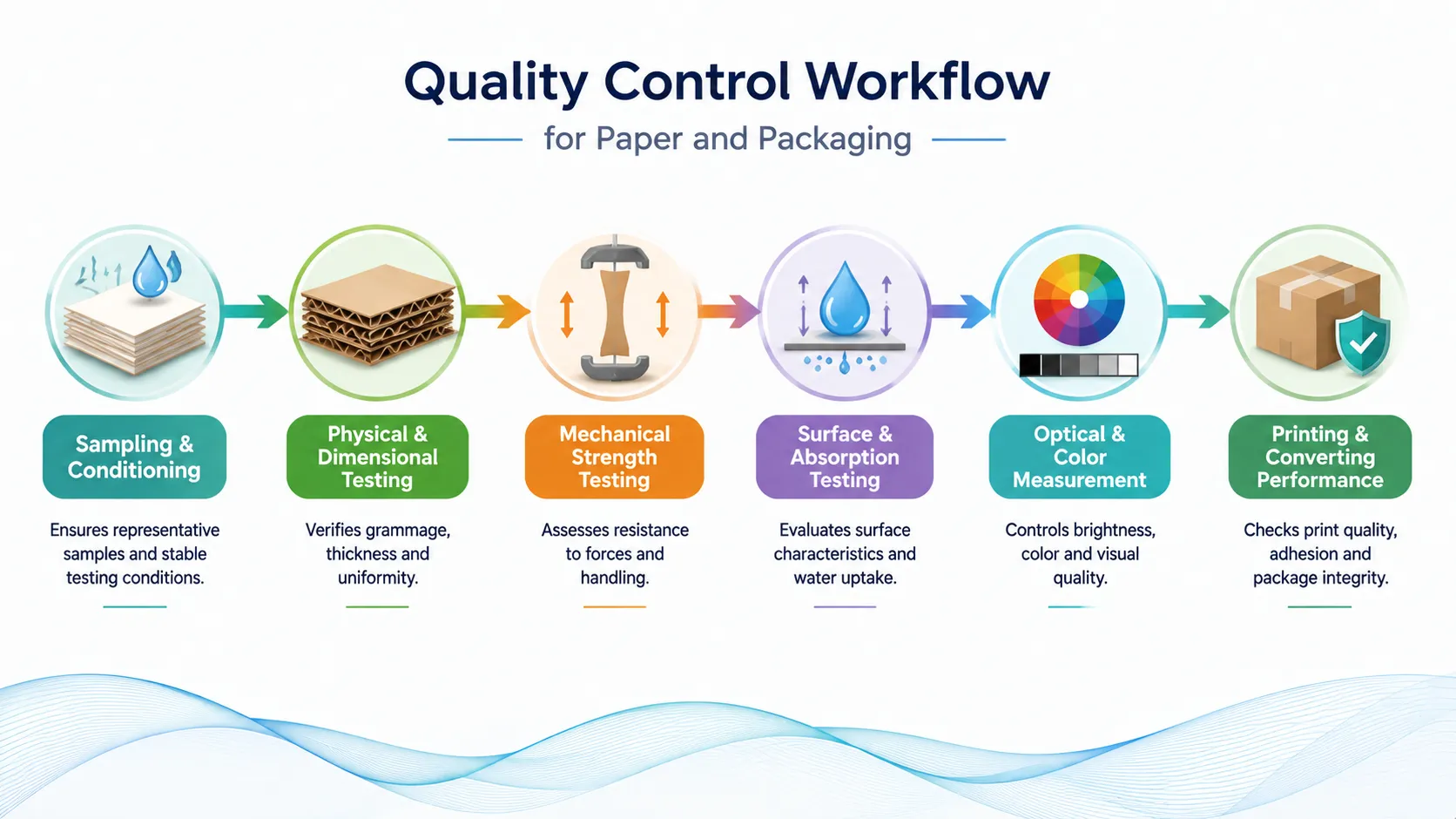
1. Sampling and Conditioning
Representative sampling and controlled conditioning are important because paper and board respond strongly to environmental moisture. Where ISO 187 is the applicable method, specimens are conditioned under the atmosphere specified by that standard before testing.
QC checks: Sample identification, conditioning status, environmental monitoring.
Recommended equipment:
- Sample cutter or die press
- Conditioning chamber or humidity cabinet
- Digital hygro-thermometer

2. Physical and Dimensional Testing
Grammage and thickness are fundamental measurements because they help characterize material uniformity and provide context for many other paper and board properties.
QC checks: Grammage variability, caliper uniformity, apparent density where required.
Recommended equipment:
- Analytical balance with a suitable range
- Micrometer or electronic thickness gauge
- Grammage scale with automatic calculation


3. Mechanical Strength Testing
Mechanical tests evaluate how paper, board, corrugated materials, films, or laminates respond to forces encountered during converting, handling, packaging, and use. Depending on the material and specification, laboratories may perform tensile, tear, burst, or compression testing.
Common referenced methods include ISO 1924-2 for tensile testing, ISO 1974 for tear resistance, ISO 2758 for bursting strength of paper, and ISO 3037 for edgewise crush resistance of corrugated fibreboard.
QC checks: Peak load, elongation, tear index, burst factor, edge crush resistance where required by the applicable method.
Recommended equipment:
- Tensile tester with suitable grips and load cell
- Elmendorf tear tester
- Mullen-type burst tester
- Compression tester for applicable corrugated compression tests
4. Surface and Absorption Testing
Surface characteristics influence printing, coating, gluing, and other converting operations. Water absorption is also important for many paper and board grades.
QC checks: Surface roughness or smoothness, Cobb value, and contact angle where relevant.
Recommended equipment:
- Bendtsen or Sheffield roughness tester
- Cobb sizing tester
- Contact angle goniometer for applications requiring surface-wetting evaluation
5. Optical and Color Measurement
Optical measurements help control the visual properties of paper and printed materials. Depending on the product, laboratories may monitor brightness, opacity, color difference, whiteness, or gloss.
ISO 2470 and ISO 5631 are examples of referenced methods for paper optical properties. The exact instrument geometry and test configuration should match the applicable method and material.
QC checks: Brightness, opacity, L*a*b* color values, color difference (ΔE), gloss where specified.
Recommended equipment:
- Spectrophotometer with geometry suitable for the required method
- Brightness and opacity meter
- Gloss meter with the measurement geometry required by the applicable method


6. Printing and Converting Performance Tests
Finished or converted materials may require application-specific tests that simulate handling or package use. Printed materials can be evaluated for rub or scuff resistance, while flexible packaging may require seal-strength or integrity testing.
QC checks: Rub fastness, adhesion where specified, seal strength, package or seal integrity.
Recommended equipment:
- Motorized rub tester, such as a Sutherland-type tester
- Heat sealer and suitable tensile or peel-testing equipment for seal evaluation
- Pinhole detector or leak tester where package-integrity testing is required
Key Quality Control Tests for Paper, Packaging & Printing
| Quality Control Test | Purpose | Common Laboratory Equipment | Relevant Product Types / Applications |
|---|---|---|---|
| Grammage (Basis Weight) | Determine mass per unit area | Analytical balance, grammage cutter | Paper and board grades |
| Thickness (Caliper) | Measure material thickness or bulk | Micrometer, electronic thickness gauge | Paper, board, corrugated materials, films |
| Bursting Strength | Evaluate resistance to pressure applied through the test diaphragm | Mullen-type burst tester | Paper, paperboard, applicable corrugated materials |
| Tensile Strength | Measure tensile force and elongation behavior | Tensile tester, suitable grips | Paper, board, films, laminates |
| Tear Resistance | Evaluate resistance to tear propagation | Elmendorf tear tester | Paper and other materials where the method is applicable |
| Edge Crush Test (ECT) | Evaluate edgewise compression resistance of corrugated board | Compression tester with suitable ECT setup | Corrugated board |
| Cobb Water Absorption | Evaluate water absorbed by paper or board under defined test conditions | Cobb sizing tester, roller, blotter | Paper, board, sized grades |
| Brightness / Opacity | Evaluate specified optical properties | Brightness/opacity meter or suitable spectrophotometer | Printing papers and other grades with optical specifications |
| Color (L*a*b*) | Compare measured color with a target or reference | Spectrophotometer, color software | Printed packaging, labels, corrugated pre‐print |
| Rub Resistance / Scuff | Evaluate durability of a printed surface under rubbing or abrasion | Motorized rub tester, Sutherland-type tester | Printed cartons, labels, flexible packaging |
Recommended Laboratory Equipment for Paper, Packaging & Printing Laboratories
The best equipment list depends on the materials and tests handled by the laboratory. A basic paper or board QC laboratory normally prioritizes frequent physical and mechanical measurements, while printing, flexible packaging, or advanced converting applications may require additional optical, surface, seal, or integrity-testing instruments.
| Laboratory Equipment | Main Application | Why It Matters |
|---|---|---|
| Precision Analytical Balance | Grammage determination, specimen weighing | Supports basis-weight and other mass-based measurements |
| Digital Thickness Gauge | Caliper measurement | Helps monitor dimensional uniformity and material bulk |
| Mullen Burst Tester | Bursting strength of applicable paper and board | Supports burst-strength specifications where this test is required |
| Universal Tensile Tester | Tensile, elongation, peel, and seal-strength applications with suitable fixtures | Provides a flexible platform for multiple force-based tests |
| Elmendorf Tear Tester | Internal tearing resistance | Evaluates tear behavior where Elmendorf testing is applicable |
| ECT/Compression Tester | Applicable corrugated compression tests | Supports evaluation of corrugated material and package compression performance |
| Cobb Sizing Tester | Water absorption of paper and board | Helps evaluate material response to water under defined test conditions |
| Spectrophotometer | Color and applicable optical measurements | Supports objective comparison of color and optical properties |
| Rub Tester (Sutherland) | Ink rub and scuff resistance | Evaluates durability of printed surfaces during handling |
| Sample Cutter / Die Press | Prepare test specimens of controlled dimensions | Reduces specimen-preparation variability |
| Conditioning Chamber | Condition samples under controlled environmental conditions | Helps control moisture-related variation before testing |
| Leak / Pinhole Tester | Flexible-package or seal-integrity applications | Supports integrity evaluation where required by the package specification |
Basic vs Application-Specific Laboratory Equipment
Not every paper, packaging, or printing laboratory needs every instrument listed above. Equipment should be prioritized according to the materials produced and the specifications the laboratory must verify.
Common starting equipment for paper and board QC:
- Balance and specimen cutter for grammage testing
- Thickness gauge for caliper measurement
- Appropriate strength tester, such as tensile, tear, burst, or compression equipment, based on the product specification
- Conditioning and environmental monitoring equipment where required by the test method
Application-specific additions may include:
- Cobb and surface-testing equipment for paper or board absorption and surface evaluation
- Spectrophotometers, gloss meters, and rub testers for printing and appearance control
- Seal-strength, coefficient-of-friction, haze, leak, or pinhole testing equipment for flexible packaging
- Specialized barrier-property instruments when permeability measurements are part of the product specification
This approach helps laboratories prioritize instruments that support routine release and process-control tests before investing in specialized equipment that is only required for particular products or customer specifications.
How to Choose Laboratory Equipment for Paper, Packaging & Printing QC
Selecting the right instruments starts with the materials you test, the methods you follow, and the decisions the test results must support. Before comparing individual instruments, define the required test list and sample types.
Consider the following factors:
- Product type and sample range: Determine whether the laboratory handles lightweight paper, heavy paperboard, corrugated materials, thin films, laminates, printed surfaces, or multiple substrate types. The instrument configuration must suit the samples actually tested.
- Applicable test methods: Confirm the ISO, TAPPI, ASTM, DIN, customer, or internal methods that apply before selecting equipment. Instrument configuration and accessories should match the required method.
- Measurement range and test configuration: Select the force range, grips, fixtures, geometry, specimen dimensions, and other test-specific features according to the application rather than choosing an instrument only by its general category.
- Throughput and sample volume: High-volume production laboratories may benefit from faster specimen preparation, automated calculations, or semi-automated test cycles.
- Repeatability and data handling: Consider how the instrument controls test conditions, records results, and reduces operator-dependent variation.
- Calibration and maintenance: Confirm the calibration approach, verification requirements, service needs, and availability of appropriate reference or verification tools for the selected test method.
- Software and data management: Where required, evaluate result storage, statistical analysis, reporting, export, and laboratory data-management requirements.
- Technical support and training: When evaluating suppliers such as AELAB, consider installation, method setup, operator training, troubleshooting support, and access to replacement parts or accessories.
- Future testing requirements: Where practical, choose platforms that can accommodate additional fixtures or test applications if the laboratory’s product range is expected to expand.
A useful purchasing sequence is to define product → required test → applicable method → specimen type → instrument configuration. This prevents a laboratory from purchasing equipment that is technically capable of measuring a property but is not properly configured for the required test method.
Frequently Asked Questions
What basic equipment is needed to start a paper and packaging QC lab?
A basic laboratory commonly starts with specimen-preparation equipment, a precision balance, a thickness gauge, and the strength-testing instruments required by its product specifications. Depending on the materials being tested, a Cobb tester, spectrophotometer, compression tester, or conditioning cabinet may also be required.
What is the difference between bursting strength and tensile strength?
Bursting strength evaluates resistance to pressure applied through a diaphragm perpendicular to the specimen, while tensile strength measures material behavior when it is pulled in tension. The tests represent different loading conditions, so one does not replace the other.
How often should paper testing equipment be calibrated?
Calibration frequency should follow the instrument manufacturer’s requirements, the laboratory’s quality system, applicable test methods, usage level, and calibration history. High-use or critical instruments may also need routine verification between formal calibrations.
Which standards govern corrugated board testing?
The applicable standard depends on the property being measured and the customer or regional specification. Examples referenced in corrugated testing include ISO 3035 for flat crush, ISO 3037 for edgewise crush resistance, ISO 12048 for compression testing of complete filled transport packages, and TAPPI T 811 for edgewise compressive strength. Laboratories should confirm the required method and current edition before selecting equipment or fixtures.
Why is sample conditioning important before testing?
Paper and board are hygroscopic, so changes in environmental moisture can change their measured properties. Conditioning specimens under the atmosphere required by the applicable method improves repeatability and comparability between tests.
Can one instrument measure both color and brightness?
Some spectrophotometers can support both color measurement and specified paper optical measurements, but capability depends on instrument geometry, optical configuration, software, and the applicable test method. The required standards should therefore be checked before assuming that one instrument can replace dedicated optical equipment.
Conclusion
A paper, packaging, or printing QC laboratory should be designed around the tests that support real production and product-release decisions. Start by identifying the material, required property, applicable test method, specimen configuration, and expected sample volume; then select the corresponding instrument family.
For paper and board, this often means prioritizing grammage, thickness, conditioning, and relevant strength tests. Corrugated operations may place greater emphasis on compression and absorption testing, while printing laboratories require stronger color and surface-performance capability. Flexible-packaging laboratories may add tensile, seal, friction, optical, integrity, or barrier testing according to the package specification.
Building the laboratory around these explicit product → test → method → equipment relationships helps avoid unnecessary purchases while ensuring that essential QC measurements are properly supported.