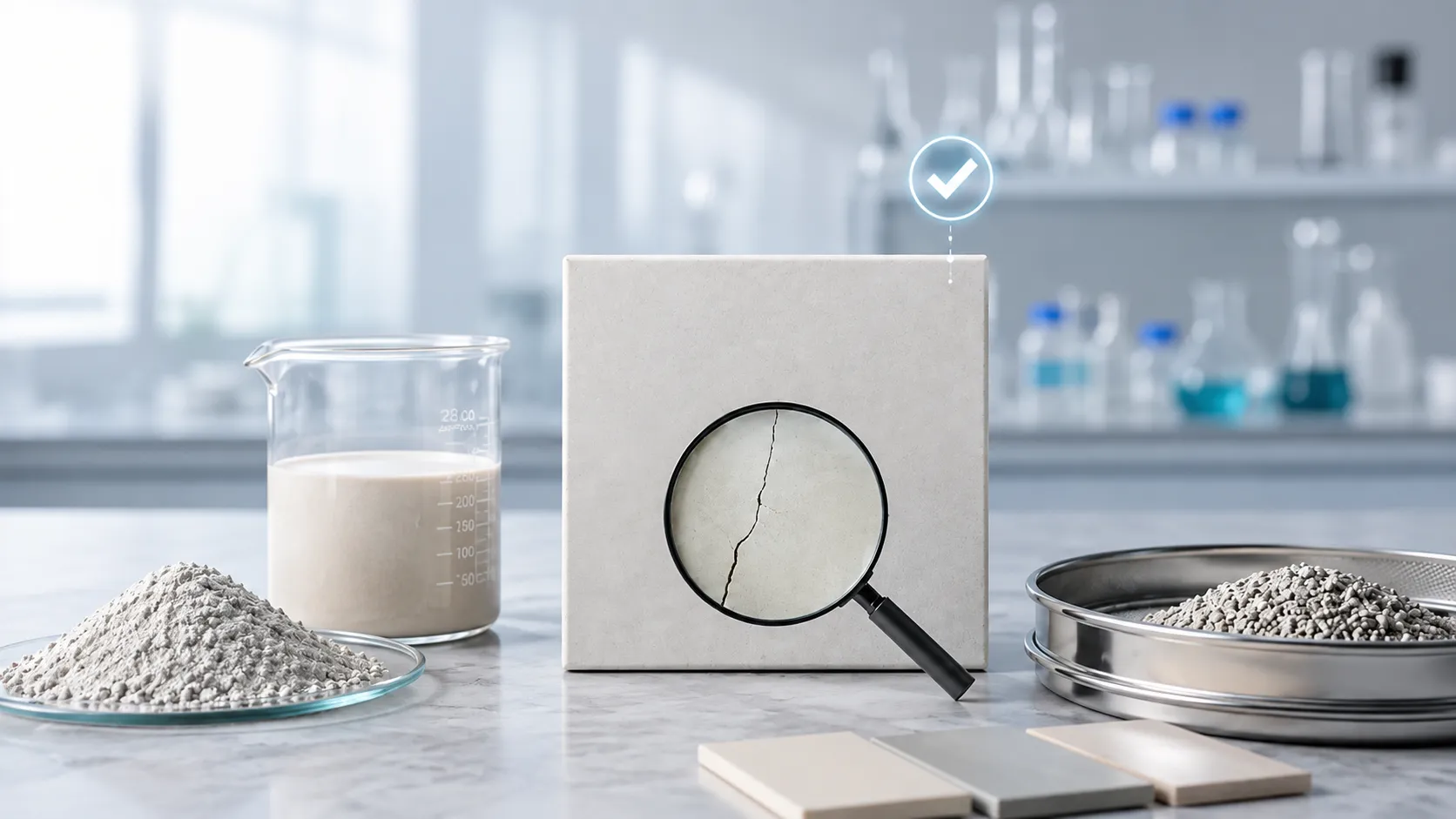
Laboratory Equipment for Ceramic Manufacturing Overview
Selecting the right laboratory equipment for ceramic manufacturing is critical to product consistency, process control, and reliable quality evaluation. From raw material analysis to finished-product testing, ceramic laboratories use different instruments to identify material variation, monitor production conditions, and investigate defects such as cracking, warping, inconsistent density, or glaze problems.
Ceramic production involves physical and chemical changes during preparation, forming, drying, and firing. A well-planned quality control laboratory therefore needs equipment matched to the tests performed at each production stage rather than simply a long list of general laboratory instruments.
In practical terms, the main equipment groups include balances and moisture-testing equipment, ovens and furnaces, particle-size equipment, viscosity and density instruments, mechanical testing machines, water-absorption and density setups, thermal-analysis equipment, and surface inspection tools.
What Is Laboratory Equipment Used in Ceramic Manufacturing?
Laboratory equipment for ceramic manufacturing encompasses instrumentation used to test raw materials, monitor process parameters, and evaluate green and fired ceramic products. The required equipment depends on the ceramic product, production method, quality-control plan, and tests that must be performed.
Common categories include weighing devices, heating apparatus, particle-size analyzers, rheological instruments, mechanical testers, thermal-analysis instruments, and microstructure or surface-evaluation tools. Each equipment family serves a specific role in the quality chain, from clay characterization and slip preparation to final inspection of tiles, sanitaryware, tableware, or advanced ceramics.
Common Laboratory Applications in Ceramic Manufacturing
Ceramic laboratories perform different tests depending on the product type and production stage. The main applications can be grouped into raw material assessment, process control, green-body evaluation, firing studies, and finished-product testing.
- Raw material characterization: Testing clays, feldspars, quartz, and additives for properties such as moisture, particle size distribution, chemical composition, and mineralogy where required.
- Body and glaze preparation: Measuring slip rheology, density, solid content, and homogeneity to support consistent preparation and application.
- Green body testing: Determining moisture content, green strength, density, and drying shrinkage before firing.
- Firing control: Evaluating firing shrinkage, water absorption, bulk density, and thermal behavior to understand body development during firing.
- Final product quality: Assessing properties such as mechanical strength, abrasion or scratch resistance, thermal shock behavior, water absorption, dimensional consistency, and surface quality as relevant to the product.
Ceramic Quality Control Workflow
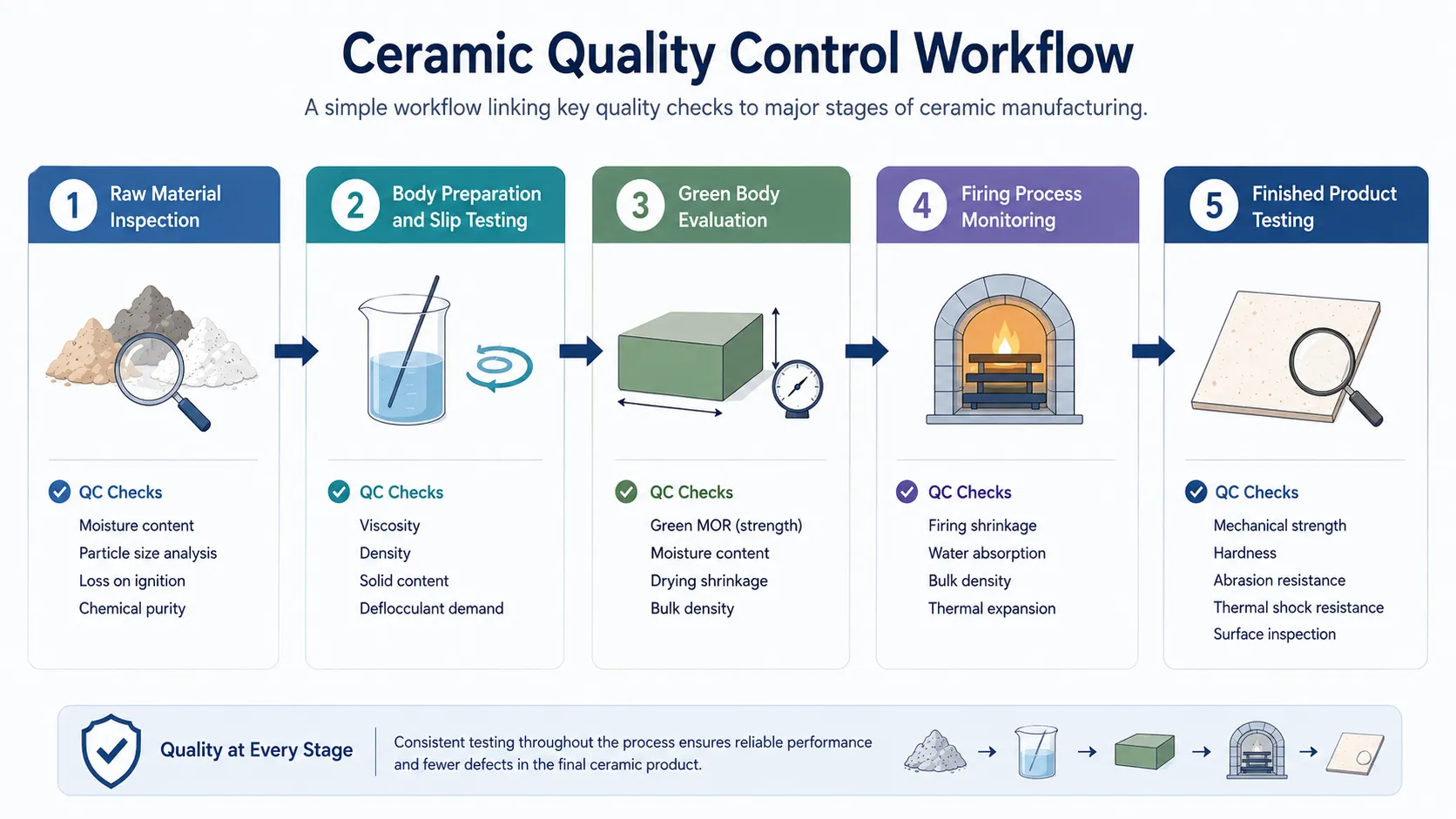
A ceramic QC laboratory is most useful when testing is connected directly to production checkpoints. The following workflow shows how common tests and laboratory equipment relate to major manufacturing stages.
1. Raw Material Inspection
Incoming raw materials such as clays, feldspars, and silica should be checked for consistency before they enter production. Changes in moisture, particle-size distribution, loss on ignition, or composition can influence downstream forming and firing behavior.
QC checks: Moisture content, particle size analysis, loss on ignition, chemical purity.
Recommended laboratory equipment:
- Drying oven for moisture determination
- Analytical balance for weighing
- Sieve shaker and laser diffraction analyzer for particle size
- Muffle furnace for loss on ignition


2. Body Preparation and Slip Testing
During body preparation, the rheological properties of slips and pastes must be controlled to support consistent forming and application. Viscosity, density, and solid content are particularly important where liquid ceramic suspensions are used in processes such as slip casting, glazing, or spray preparation.
QC checks: Viscosity (Brookfield or flow cup), density (pycnometer), solid content, deflocculant demand.
Recommended laboratory equipment:
- Viscometer or flow cup
- Pycnometer or density cup
- Moisture balance or drying oven

3. Green Body Evaluation
After shaping, green ceramic products need sufficient strength for handling and sufficiently controlled moisture and dimensions for subsequent drying and firing. Green-body testing can help identify conditions that may contribute to handling damage, cracking, or dimensional variation.
QC checks: Green MOR, moisture content, linear drying shrinkage, bulk density.
Recommended laboratory equipment:
- Universal testing machine with three-point bending fixture
- Drying oven and balance
- Shrinkage gauge or micrometer
- Archimedes balance for density
4. Firing Process Monitoring
Firing develops the final structure and properties of many ceramic products. Laboratory evaluation of fired specimens helps manufacturers compare firing conditions and assess whether the ceramic body is developing consistently.
QC checks: Firing shrinkage, water absorption, bulk density, thermal expansion coefficient.
Recommended laboratory equipment:
- Muffle furnace or laboratory kiln
- Water absorption setup (boiling method, vacuum chamber)
- Dilatometer for thermal expansion
- Archimedes balance
5. Finished Product Mechanical and Surface Testing
Finished-product testing evaluates whether fired ceramics achieve the mechanical, surface, thermal, and physical properties required for their intended application. The exact tests vary considerably between tiles, sanitaryware, tableware, refractories, and technical ceramics.
QC checks: Modulus of rupture (MOR), compressive strength, Mohs hardness, abrasion resistance, thermal shock resistance, glaze defect inspection.
Recommended laboratory equipment:
- Universal testing machine with compression and flexure fixtures
- Mohs hardness picks or scratch tester
- Abrasion tester (PEI abrasion for tiles)
- Thermal shock chamber or bath
- Stereomicroscope or digital microscope for surface inspection
Key Quality Control Tests for Ceramic Manufacturing
The most useful way to plan a ceramic laboratory is to connect each test with its purpose, required instrument, and relevant product or process stage.
| Quality Control Test | Purpose | Common Laboratory Equipment | Relevant Product Types / Applications |
|---|---|---|---|
| Particle Size Analysis | Ensure consistent raw material milling and clay reactivity | Sieve shaker, laser diffraction analyzer | All ceramic bodies, glazes, engobes |
| Moisture Content | Prevent drying defects and control powder behavior in pressing | Drying oven, moisture balance | Granulates, green bodies, powders |
| Loss on Ignition (LOI) | Determine organic content and carbonate decomposition | Muffle furnace, analytical balance | Clays, talc, additives |
| Rheology (Viscosity, Thixotropy) | Optimize slip casting and glazing suspensions | Viscometer, flow cup, rheometer | Slips, glazes, engobes |
| Green Modulus of Rupture | Assess handling strength before firing | Universal testing machine, three-point fixture | Extruded or pressed green bodies |
| Drying and Firing Shrinkage | Control dimensional accuracy and avoid cracks | Shrinkage gauge, micrometer, caliper | All shaped products |
| Water Absorption | Evaluate water uptake and assess firing or vitrification behavior | Water bath, vacuum chamber, balance | Ceramic tiles, sanitaryware, tableware |
| Bulk Density and Porosity | Evaluate physical structure and compare firing development | Archimedes balance, pycnometer | All fired ceramics |
| Modulus of Rupture (Fired) | Quantify mechanical strength of finished product | Universal testing machine | Ceramic tiles, tableware, refractories |
| Thermal Shock Resistance | Evaluate resistance to rapid temperature changes | Thermal shock chamber, water bath | Tableware, sanitaryware, cookware |
Recommended Laboratory Equipment for Ceramic Manufacturing Laboratories
Not every ceramic laboratory requires every available instrument. Equipment should be selected according to the actual QC tests, product types, sample throughput, and level of analytical detail required.
| Laboratory Equipment | Main Application | Why It Matters |
|---|---|---|
| Analytical Balance | Precise weighing of raw materials, test specimens | Supports gravimetric measurements used for moisture, LOI, density, and sample preparation. |
| Drying Oven | Moisture determination, sample conditioning | Provides controlled drying and conditioning for repeatable moisture and specimen-preparation procedures. |
| Muffle Furnace or Laboratory Kiln | Loss on ignition, ash content, small-scale firing trials | Supports high-temperature laboratory procedures and comparative firing studies. |
| Sieve Shaker | Particle size distribution of powdered raw materials | Provides routine particle-size screening for powdered ceramic materials and prepared batches. |
| Viscometer (Rotational or Flow Cup) | Slip and glaze viscosity measurement | Helps monitor the consistency of ceramic suspensions used in casting or coating processes. |
| Universal Testing Machine | Green and fired mechanical strength (MOR, compression) | Supports mechanical testing of green or fired specimens when suitable fixtures and methods are used. |
| Dilatometer | Thermal expansion measurement | Provides thermal-expansion data useful when evaluating ceramic bodies and glaze/body compatibility. |
| Water Absorption Test Setup | Boiling/vacuum method for water absorption | Supports water-absorption evaluation and assessment of fired ceramic body characteristics. |
| Mohs Hardness Kit / Scratch Tester | Surface hardness evaluation | Provides a practical means of comparing scratch or surface-hardness behavior where relevant. |
| Abrasion Tester (PEI or Taber) | Resistance to surface wear for applicable ceramic products | Supports evaluation of surface-wear behavior when abrasion testing is part of the product QC program. |
| Microscope (Stereo or Digital) | Surface defect inspection, microstructure analysis | Helps inspect cracks, pinholes, glaze defects, and other visible surface features during troubleshooting. |
| pH Meter and Conductivity Meter | Control of slip and glaze chemistry | Provides additional process data for monitoring ceramic suspensions and investigating rheology-related variation. |
Basic vs. Advanced Ceramic Laboratory Equipment
The appropriate laboratory configuration depends on how much testing must be performed in-house.
A basic ceramic QC laboratory will often focus on frequent production-control measurements such as weighing, moisture determination, particle-size screening, viscosity or density checks, shrinkage measurement, and routine firing or water-absorption evaluation. Equipment may therefore include balances, ovens, a furnace or laboratory kiln, sieving equipment, dimensional measurement tools, and basic slip-testing instruments.
A more advanced laboratory may add equipment for detailed mechanical, thermal, particle-size, chemical, mineralogical, or microstructural evaluation. Examples include universal testing machines, dilatometers, laser diffraction analyzers, XRF or XRD systems, rheometers, and microscopy equipment where these analyses are justified by the product and quality-control requirements.
The decision should be based on the tests the laboratory must perform, how frequently samples are tested, and whether specialized analyses are better performed internally or through an external laboratory.
How to Choose Laboratory Equipment for Ceramic Manufacturing
Selecting instruments for a ceramic quality control laboratory should begin with the required tests rather than with individual equipment models. Map each production stage to its critical QC measurements, then identify the instrument type required to perform those measurements.
Consider the following factors:
- Product type and technology: Tile producers may place greater emphasis on water absorption, dimensional, mechanical, and surface testing, while other ceramic products can require different thermal or strength evaluations.
- Required tests: Define which measurements must be performed routinely, which are needed for troubleshooting or R&D, and which can be outsourced before selecting equipment.
- Sample volume and throughput: Higher testing volumes may justify instruments or workflows designed for faster routine measurements.
- Accuracy and method requirements: Match the instrument to the applicable test method and the level of measurement performance required by the laboratory.
- Operational environment: Consider dust, heat, available bench space, utilities, and sample-preparation requirements when planning instrument placement.
- Calibration and maintenance: Evaluate how instruments will be checked, calibrated, cleaned, and maintained and whether suitable service and spare parts are available.
- Technical support and training: When sourcing laboratory equipment, assess after-sales assistance and operator training requirements to support reliable instrument use.
- Future expansion: Consider whether the laboratory may later need higher sample throughput, additional test methods, or more advanced analytical capability.
A balanced ceramic laboratory usually combines routine QC equipment with selected advanced instruments where additional analytical or mechanical data provides clear production, troubleshooting, or product-development value.
Frequently Asked Questions
What laboratory equipment is essential for a ceramic tile plant?
The essential equipment includes an analytical balance, drying oven, muffle furnace, universal testing machine for modulus of rupture, sieve shaker, water absorption test setup, abrasion tester, and a dimension measurement tool (e.g., calipers). A moisture balance and viscometer are also highly recommended for daily process control.
How do you test the quality of ceramic raw materials?
Ceramic raw materials are tested for particle size distribution (using sieve shaker or laser diffraction), chemical composition (XRF or wet analysis), moisture content (drying oven), loss on ignition (muffle furnace), and sometimes mineralogical composition (XRD). Rheological tests on clays include plasticity measurements and deflocculant demand.
Which instrument is used to measure ceramic tile water absorption?
Water absorption is measured using a standardized boiling method or vacuum saturation method, as described in ISO 10545-3. The setup requires a water bath or vacuum chamber, a desiccator, and an analytical balance with a density determination kit. The results classify tiles into groups (e.g., < 0.5% for porcelain tiles).
What is the difference between green strength and fired strength testing?
Green strength refers to the mechanical strength of the unfired ceramic body, tested in three-point bending (MOR) to evaluate handling and glazing line durability. Fired strength is measured after firing and reflects the product’s service strength. Both use a universal testing machine but require different fixtures and specimen preparation.
How do you select a suitable viscometer for ceramic slips?
For ceramic slips, rotational viscometers (e.g., Brookfield) with spindle geometries like LV or RV are common for measuring low to medium viscosity suspensions. Flow cups (e.g., Ford cup, Zahn cup) are simpler and suitable for quick in-process checks. The choice depends on required precision and the viscosity range of the slip system.
Why is thermal expansion testing important in ceramic production?
Thermal expansion testing with a dilatometer ensures that the glaze and body have compatible expansion coefficients. Mismatch leads to crazing (glaze under tension) or peeling (glaze under compression). It is critical for defect prevention in glazed ceramics including tiles, sanitaryware, and tableware.
Conclusion
A reliable ceramic quality control laboratory should be designed around the product, manufacturing process, and tests that influence production decisions. Routine instruments such as balances, ovens, furnaces, sieves, and viscosity or density equipment can support daily process control, while mechanical, thermal, particle-size, chemical, and microscopy systems can provide deeper information when the application requires it.
Before selecting equipment, define the ceramic products being tested, map the required tests to each production stage, estimate sample throughput, and separate essential routine measurements from advanced analytical needs. This test-driven approach helps create a laboratory configuration that supports both day-to-day quality control and future testing requirements.