Cement Quality Control Laboratory Equipment Overview
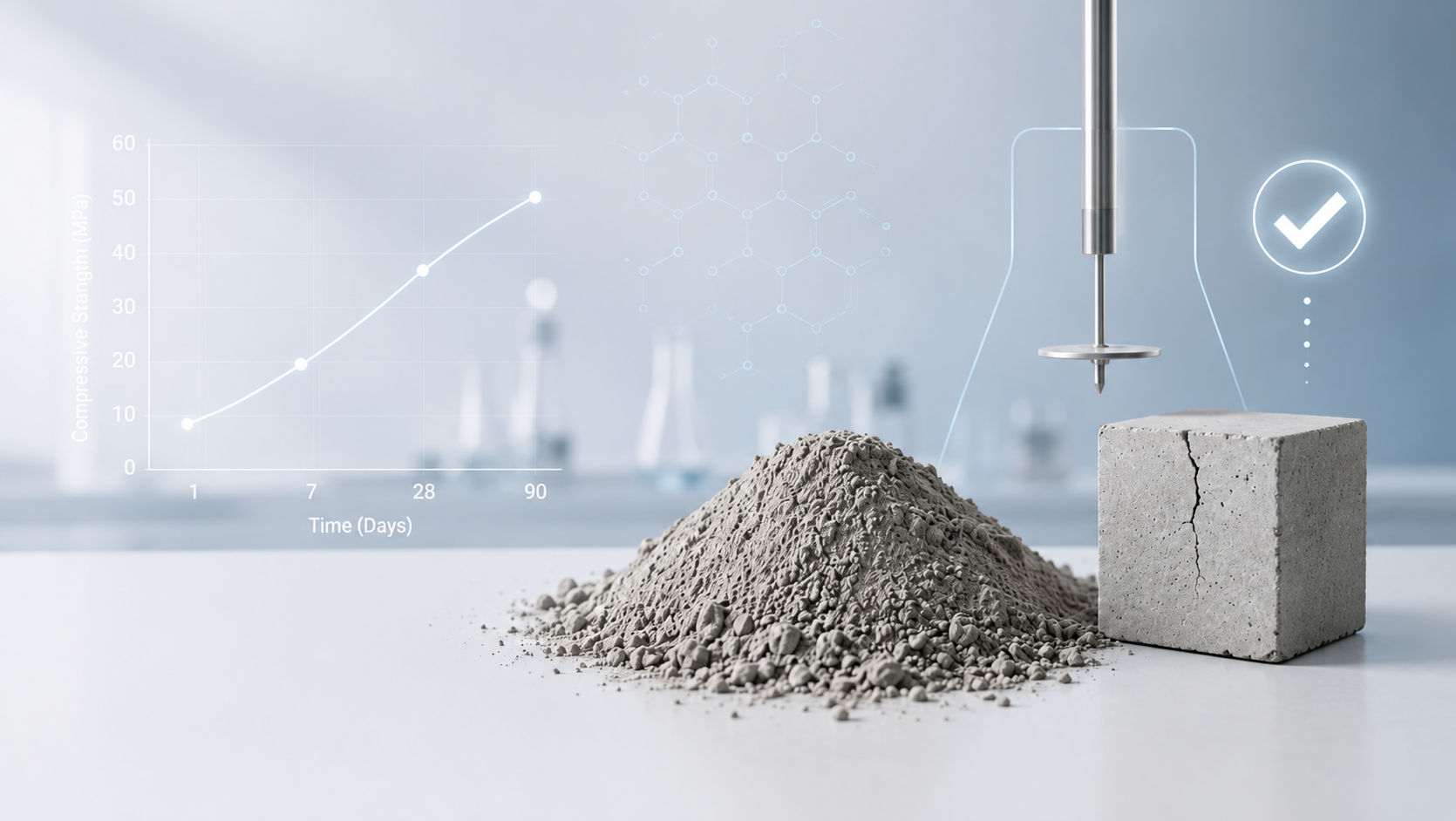
Reliable cement quality control laboratory equipment allows manufacturers to monitor raw materials, clinker, cement production, and finished-product performance with repeatable test data. A typical cement QC laboratory combines sample preparation equipment, chemical analysis instruments, physical testing apparatus, mortar preparation and curing equipment, and mechanical strength testing systems.
The exact laboratory configuration depends on the cement products being manufactured, applicable test standards, sample throughput, and the level of process automation required. For most laboratories, the core objective is the same: connect each production or quality-control question to the appropriate test method and laboratory instrument.
From raw material evaluation to final product certification, a structured QC program helps laboratories identify variations in composition, fineness, setting behavior, soundness, and strength before they become larger production or product-quality problems.
What Is Cement Quality Control Laboratory Equipment?
Cement quality control laboratory equipment encompasses the instruments and apparatus used to prepare samples and evaluate the physical, chemical, and mechanical properties of cement and its intermediate materials.
Typical installations include sample preparation tools, analytical balances, standard molds, ovens, water baths, compression testing machines, Blaine air permeability apparatus, and Vicat instruments. Laboratories performing more extensive chemical or process analysis may also use X-ray fluorescence (XRF) spectrometers, high-temperature furnaces, titration systems, and other analytical equipment.
The equipment supports two related functions: routine production control and finished-product testing. The appropriate combination therefore depends on which materials are tested, which properties must be measured, how frequently samples arrive, and which test methods the laboratory follows.
Main Testing Requirements for Cement Quality Control
Cement QC normally combines several test groups rather than relying on a single instrument or measurement:
- Physical Tests: Fineness, consistency, setting time, and soundness help characterize cement behavior and production consistency.
- Mechanical Tests: Compressive and, where applicable, flexural strength testing evaluates mortar specimens after defined preparation and curing periods.
- Chemical Tests: Depending on the material and applicable method, laboratories may evaluate loss on ignition, insoluble residue, sulfate, chloride, free lime, and oxide composition.
- Performance-Related Tests: More specialized laboratories may investigate heat of hydration, water demand, admixture compatibility, or other application-specific performance characteristics.
Each test requires suitable sample preparation, test apparatus, environmental conditions, calibration or verification procedures, and a documented method. The applicable standard or laboratory procedure should determine the exact specimen dimensions, conditioning requirements, test parameters, and acceptance criteria.
Cement Quality Control Testing Workflow
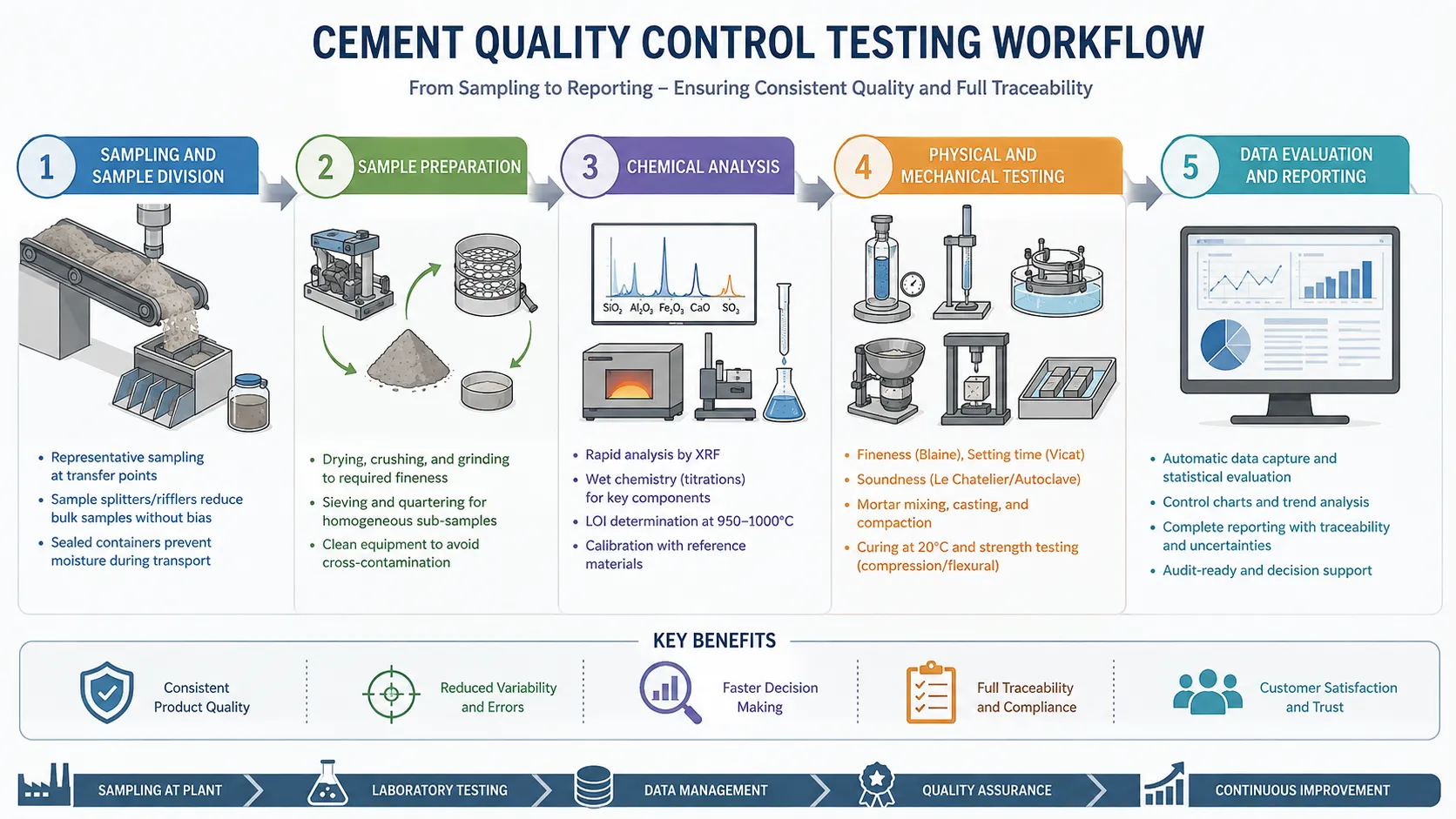
A well-structured testing workflow improves traceability and reduces avoidable variation between sampling, preparation, testing, and reporting. A typical cement QC workflow includes the following stages.
1. Sampling and Sample Division
Representative sampling is the foundation of useful QC data. Samples may be collected from process streams, silos, transfer points, or finished-product lots depending on the plant and control plan. Bulk samples then need to be reduced to suitable laboratory portions without introducing unnecessary segregation or contamination.
Recommended laboratory equipment:
- Automatic process samplers
- Sample splitters or rotary rifflers
- Airtight sample containers
- Scoops and sampling spears
The sampling system should match the material, sampling location, required frequency, and laboratory throughput. Containers and handling procedures should also protect samples from moisture uptake and cross-contamination.
2. Sample Preparation
Sample preparation depends on the material and subsequent analysis. Clinker and other coarse materials may require crushing or grinding before chemical analysis, while cement samples may require drying, homogenization, weighing, or sieving according to the test method.
Recommended laboratory equipment:
- Laboratory jaw crusher or disc mill
- Laboratory oven
- Sample divider or quartering equipment
- Analytical sieve set
- Electronic balance
Preparation equipment should be selected for the material being handled and the required final sample condition. Cleaning between samples is particularly important when the same crusher, mill, divider, or preparation surface is used for different materials.

3. Chemical Analysis
Chemical analysis helps the laboratory monitor raw meal, clinker, cement, and other constituent materials. X-ray fluorescence (XRF) can provide rapid multi-element or oxide analysis when supported by appropriate sample preparation, calibration, and reference materials. Wet-chemistry methods may also be used for specific determinations or as reference procedures.
Loss on ignition and other gravimetric or chemical procedures require suitable balances, furnaces, crucibles, and sample-handling equipment. The exact preparation and analytical method should follow the laboratory’s applicable standard or validated procedure.
Recommended laboratory equipment:
- Benchtop XRF spectrometer
- Fusion bead machine or hydraulic press, where required by the XRF preparation method
- Muffle furnace
- Automatic titrator, where applicable
- Analytical balance
- Suitable crucibles and desiccators
For laboratories with limited chemical-analysis requirements, not every advanced instrument is necessarily essential. Higher-throughput plants may justify automated preparation and instrumental analysis when faster process feedback and reduced manual handling provide operational value.


4. Physical and Mechanical Testing
Physical testing commonly evaluates fineness, consistency, setting behavior, and soundness. Mechanical testing evaluates the strength development of prepared mortar specimens.
Fineness may be determined using a Blaine air permeability apparatus where that method applies. A Vicat apparatus is used for consistency and setting-time procedures, while soundness testing requires the apparatus specified by the selected method. Strength testing adds another sequence of controlled operations: mortar preparation, molding, compaction, curing, and loading of specimens.
Recommended laboratory equipment:
- Blaine air permeability apparatus with manometer
- Vicat apparatus
- Le Chatelier molds and water bath, where the method applies
- Mortar mixer
- Compaction or jolting equipment required by the test method
- Cube or prism molds appropriate to the selected standard
- Temperature-controlled curing equipment
- Compression testing machine
- Flexural testing device, where flexural testing is required
Repeatable strength results depend on the complete test system rather than the compression machine alone. Mixing, specimen dimensions, compaction, curing conditions, machine verification, specimen alignment, and loading procedure all need to be controlled according to the applicable method.
5. Data Evaluation and Reporting
The final stage converts individual test measurements into useful quality-control information. Laboratories may record results manually or integrate instruments with laboratory information management systems (LIMS) or dedicated QC software.
Trend analysis and control charts can help production teams distinguish routine variation from changes that warrant investigation. Regardless of the software used, records should provide sufficient sample identification, test-method information, results, and traceability for the laboratory’s quality system.
Recommended laboratory equipment and systems:
- LIMS or dedicated QC software
- Environmental loggers for temperature and humidity
- Scanner or barcode system for sample tracking
Key Quality Control Tests for Cement
The following table summarizes the relationship between common cement QC questions, the purpose of each test, and the laboratory equipment typically involved.
| Quality Control Test | Purpose | Common Laboratory Equipment | Relevant Materials / Applications |
|---|---|---|---|
| Fineness (Blaine) | Evaluates specific surface area where the Blaine method is used, supporting control of grinding and cement consistency | Blaine air permeability apparatus, manometer, balance | Cement products tested by the applicable Blaine method |
| Consistency and Setting Time (Vicat) | Evaluates water requirement for the test procedure and initial/final setting behavior | Vicat apparatus and associated test accessories | Cement products covered by the selected Vicat test method |
| Soundness | Evaluates dimensional stability using the soundness method required by the applicable standard | Le Chatelier apparatus or other method-specific equipment | Finished cement quality control |
| Compressive Strength | Measures strength development of standardized mortar specimens | Compression testing machine, molds, mortar preparation equipment, curing equipment | Cement strength classification and quality control |
| Chemical Composition (XRF) | Provides rapid elemental or oxide composition data for production and material control | XRF spectrometer and appropriate sample-preparation equipment | Raw meal, clinker, cement, and other suitable materials |
| Loss on Ignition (LOI) | Measures mass change on ignition under the specified test procedure | Muffle furnace, analytical balance, suitable crucibles | Materials for which LOI is part of the applicable QC method |
| Free Lime Content | Supports clinker process control by evaluating uncombined calcium oxide using an appropriate analytical method | Method-dependent wet-chemistry or analytical equipment | Clinker process and quality control |
| Insoluble Residue | Determines the fraction remaining insoluble under the specified chemical procedure | Analytical balance, filtration and laboratory preparation equipment | Cement testing where required by the applicable method |
| Chloride Content | Determines chloride concentration for material or product specification control | Method-dependent titration, electrode, or analytical equipment | Cement and constituent materials where chloride determination is required |
Recommended Laboratory Equipment for Cement QC Laboratories
Equipment should be selected as a complete testing system rather than as isolated instruments. Sample preparation, conditioning, measurement, curing, calibration, and data handling all affect the reliability of the final result.
| Laboratory Equipment | Main Application | Why It Matters |
|---|---|---|
| Sample Splitter / Rotary Riffle | Reducing bulk samples to representative laboratory portions | Helps reduce sample-selection bias before testing |
| Laboratory Oven | Drying or conditioning materials where required by the test procedure | Provides controlled thermal conditions for preparation and testing |
| Analytical Balance | Precise weighing for chemical and gravimetric procedures | Supports reliable mass-based calculations and sample preparation |
| XRF Spectrometer | Rapid elemental or oxide analysis of suitable cement-process materials | Can provide faster chemical feedback for laboratories with sufficient analytical workload |
| Automatic Titrator | Automating suitable wet-chemistry determinations | Can improve consistency and throughput where repetitive titration methods are used |
| Blaine Air Permeability Apparatus | Fineness measurement by air permeability | Supports routine control of cement fineness where the Blaine method applies |
| Vicat Apparatus | Consistency and setting-time testing | Supports standardized evaluation of cement paste behavior |
| Compression Testing Machine | Compressive strength testing of prepared mortar specimens | Provides the controlled load measurement required for mechanical strength testing |
| Curing Equipment | Conditioning strength specimens before testing | Maintains the environmental conditions required by the selected test method |
| Muffle Furnace | High-temperature procedures such as loss-on-ignition testing | Provides controlled heating for applicable gravimetric and preparation procedures |
| Mortar Mixer | Preparing standardized cement mortar | Improves repeatability by controlling specimen preparation |
Essential vs. Advanced Equipment for a Cement QC Lab
Not every cement laboratory needs the same level of instrumentation. The appropriate setup depends on the tests performed on site and which analyses are handled by another laboratory.
Essential Routine QC Equipment
For laboratories responsible for routine physical and mechanical cement testing, the core setup commonly centers on:
- Balances and basic sample-handling equipment
- Fineness testing equipment
- Vicat apparatus and related accessories
- Soundness testing equipment required by the selected method
- Mortar preparation and molding equipment
- Controlled curing equipment
- Compression testing equipment
The exact list should be built from the laboratory’s required test methods rather than from a generic equipment checklist.
Advanced Process and Analytical Equipment
Plants requiring faster chemical feedback, higher sample throughput, or more extensive process control may add:
- XRF analysis systems
- Automated sample preparation
- Automatic titration systems
- Additional thermal or analytical equipment
- LIMS and automated sample-tracking systems
Advanced equipment is most useful when the additional analytical speed, repeatability, automation, or data integration addresses a real production-control requirement.
How to Choose Laboratory Equipment for Cement Quality Control
Selecting the right cement quality control laboratory equipment starts with the tests the laboratory must perform—not with an equipment catalog. Define the materials, methods, sample volume, required turnaround time, and reporting needs first, then configure the equipment around that workflow.
Consider the following factors:
- Required Tests and Standards: Build an equipment list from the actual test methods required for your cement products and target markets. Different methods can require different molds, preparation procedures, accessories, and test conditions.
- Test Scope and Throughput: Estimate samples per shift or per day for each test. A laboratory with frequent process samples may benefit more from automation than one performing occasional certification tests.
- Sample Types and Preparation: Raw meal, clinker, cement, gypsum, and supplementary materials can require different preparation procedures. Confirm that preparation equipment is appropriate for the materials and analytical methods used.
- Measurement Performance: Select instruments capable of meeting the performance requirements of the applicable test method. Avoid specifying greater capability than the laboratory actually needs unless it provides a clear operational benefit.
- Calibration and Verification: Consider how each instrument will be calibrated, verified, documented, and maintained within the laboratory quality system.
- Laboratory Space and Utilities: Check power, ventilation, water, drainage, environmental control, bench space, and safe material-handling requirements before finalizing the laboratory layout.
- Maintenance and Consumables: Evaluate routine maintenance, wear parts, molds, crucibles, reference materials, and other consumables that affect long-term availability and operating cost.
- Technical Support and Training: Operator training and application support are particularly important for sample preparation, analytical instruments, and standardized mechanical testing systems.
- Data Management: For higher-throughput laboratories, digital output, instrument connectivity, sample identification, and LIMS compatibility can reduce manual transcription and improve traceability.
A practical purchasing approach is to divide the equipment list into required for routine testing, required for process control, and advanced or future expansion. This helps prevent both under-equipping the laboratory and purchasing analytical capability that does not address a current testing need.
Frequently Asked Questions
What is the most important piece of equipment in a cement QC lab?
The compression testing machine is often considered the most critical because compressive strength is the primary performance parameter for structural cements. However, a complete lab requires balanced investment across chemical and physical testing instruments to fully control quality.
How often should cement testing equipment be calibrated?
Calibration frequencies depend on the instrument and usage rate. For example, compression testing machines typically require annual calibration, while balances and Blaine apparatus may need verification every six months or more frequently in high-volume labs. Always follow manufacturer recommendations and standard requirements.
What standards govern cement testing?
Key international standards include ASTM C150 and C109 (USA), EN 197-1 and EN 196 series (Europe), and ISO 679. National standards also exist, such as IS 4031 in India. Laboratories must comply with the standard accepted in their market or with multiple standards for export.
Can one machine perform multiple cement tests?
Some instruments are multifunctional; for instance, a Vicat apparatus can measure both normal consistency and setting time. However, critical tests like fineness, strength, and chemical analysis generally require dedicated equipment to maintain accuracy and throughput.
What is the typical cost of setting up a cement QC lab?
Costs vary widely based on automation level and test capacity. A basic lab with manual equipment for physical tests might start at a few tens of thousands of dollars, while a fully automated lab with XRF and robotic sample handling can exceed several hundred thousand dollars. Careful planning is essential to match investment with actual production needs.
How do I ensure accurate compressive strength results?
Accurate strength results depend on strict adherence to standard mixing, molding, and curing procedures, as well as precise alignment and loading rate in the compression machine. Use calibrated gauges, maintain proper specimen shape, and regularly verify the machine’s load cell with a proving ring or reference load cell.
Conclusion
A reliable cement QC laboratory is built around the tests the plant actually needs to perform. Sampling and sample preparation establish the quality of the test portion; physical and chemical tests provide production and material information; and controlled mortar preparation, curing, and mechanical testing provide comparable strength data.
When planning a new laboratory or upgrading an existing one, start by mapping each material and production stage to its required test, then map each test to the necessary preparation and measurement equipment. Separate essential routine instruments from advanced analytical or automation systems, and consider throughput, calibration, maintenance, utilities, and data integration before purchasing.
This test-driven approach makes it easier to select cement quality control laboratory equipment that supports the laboratory’s real workflow while leaving a clear path for future expansion.