Laboratory Equipment for Tile Manufacturing Quality Control Overview
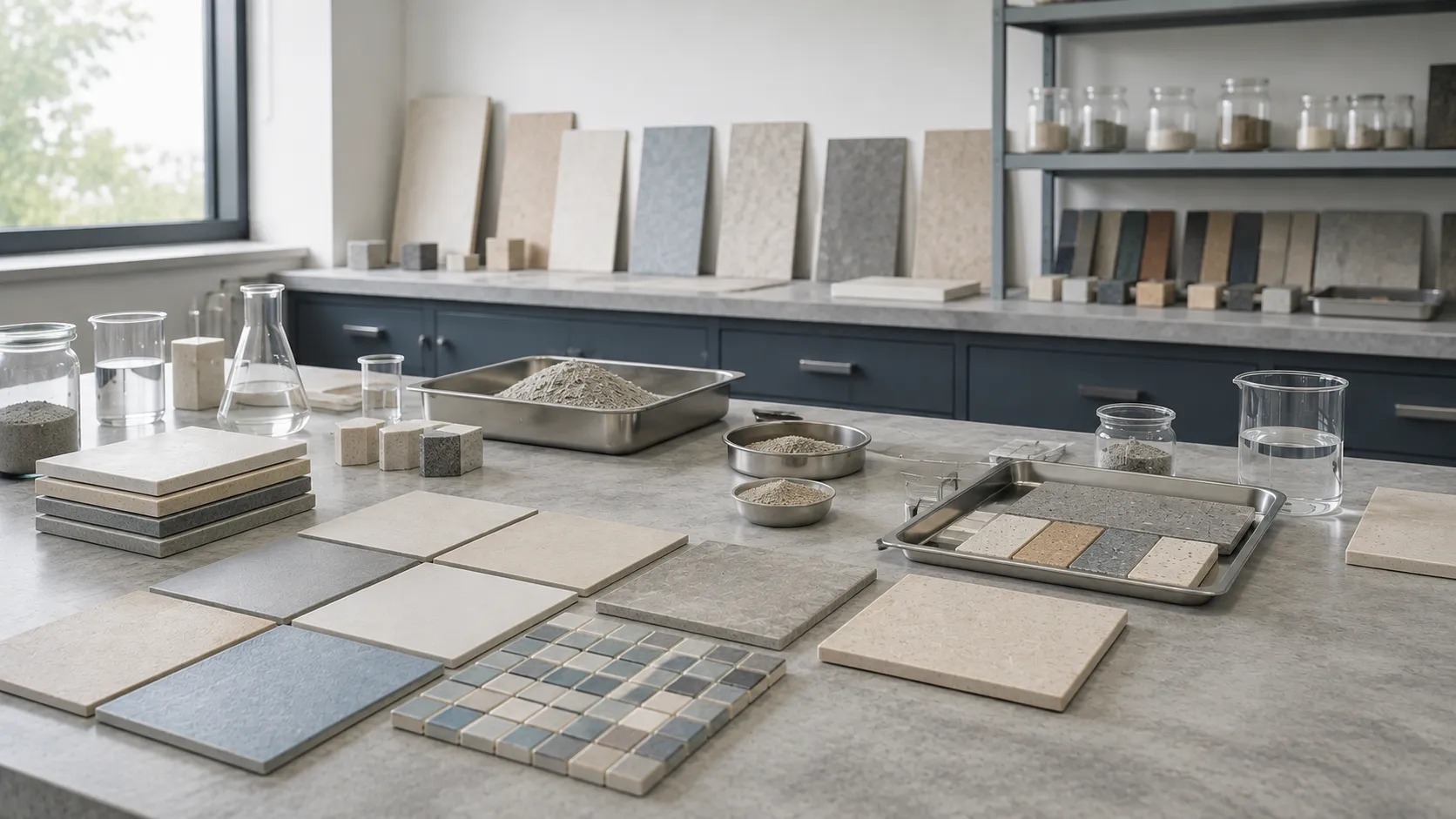
Tile manufacturing quality control requires laboratory testing at three main levels: raw materials, in-process production, and finished tiles. The core test groups typically include moisture and particle-size control, chemical composition analysis, dimensional and mechanical testing, water absorption, surface wear, chemical resistance, and color or gloss evaluation. The corresponding equipment ranges from balances, moisture analyzers, calipers, and universal testing machines to particle size analyzers, spectrophotometers, dilatometers, and X-ray fluorescence spectrometers.
A well-planned tile QC laboratory helps manufacturers identify process variation before it becomes a finished-product defect. Test results can support decisions on raw-material blending, pressing, drying, glazing, firing, product grading, and final release. The appropriate laboratory configuration depends on the tile types produced, the tests required by the manufacturer or target market, expected sample throughput, and the level of in-house analysis needed.
Main Products and Applications
Ceramic tile manufacturers produce a variety of products used in residential, commercial, and industrial settings. The main products include:
- Floor Tiles – Porcelain, ceramic, and quarry tiles designed for mechanical durability and slip resistance.
- Wall Tiles – Glazed and unglazed tiles for interior and exterior wall coverings, focusing on aesthetic uniformity and moisture resistance.
- Porcelain Tiles – High-density tiles with low water absorption, suitable for heavy-traffic areas and outdoor use.
- Decorative Tiles – Specialized tiles with complex glazes and prints, requiring precise color and pattern control.
- Mosaic Tiles – Small-format ceramic pieces often used in artistic applications, demanding dimensional accuracy and consistent glaze quality.
Tile Manufacturing Quality Control Workflow
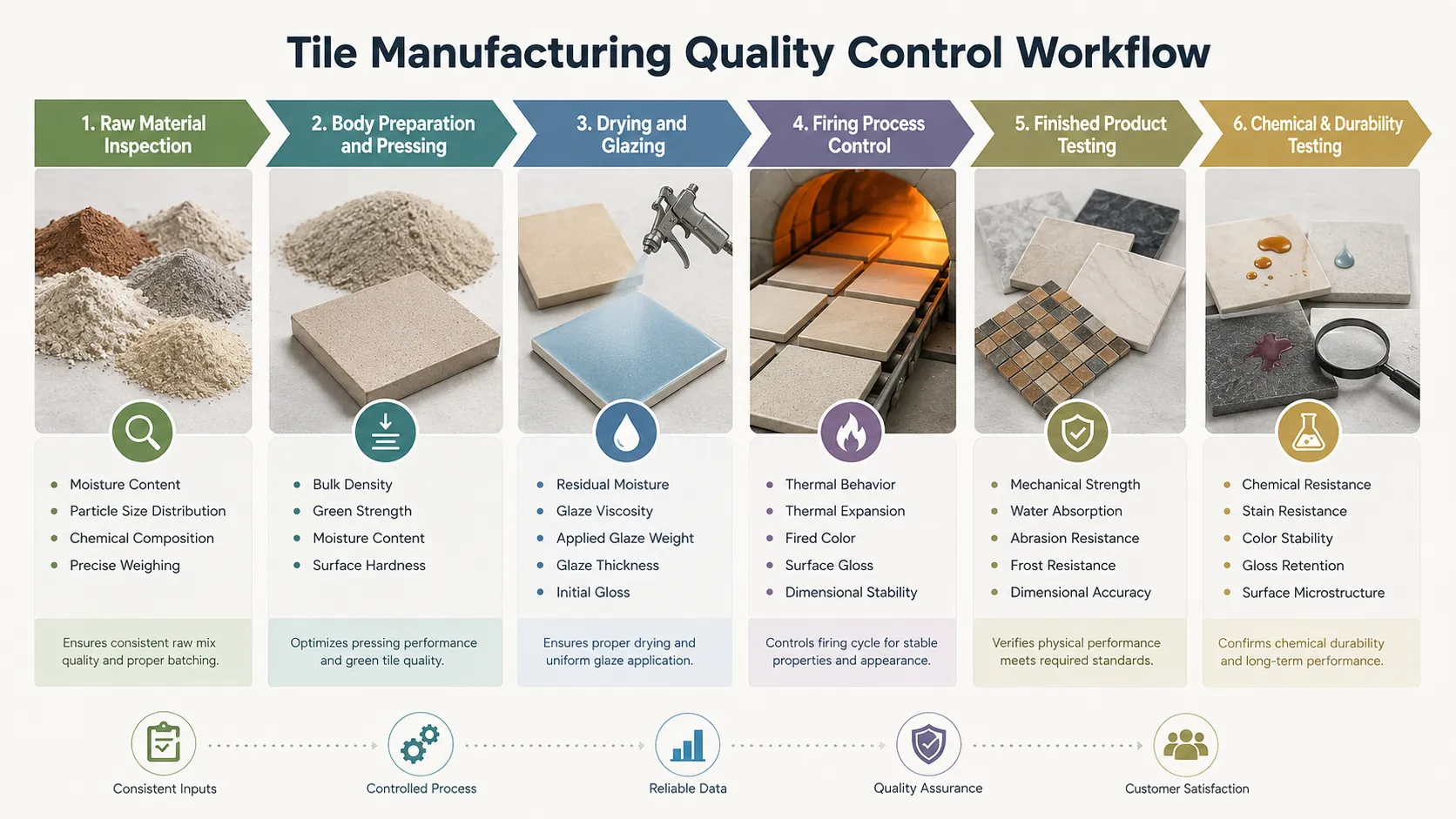
Raw Material Inspection
Raw materials such as clays, feldspar, and silica directly influence tile body and glaze properties. Inconsistencies in particle size distribution, chemical composition, or moisture content can lead to poor compaction, bloating, or color defects. Quality control testing includes moisture determination, particle size analysis, and chemical composition verification. Results guide blending adjustments to maintain consistent raw mix properties.
Recommended laboratory equipment for this stage:
- Moisture Analyzer – Measures moisture content in raw materials to ensure proper handling and batch consistency.
- Particle Size Analyzer – Determines particle size distribution of clays and frits, critical for slip rheology and pressing behavior.
- X-ray Fluorescence Spectrometer – Analyzes elemental composition of raw materials to confirm chemical conformity.
- Analytical Balance – Provides precise weight measurements for sample preparation and batch calculations.


Body Preparation and Pressing
After milling and spray-drying, ceramic powder is pressed into green tiles. Quality risks at this stage include density variation, lamination, and insufficient green strength. Monitoring powder moisture, pressed-body density, and green mechanical behavior helps operators identify forming problems before glazing and firing, where defects become more costly to correct.
Recommended laboratory equipment for this stage:
- Dry Bulk Density Tester – Measures pressed tile density to detect under-compaction.
- Green Strength Tester – Quantifies bending strength of unfired tiles, indicating handling durability.
- Moisture Analyzer – Checks spray-dried powder moisture to avoid pressing lamination.
- Hardness Tester – Assesses surface hardness of green tiles for subsequent glazing quality.
Drying and Glazing
After pressing, tiles are dried and then glazed. Residual moisture or uneven drying can cause cracks. Glaze application must be uniform to avoid shade variation and pinholing. Quality control tests include moisture content after drying, glaze viscosity, applied glaze weight, and dried glaze thickness. Consistent glazing directly affects final appearance and surface quality.
Recommended laboratory equipment for this stage:
- Moisture Analyzer – Verifies low moisture after drying to prevent firing defects.
- Viscometer – Checks glaze slurry viscosity to ensure consistent application.
- Analytical Balance – Determines applied glaze weight per tile.
- Thickness Gauge – Supports glaze-layer thickness checks where the selected gauge and sample geometry are suitable for the method.


Firing Process Control
The firing cycle strongly influences dimensional stability, surface appearance, and the final properties of the tile body and glaze. Routine QC can compare fired dimensions, flatness, color, and gloss against production targets, while thermal-analysis instruments are more appropriate when the laboratory needs deeper material-development or troubleshooting data. These measurements help distinguish routine production drift from body-glaze or firing-related problems.
Recommended laboratory equipment for this stage:
- Differential Scanning Calorimeter – Supports advanced thermal characterization of body or glaze materials during R&D and troubleshooting.
- Dilatometer – Measures thermal expansion of tile body and glaze to prevent crazing and shivering.
- Spectrophotometer – Quantifies fired color to assess shade consistency.
- Gloss Meter – Measures surface gloss after firing for quality grading.
- Laser Distance Sensor – Supports non-contact dimensional or profile measurements where the measurement setup is suitable for the required geometry.


Finished Product Physical Testing
Finished-tile testing verifies whether production output meets the manufacturer’s defined product and market requirements. Common checks include breaking strength or modulus of rupture, water absorption, abrasion resistance, dimensional accuracy, and—where relevant—frost resistance. The required test set should be selected according to tile type, intended use, and the applicable specification or customer requirement.
Recommended laboratory equipment for this stage:
- Universal Testing Machine – Performs bending strength and modulus of rupture tests.
- Water Absorption Test Setup – Comprising vacuum chamber, balance, and boiling bath for accurate water absorption determination.
- Abrasion Tester – Evaluates surface wear resistance for glazed and unglazed tiles.
- Freeze-Thaw Cabinet – Tests frost resistance for outdoor tiles.
- Digital Caliper – Verifies dimensional accuracy and thickness.
Finished Product Chemical and Durability Testing
For many applications, finished tiles are also evaluated for resistance to chemicals and staining. The exact reagents, exposure conditions, and evaluation criteria depend on the test method or specification being followed. Comparing surface appearance, color, gloss, and visible damage before and after exposure can help identify durability problems and support consistent product classification.
Recommended laboratory equipment for this stage:
- Chemical Resistance Test Kit – Exposes tiles to standard reagents to check surface deterioration.
- Stain Resistance Test Setup – Applies staining agents and cleaning procedures to assess cleanability.
- Spectrophotometer – Measures color change after chemical exposure.
- Gloss Meter – Quantifies loss of gloss after durability tests.
- Microscope – Inspects surface microstructure for etching or damage.

Common Quality Control Challenges in Tile Manufacturing
- Inconsistent raw material composition leading to batch-to-batch variation
- Dimensional instability and warpage after firing
- Glaze defects such as pinholing, crazing, or color mismatch
- Low mechanical strength resulting in breakage during handling and installation
- High water absorption causing tiles to fail in moisture-prone environments
- Poor surface resistance to chemicals, stains, and abrasion
Key Quality Control Tests for Tile Manufacturing
| Quality Challenge | Quality Control Test | Recommended Laboratory Equipment | Application |
|---|---|---|---|
| Raw material variation | Chemical composition analysis | X-ray Fluorescence Spectrometer | Verify oxide content |
| Dimensional instability | Dimension measurement | Digital Caliper, Laser Distance Sensor | Check length, width, thickness, flatness |
| Low strength | Bending strength test | Universal Testing Machine | Determine modulus of rupture |
| High water absorption | Water absorption test | Water Absorption Test Setup | Classify tiles by water absorption class |
| Glaze defects | Gloss and color measurement | Spectrophotometer, Gloss Meter | Assess glaze quality |
| Poor abrasion resistance | Abrasion resistance test | Abrasion Tester | Assess wear resistance of applicable tile surfaces |
| Chemical sensitivity | Chemical resistance test | Chemical Resistance Test Kit | Evaluate resistance to acids/alkalis |
| Crazing/shivering | Thermal expansion mismatch | Dilatometer | Measure thermal expansion coefficients |
Laboratory Equipment Required for Tile Manufacturing Quality Control
Quality control in tile manufacturing relies on a combination of physical, mechanical, chemical, and optical testing instruments. Physical testing equipment such as dimensional measurement tools and water absorption setups verifies product conformity to size and porosity standards. Mechanical testers like universal testing machines and abrasion testers assess durability under load and wear. Chemical analysis instruments, including X-ray fluorescence spectrometers, monitor raw material and glaze chemistry to prevent defects. Optical instruments like spectrophotometers and gloss meters ensure consistent visual appearance. Together, these instrument groups provide a comprehensive picture of tile quality from raw material intake to finished product release.
Selecting the right laboratory equipment depends on the specific quality parameters that a manufacturer must control. The table below highlights critical testing requirements and the corresponding instrument categories essential for a modern tile QC laboratory.
| Testing Requirement | Laboratory Equipment | Why Manufacturers Need It |
|---|---|---|
| Dimensional accuracy | Digital Caliper, Laser Distance Sensor | Ensures tiles meet size and flatness tolerances |
| Mechanical strength | Universal Testing Machine | Confirms breaking strength and bending resistance for safe installation |
| Water absorption | Water Absorption Test Setup | Classifies tiles according to porosity groups (e.g., porcelain vs. ceramic) |
| Surface abrasion | Abrasion Tester | Evaluates surface wear resistance for applicable tile products |
| Chemical durability | Chemical Resistance Test Kit | Verifies resistance to cleaning agents and environmental chemicals |
| Color and gloss | Spectrophotometer, Gloss Meter | Maintains shade consistency and surface finish across production batches |
| Thermal expansion | Dilatometer | Prevents crazing or shivering by matching body-glaze expansion |
| Particle size distribution | Particle Size Analyzer | Controls slip and powder characteristics for consistent forming |
When these instruments are implemented as part of a systematic quality program, manufacturers can detect deviations early, reduce waste, and consistently deliver tiles that meet both domestic and international requirements.
Basic Laboratory Setup for Tile Manufacturers
A basic laboratory should cover the tests needed for routine production release before adding advanced analytical instruments. Higher-tier equipment is justified when the plant needs tighter process diagnosis, broader product development capability, or more testing to be performed in-house.
| Laboratory Level | Recommended Equipment | Suitable For |
|---|---|---|
| Basic QC Laboratory | Digital Caliper, Moisture Analyzer, Universal Testing Machine, Water Absorption Test Setup, Gloss Meter | Small-scale tile producers requiring raw material and basic finished product checks |
| Advanced QC Laboratory | Above plus Spectrophotometer, Abrasion Tester, Dilatometer, Chemical Resistance Kit, Particle Size Analyzer | Medium to large manufacturers needing full in-house QC for diverse product lines |
| Advanced Analysis Laboratory | Above plus X-ray Fluorescence Spectrometer, Differential Scanning Calorimeter, Microscope | R&D centers and high-volume plants conducting material research and failure analysis |
How to Choose Laboratory Equipment for Tile Manufacturing
Selecting the right laboratory equipment for tile quality control requires a systematic evaluation of testing needs, operational workflow, and long-term support capabilities.
Define the Testing Scope
Start by identifying the sample types—such as raw materials, spray-dried powder, green tiles, fired tiles, and glazes—and the tests required by product specifications, customer requirements, or target markets. Then define the measurement range, resolution, accuracy, sample size, and method compatibility needed for each test. These requirements should be confirmed before comparing instrument models so the laboratory does not over- or under-invest.
Evaluate Laboratory Workflow Requirements
Consider the daily testing frequency and sample throughput. High-volume production lines may require semi-automated equipment and rapid test methods. Assess operator skill levels; choose instruments with intuitive interfaces if training is limited. Ensure the laboratory space can accommodate the equipment, and that environmental conditions (temperature, humidity) meet instrument requirements.
Compare Long-Term Equipment Support
Laboratory instruments need regular calibration, maintenance, and occasional repairs. Verify the availability of spare parts, consumables, and technical support from the supplier. Training programs for lab staff can significantly reduce downtime. AELAB can help match your testing requirements with appropriate instrument categories and provide guidance on serviceability and support.
Match Equipment Level to the Decision You Need to Make
Not every tile plant needs the same analytical depth. Routine production control should prioritize instruments that support frequent release and process checks, while advanced material-analysis equipment is most valuable when the laboratory must investigate raw-material chemistry, thermal behavior, formulation changes, or recurring defects. Before purchasing, separate essential routine tests from advanced troubleshooting and R&D needs, then confirm that each instrument is compatible with the laboratory’s actual test method and sample format.
Who Needs Laboratory Testing Solutions for Tile Manufacturing?
- Ceramic tile manufacturers seeking to set up a new in-house quality control laboratory
- Existing tile plants planning to upgrade existing QC equipment for more comprehensive testing
- Technical consultants specifying laboratory apparatus for tile factory projects
- R&D centers developing new tile formulations and glazes
- Third-party testing laboratories expanding their scope to include ceramic tile analysis
Frequently Asked Questions
What are the most essential laboratory instruments for a basic tile QC lab?
A basic tile QC laboratory should include a universal testing machine for strength, a water absorption test setup, a digital caliper for dimensional checks, a moisture analyzer, and a gloss meter. These instruments cover the core physical and surface property tests required for product release.
How often should tile laboratory instruments be calibrated?
Calibration frequency depends on instrument type, usage intensity, and internal quality procedures. High-use equipment such as balances and universal testing machines may require more frequent checks. Follow manufacturer recommendations and establish a schedule that aligns with your laboratory’s quality system.
Can spectrophotometers detect color differences that are not visible to the eye?
Yes, a spectrophotometer provides objective color measurement data (CIELAB values) that can detect minor shade variations invisible to the human eye. This supports tight color consistency control, especially for decorative or matching tile sets.
What is the difference between ceramic tile and porcelain tile testing requirements?
Ceramic and porcelain tiles may use many of the same test categories, including water absorption, dimensions, strength, and surface-performance testing. However, the acceptance criteria can differ by product classification and the specification being followed, so the laboratory should confirm the applicable method and performance limits before selecting equipment.
Conclusion
Establishing a rigorous quality control laboratory equipped with appropriate testing instruments is fundamental for any ceramic tile manufacturer aiming to produce consistent, high-performance products. From raw material screening to finished tile durability testing, each instrument contributes to a data-driven quality assurance system that minimizes defects and meets market demands.
Laboratory Equipment Solutions for Tile Manufacturing
AELAB understands the challenges that tile manufacturers face in selecting and integrating laboratory equipment. By evaluating your specific sample types, required quality control tests, accuracy needs, and laboratory workflow, AELAB can help identify the most suitable instrument categories—from physical testers to spectroscopic analyzers—that align with your production scale and technical requirements.
To receive a practical equipment configuration recommendation, please share details about the products or samples you test, the test methods you use, your expected testing volume, and your current laboratory setup. This information, combined with your main quality control challenges, allows us to propose a tailored solution that supports consistent tile quality and operational efficiency.