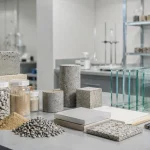
Construction Material Testing Equipment Guide Overview
Construction material testing equipment is used to verify the physical, chemical, mechanical and thermal properties that affect the quality of cement, concrete, ceramics, glass and other building materials. A practical quality control laboratory connects each production stage with the appropriate test method and instrument so manufacturers can identify material or process deviations before products reach the market.
In practical terms, construction material quality control typically combines:
- Raw-material testing – composition, moisture and particle size
- Process control – proportioning, consistency, temperature, drying, curing or firing conditions
- Physical and mechanical testing – dimensions, density, compressive strength, flexural strength and impact resistance where relevant
- Final-product verification – water absorption, appearance, thermal performance and other product-specific properties
The exact laboratory configuration depends on the material being manufactured, the tests required, expected sample throughput and the level of analytical capability needed. Basic QC laboratories may focus on routine physical and mechanical tests, while larger plants and R&D laboratories may also require chemical and thermal analysis instruments.
Main Products and Applications
The construction material sector produces a wide range of products, each requiring specific quality control measures:
- Cement and concrete – used in structural elements, pavements, and precast components
- Bricks, tiles and ceramics – for walls, floors, roofing, and decorative surfaces
- Glass and glazing products – windows, facades, and safety glass applications
- Aggregates and mortars – base materials for concrete, plastering, and masonry
- Insulation and other building materials – thermal and acoustic products, waterproofing membranes

Construction Material Testing Quality Control Workflow
A construction materials laboratory is most effective when testing is organized around production decisions rather than around instruments alone. Incoming inspection determines whether raw materials are suitable for use, in-process testing helps operators correct production conditions, and final testing confirms whether finished materials meet the manufacturer’s required quality criteria.
Raw Material Incoming Inspection
Before production begins, incoming raw materials such as limestone, clay, silica sand, aggregates and chemical additives may need inspection. Variability in raw material composition can affect the quality and consistency of the final product, making incoming inspection an important control point for many construction material manufacturers.
Testing at this stage can include particle size distribution, moisture content, purity and chemical composition, depending on the material and manufacturing process. These measurements help determine whether materials are suitable for the intended formulation or mix and allow production teams to identify deviations before processing begins.
Recommended laboratory equipment for this stage:
- Analytical Balance – For precise weighing of raw material samples and laboratory preparations
- Moisture Analyzer – Measures moisture content in aggregates or powders to support drying and batching control
- Sieve Shaker – Separates particles by size for aggregate or powder gradation testing
- XRF Spectrometer – Provides elemental analysis where raw-material or process chemistry must be monitored
- Laboratory Oven – Supports sample drying and gravimetric moisture-related procedures


Mixing and Proportioning Control
In cement, concrete, ceramic body or glass batch preparation, controlled mixing and proportioning are important for product consistency. Deviations in raw-material, water or additive proportions can affect properties such as workability, setting behavior, strength development or forming performance.
Testing activities can include monitoring water content, checking mix consistency, and measuring temperature or flow behavior where these parameters are relevant to the process. Rapid in-process measurements help production teams identify batching deviations before larger quantities of material are processed.
Recommended laboratory equipment for this stage:
- Concrete Slump Test Apparatus – Assesses the consistency and workability of fresh concrete
- Viscometer – Measures flow behavior of liquid or slurry samples where viscosity is a relevant process parameter
- Thermometer or Data Logger – Monitors process or mix temperature
- Analytical Balance – Supports accurate weighing of laboratory samples and small additive quantities
- Moisture Meter – Checks moisture in aggregates or powders where water content affects batching

Forming and Green Product Testing
After mixing, materials may be shaped by casting, pressing, extruding or molding. Green or uncured products can be checked before subsequent curing, drying or firing so dimensional or forming problems are identified early.
Relevant checks depend on the product. They can include dimensions, density, surface condition and mechanical properties of green bodies. For concrete, representative specimens may be prepared from a batch for later hardened-property testing. For ceramic products, green-body measurements can help identify compaction or handling problems before firing.
Recommended laboratory equipment for this stage:
- Universal Testing Machine – Performs mechanical testing when the machine, load range and fixtures are suitable for the specimen and method
- Digital Caliper – Checks dimensional characteristics of formed tiles, bricks, glass or other specimens
- Density Determination Kit – Supports density measurements where the selected method is appropriate for the sample
- Surface Roughness Tester – Evaluates surface texture where roughness is a defined quality parameter
- Mold or Form Inspection Tools – Help verify mold dimensions, shape and alignment
Curing, Drying or Firing Process Control
Curing for cementitious products, drying for ceramic bodies, and firing or thermal processing for ceramics and glass can strongly influence final material properties. Poor control of time, temperature, humidity or heating conditions can contribute to strength variation, cracking, dimensional changes or other quality problems.
Process monitoring can include temperature profiles, humidity, mass change and other parameters relevant to the specific material. These measurements help manufacturers compare process conditions with product quality results and identify sources of production variability.
Recommended laboratory equipment for this stage:
- Muffle Furnace – Provides controlled high-temperature heating for applicable laboratory procedures and material investigations
- Temperature Data Logger – Records temperature changes or uniformity during thermal processes
- Humidity Sensor or Logger – Monitors relative humidity where controlled curing or conditioning is required
- Precision Balance – Tracks mass change during drying or other gravimetric procedures
- Thermal Analysis System (DSC/TGA) – Investigates thermal transitions, mass changes and decomposition behavior when advanced material characterization is required


Final Product Performance Verification
Once products are fully cured, fired, dried or otherwise finished, final testing provides the quality data used for product evaluation and lot-release decisions. The required tests vary significantly between concrete, masonry, ceramic, glass and insulation products, so the laboratory should be configured around the properties that are critical for each product family.
Common evaluations include mechanical strength, water absorption, dimensional properties, appearance and thermal performance. Glass products may require optical or impact-related testing, while cementitious materials can require additional physical-property tests. The appropriate test program should therefore be defined by product type and the manufacturer’s applicable quality requirements.
Recommended laboratory equipment for this stage:
- Compression Testing Machine – Determines compressive strength of suitable concrete, masonry or related specimens
- Flexural Testing Machine – Measures bending or flexural behavior of applicable construction material specimens
- Water Absorption Tester – Supports water absorption or related porosity evaluations where required by the selected method
- Spectrophotometer or Colorimeter – Measures color where appearance consistency is a controlled product characteristic
- Thermal Conductivity Meter – Evaluates thermal conductivity of materials where thermal performance is a required property
- Impact Tester – Evaluates resistance to impact where applicable to the product and test method


Common Quality Control Challenges in Construction Material Manufacturing
Manufacturers routinely face several obstacles that can affect product consistency and increase testing requirements:
- Variability in natural raw materials leading to inconsistent chemical or physical properties
- Difficulty maintaining mix proportions when raw-material moisture or weighing conditions change
- Inadequate curing, drying or firing control causing strength or dimensional variation
- Surface defects such as cracks, warping or finish imperfections that require consistent inspection methods
- Insufficient mechanical strength associated with material formulation, compaction, processing or curing conditions
- Thermal performance variation in insulation and other materials where heat-transfer properties are critical
Key Quality Control Tests for Construction Material Testing
The most useful equipment decisions start with the required quality characteristic rather than with an instrument name. The table below maps common construction-material problems to the corresponding test and laboratory equipment category.
| Quality Challenge | Quality Control Test | Recommended Laboratory Equipment | Application |
|---|---|---|---|
| Variability in raw material composition | Chemical composition analysis | XRF Spectrometer | Verifying cement chemistry and raw material composition |
| Moisture content fluctuations | Moisture content determination | Moisture Analyzer | Supporting batching and raw-material moisture control |
| Incorrect particle size distribution | Sieve analysis | Sieve Shaker | Checking aggregate or powder gradation |
| Weak compressive strength | Compressive strength test | Compression Testing Machine | Evaluating concrete, brick, block or other suitable specimens |
| High water absorption | Water absorption test | Water Absorption Tester | Evaluating water uptake of applicable construction materials |
| Poor workability of fresh concrete | Slump test | Slump Test Apparatus | Checking fresh concrete consistency and workability |
| Color inconsistency in ceramics or glass | Color measurement | Spectrophotometer | Monitoring batch-to-batch appearance consistency |
| Inadequate thermal performance | Thermal conductivity test | Thermal Conductivity Meter | Evaluating thermal properties of insulation and other applicable materials |
Laboratory Equipment Required for Construction Material Quality Control
There is no single equipment list that applies to every construction materials laboratory. The required instruments depend on the products manufactured and the quality characteristics that must be measured. A concrete laboratory may emphasize fresh-concrete and mechanical testing, while a ceramic or glass laboratory may require additional thermal, dimensional, color or analytical capabilities.
A practical laboratory therefore combines equipment according to the testing workflow. Routine instruments handle frequent production-control measurements, while advanced analytical equipment is added when chemical composition, thermal behavior or more detailed material characterization is necessary. This approach helps avoid both under-equipping a laboratory and purchasing advanced instruments that do not support an actual testing requirement.
| Testing Requirement | Laboratory Equipment | Why Manufacturers Need It |
|---|---|---|
| Chemical composition of raw materials | XRF Spectrometer | Supports composition monitoring for applicable cement, glass and mineral raw materials |
| Moisture content in aggregates or powders | Moisture Analyzer | Provides moisture data for raw-material and batching control |
| Particle size distribution | Sieve Shaker | Supports gradation testing of aggregates and other particulate materials |
| Compressive strength | Compression Testing Machine | Measures compressive strength of suitable concrete, masonry and related specimens |
| Flexural or tensile properties | Universal Testing Machine | Provides configurable mechanical testing when suitable fixtures, load capacity and methods are used |
| Water absorption and related properties | Water Absorption Tester | Supports water-uptake evaluation for applicable porous construction materials |
| Color and appearance | Spectrophotometer | Provides objective color measurement for products where appearance consistency matters |
| Thermal performance | Thermal Conductivity Meter | Measures thermal conductivity where insulation or heat-transfer performance must be evaluated |
Together, these instrument groups can support a structured quality control laboratory, but the correct configuration should follow the actual test program. The first question is not simply which instruments are available; it is which material properties must be measured, how frequently samples will be tested, and what measurement capability the selected methods require.
Basic Laboratory Setup for Construction Material Manufacturers
The required investment in laboratory equipment depends on the product range, testing scope and quality objectives. A basic QC laboratory generally focuses on frequent production-control tests, while advanced laboratories add analytical and characterization capabilities when those measurements support the manufacturing process.
| Laboratory Level | Recommended Equipment | Suitable For |
|---|---|---|
| Basic QC Laboratory | Analytical Balance, Moisture Analyzer, Sieve Shaker, Slump Test Apparatus, Compression Testing Machine, Laboratory Oven | Concrete batching plants, small brick or tile factories needing fundamental quality checks |
| Advanced QC Laboratory | Above plus XRF Spectrometer, Universal Testing Machine, Water Absorption Tester, Spectrophotometer, Muffle Furnace, Thermal Conductivity Meter | Manufacturers requiring broader physical, mechanical, chemical, appearance or thermal testing capabilities |
| Advanced Analysis Laboratory | All above plus Thermal Analysis System (DSC/TGA), Dilatometer, Advanced Microscope | R&D centers, large integrated plants, third-party testing labs and facilities requiring deeper material characterization |
These levels should be treated as configuration examples rather than fixed purchasing lists. A plant producing only one construction material may need fewer instrument families but higher testing capacity in its core methods, while a multi-product or independent laboratory may need broader capabilities.
How to Choose Laboratory Equipment for Construction Material Testing
Selecting construction material testing equipment should begin with the test requirement and sample rather than with a particular instrument model. The most important selection factors are the materials being tested, required methods, measurement range, sample throughput, fixtures or accessories, operator workflow and long-term support.
Define the Testing Scope
Start by identifying the sample types—such as powders, aggregates, liquids, tiles, blocks or prepared mechanical-test specimens—and the properties that need to be measured. Examples include compressive strength, particle size, chemical composition, moisture, color or thermal conductivity.
The expected measurement range and required accuracy or detection capability should then be matched to the relevant test method. A cement plant performing composition analysis has different requirements from a concrete batching plant focused on moisture, workability and strength testing. Defining the actual test scope prevents unnecessary equipment from being included in the laboratory configuration.
Match Instrument Capacity and Accessories to the Test
Instrument category alone is not enough. Mechanical testing equipment, for example, must be selected with suitable load capability, specimen dimensions, fixtures and test configuration. Analytical instruments must be appropriate for the sample type and measurement objective.
Before purchasing, confirm the relationship:
Material → Required Property → Test Method → Measurement Requirement → Instrument → Accessories or Sample Preparation
This sequence is particularly important for universal testing machines and other configurable systems because the same instrument family can support different tests only when its configuration is appropriate for the specimen and method.
Evaluate Laboratory Workflow Requirements
Consider how frequently tests will be performed, the number of samples expected, and the skill level of laboratory operators. High-throughput production laboratories may place greater value on efficient sample handling, repeatable workflows and data recording, while a smaller QC laboratory may prioritize straightforward routine instruments.
Laboratory space and operating conditions should also be considered. Dust, vibration, temperature, available utilities and sample-preparation requirements can influence where equipment is installed and how reliably measurements can be performed.
Separate Essential QC Equipment from Advanced Analysis
Not every laboratory needs advanced analytical instrumentation. Routine QC equipment should normally cover the measurements required for regular production decisions. XRF, DSC/TGA, microscopy or other advanced systems become more relevant when manufacturers need deeper composition, thermal or material-characterization data.
Separating essential tests from advanced analysis helps manufacturers prioritize investment according to the tests that directly support production and product evaluation.
Compare Calibration, Maintenance and Long-Term Equipment Support
Reliable performance over time depends on appropriate calibration or verification procedures, maintenance, availability of consumables and spare parts, operator training, and technical support. These factors should be evaluated alongside the initial instrument purchase.
AELAB assists manufacturers in matching their testing requirements with appropriate instrument categories and in considering installation, calibration and ongoing support as part of the laboratory configuration process.
Who Needs Laboratory Testing Solutions for This Industry?
- Cement plants and grinding units monitoring raw materials, process materials and finished-product quality
- Concrete batching plants and precast factories testing fresh and hardened concrete properties
- Ceramic tile, sanitaryware, and brick manufacturers monitoring dimensional, physical and mechanical consistency
- Glass production facilities requiring composition, thermal, optical or mechanical quality measurements
- Independent testing laboratories performing construction-material testing for multiple customers or product types
Frequently Asked Questions
What equipment is essential for a basic construction materials testing laboratory?
A basic setup typically includes an analytical balance, moisture analyzer, sieve shaker, compression testing machine, laboratory oven, and slump test apparatus when concrete testing is part of the laboratory scope. These instruments cover common measurements such as sample mass, moisture, particle size, fresh-concrete workability and compressive strength. The exact configuration should reflect the products manufactured and the critical properties that need routine control.
How often should compression testing machines be calibrated?
Calibration frequency depends on instrument type, usage intensity, manufacturer recommendations, internal quality procedures, and applicable laboratory requirements. High-usage machines may require more frequent verification to ensure accurate load measurements. Regular checks using appropriate calibrated reference equipment help maintain testing reliability over time.
Can one universal testing machine test both concrete and ceramic materials?
A universal testing machine can support different construction-material mechanical tests when its load capacity, frame configuration, fixtures, specimen dimensions and test controls are appropriate for the required method. Depending on its configuration, it may be used for compression, flexural or tensile testing of different specimens. Equipment should therefore be selected against the actual test methods rather than assuming that one configuration is suitable for every material.
What is the difference between a muffle furnace and a laboratory oven for ceramic testing?
A muffle furnace is designed for higher-temperature laboratory heating and is used for applicable firing, ignition or thermal-treatment procedures. A laboratory oven is generally used for drying, moisture-related procedures and lower-temperature conditioning or heating. The correct choice depends on the required test method and operating temperature rather than on the material name alone.
Conclusion
Construction material testing equipment should be selected as part of a complete quality control workflow rather than as a standalone equipment list. Raw-material inspection establishes whether incoming materials are suitable for production, in-process testing helps identify manufacturing deviations, and final-product testing provides evidence about the properties that matter for release and performance.
For a basic laboratory, the priority is to cover frequent and decision-critical measurements with suitable routine equipment. Advanced chemical, thermal or material-characterization instruments can then be added when the manufacturing process, product range or R&D program requires deeper analysis.
The most reliable selection process is to define the material, required property, test method, measurement requirements, sample volume and laboratory environment before choosing the instrument configuration.
Laboratory Equipment Solutions for Construction Material Industry
AELAB supports manufacturers in configuring laboratories around their materials, testing scope and production requirements. Whether the priority is raw-material composition, moisture and particle size, mechanical strength, appearance or thermal performance, defining the required tests first helps narrow the appropriate instrument categories.
When planning a new laboratory or upgrading an existing facility, prepare a list of the products being tested, required measurements, sample types, expected testing frequency and any existing equipment. This information provides a practical basis for comparing essential QC instruments with advanced analytical equipment and building a laboratory configuration that fits the actual workflow.