Hair Care Product Manufacturing and Quality Control Overview
Hair care product manufacturing combines controlled formulation and processing with laboratory quality control from incoming raw materials through finished product release. The exact test plan varies by product type, formulation, packaging, target market, and the manufacturer’s approved specifications.
For most hair care products, the QC program combines physical testing, stability evaluation, microbiological control, and—when the formulation requires it—instrumental analysis of selected ingredients. The most common test-to-equipment relationships include:
- pH and batch consistency → pH Meter
- Texture and flow behavior → Rotational or Brookfield Viscometer
- Density and concentration-related checks → Density Meter and, for selected formulations, Refractometer
- Emulsion or suspension stability → Laboratory Centrifuge and Stability Chamber
- Microbiological quality → Incubator, Laminar Flow Cabinet, Autoclave, and Colony Counter
- Selected active, preservative, identity, or volatile-compound analysis → HPLC, GC, FTIR, or UV-Visible Spectrophotometer, depending on the analytical requirement
This guide explains where these tests fit into the manufacturing process, which equipment is relevant for different hair care products, and how to distinguish routine QC needs from more advanced analytical requirements.
What Are Hair Care Products?
Hair care products are cosmetic formulations designed to cleanse, condition, protect, nourish, repair, style, or improve the appearance of hair and scalp. Depending on the product type, a formulation may contain surfactants, conditioning agents, oils, silicones, polymers, botanical extracts, proteins, vitamins, preservatives, fragrances, colorants, and deionized water.
Common hair care product categories include:
- Shampoo
- Hair conditioner
- Hair mask
- Hair serum
- Hair oil
- Scalp tonic
- Heat protection spray
- Hair cream
- Anti-hair loss products
- Hair styling gel, wax, mousse, and spray
Before reaching the market, each product should be evaluated through physical, chemical, microbiological, and stability tests to confirm that it meets the required quality specifications.
Main Raw Materials Used in Hair Care Product Manufacturing
The quality of raw materials has a direct impact on the performance, safety, texture, stability, and shelf life of the finished hair care product. For this reason, incoming raw materials should be inspected before entering the formulation and production process.
Typical raw materials used in hair care manufacturing include:
- Surfactants for cleansing and foam formation
- Conditioning agents for softness and combability
- Vegetable oils and mineral oils for nourishment and shine
- Silicones for smoothness, gloss, and frizz control
- Styling polymers for hold and film formation
- Preservatives for microbial protection
- Botanical extracts and active ingredients
- Proteins, vitamins, and peptides
- Fragrances and colorants
- Deionized water
Raw material testing may include appearance inspection, odor evaluation, pH measurement, moisture content determination, density measurement, purity checks, and identity confirmation using analytical instruments.
Hair Care Product Manufacturing Process
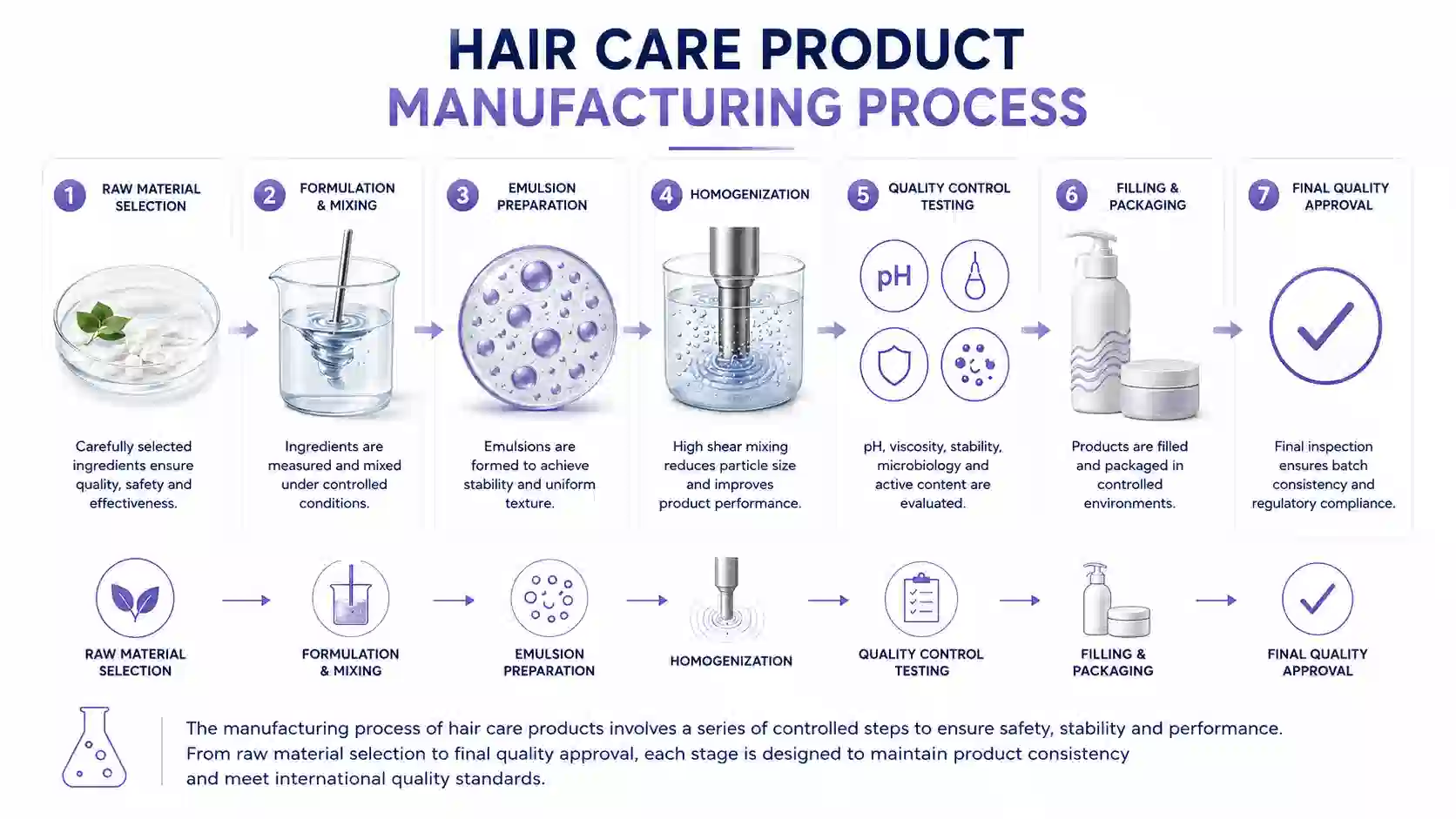
The manufacturing process of hair care products includes several controlled stages. Each stage requires laboratory testing to confirm that the formulation remains stable, homogeneous, safe, and consistent from one production batch to another.
Raw Material Inspection
Before production starts, all incoming raw materials should be checked against approved specifications. This step helps prevent formulation defects, contamination, viscosity variation, instability, and batch rejection.
Common raw material quality control tests include:
- Appearance, color, and odor inspection
- pH measurement of liquid raw materials
- Moisture content determination of powders and hygroscopic materials
- Density measurement of liquid ingredients
- Purity and identity testing where required
Recommended laboratory equipment for raw material inspection:
- Analytical Balance – Used for accurate weighing of raw materials, standards, and laboratory samples.
- pH Meter – Measures the acidity or alkalinity of liquid raw materials and aqueous solutions.
- Moisture Analyzer – Determines moisture content in powders, extracts, and selected raw materials.
- Density Meter – Measures liquid density to verify raw material consistency.
- FTIR Spectrometer – Supports raw material identification and chemical verification.


Formulation Development and Laboratory Mixing
After raw materials are approved, ingredients are weighed and mixed according to the formulation. During formulation development, laboratory teams evaluate mixing speed, heating temperature, ingredient addition sequence, hydration time, emulsification conditions, and final texture.
For shampoos, conditioners, masks, creams, and serums, proper mixing and homogenization are essential for product uniformity, appearance, viscosity, and stability.
Recommended laboratory equipment for formulation development:
- Magnetic Stirrer – Used for laboratory-scale mixing, sample preparation, and solution blending.
- Hot Plate Stirrer – Provides simultaneous heating and stirring during formulation trials.
- Laboratory Homogenizer – Produces uniform emulsions and improves dispersion of oils, polymers, and active ingredients.
- Overhead Stirrer – Suitable for higher-viscosity formulations such as conditioners, creams, and hair masks.


In-Process Quality Control During Production
In-process quality control is performed while the batch is being manufactured. Representative samples are collected to confirm that the product remains within the required specifications before filling and packaging.
Common in-process quality control parameters include pH, viscosity, density, appearance, odor, color, homogeneity, foam behavior, and emulsion stability.
Recommended laboratory equipment for in-process hair care QC:
- pH Meter – Controls formulation pH and helps ensure product compatibility with hair and scalp.
- Brookfield Viscometer – Measures viscosity and flow behavior in shampoos, conditioners, masks, and gels.
- Density Meter – Verifies density uniformity and batch consistency.
- Refractometer – Measures refractive index for selected formulations where concentration control is required.
- Laboratory Centrifuge – Accelerates phase separation to evaluate emulsion and suspension stability.


Finished Product Release Testing
Finished product release testing confirms that a manufactured batch meets the company’s approved quality specifications before it is released. The exact release panel depends on the product and its specification, but commonly reviewed parameters include appearance, odor, color, pH, viscosity, density, microbiological quality, and selected chemical or active-ingredient results where these are part of the product specification.
For routine finished-product QC, the most relevant instruments are usually the same instruments used during in-process control: pH meters, viscometers, density meters, and appropriate microbiology equipment. HPLC, GC, FTIR, or UV-Visible spectrophotometry may be used when the release specification includes identity or quantitative analysis of selected compounds.
Stability Testing and Shelf Life Evaluation
Stability testing evaluates how hair care formulations respond to temperature, humidity, light exposure, storage time, and transportation conditions. These tests help manufacturers predict shelf life and confirm that the product remains safe, stable, and visually acceptable until the end of its intended use period.
Stability testing may include accelerated stability studies, long-term stability studies, freeze-thaw cycles, centrifuge stability testing, high-temperature storage, low-temperature storage, packaging compatibility, and visual inspection over time.
Recommended laboratory equipment for stability testing:
- Stability Test Chamber – Simulates controlled temperature and humidity conditions for accelerated and long-term stability studies.
- Environmental Chamber – Provides precise control of temperature and humidity for standardized testing.
- Laboratory Oven – Used for high-temperature stability evaluation.
- Laboratory Refrigerator – Assesses product behavior under low-temperature storage conditions.
- Laboratory Centrifuge – Helps identify possible phase separation in emulsions, creams, masks, and serums.


Microbiological Testing for Hair Care Products
Microbiological testing is one of the most important quality control steps in cosmetic and hair care product manufacturing. Products that contain water, botanical extracts, proteins, or nutrients may support microbial growth if they are not properly preserved and manufactured under hygienic conditions.
Routine microbiological analysis helps verify product safety, preservative performance, hygiene control, and compliance with cosmetic microbiology requirements. Microbiological testing may include total aerobic microbial count, yeast and mold count, pathogen screening, and preservative efficacy testing.
Recommended microbiology laboratory equipment:
- Laboratory Incubator – Maintains controlled temperatures for microbial culture growth.
- Laminar Flow Cabinet – Provides a clean working area for microbiological sample preparation.
- Autoclave – Sterilizes culture media, glassware, tools, and laboratory materials.
- Colony Counter – Counts microbial colonies accurately and efficiently.
- Laboratory Microscope – Supports microscopic examination of microorganisms and contamination investigation.


Active Ingredient and Preservative Analysis
Modern hair care products often contain active and functional ingredients such as vitamins, botanical extracts, peptides, proteins, preservatives, conditioning agents, anti-dandruff ingredients, and anti-hair loss actives. Their concentration should be monitored to ensure product performance, safety, label accuracy, and batch consistency.
Instrumental analysis allows laboratories to identify and quantify selected compounds in raw materials, in-process samples, and finished products.
Recommended analytical instruments for active ingredient testing:
- HPLC System – Quantifies preservatives, vitamins, botanical marker compounds, and non-volatile active ingredients.
- Gas Chromatography System – Analyzes volatile compounds such as fragrances, solvents, and essential oils.
- FTIR Spectrometer – Identifies chemical compounds and verifies raw material identity.
- UV-Visible Spectrophotometer – Measures concentration of selected ingredients based on light absorption.


Key Quality Control Tests for Hair Care Products
Hair care quality control testing should cover the physical, chemical, microbiological, and stability characteristics of the product. The exact test plan depends on product type, formulation, packaging, target market, and regulatory requirements.
| Quality Control Test | Purpose | Common Laboratory Equipment | Relevant Product Types |
|---|---|---|---|
| pH Measurement | Checks acidity, formulation compatibility, and batch consistency | pH Meter | Shampoo, conditioner, hair mask, scalp tonic, serum |
| Viscosity Testing | Evaluates texture, flow behavior, filling performance, and consumer feel | Brookfield Viscometer | Shampoo, conditioner, hair mask, gel, cream |
| Density Measurement | Confirms batch uniformity and supports filling control | Density Meter | Liquid and semi-liquid hair care products |
| Foam Performance Test | Evaluates foam volume, foam stability, and cleansing performance | Foam Tester, Graduated Cylinder, Stopwatch | Shampoo and cleansing products |
| Centrifuge Stability Test | Checks potential phase separation and emulsion instability | Laboratory Centrifuge | Conditioner, mask, cream, serum, emulsion |
| Accelerated Stability Test | Predicts product behavior under controlled stress conditions | Stability Chamber, Environmental Chamber | All hair care products |
| Moisture Content Determination | Measures water content in powders, extracts, and selected raw materials | Moisture Analyzer | Powder ingredients, extracts, raw materials |
| Microbiological Testing | Checks microbial quality and product safety | Incubator, Laminar Flow Cabinet, Autoclave, Colony Counter | Water-based hair care products |
| Active Ingredient Analysis | Confirms concentration of preservatives, vitamins, actives, and functional ingredients | HPLC, GC, FTIR, UV-Vis Spectrophotometer | Serum, tonic, anti-hair loss products, treatment products |

Recommended Laboratory Equipment by Hair Care Product Type
Different hair care products require different testing methods. A shampoo laboratory may focus on pH, viscosity, foam, microbial quality, and stability, while a hair serum laboratory may require density, refractive index, active ingredient analysis, and packaging compatibility testing.
| Hair Care Product | Critical Quality Tests | Recommended Laboratory Equipment |
|---|---|---|
| Shampoo | pH, viscosity, foam performance, density, microbial count, stability | pH Meter, Brookfield Viscometer, Density Meter, Incubator, Stability Chamber |
| Hair Conditioner | pH, viscosity, emulsion stability, appearance, microbial quality | pH Meter, Viscometer, Homogenizer, Centrifuge, Stability Chamber |
| Hair Mask | Viscosity, texture, stability, microbial testing, active ingredient consistency | Brookfield Viscometer, Homogenizer, Incubator, HPLC, Stability Chamber |
| Hair Serum | Density, refractive index, active ingredient analysis, stability, appearance | Density Meter, Refractometer, HPLC, GC, FTIR, Stability Chamber |
| Scalp Tonic | pH, microbial testing, preservative efficacy, active ingredient concentration | pH Meter, Incubator, Laminar Flow Cabinet, HPLC, UV-Vis Spectrophotometer |
| Hair Oil | Density, refractive index, oxidation stability, fragrance analysis | Density Meter, Refractometer, GC, FTIR |
| Styling Gel or Cream | pH, viscosity, polymer performance, stability, microbial quality | pH Meter, Brookfield Viscometer, Stability Chamber, Incubator |
Essential Laboratory Equipment for Cosmetic and Hair Care QC Laboratories
A complete hair care quality control laboratory usually includes equipment for weighing, sample preparation, physical testing, chemical analysis, microbiological testing, and stability studies. The following instruments are widely used in cosmetic manufacturing and personal care laboratories.
| Laboratory Equipment | Primary Application | Why It Matters in Hair Care Manufacturing |
|---|---|---|
| Analytical Balance | Accurate weighing | Ensures formulation accuracy and repeatable batch preparation |
| pH Meter | pH measurement | Controls product compatibility, stability, and batch consistency |
| Magnetic Stirrer | Solution mixing | Supports laboratory-scale formulation and sample preparation |
| Hot Plate Stirrer | Heating and stirring | Helps dissolve ingredients and prepare heated formulations |
| Laboratory Homogenizer | Emulsification and dispersion | Improves uniformity in conditioners, masks, creams, and emulsions |
| Brookfield Viscometer | Viscosity measurement | Controls texture, flow behavior, and filling performance |
| Density Meter | Density determination | Confirms raw material and finished product consistency |
| Refractometer | Refractive index measurement | Useful for concentration control in selected liquid formulations |
| Laboratory Centrifuge | Accelerated separation testing | Detects possible phase separation and emulsion instability |
| Stability Test Chamber | Accelerated and long-term stability testing | Supports shelf life prediction and packaging compatibility evaluation |
| Environmental Chamber | Controlled temperature and humidity testing | Simulates storage and transport conditions |
| Laboratory Oven | High-temperature testing | Evaluates formulation behavior under heat stress |
| Laboratory Refrigerator | Low-temperature storage | Evaluates product behavior under cold storage conditions |
| Moisture Analyzer | Moisture content determination | Controls moisture in powders, extracts, and selected ingredients |
| Laminar Flow Cabinet | Sterile sample preparation | Reduces contamination risk during microbiological testing |
| Laboratory Incubator | Microbial culture incubation | Supports total count, yeast, mold, and microbial quality testing |
| Autoclave | Sterilization | Sterilizes culture media, tools, and microbiology lab materials |
| Colony Counter | Microbial colony counting | Improves accuracy and speed in microbiological analysis |
| Laboratory Microscope | Microscopic examination | Supports contamination investigation and microorganism observation |
| UV-Visible Spectrophotometer | Absorbance-based concentration analysis | Measures selected active ingredients and color-related parameters |
| FTIR Spectrometer | Chemical identification | Verifies raw material identity and supports failure investigation |
| HPLC System | Quantitative analysis | Measures preservatives, vitamins, actives, and marker compounds |
| Gas Chromatography System | Volatile compound analysis | Analyzes fragrances, solvents, and essential oil components |
Basic vs Advanced Hair Care QC Laboratory Setup
Not every hair care laboratory needs the same level of instrumentation. A practical equipment plan should start with the tests that are performed routinely and add specialized analytical systems only when the product specification, formulation, or laboratory responsibility requires them.
| Laboratory Level | Main QC Role | Typical Equipment | When It Is Relevant |
|---|---|---|---|
| Core Physical QC | Routine formulation and batch checks | Analytical Balance, pH Meter, Viscometer, Density Meter, Magnetic or Overhead Stirrer, Homogenizer, Centrifuge | Routine control of shampoos, conditioners, masks, gels, creams, and similar formulations |
| Stability and Microbiology | Storage-behavior and microbial-quality evaluation | Stability Chamber, Environmental Chamber, Oven, Refrigerator, Incubator, Laminar Flow Cabinet, Autoclave, Colony Counter | When stability studies and microbiological testing are performed as part of the laboratory’s QC program |
| Advanced Analytical QC | Identity and quantitative analysis of selected compounds | HPLC, GC, FTIR, UV-Visible Spectrophotometer | When approved methods require active-ingredient, preservative, marker-compound, volatile-compound, or identity analysis |
The key purchasing decision is therefore not “Which instruments belong in every cosmetic lab?” but “Which tests must this laboratory perform for these products, at this sample volume, using these approved methods?” That distinction helps avoid both under-equipped QC laboratories and unnecessary analytical investment.
Quality Standards and Cosmetic GMP Considerations
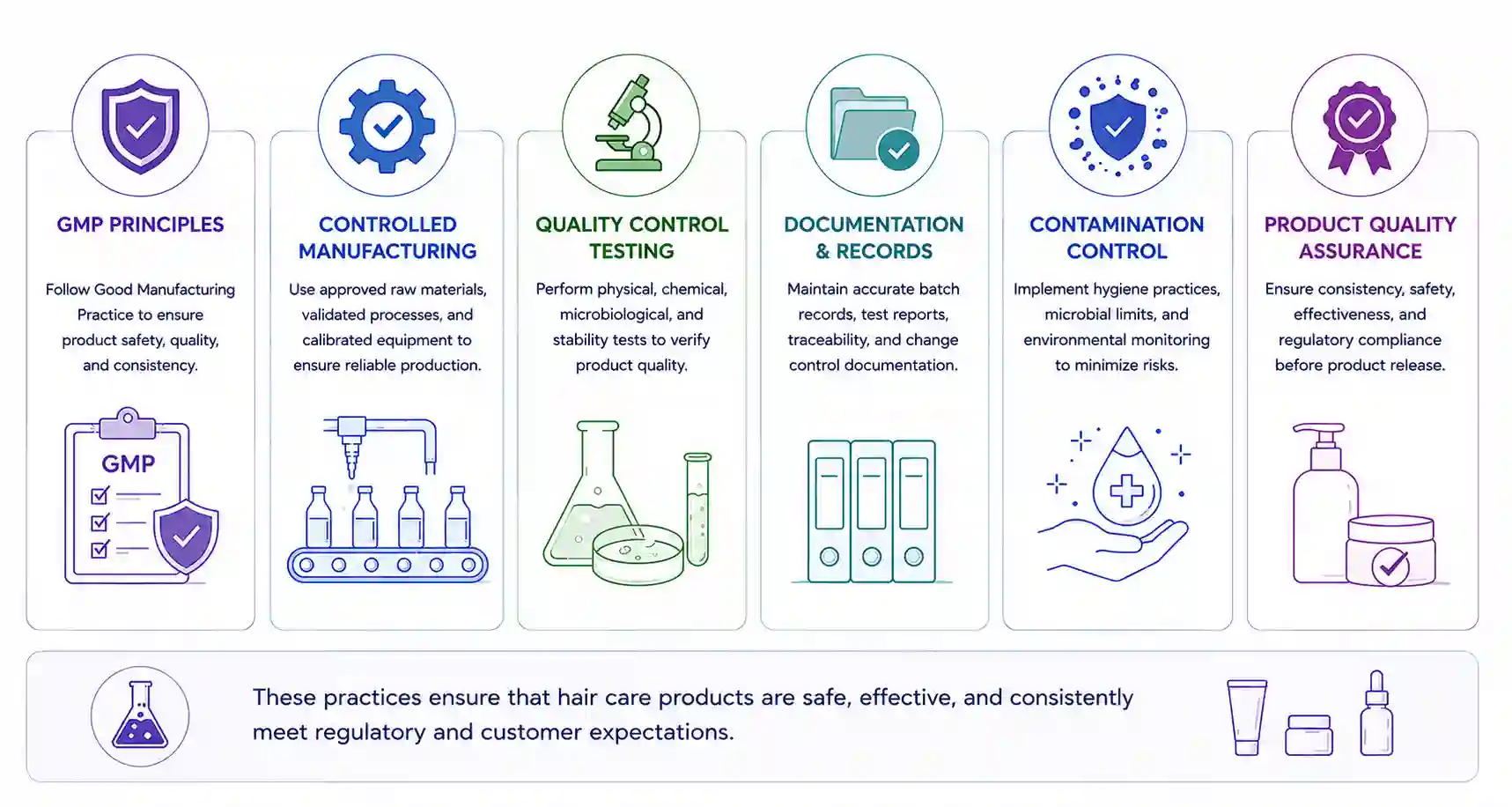
Hair care product manufacturers should use validated methods, calibrated instruments, controlled production records, approved specifications, and documented quality control procedures. Cosmetic GMP principles help reduce contamination risks, improve manufacturing consistency, and support product quality throughout production, storage, and distribution.
Depending on the target market and product type, manufacturers may refer to cosmetic GMP guidelines, microbiological limits, preservative efficacy testing, stability testing protocols, and internal quality specifications. A well-equipped QC laboratory helps manufacturers confirm that every batch meets predefined requirements before release.
How to Choose Laboratory Equipment for a Hair Care QC Laboratory
The right equipment list should follow the laboratory’s actual test plan rather than a fixed “cosmetic lab” package. Start by defining the products to be tested, the approved test methods, expected sample volume, measurement requirements, production scale, and the responsibilities of the QC laboratory. A shampoo-focused laboratory, for example, may place greater emphasis on routine pH, viscosity, foam, density, microbiological, and stability testing, while a serum or treatment-product laboratory may require more instrumental analysis.
Important selection factors include:
- Product type and formulation complexity
- Required quality control tests and approved methods
- Measurement range and accuracy required by those methods
- Sample throughput and laboratory workload
- Calibration and maintenance requirements
- Compatibility with the laboratory’s cosmetic GMP documentation and QC procedures
- Availability of technical support and spare parts
For routine physical QC and formulation work, an analytical balance, pH meter, viscometer, density meter, mixing equipment, homogenizer, and centrifuge form a practical core. Stability and microbiology work add chambers, controlled-temperature equipment, incubators, sterilization equipment, and microbiology tools. HPLC, GC, FTIR, and UV-Visible spectrophotometer systems should be selected when the laboratory’s approved methods require the analytical functions they provide.
Frequently Asked Questions About Hair Care Product Testing
What are the most important quality control tests for shampoo?
The most important shampoo quality control tests include pH measurement, viscosity testing, foam performance evaluation, density measurement, appearance inspection, stability testing, and microbiological testing.
Which instrument is used to measure shampoo viscosity?
A Brookfield viscometer or rotational viscometer is commonly used to measure shampoo viscosity, texture, and flow behavior. Viscosity testing helps manufacturers maintain consistent product feel and filling performance.
Why is pH testing important in hair care products?
pH testing is important because it affects product stability, scalp compatibility, preservative performance, and overall formulation consistency. A pH meter is one of the most essential instruments in a hair care quality control laboratory.
Why do hair care products need microbiological testing?
Many hair care products contain water, extracts, proteins, or other ingredients that may support microbial growth. Microbiological testing helps verify product safety, hygiene control, and preservative system performance.
What equipment is needed for cosmetic stability testing?
Cosmetic stability testing commonly requires a stability test chamber, environmental chamber, laboratory oven, laboratory refrigerator, centrifuge, pH meter, viscometer, and visual inspection tools.
Which analytical instruments are used for active ingredient testing?
HPLC, GC, FTIR spectrometer, and UV-Visible spectrophotometer systems are commonly used to identify and quantify active ingredients, preservatives, fragrances, botanical markers, and other functional compounds in hair care formulations.
Conclusion
A reliable hair care QC program connects each manufacturing stage with the tests that matter at that stage: incoming material checks, formulation and in-process control, finished product release, stability evaluation, microbiological testing, and selected chemical analysis. This makes the laboratory equipment plan easier to define and keeps purchasing decisions tied to real testing requirements.
For many manufacturers, the core requirement is routine physical QC with instruments such as analytical balances, pH meters, viscometers, density meters, mixers, homogenizers, and centrifuges, supported by appropriate stability and microbiology equipment. Advanced systems such as HPLC, GC, FTIR, and UV-Visible spectrophotometers become relevant when approved methods require more specific identity or quantitative analysis.
The most effective laboratory configuration is therefore product- and method-specific: define the products, required tests, expected sample workload, and analytical responsibilities first, then select the equipment that supports those needs.