Laboratory Equipment for Groundwater Monitoring Overview
Groundwater monitoring laboratories need equipment that can preserve sample integrity and measure physical properties, major ions, trace metals, organic contaminants, and microbiological indicators. A typical laboratory may combine field multi-parameter meters, pH and conductivity meters, turbidity meters, ion chromatography, spectrophotometry, metal-analysis instruments, chromatographic systems, microbiology equipment, and data-management tools.
The exact configuration depends on the groundwater source, target analytes, required sensitivity, sample volume, applicable analytical methods, and whether the laboratory performs routine screening or advanced trace-level analysis. Effective quality control therefore starts by matching each monitoring requirement to the appropriate test, analytical method, and instrument rather than purchasing equipment as an isolated list.
In the water and environmental industry, groundwater monitoring supports water-quality assessment, contamination investigations, environmental management, drinking-water source evaluation, and remediation programs. Because groundwater samples can change between collection and analysis, reliable results also depend on sampling, preservation, transport, calibration, blanks, controls, and documented data review.
Main Groundwater Monitoring Applications
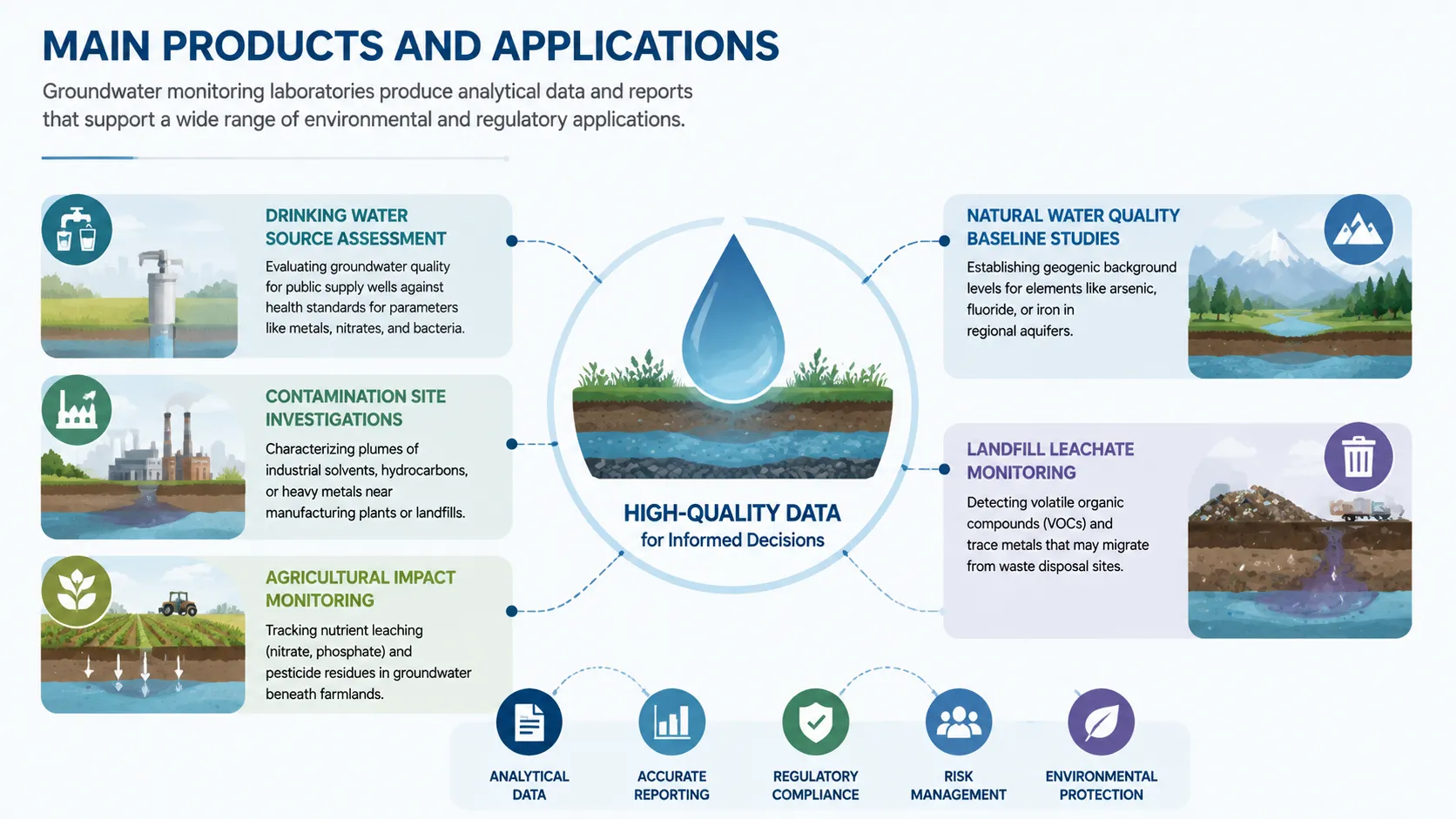
Groundwater monitoring laboratories produce analytical data and reports rather than physical products. These data support several environmental and water-management applications:
- Drinking water source assessment – Evaluating groundwater quality for public supply wells for parameters such as metals, nutrients, and microbiological indicators.
- Contamination site investigations – Characterizing groundwater affected by industrial solvents, hydrocarbons, metals, or other site-related contaminants.
- Agricultural impact monitoring – Tracking nutrients and, where required, pesticide residues in groundwater beneath agricultural areas.
- Natural water quality baseline studies – Establishing background concentrations for naturally occurring constituents such as arsenic, fluoride, iron, and major ions.
- Landfill and waste-site monitoring – Detecting organic compounds, dissolved constituents, and trace metals that may migrate from waste-management areas.
Groundwater Monitoring Quality Control Workflow
A reliable groundwater monitoring program links field sampling, laboratory analysis, analytical QC, and data validation. The following stages show where quality problems can occur and which equipment supports each part of the workflow.
Sample Collection and Preservation
Groundwater sampling is the first stage at which data quality can be compromised. Parameters such as pH, dissolved oxygen, temperature, redox conditions, and volatile compounds can change after water is removed from the well. Field QC may include duplicates and appropriate blanks to help identify sampling variability or contamination.
Preservation, container selection, filtration, cooling, and holding-time requirements should follow the analytical method and monitoring program being used. Parameters that are unstable after collection are generally measured in the field or handled under method-specific preservation procedures.
Recommended laboratory and field equipment for this stage:
- Portable multi-parameter meters – Measure parameters such as pH, conductivity, dissolved oxygen, and temperature at the sampling point.
- Sample coolers and temperature-control supplies – Help maintain method-required transport conditions before laboratory analysis.
- Field filtration apparatus – Supports filtered groundwater analysis when the selected method or monitoring objective requires a dissolved fraction.
- Analytical balance – Supports accurate preparation or verification of reagents and other gravimetric laboratory tasks.

Physical and Aggregate Parameter Testing
After sample receipt, laboratories commonly perform basic water-quality measurements such as pH, conductivity, turbidity, alkalinity, hardness, and solids-related tests according to the required monitoring program. These measurements provide an initial picture of groundwater chemistry and can help identify changes between wells, sampling rounds, or site conditions.
Sample condition and analysis timing matter because particle settling, biological activity, gas exchange, and temperature changes can affect some measurements. Routine instrument calibration and documented sample handling are therefore important parts of this stage.
Recommended laboratory equipment for this stage:
- Turbidity meter – Measures light scattering associated with suspended particles and provides a direct water-clarity measurement.
- pH meter – Measures acidity or alkalinity and supports interpretation of groundwater chemistry.
- Conductivity meter – Measures electrical conductivity as an indicator of dissolved ionic content.
- Laboratory oven – Supports gravimetric solids methods that require controlled drying or evaporation.
- Analytical balance – Provides the mass measurements required for gravimetric determinations and reagent preparation.


Inorganic Chemical Analysis
Inorganic analysis can include major ions, nutrients, and trace metals. Common targets include sodium, potassium, calcium, magnesium, chloride, sulfate, nitrate, arsenic, lead, cadmium, and other elements selected for the monitoring objective.
The appropriate instrument depends on the analyte list, required reporting limits, sample matrix, throughput, and analytical method. Quality control commonly includes calibration verification, blanks, reference materials, duplicates, and spike-based checks where required by the method. Matrix effects and contamination control become increasingly important as target concentrations decrease.
Recommended laboratory equipment for this stage:
- Ion chromatography system – Separates and quantifies ionic species such as fluoride, chloride, nitrate, sulfate, and other ions supported by the selected analytical configuration.
- Inductively coupled plasma mass spectrometer (ICP-MS) – Supports sensitive multi-element analysis when groundwater programs require trace-level metal determination.
- Atomic absorption spectrophotometer – Provides element-specific metals analysis and can be appropriate when the laboratory tests a more limited analyte list.
- UV-Visible spectrophotometer – Supports colorimetric water-analysis methods for applicable nutrients and other analytes.
- Water purification system – Produces purified laboratory water for blanks, standards, reagents, and other contamination-sensitive analytical work.


Organic Contaminant Analysis
Groundwater investigations may require analysis of volatile organic compounds (VOCs), semi-volatile compounds, pesticides, or other organic contaminants associated with industrial, agricultural, landfill, or remediation sites. Because these analytes differ significantly in volatility, polarity, concentration, and sample-preparation requirements, no single chromatographic configuration covers every groundwater application.
QC priorities include preventing analyte loss and cross-contamination, controlling sample preparation, verifying calibration, monitoring blanks, and evaluating matrix effects. Preservation and holding conditions should be selected according to the analytical method rather than applied as a universal procedure.
Recommended laboratory equipment for this stage:
- Gas chromatograph-mass spectrometer (GC-MS) – Supports compound-specific analysis of suitable volatile and semi-volatile organic contaminants with the appropriate sample-introduction and preparation system.
- Liquid chromatograph-mass spectrometer (LC-MS/MS) – Supports sensitive analysis of suitable polar and non-volatile organic contaminants.
- Total organic carbon (TOC) analyzer – Measures total organic carbon as an aggregate parameter for evaluating overall organic content.
- Solvent evaporation or concentration equipment – Supports analytical workflows that require controlled concentration of prepared extracts.
- Analytical balance – Supports accurate gravimetric preparation of standards, reagents, and sample-preparation materials.


Microbiological Testing
Microbiological testing is particularly important when groundwater is used or evaluated as a drinking-water source. Depending on the monitoring program, laboratories may test indicator organisms such as total coliforms and E. coli.
Microbiological results are highly sensitive to sampling technique, container sterility, transport conditions, analysis timing, culture conditions, and contamination during processing. Quality control may include positive and negative controls, media checks, equipment-temperature monitoring, and sterile handling procedures according to the selected microbiological method.
Recommended laboratory equipment for this stage:
- Autoclave – Sterilizes suitable culture media, reusable laboratory materials, and microbiological waste according to laboratory procedures.
- Laboratory incubator – Maintains the controlled incubation conditions required by the selected microbiological method.
- Membrane filtration apparatus – Supports membrane-filtration methods that concentrate microorganisms from measured water volumes onto filters for subsequent culture.
- Laminar flow hood or appropriate microbiological work enclosure – Supports contamination-controlled sample and media handling where required by laboratory procedures.
- Colony counter – Assists with enumeration when the selected culture method produces countable colonies.


Data Validation and Quality Assurance Reporting
Analytical measurement is not complete until the associated QC information has been reviewed. Laboratories may need to evaluate calibration performance, blanks, duplicates, control samples, spikes, instrument drift, carryover, sample preparation records, and other method-specific acceptance criteria before results are released.
A laboratory information management system can improve sample traceability and reduce manual data handling, while instrument software supports calibration review, chromatographic integration, analytical calculations, and result export. The objective is a documented path from sample receipt to the final reported result.
Recommended systems and equipment for this stage:
- Laboratory information management system (LIMS) – Supports sample tracking, QC records, result management, reporting, and audit trails.
- Electronic balances with data interfaces – Can reduce manual transcription when balance results are transferred into compatible laboratory data systems.
- Analytical instrument software – Supports calibration review, data processing, peak or signal evaluation, and export of analytical results.
Common Quality Control Challenges in Groundwater Monitoring
- Sample instability – Some field parameters, dissolved gases, redox-sensitive species, and volatile compounds can change after sampling, making proper collection and preservation critical.
- Cross-contamination – Sampling equipment, containers, preparation equipment, laboratory surfaces, and analytical carryover can introduce contaminants that were not present in the groundwater.
- Low-level detection requirements – Trace contaminant programs may require sensitive instrumentation, clean preparation practices, low-background reagents, and careful blank control.
- Matrix interferences – Dissolved solids, metals, organic matter, and other matrix components can affect instrumental response and may require dilution, cleanup, alternative calibration, or other method-specific controls.
- Holding-time and preservation control – Different analytes have different stability requirements. Laboratories must manage sampling-to-analysis time according to the applicable method or monitoring program.
- Field versus laboratory comparability – Field and laboratory measurements can differ because of temperature, sample handling, instrument calibration, and changes in water chemistry after collection.
Key Groundwater Monitoring Tests and Laboratory Equipment
The table below makes the relationship between common groundwater quality challenges, the corresponding analytical test, and the required instrument more explicit.
| Quality Challenge | Quality Control Test | Recommended Laboratory Equipment | Application |
|---|---|---|---|
| Sample instability for VOCs | Volatile organic compound analysis using an appropriate GC-MS method | Gas chromatograph-mass spectrometer (GC-MS) with suitable sample-introduction system | Identifying and quantifying target VOCs in groundwater investigations |
| Microbial contamination risk | Total coliform and E. coli analysis where required | Membrane filtration system, incubator, colony counter | Evaluating microbiological quality of groundwater and drinking-water sources |
| Trace metal interferences and low reporting limits | Multi-element trace analysis | Inductively coupled plasma mass spectrometer (ICP-MS) | Measuring selected trace metals in groundwater |
| High dissolved solids affecting ion analysis | Ion analysis with method-appropriate sample preparation or dilution | Ion chromatography system | Determining chloride, sulfate, nitrate, and other target ions |
| Nutrient stability and measurement | Applicable nutrient analysis | UV-Visible spectrophotometer or suitable nutrient analyzer | Monitoring nutrients in agricultural, environmental, and water-quality programs |
| Particulate matter | Turbidity measurement | Turbidity meter | Evaluating groundwater clarity and changes in suspended material |
| Overall organic content | Total organic carbon analysis | Total organic carbon (TOC) analyzer | Measuring aggregate organic carbon as part of groundwater characterization |
| Field pH and conductivity data quality | Calibration and laboratory comparison where appropriate | Bench-top pH meter, conductivity meter | Supporting QA/QC review of basic groundwater chemistry measurements |
Laboratory Equipment Required for Groundwater Monitoring Quality Control
A groundwater monitoring laboratory normally needs a combination of routine water-quality instruments and application-specific analytical systems. The essential equipment depends on which analyses are performed internally and which are outsourced.
For routine characterization, portable or bench-top meters for pH and conductivity, a turbidity meter, analytical balance, and suitable sample-handling equipment form a practical starting point. UV-Visible spectrophotometry can support applicable colorimetric methods, while ion chromatography expands the laboratory’s capability for ionic species.
Trace metal programs may justify atomic absorption or ICP-MS depending on the number of elements, sensitivity requirements, sample volume, and analytical methods. Organic contaminant programs may require GC-MS, LC-MS/MS, TOC analysis, and appropriate sample-preparation equipment. Microbiological testing adds incubators, sterilization equipment, membrane filtration systems, and contamination-controlled work areas.
Supporting infrastructure is equally important. Purified water systems help control analytical background, analytical balances support standards and reagent preparation, and LIMS or other laboratory data systems improve sample traceability and QC documentation.
| Testing Requirement | Laboratory Equipment | Why It Is Needed |
|---|---|---|
| Field parameter stability | Portable multi-parameter meter | Allows rapidly changing groundwater parameters to be measured at or near the sampling point. |
| Microbiological analysis | Autoclave, incubator, membrane filtration system | Supports culture-based microbiological methods and contamination-controlled laboratory work. |
| Trace metal analysis | ICP-MS or atomic absorption spectrophotometer | Provides instrumental analysis for target metals, with the appropriate technology selected according to analyte scope and sensitivity requirements. |
| Ion and nutrient analysis | Ion chromatograph, UV-Vis spectrophotometer | Supports measurement of target ions and applicable colorimetric water-quality parameters. |
| Volatile organic contaminant analysis | Gas chromatograph-mass spectrometer (GC-MS) | Provides chromatographic separation and compound-specific detection for suitable organic contaminant methods. |
| Total organic carbon | Total organic carbon (TOC) analyzer | Measures aggregate organic carbon as a water-quality parameter. |
| Water clarity and gravimetric solids measurements | Turbidity meter, laboratory oven, analytical balance | Supports turbidity and applicable gravimetric water-quality measurements. |
Together, these instruments can cover the analytical path from field screening and routine chemistry to specialized trace-level analysis. A laboratory does not necessarily need every instrument listed; the correct configuration depends on its testing scope and the analyses that must be performed in-house.
Basic vs Advanced Laboratory Setup for Groundwater Monitoring
The most cost-effective laboratory configuration is usually built in stages. Routine monitoring programs can begin with core physical and chemical measurements, while laboratories handling broader contaminant lists or lower reporting limits can add advanced analytical systems.
| Laboratory Level | Recommended Equipment | Suitable For |
|---|---|---|
| Basic QC Laboratory | Portable pH/conductivity meters, turbidity meter, UV-Vis spectrophotometer, laboratory oven, analytical balance, basic incubator | Field-support or small laboratories performing routine groundwater characterization and a limited range of water-quality tests. |
| Advanced QC Laboratory | Above plus ion chromatograph, atomic absorption spectrophotometer, TOC analyzer, GC-MS, membrane filtration system, autoclave | Environmental laboratories performing a broader combination of inorganic, organic, and microbiological groundwater tests. |
| Advanced Analysis Laboratory | All above plus ICP-MS, LC-MS/MS, LIMS, cleanroom facilities | High-capability laboratories handling complex contaminant programs, sensitive trace analysis, higher sample throughput, or specialized research applications. |
How to Choose Laboratory Equipment for Groundwater Monitoring
Selecting groundwater testing equipment should begin with the required analytical program rather than with individual instrument features. The most important questions are what must be measured, at what sensitivity, in what sample matrix, how many samples will be processed, and which methods the laboratory intends to perform.
1. Define the Testing Scope
List the target parameters and separate them into field measurements, routine physical chemistry, ions and nutrients, metals, organic contaminants, and microbiological indicators. Then identify which analyses must be performed internally.
The required reporting limits and analytical methods are important because they determine whether a routine instrument is sufficient or whether a more sensitive analytical platform is necessary. Sample matrix also matters: groundwater with elevated dissolved solids or complex contamination may require different preparation and interference-control strategies than relatively clean source water.
2. Match the Test to the Instrument
Equipment selection becomes easier when the relationship is explicit:
- pH, conductivity, dissolved oxygen, temperature → portable or bench-top meters.
- Turbidity → turbidity meter.
- Applicable colorimetric nutrients → UV-Visible spectrophotometer or dedicated analyzer.
- Target ions → ion chromatography.
- Trace metals → atomic absorption or ICP-MS, depending on analytical requirements.
- Suitable VOC/SVOC methods → GC-MS with the required sample-preparation or introduction system.
- Suitable polar/non-volatile organic contaminants → LC-MS/MS.
- Total organic carbon → TOC analyzer.
- Culture-based microbiological indicators → membrane filtration, incubation, sterilization, and colony-counting equipment as required by the method.
This test-to-instrument mapping helps prevent both under-specification and unnecessary investment.
3. Evaluate Sample Throughput and Workflow
A laboratory processing occasional groundwater samples has different requirements from a commercial environmental laboratory handling large sample batches. Consider daily and weekly sample volume, sample-preparation time, calibration workload, QC sample frequency, analysis time, and reporting deadlines.
Where throughput justifies it, autosamplers and compatible data-transfer systems can reduce repetitive manual work. Laboratories should also consider whether advanced analytical instruments can be operated, maintained, and quality-controlled by the available staff.
4. Check Laboratory Infrastructure
Instrument purchase decisions should account for laboratory space and supporting services. Depending on the equipment, requirements may include suitable electrical supply, ventilation, gases, purified water, temperature control, sample-preparation space, contamination control, waste handling, and data-system connectivity.
Planning these requirements before equipment installation can reduce later workflow problems and unnecessary laboratory modifications.
5. Compare Long-Term Equipment Support
Initial purchase price is only one part of instrument selection. Laboratories should also consider calibration and QC requirements, consumables, routine maintenance, operator training, spare-parts availability, technical support, and expected instrument utilization.
A basic instrument may be the better choice when the analytical scope is narrow and sample volume is modest. Advanced platforms become more appropriate when broader analyte coverage, greater sensitivity, higher throughput, or specialized methods justify the additional investment and operating requirements.
Who Needs Groundwater Laboratory Testing Solutions?
- Environmental consulting firms – For site investigations, remediation monitoring, environmental due diligence, and long-term monitoring programs.
- Public water utilities – For evaluating groundwater sources and supporting drinking-water quality programs.
- Industrial facility operators – For groundwater surveillance around facilities, waste areas, and sites requiring environmental monitoring.
- Government and public laboratories – For water-quality monitoring, environmental investigations, and reference testing.
- Research institutions – For studies of groundwater chemistry, contaminant transport, aquifer processes, and analytical methods.
Frequently Asked Questions
What basic parameters are essential for a groundwater monitoring program?
A basic program commonly starts with field parameters such as pH, conductivity, dissolved oxygen, and temperature, followed by laboratory tests selected for the monitoring objective. These may include turbidity, alkalinity, major ions, nutrients, metals, and microbiological indicators. The final parameter list should be based on the groundwater source, site risks, applicable monitoring requirements, and expected contaminants.
How do I know if I need ICP-MS or atomic absorption for metals analysis?
ICP-MS is generally more suitable when the laboratory needs sensitive multi-element analysis across a broader metals program or higher sample throughput. Atomic absorption can be a practical option when the analyte list is smaller or the selected analytical methods are well suited to element-specific measurement. The decision should consider target elements, required reporting limits, sample volume, matrix, operating cost, and staff capability.
Why does sample handling matter for groundwater VOC analysis?
Volatile compounds can be lost or altered between sampling and analysis if samples are collected, transported, or stored incorrectly. Groundwater VOC programs therefore require method-specific containers, preservation, handling, and analysis timing. GC-MS with the appropriate sample-introduction system is commonly used for suitable VOC methods.
What is the role of a LIMS in groundwater monitoring?
A LIMS helps manage sample identification, analytical status, QC records, results, reporting, and audit trails. For laboratories processing many groundwater samples, it can improve traceability and reduce manual data handling between sample receipt, instruments, QC review, and final reporting.
What equipment is essential for a basic groundwater testing laboratory?
A basic laboratory commonly starts with portable or bench-top pH and conductivity meters, a turbidity meter, analytical balance, suitable sample-handling equipment, and instruments for the laboratory’s routine chemistry tests. UV-Visible spectrophotometry, an oven, and basic microbiology equipment may be added where those methods are part of the testing scope. Advanced systems such as ICP-MS, GC-MS, or LC-MS/MS should be added only when the analyte program and required analytical performance justify them.
When does a groundwater laboratory need advanced analytical equipment?
Advanced equipment becomes more relevant when the laboratory must measure trace contaminants, cover broad analyte lists, handle complex organic compounds, achieve demanding reporting limits, or process higher sample volumes. The decision should be based on validated analytical requirements and workflow needs rather than on instrument capability alone.
Conclusion
A groundwater monitoring laboratory should be designed around the relationship between the sample, target analyte, required test, analytical method, and instrument. Routine programs may rely mainly on field meters, turbidity and conductivity instruments, spectrophotometry, balances, and basic sample-processing equipment, while broader contaminant programs can require ion chromatography, metal-analysis systems, GC-MS, LC-MS/MS, TOC analysis, and microbiological facilities.
The best laboratory configuration is therefore not necessarily the one with the largest number of instruments. It is the setup that covers the required tests at the necessary analytical performance and sample throughput while supporting reliable calibration, QC, contamination control, data traceability, maintenance, and operator capability.