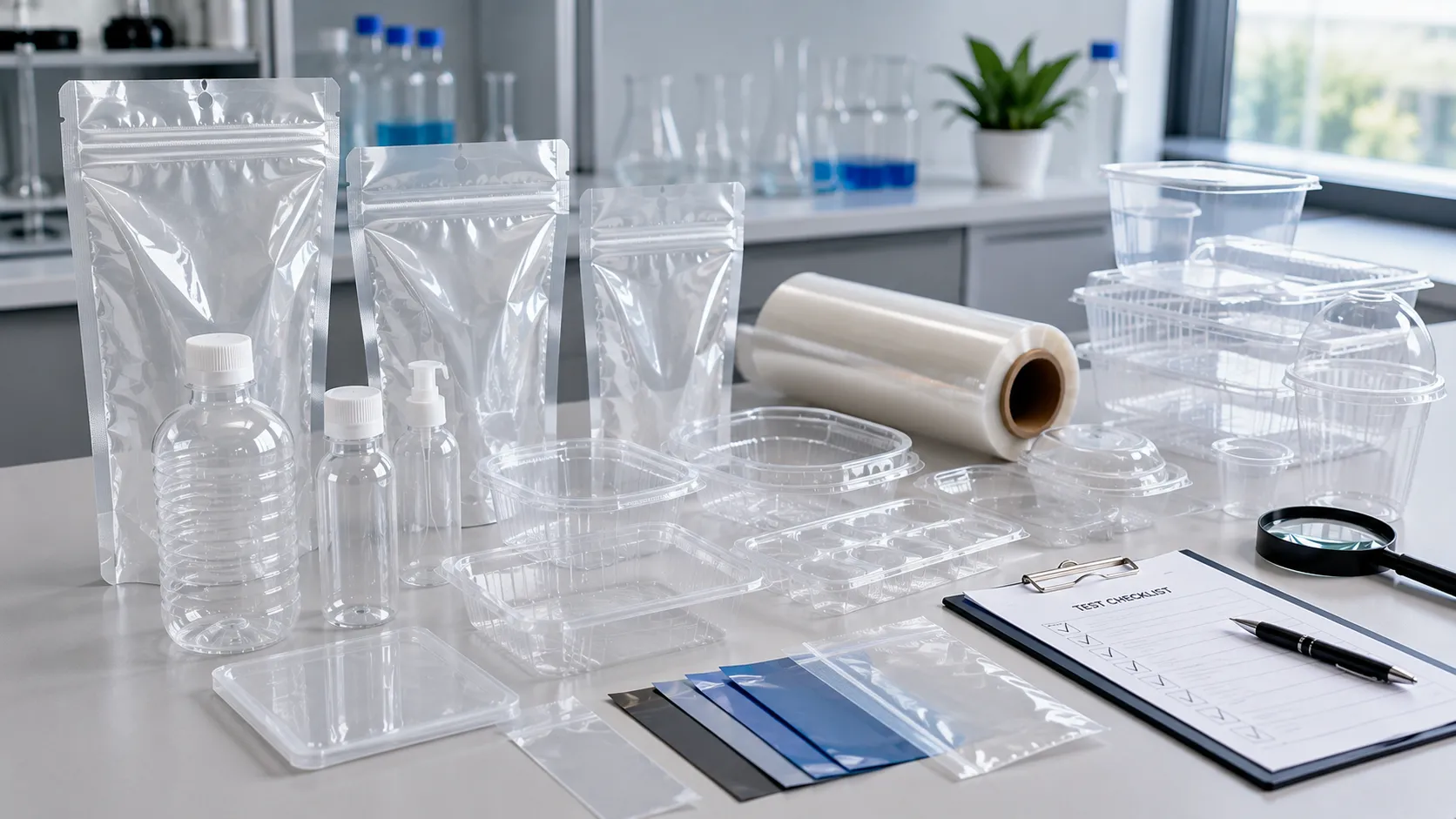
Plastic Packaging Testing Laboratory Equipment Overview
Plastic packaging testing equipment is used to verify the dimensional, mechanical, optical, barrier, surface, and seal properties that affect packaging performance. For many quality control laboratories, core instruments include a thickness gauge, universal testing machine, coefficient of friction tester, and heat seal testing equipment. Laboratories working with barrier packaging may also require oxygen and water vapor permeation analyzers, while specialized applications can justify impact testing, optical measurement, leak detection, or gas chromatography.
The right laboratory configuration depends on the packaging format and its critical failure risks. Flexible films and pouches may require thickness, tensile, friction, impact, barrier, and seal testing, while rigid bottles, jars, trays, caps, and closures can require a different combination of dimensional, mechanical, optical, and leak-integrity checks.
Laboratory testing connects raw material verification, manufacturing process control, and finished-package release. By selecting instruments around the actual sample type and required test, manufacturers can identify material variation earlier, investigate production problems, compare suppliers, and generate more useful QC data.
This guide provides a structured overview of the laboratory equipment used for plastic packaging quality control, from basic thickness and mechanical testing to advanced barrier analysis.
Main Products and Applications
Plastic packaging covers a broad range of materials and formats, and the required tests vary according to package construction and intended function. Common products and applications tested in a QC laboratory include:
- Flexible Films and Laminates – Used for food pouches, barrier wraps, shrink applications, and other converted flexible packaging.
- Rigid Containers – Bottles, jars, and trays made from materials such as PET, HDPE, or PP.
- Flexible Intermediate Bulk Containers (FIBCs) – Heavy-duty packaging used for industrial materials.
- Closures and Lids – Caps, lids, and sealing components where fit and package integrity are important.
- Multilayer and Barrier Packaging – Structures designed to control oxygen, moisture, or other package-environment interactions.
Because these formats have different performance requirements, equipment should be selected from the required test backward rather than by purchasing a generic list of instruments.
Plastic Packaging Testing Quality Control Workflow
A practical plastic packaging QC workflow can be divided into incoming material inspection, manufacturing process control, mechanical performance testing, barrier analysis, and seal or package-integrity testing. Not every manufacturer needs every test: the appropriate combination depends on the materials being processed and the functions the finished package must perform.
Incoming Raw Material Inspection
Before resin, film, sheet, or other incoming material enters production, the laboratory can verify properties that influence processing consistency and finished-package performance. Variation in polymer grade, moisture, density, or film thickness can affect extrusion, converting, and subsequent quality results.
Typical incoming checks may include melt flow behavior, density, moisture content, material weight, and film or sheet thickness. These measurements can help production teams compare incoming lots with established specifications and investigate material-related process variation.
Recommended laboratory equipment for this stage:
- Melt Flow Indexer – Measures polymer flow behavior under defined test conditions and can support incoming resin comparison and processability assessment.
- Moisture Analyzer – Measures moisture in pellets, powders, or other applicable raw materials where moisture control is relevant to processing.
- Density Tester – Supports verification of material density and lot-to-lot consistency.
- Thickness Gauge – Measures film or sheet thickness at selected points to identify caliper variation.
- Analytical Balance – Supports gravimetric measurements and other weight-based laboratory procedures.


Manufacturing Process Control
During extrusion, blow molding, thermoforming, printing, lamination, or other converting operations, laboratory spot checks provide data that complements production-line monitoring. Thickness deviations, optical variation, or changing surface properties can indicate material or process variation that needs investigation.
Typical parameters at this stage include film thickness, color, haze, and coefficient of friction. The priority depends on the process: film converters may focus heavily on caliper and surface slip, while printed packaging operations may place greater emphasis on color consistency.
Recommended laboratory equipment for this stage:
- Thickness Gauge (Micrometer) – Measures film or sheet caliper and supports comparison across different points of the sample.
- Spectrophotometer – Provides objective color measurement for printed or colored packaging where color consistency is a QC requirement.
- Haze Meter – Evaluates haze or transparency-related optical properties of applicable transparent packaging materials.
- Coefficient of Friction (COF) Tester – Measures surface friction characteristics that can influence film handling, feeding, converting, and filling operations.

Mechanical Performance Testing
Mechanical testing evaluates whether packaging materials have the strength and resistance required for converting, handling, filling, distribution, or end use. The appropriate test depends strongly on package format: a flexible film and a rigid container should not automatically be evaluated with the same mechanical test.
For flexible materials, tensile strength, elongation, puncture resistance, seal strength, and impact behavior may be important. Rigid packaging may require impact or other mechanical evaluations appropriate to the container design.
Recommended laboratory equipment for this stage:
- Universal Testing Machine (UTM) – Provides controlled force and displacement measurement for applicable tensile, elongation, peel, seal-strength, and other fixture-dependent mechanical tests.
- Pendulum Impact Tester – Used for applicable impact testing where the sample geometry and required method are compatible with pendulum testing.
- Dart Drop Impact Tester – Evaluates the impact resistance of applicable flexible films using a falling-dart method.
- Puncture Resistance Tester – Measures resistance to penetration or puncture using an appropriate probe and test configuration.
For buyers selecting a mechanical testing system, sample dimensions, expected force range, grip or fixture requirements, test method, and daily sample volume should be defined before choosing the instrument configuration.
Barrier Property Analysis
Barrier testing is important when the package must control oxygen or water-vapor transmission. This is especially relevant to packaging used for products whose stability or quality depends on limiting exposure to oxygen or moisture.
Laboratory barrier testing can quantify Oxygen Transmission Rate (OTR) and Water Vapor Transmission Rate (WVTR). These measurements help manufacturers compare barrier structures, evaluate material consistency, and investigate whether changes in films, laminates, coatings, or package construction affect barrier performance.
Recommended laboratory equipment for this stage:
- Oxygen Permeation Analyzer – Measures oxygen transmission through applicable packaging materials under defined test conditions.
- Water Vapor Permeation Analyzer – Measures water-vapor transmission through applicable films, sheets, or package structures.
- Gas Chromatograph (with headspace sampling) – Can support specialized analysis such as residual-solvent or package-headspace investigations when those analyses are part of the laboratory scope.

Barrier analyzers are more specialized than basic physical testing instruments. Before purchasing one, laboratories should define the sample format, expected transmission level, required test conditions, measurement needs, and anticipated sample throughput.
Seal Integrity and Heat Seal Strength Testing
For sealed flexible packaging, seal formation and finished-package integrity can be critical QC requirements. Inadequate sealing conditions can produce weak or inconsistent seals, while unsuitable process settings may also affect package appearance or material performance.
Heat seal testing and seal-strength testing answer related but different questions. A heat seal tester produces controlled laboratory seals so different sealing conditions or materials can be compared. A UTM or suitable seal-strength tester then measures the force behavior of the sealed interface. Finished-package leak testing evaluates the integrity of the assembled package rather than only the strength of a seal strip.
Recommended laboratory equipment for this stage:
- Heat Seal Tester – Produces repeatable laboratory seals under controlled sealing conditions for subsequent evaluation.
- Seal Strength Tester – Measures the mechanical strength or peel behavior of applicable sealed samples; this function may also be performed using a suitably configured UTM.
- Leak Detection System – Supports finished-package integrity testing using a leak-detection principle appropriate to the package and required method.
Common Quality Control Challenges in Plastic Packaging
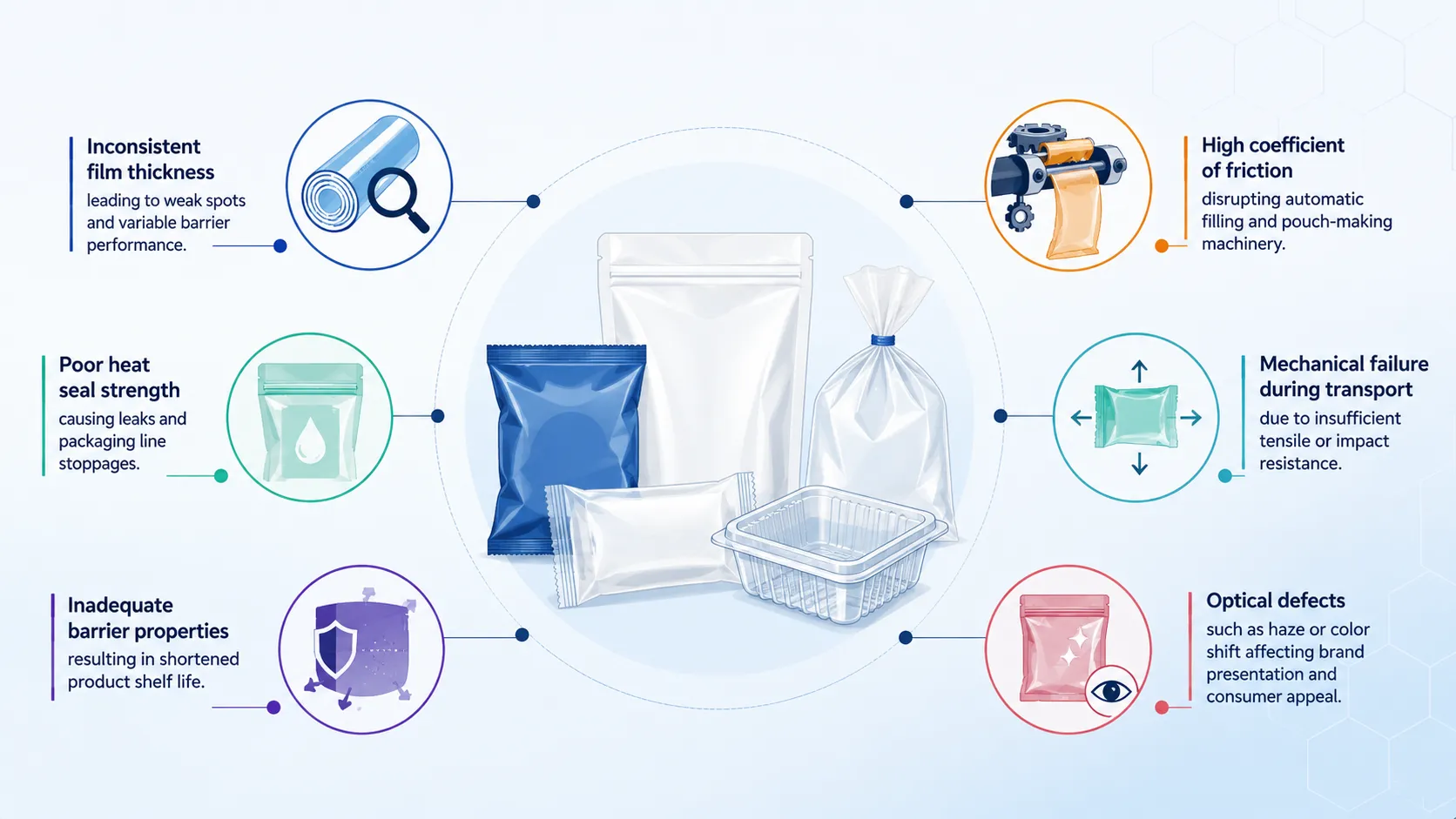
Plastic packaging manufacturers frequently encounter recurring quality problems that can be connected to specific laboratory tests:
- Inconsistent film thickness – can create variation in material usage and package performance.
- Poor heat seal strength – can contribute to seal failure, leakage, or packaging-line problems.
- Inadequate barrier properties – can reduce the package’s ability to control oxygen or moisture transmission.
- Unsuitable coefficient of friction – can affect film feeding, handling, converting, or filling operations.
- Mechanical failure during handling or transport – may indicate inadequate tensile, puncture, seal, or impact performance for the application.
- Optical variation – including haze or color differences that can affect packaging appearance and print consistency.
Key Quality Control Tests for Plastic Packaging
The most useful way to select packaging laboratory equipment is to connect a known quality risk with the test that can investigate it. The following table summarizes common relationships.
| Quality Challenge | Quality Control Test | Recommended Laboratory Equipment | Application |
|---|---|---|---|
| Variable film thickness | Thickness measurement | Thickness Gauge (Micrometer) | Raw film rolls, sheets, and applicable package walls |
| Weak seals and leakers | Heat seal and seal-strength testing | Heat Seal Tester + UTM | Pouches, lidding films, and other heat-sealed structures |
| Poor oxygen barrier | Oxygen Transmission Rate (OTR) | Oxygen Permeation Analyzer | Barrier films and packaging for oxygen-sensitive products |
| High moisture transmission | Water Vapor Transmission Rate (WVTR) | Water Vapor Permeation Analyzer | Packaging where moisture-barrier performance is critical |
| Film breaks during converting | Tensile strength and elongation | Universal Testing Machine | Flexible films, laminates, and shrink films |
| Unexpected impact failure | Impact testing appropriate to the sample | Dart Drop Impact Tester / Applicable Impact Tester | Flexible films or other compatible packaging samples |
| Slip and feeding issues | Coefficient of Friction (COF) | COF Tester | Film rolls used in converting and filling operations |
| Print and color mismatch | Color and haze measurement | Spectrophotometer / Haze Meter | Printed, colored, or transparent packaging as applicable |
Laboratory Equipment Required for Plastic Packaging Quality Control
A plastic packaging laboratory does not necessarily need every available instrument. The core equipment should be selected according to the package types being produced, the quality risks that need to be controlled, and the tests required by the manufacturer’s internal or customer specifications.
For a flexible-film converter, thickness measurement, mechanical testing, COF testing, and heat-seal evaluation may form the practical core of the laboratory. A manufacturer producing high-barrier structures may additionally need OTR and WVTR analysis. Printed or transparent packaging can justify color and haze measurement, while specialized package-integrity or analytical requirements may add leak detection or chromatography.
| Testing Requirement | Laboratory Equipment | Why Manufacturers Use It |
|---|---|---|
| Dimensional control | Thickness Gauge (Micrometer) | Checks film or sheet caliper and helps identify thickness variation |
| Mechanical strength | Universal Testing Machine | Measures applicable tensile, elongation, peel, and seal-strength properties with suitable fixtures |
| Impact resistance | Dart Drop Impact Tester | Evaluates impact behavior of applicable flexible-film samples |
| Barrier performance | Oxygen Permeation Analyzer | Quantifies oxygen transmission where oxygen barrier is a critical package function |
| Moisture barrier | Water Vapor Permeation Analyzer | Quantifies water-vapor transmission where moisture protection is required |
| Seal quality | Heat Seal Tester + Seal Strength Tester | Supports controlled seal preparation and subsequent seal-strength evaluation |
| Surface properties | Coefficient of Friction Tester | Evaluates film friction characteristics relevant to handling and packaging-line performance |
| Optical quality | Spectrophotometer / Haze Meter | Provides objective color or haze measurements where appearance is a QC requirement |
Together, these instruments can provide a practical framework for investigating material variation, qualifying incoming materials, monitoring production, comparing packaging structures, and supporting finished-product quality control.
Basic Laboratory Setup for Plastic Packaging Manufacturers
Laboratory investment should normally follow the testing risk and production complexity. A basic laboratory can concentrate on high-frequency dimensional, mechanical, surface, and seal tests, while advanced laboratories add specialized barrier, optical, or analytical capabilities.
| Laboratory Level | Recommended Equipment | Suitable For |
|---|---|---|
| Basic QC Laboratory | Thickness Gauge, Analytical Balance, COF Tester, Heat Seal Tester, Manual UTM | Small to mid-size converters requiring routine dimensional, mechanical, friction, and seal checks |
| Advanced QC Laboratory | Computer-controlled UTM, Oxygen Permeation Analyzer, WVTR Analyzer, Spectrophotometer, Dart Impact Tester | Manufacturers requiring more detailed mechanical, barrier, optical, or impact characterization |
| Advanced Analysis Laboratory | All above plus Gas Chromatograph, automated permeation systems, multi-station UTMs | R&D centers, contract laboratories, and larger manufacturers with broader analytical or higher-throughput testing requirements |
These levels are planning frameworks rather than fixed equipment lists. A manufacturer of simple non-barrier film may not need permeation equipment, while a specialized barrier-packaging operation may consider OTR or WVTR analysis essential rather than optional.
How to Choose Laboratory Equipment for Plastic Packaging Testing
Selecting plastic packaging testing equipment starts with the sample and required test—not with the instrument catalogue. Define the packaging formats, critical quality risks, required methods, measurement needs, and expected workload before deciding which instruments belong in the laboratory.
Define the Packaging Format and Testing Scope
Start by listing the materials and finished packages that the laboratory must evaluate: resin, film, laminate, pouch, bottle, tray, closure, or another structure. Then connect each format with the properties that matter to production or package performance.
For example:
- Flexible film → thickness, tensile behavior, COF, impact resistance, and possibly barrier performance.
- Heat-sealed pouch → seal preparation, seal strength, and package-integrity testing.
- Barrier laminate → OTR and/or WVTR in addition to relevant physical and mechanical checks.
- Printed packaging → objective color measurement where print consistency is a defined QC requirement.
- Transparent packaging → haze measurement where optical clarity is important.
This mapping prevents a laboratory from buying equipment that does not address a real production or quality-control requirement.
Match the Instrument to the Test Method and Measurement Need
Once the required tests are defined, determine what the instrument must actually measure. Important considerations can include the expected measurement range, required accuracy or sensitivity, sample dimensions, fixture requirements, test environment, and method compatibility.
This is particularly important for mechanical and barrier instruments. A UTM must be configured with suitable grips, fixtures, and force capability for the intended tests. A permeation analyzer must be appropriate for the expected barrier level and sample configuration. Instrument selection should therefore be based on defined testing requirements rather than a generic equipment name alone.
Evaluate Laboratory Workflow Requirements
Daily sample volume can change the appropriate equipment configuration. A laboratory running occasional verification tests may prioritize versatility and straightforward operation, while a high-throughput QC laboratory may benefit from automation, easier sample handling, software-based test control, and efficient data export.
Laboratory space, sample conditioning requirements, environmental control, operator skill, calibration procedures, and maintenance requirements should also be considered before installation.
Compare Long-Term Equipment Support
The purchase price is only one part of laboratory equipment selection. Manufacturers should also consider calibration and maintenance support, availability of compatible fixtures and consumables, operator training, spare parts, software support where applicable, and assistance with method setup.
Defining these requirements before requesting a quotation makes it easier to compare instrument configurations on the basis of laboratory suitability rather than price alone.
Who Needs Laboratory Testing Solutions for This Industry?
- Flexible Packaging Converters – Printing, laminating, film-converting, and pouch-making operations requiring routine production QC.
- Rigid Container Manufacturers – Bottle, jar, tray, cap, and closure producers evaluating relevant dimensional, mechanical, optical, or integrity properties.
- Food and Pharmaceutical Packagers – Packaging users that need to evaluate properties such as barrier performance or seal integrity according to their package requirements.
- Material Suppliers and Distributors – Resin, film, laminate, and additive suppliers performing material characterization and lot verification.
- Third-party Testing Laboratories – Independent laboratories performing packaging and material tests for manufacturers, converters, suppliers, or end users.
Frequently Asked Questions
What is the most critical testing equipment for starting a plastic packaging QC lab?
A basic lab should begin with a thickness gauge, a universal testing machine with seal strength fixtures, and a coefficient of friction tester. These instruments cover dimensional, mechanical, and converting-related tests that directly affect production efficiency and product quality.
How often should barrier testing equipment be calibrated?
Calibration intervals depend on instrument type, usage frequency, and manufacturer recommendations. However, many laboratories perform annual calibration with routine verification using certified reference films to ensure data reliability between formal calibrations.
Can one universal testing machine handle all mechanical tests for plastic packaging?
Yes, a properly configured UTM can perform tensile strength, elongation, tear resistance, and seal strength tests by swapping appropriate grips and fixtures. For high-volume testing, dedicated setups may be preferred, but a single versatile UTM is a cost-effective starting point.
Why is oxygen transmission rate testing important for food packaging?
OTR testing quantifies how much oxygen passes through a package over time. For oxygen-sensitive products, a low OTR is essential to prevent oxidation, spoilage, and loss of nutritional value, directly impacting shelf life and consumer safety.
Conclusion
A practical plastic packaging quality control laboratory should be built around the packaging formats, failure risks, and tests that matter to the manufacturer. Thickness, mechanical properties, surface friction, and seal performance commonly form the foundation for flexible-packaging QC, while barrier, optical, impact, leak-detection, or analytical instruments become important when the package application requires those measurements.
The most effective selection process is therefore package or material → quality risk → required test → suitable instrument → laboratory configuration. This approach helps manufacturers prioritize essential equipment first and add advanced analytical capability where it provides genuine quality-control value.
Laboratory Equipment Solutions for Plastic Packaging
AELAB supports plastic packaging manufacturers by connecting sample types and quality control requirements with appropriate testing instrument categories. Whether you need to verify film thickness, quantify oxygen barrier, or validate heat seal consistency, defining your testing scope clearly is the first step toward building an effective laboratory. Our team can help map your production workflow to the essential equipment, avoiding over-investment while closing quality gaps.
If you are setting up or upgrading a packaging testing laboratory, share your key sample types, required test methods, anticipated throughput, and current equipment. This information helps us propose a practical configuration aligned with your daily operations and long-term quality goals—without unnecessary complexity.