Resin Testing Methods and Analytical Instruments Overview
Resin testing is used to verify the chemical, physical, processing, and performance properties that determine whether a resin is suitable for production and its intended application. For manufacturers of adhesives, paints, coatings, inks, sealants, composites, and polymer materials, the most important testing groups typically include raw-material verification, viscosity and moisture control, resin-property characterization, application testing, mechanical performance, and environmental durability.
The laboratory equipment required depends on the resin chemistry, sample state, production stage, and end-use requirements. Routine production QC may rely on viscometers, moisture analyzers, balances, ovens, pH meters, and density measurement, while advanced characterization can require Karl Fischer titration, differential scanning calorimetry (DSC), gel permeation chromatography (GPC), mechanical testing, and accelerated weathering equipment.
This article maps common resin quality-control challenges to the tests and analytical laboratory instruments used across the manufacturing workflow, helping production, QC, and R&D teams determine which equipment is essential and when more advanced analysis is justified.
Main Products and Applications
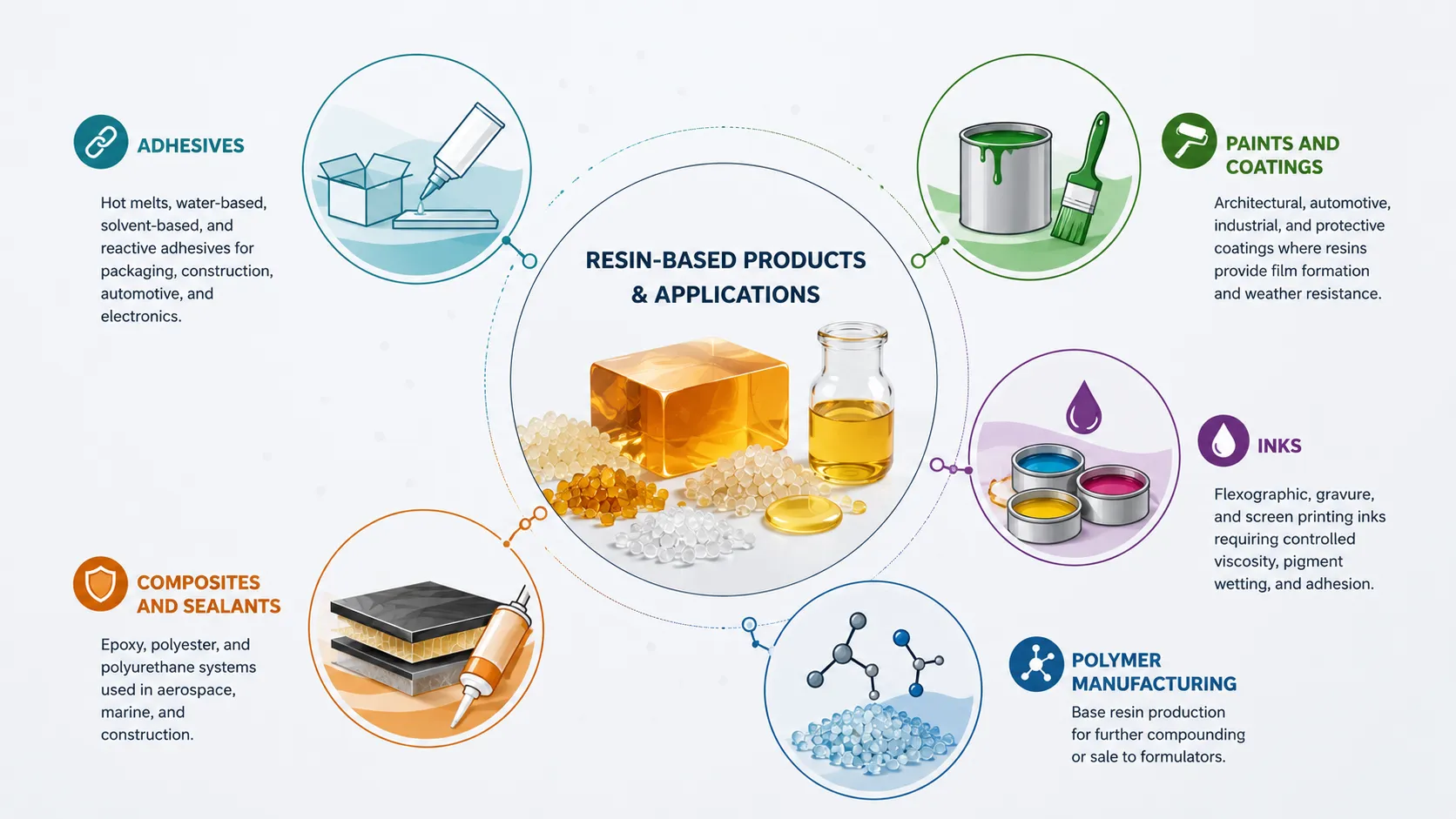
Resins serve as the binding backbone for a wide range of formulated products. Their properties directly influence adhesion, durability, processing behavior, and appearance. Typical resin-based products and applications include:
- Adhesives – Hot melts, water-based, solvent-based, and reactive adhesives for packaging, construction, automotive, and electronics.
- Paints and coatings – Architectural, automotive, industrial, and protective coatings where resins contribute to film formation, adhesion, and durability.
- Inks – Flexographic, gravure, and screen printing inks requiring controlled viscosity, pigment wetting, film formation, and adhesion.
- Composites and sealants – Epoxy, polyester, and polyurethane systems used in aerospace, marine, construction, and other engineered applications.
- Polymer manufacturing – Base resin production for further compounding, formulation, or sale to downstream manufacturers.
Resin Testing Quality Control Workflow
A practical resin QC program follows the material from incoming inspection through resin production, formulation, application, and final performance testing. The required tests become progressively more application-specific as the material moves through the manufacturing process.
| Production Stage | Main QC Requirement | Typical Tests | Relevant Equipment |
|---|---|---|---|
| Incoming raw materials | Confirm consistency before production | Moisture, solids/non-volatile content, viscosity, pH where applicable, identity or composition checks | Moisture Analyzer, Analytical Balance, Laboratory Oven, Viscometer, pH Meter, appropriate analytical instrument |
| Resin synthesis or blending | Control batch properties | Viscosity, density, moisture, color, acid/hydroxyl value where applicable, molecular-weight distribution | Rotational Viscometer, Density Meter, Karl Fischer Titrator, Color Measurement Instrument, titration equipment, GPC |
| Formulation and application | Confirm processability and film formation | Viscosity/rheology, surface tension, film preparation, drying behavior, color, adhesion | Viscometer/Rheometer, Surface Tensiometer, Film Applicator, Drying Time Recorder, Color Measurement Instrument, Adhesion Tester |
| Cured product or film | Verify mechanical performance | Tensile/flexural properties, hardness, impact, flexibility, abrasion | Universal Testing Machine, Hardness Tester, Impact Tester, Flexibility Tester, Abrasion Tester |
| Durability qualification | Evaluate resistance to service conditions | Weathering, humidity, corrosion exposure, thermal cycling, chemical resistance | Weathering Tester, Humidity Chamber, Salt Spray Chamber, Thermal Cycling Chamber, Chemical Resistance Test Setup |
Raw Material Verification
Resin quality begins with incoming raw materials such as base monomers, hardeners, solvents, and additives. Contaminated or off-spec raw materials can introduce variability that propagates into final product defects. Common risks include incorrect non-volatile content, excessive moisture, foreign material, or composition changes that affect resin synthesis, blending, curing, or final performance.
Incoming inspection should therefore focus on the critical properties defined for each material rather than applying the same test package to every raw material. Depending on the chemistry, useful parameters may include non-volatile content, moisture, viscosity, refractive index, pH, density, or analytical identity/composition checks. Establishing acceptance criteria within the manufacturer’s quality system allows nonconforming materials to be identified before they enter production.
Recommended laboratory equipment for this stage:
- Moisture Analyzer – Provides rapid gravimetric moisture or loss-on-drying measurements for suitable raw materials where this method is appropriate.
- Viscometer – Measures the flow behavior of liquid raw materials and helps detect consistency changes between incoming lots.
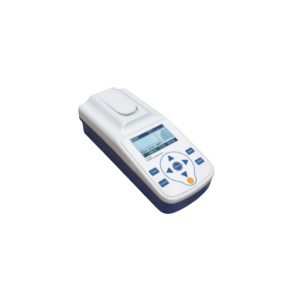
- Spectrophotometer – Can support optical absorbance measurements when an appropriate validated spectrophotometric method is available for the material being tested.
- Analytical Balance – Required for accurate sample, reagent, and gravimetric measurements.
- pH Meter – Checks acidity or alkalinity of applicable aqueous raw materials and resin systems.
- Laboratory Oven – Used with an analytical balance for gravimetric non-volatile or solids-content determination where the selected method requires oven drying.


Resin Property Testing
During resin synthesis or blending, physical and chemical properties must be monitored to confirm that the batch remains within its defined manufacturing specification before transfer, formulation, or storage. Variations in reaction conditions, mixing efficiency, or raw-material lots can change viscosity, density, color, moisture, functional-group values, or molecular-weight distribution.
The exact test package depends on the resin chemistry. Viscosity is a common production-control parameter because it affects pumping, mixing, formulation, and application. Density can provide a rapid consistency check. Trace moisture is particularly important for moisture-sensitive reactive systems. Acid or hydroxyl value may be relevant to specific resin chemistries, while GPC can be used when molecular-weight distribution is an important characterization requirement.
Recommended laboratory equipment for this stage:
- Rotational Viscometer – Measures apparent or dynamic viscosity under defined test conditions for routine resin consistency control.
- Density Meter – Verifies resin density and can help identify composition or batch-consistency changes.
- Karl Fischer Titrator – Determines water content at low levels when trace-moisture measurement is required, particularly for moisture-sensitive systems.
- pH Meter – Used for applicable aqueous resin emulsions or solutions where pH influences stability, processing, or compatibility.
- Color Measurement Instrument – Provides objective resin color measurement using the color scale and method appropriate to the product specification.
- Gel Permeation Chromatography (GPC) – Characterizes molecular-weight distribution when polymer molecular-weight information is needed for R&D, process development, or troubleshooting.

Application and Film Formation Control
Once a resin is incorporated into a paint, ink, coating, or adhesive formulation, application behavior becomes an important quality indicator. Poor wetting, cratering, bubbles, leveling problems, or incorrect film build can result from formulation, rheology, surface-interaction, or application-process issues.
Application testing should reproduce the intended use conditions as closely as practical. Depending on the product, this may involve drawdowns, spraying, printing, laminating, or another controlled application procedure. Useful measurements can include viscosity or rheological behavior, surface tension, wet or dry film thickness, drying time, color, gloss, and initial adhesion. Results help formulators determine whether adjustments are needed before customer trials or production release.
Recommended laboratory equipment for this stage:
- Viscometer or Rheometer – Evaluates flow behavior under defined conditions; instrument geometry and control capability should be selected according to the resin or formulation behavior and the required method.
- Surface Tensiometer – Measures liquid surface tension where wetting, coating, or interfacial behavior is an important formulation parameter.
- Film Applicator – Produces controlled laboratory films or drawdowns for comparative evaluation.
- Drying Time Recorder – Evaluates stages of drying or curing under defined test conditions.
- Color Measurement Instrument – Quantifies color differences in applied or cured films. Gloss should be measured separately when gloss is a specified QC property.
- Adhesion Tester – Supports evaluation of coating or film adhesion using the test method appropriate to the substrate and product specification.
Mechanical Performance Testing
For many resin-based products, mechanical integrity is a primary performance requirement. Coatings may need to resist impact, bending, scratching, or abrasion, while adhesives, sealants, composites, and cured bulk resins may require tensile, compressive, flexural, or elongation measurements. Mechanical-property failures can result from resin formulation, curing conditions, stoichiometry, film thickness, substrate preparation, or other processing variables.
The required test depends strongly on the final application. A universal testing machine can characterize bulk specimens, adhesive joints, or other prepared samples using suitable fixtures and methods. Coating films may instead require hardness, mandrel bending, impact, or abrasion testing. These tests convert final-use requirements into measurable laboratory acceptance criteria.
Recommended laboratory equipment for this stage:
- Universal Testing Machine (UTM) – Measures tensile, compression, flexural, or related mechanical properties when configured with the appropriate fixtures and test method.
- Hardness Tester (Pencil/Pendulum) – Evaluates coating surface hardness using the selected hardness method.
- Impact Tester – Assesses the resistance of coated panels or other prepared specimens to defined impact or deformation conditions.
- Flexibility Tester (Mandrel Bending) – Evaluates whether a coating can withstand bending without unacceptable cracking or loss of adhesion.
- Abrasion Tester – Measures comparative wear or abrasion resistance of cured films and coated surfaces.
Durability and Environmental Resistance Testing
Resin-based products intended for demanding service conditions may need to withstand UV exposure, moisture, temperature changes, chemicals, or corrosive environments. Failures such as yellowing, chalking, blistering, cracking, corrosion, or adhesion loss may not appear during routine production testing, so accelerated or controlled exposure testing is often used during formulation qualification and periodic quality verification.
The exposure program should reflect the intended service environment and the applicable product or customer test method. After exposure, properties such as color, gloss, adhesion, appearance, and mechanical performance can be compared with the initial condition.
Recommended laboratory equipment for this stage:
- Accelerated Weathering Tester – Exposes specimens to controlled light, moisture, and temperature conditions for comparative durability evaluation.
- Salt Spray Chamber – Provides a controlled corrosive environment for evaluating coated metal systems where salt-spray testing is relevant to the required method.
- Humidity Chamber – Evaluates resistance to controlled high-humidity conditions and helps assess effects such as blistering or adhesion change.
- Color Measurement Instrument – Quantifies color change before and after environmental exposure; gloss retention requires an appropriate gloss-measurement instrument when specified.
- Thermal Cycling Chamber – Subjects specimens to repeated temperature changes where thermal-cycle resistance is relevant to the intended application.
- Chemical Resistance Test Setup – Supports controlled exposure to specified chemicals using a procedure appropriate to the resin, coating, substrate, and service environment.

Common Quality Control Challenges in Resin Manufacturing
Resin producers and downstream formulators frequently encounter recurring quality issues that require systematic laboratory control:
- Batch-to-batch viscosity variability leading to inconsistent pumping, mixing, coating, printing, or application behavior.
- Contamination or side reactions contributing to off-color, haze, instability, or unexpected changes in resin properties.
- Inadequate raw material screening allowing excessive moisture or other unsuitable material characteristics into production.
- Curing inconsistency associated with formulation ratio, raw-material condition, catalyst behavior, processing conditions, or cure schedule.
- Poor adhesion to substrates related to wetting, surface condition, resin/substrate compatibility, curing, or application variables.
- Environment-related performance shifts that become visible only after storage, transportation, weathering, humidity, or temperature exposure.
Key Quality Control Tests for Resin Testing
| Quality Challenge | Quality Control Test | Recommended Laboratory Equipment | Application |
|---|---|---|---|
| Viscosity drift between batches | Rotational viscosity measurement | Viscometer | Checks resin flow consistency for manufacturing and application |
| Unexpected curing behavior | Gel-time evaluation or thermal cure analysis, as applicable | Gel-time test setup / Differential Scanning Calorimeter | Supports evaluation of thermoset reaction and cure behavior |
| Moisture-related foam or defects | Karl Fischer titration | Karl Fischer Titrator | Controls low-level water where moisture can affect reactive resin systems |
| Poor or inconsistent product color | Instrumental color measurement | Color Measurement Instrument | Quantifies color consistency for resins, inks, and coatings |
| Low film hardness or scratch resistance | Pencil or pendulum hardness test | Hardness Tester | Evaluates cured-film hardness using the selected test method |
| Delamination on substrates | Adhesion testing | Adhesion Tester | Evaluates bonding of the cured coating or film to the substrate |
| Yellowing or appearance change after exposure | Accelerated weathering followed by appearance/color evaluation | Accelerated Weathering Tester, Color Measurement Instrument | Compares formulation stability under controlled accelerated exposure |
| Chemical attack in service | Chemical resistance testing | Chemical Resistance Test Setup | Screens resin formulations against specified service chemicals |
Laboratory Equipment Required for Resin Manufacturing Quality Control
A resin testing laboratory should combine routine physical-property measurements with the chemical, mechanical, and durability tests that are relevant to the facility’s products. The correct configuration is therefore not simply the longest possible equipment list. It should reflect which measurements are needed for incoming acceptance, in-process control, batch release, formulation development, and failure analysis.
For many resin producers and formulators, a viscometer, moisture analyzer, pH meter where aqueous systems are handled, analytical balance, and laboratory oven provide a practical starting point for routine QC. Karl Fischer titration becomes important where low-level water must be measured more selectively. Density and objective color measurement can strengthen batch-consistency control. GPC, DSC, universal testing, and environmental exposure equipment are generally more appropriate when molecular characterization, cure analysis, mechanical qualification, product development, or durability testing is required.
| Testing Requirement | Laboratory Equipment | Why Manufacturers Need It |
|---|---|---|
| Viscosity and flow properties | Viscometer / Rheometer | Supports control of pumping, mixing, formulation, coating, printing, and application behavior. |
| Moisture content | Karl Fischer Titrator / Moisture Analyzer | Provides moisture information at different levels of analytical sensitivity; the appropriate method depends on the resin and QC requirement. |
| Solid content / non-volatile matter | Laboratory Oven, Analytical Balance | Supports gravimetric determination of non-volatile content where the selected method uses controlled drying. |
| Color and appearance | Color Measurement Instrument | Provides objective comparison of resin or film color when appearance is a release or development criterion. |
| Mechanical strength | Universal Testing Machine | Supports quantitative mechanical testing of prepared resin, adhesive, sealant, composite, or film specimens. |
| Surface and adhesion properties | Surface Tensiometer, Adhesion Tester | Supports evaluation of liquid surface behavior and bonding performance to intended substrates. |
| Accelerated aging | Weathering Tester, Salt Spray Chamber, Humidity Chamber | Provides controlled exposure for comparing formulation durability under selected environmental conditions. |
| Thermal and cure behavior | Differential Scanning Calorimeter | Supports thermal characterization and analysis of relevant transitions or cure reactions. |
Together, these instruments allow a laboratory to connect incoming-material quality with process consistency and final performance. The most efficient laboratory is one in which each instrument supports a defined QC decision rather than being added simply because it is commonly used in the resin industry.
Basic Laboratory Setup for Resin Manufacturers
The appropriate laboratory level depends on whether the facility primarily performs routine batch-release testing or also conducts formulation development, troubleshooting, and advanced material characterization.
| Laboratory Level | Recommended Equipment | Suitable For |
|---|---|---|
| Basic QC Laboratory | Viscometer, Moisture Analyzer, pH Meter, Analytical Balance, Laboratory Oven | Small and medium resin producers or formulators focused on routine incoming, in-process, and batch-release checks. |
| Advanced QC Laboratory | All Basic plus Karl Fischer Titrator, Density Meter, Color Measurement Instrument, Film Applicator, Adhesion Tester | Manufacturers requiring tighter control of moisture, physical properties, appearance, application behavior, and film performance. |
| Advanced Analysis Laboratory | All Advanced plus Universal Testing Machine, Accelerated Weathering Tester, DSC, GPC | R&D, product qualification, advanced troubleshooting, failure analysis, and more extensive resin characterization. |
The levels above are configuration examples rather than universal requirements. Equipment should be selected from the actual resin chemistry, required test methods, customer specifications, sample volume, and quality-control decisions the laboratory must support.
How to Choose Laboratory Equipment for Resin Testing
Selecting resin testing equipment starts with the required test method and sample rather than with the instrument name alone. Resin chemistry, viscosity range, sample state, required sensitivity, daily sample volume, operator experience, and final product specifications all influence the correct laboratory configuration.
Define the Testing Scope
Begin by listing the resin chemistries handled by the facility, such as epoxy, acrylic, polyester, or polyurethane systems, together with the relevant sample forms: raw materials, liquid resin, emulsion, adhesive, coating, cured film, or bulk specimen.
Then identify the critical-to-quality properties for each production stage. These may include viscosity, moisture, non-volatile content, density, pH, color, molecular-weight distribution, cure behavior, adhesion, mechanical properties, or weatherability. Separate routine batch-release tests from development or troubleshooting tests. This distinction helps prevent over-equipping a production QC laboratory with analytical systems that will rarely be used.
Match the Instrument to the Test Method and Sample
Two instruments within the same broad equipment family may not be interchangeable for every resin. For viscosity testing, the expected viscosity range, sample volume, temperature control, spindle or geometry requirements, shear sensitivity, and required method all matter. For moisture testing, determine whether rapid gravimetric screening is sufficient or whether a more selective low-level water determination is required.
The same principle applies to color, mechanical, thermal, and environmental testing. Define what result the QC team needs, how the sample must be prepared, and which method or customer specification must be followed before selecting the instrument configuration.
Evaluate Laboratory Workflow Requirements
Consider how many samples will be tested per shift or per day, how quickly results are needed for production release, the skill level of operators, and the available laboratory space. High-throughput production laboratories may benefit from simplified operation, repeatable sample handling, and digital result management, while lower-volume R&D laboratories may prioritize flexibility and broader analytical capability.
Also identify installation requirements before purchase. Depending on the equipment, considerations may include stable laboratory temperature, ventilation, utilities, bench space, sample-preparation areas, chemical storage, or environmental controls.
Compare Long-Term Equipment Support
Purchase price is only one part of instrument selection. Laboratories should also evaluate calibration and verification requirements, recurring consumables, reference materials, reagents, columns or accessories where applicable, operator training, preventive maintenance, spare-parts availability, and technical support.
AELAB helps manufacturers compare instrument categories against their actual testing workflow rather than selecting equipment only from a generic laboratory list. Providing the resin type, sample condition, required tests, expected daily sample volume, and any required test method gives the equipment-selection process a much stronger technical basis.
Who Needs Laboratory Testing Solutions for This Industry?
- Resin and polymer manufacturers seeking to control synthesis, incoming materials, and batch consistency.
- Adhesive, paint, and coating formulators who need to verify resin suitability, formulation consistency, and final product performance.
- Ink manufacturers requiring controlled flow behavior, color, application, and film-performance testing.
- Quality control and R&D departments in resin-consuming industries that need production release data, troubleshooting capability, or formulation-development support.
- Third-party testing laboratories providing resin, polymer, coating, adhesive, or related material characterization services.
Frequently Asked Questions
What is the most important test for resin quality control?
Viscosity measurement is often the single most important routine test because it directly impacts processing and application. However, the most critical test depends on the resin’s end use: for adhesives, tensile strength might be key; for optical resins, color and clarity are paramount.
Can one viscometer handle all resin viscosity ranges?
Not usually. Resin systems range from low-viscosity solvents to highly thixotropic pastes. A rotational viscometer with multiple spindle or cone-plate geometries provides the flexibility needed. For very thin liquids, a capillary viscometer may be more appropriate, whereas for pastes, a cone-plate with controlled shear rate is essential.
How often should laboratory instruments be calibrated?
Calibration frequency depends on instrument type, usage intensity, manufacturer recommendations, internal quality procedures, and applicable laboratory requirements. Many labs calibrate balances and pH meters daily or before each use, while viscometers and spectrophotometers may be calibrated weekly or monthly. A robust quality management system defines the schedule based on risk and historical drift data.
Is accelerated weathering testing always necessary?
It is not always mandatory but strongly recommended for resin-based products intended for outdoor use or where colour stability is critical. For indoor applications, a simple UV stability spot check may suffice. The decision should be based on customer expectations and the potential cost of field failures.
Conclusion
Effective resin testing connects raw-material control, manufacturing consistency, application behavior, and final product performance. The most useful laboratory configuration is therefore built around the actual QC decisions a manufacturer must make: which incoming materials can be released, whether a resin batch is within specification, whether a formulation can be applied consistently, and whether the cured product meets its required performance.
Routine laboratories can begin with instruments for viscosity, moisture, pH where applicable, weighing, and non-volatile content, then add density, color, trace-moisture, film, mechanical, thermal, molecular-weight, or environmental testing as product requirements become more demanding. Defining the resin chemistry, required test methods, sample throughput, and end-use performance requirements before equipment selection helps create a laboratory that supports both production efficiency and reliable quality control.
Laboratory Equipment Solutions for Resin Manufacturers
AELAB supports resin producers and formulators by helping them translate quality-control requirements into practical instrument configurations. The selection process can cover incoming raw-material checks, in-process viscosity and moisture control, formulation and film testing, mechanical performance, or more advanced characterization depending on the facility’s needs.
When planning a new resin testing laboratory or upgrading an existing one, useful information to prepare includes the resin chemistries and sample states being tested, the required QC tests, applicable test methods or customer requirements, estimated sample volume per day, and existing laboratory equipment. These details provide a practical basis for comparing suitable equipment categories and determining which instruments belong in routine QC versus an advanced analysis laboratory.