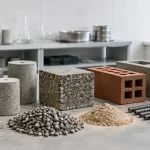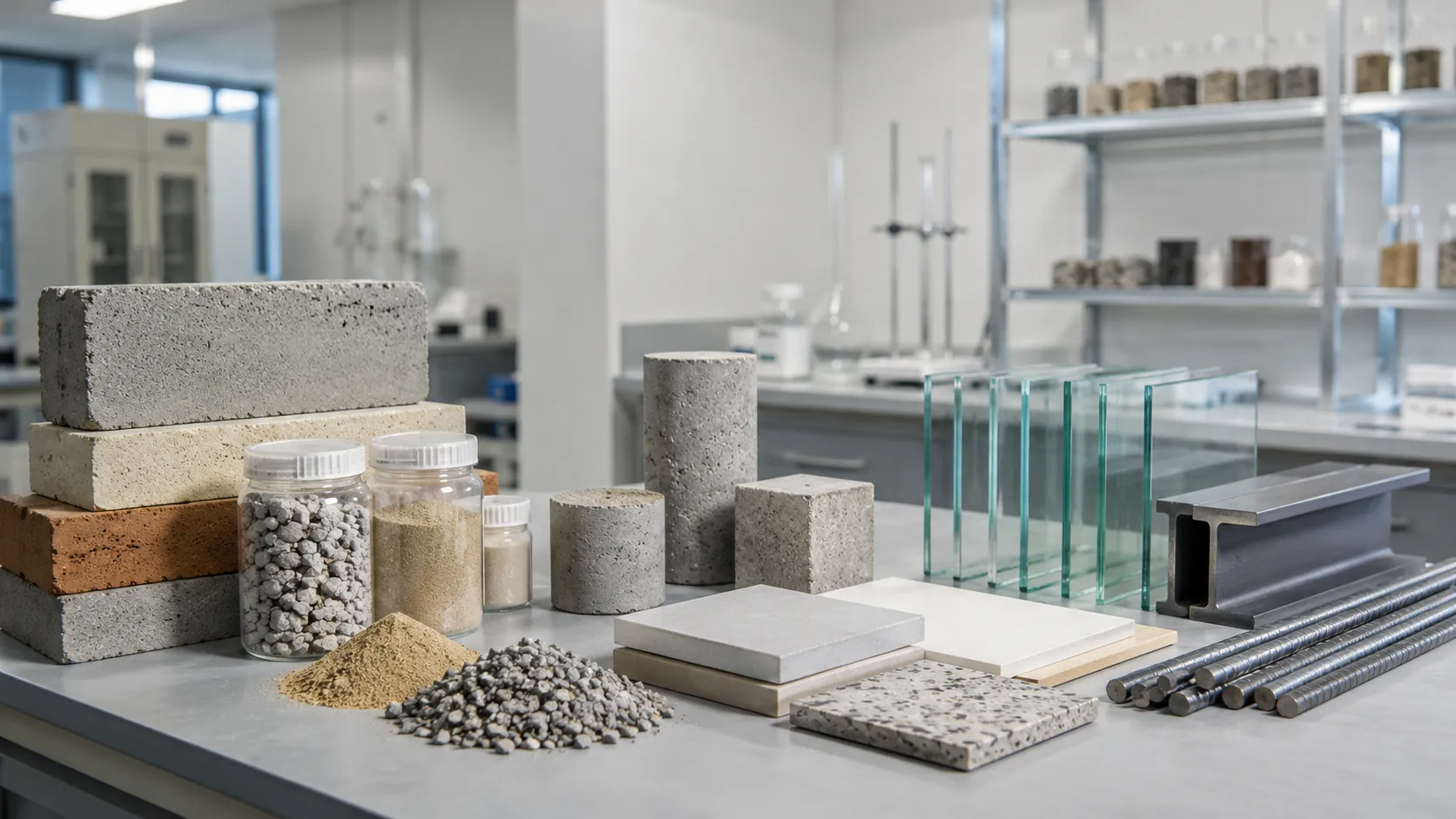
Building Material Analysis Laboratory Setup Overview
A building material analysis laboratory supports quality control from incoming raw materials through finished cement, concrete, ceramics, glass, aggregates, and related construction materials. The core testing groups typically include chemical composition, particle size and moisture, dimensional and physical checks, thermal behavior, mechanical strength, water absorption, and durability. Common equipment families include balances and moisture analyzers, sieve shakers, ovens and furnaces, XRF spectrometers, thermal analyzers, and mechanical testing systems.
The right laboratory configuration depends on the material being produced, the tests required by the manufacturer’s quality plan, expected sample volume, and the applicable test methods. Organizing equipment around the production workflow helps laboratories identify raw-material variation early, make timely process adjustments, and verify finished-product performance without adding instruments that do not serve a defined testing need.
Main Products and Applications
Building materials encompass a broad spectrum of products used in construction. The following categories commonly require rigorous quality control:
- Cement and concrete – binders, mortars, ready-mix concrete, precast elements.
- Ceramics – tiles, bricks, sanitaryware, refractories, porcelain insulators.
- Glass – flat glass, container glass, fiberglass, specialty glass for architectural applications.
- Aggregates and natural stone – sand, gravel, crushed stone, dimension stone.
- Other binders and plasters – lime, gypsum, industrial plasters.
Building Material Analysis Quality Control Workflow
Raw Material Testing and Qualification
Incoming raw materials such as cement clinker, silica sand, clay, and aggregates must exhibit consistent chemical and physical properties. Even slight variations in composition can lead to significant differences in product strength, color, or thermal behavior. Manufacturers perform chemical analysis using X-ray fluorescence (XRF) to verify oxide content, while particle size distribution is determined through sieve analysis or laser diffraction. Loss on ignition and moisture content are also checked to ensure proper batch adjustments.
Recommended laboratory equipment for this stage:
- XRF Spectrometer – provides rapid elemental analysis of raw materials to confirm oxide composition.
- Sieve Shaker and Test Sieves – measures particle size distribution of powders and aggregates.
- Moisture Analyzer – determines moisture content to adjust mix water requirements.
- Laboratory Oven – dries samples prior to loss on ignition testing or moisture determination.
- Analytical Balance – ensures precise weighing of samples for chemical and physical tests.


In-Process Physical Testing
During shaping and before thermal treatment, physical properties of green products must be controlled. For ceramics, green density and moisture content influence shrinkage and cracking. In concrete production, the workability and air content of fresh mix affect final strength and durability. Dimensions of formed products are checked to meet size tolerances. Rapid testing at this stage allows immediate corrective actions, reducing waste and rework.
Recommended laboratory equipment for this stage:
- Digital Calipers and Gauge Blocks – for accurate dimensional measurement of formed specimens.
- Bulk Density Determination Kit – measures green density by water displacement or geometric method.
- Moisture Analyzer – quick moisture content checks during processing.
- Slump Test Apparatus – evaluates workability of fresh concrete.
- Laboratory Balance – required for density and mass measurements.
Thermal Treatment and Curing Control
Thermal processes such as cement clinker cooling, ceramic firing, glass annealing, and concrete curing require precise control. Inadequate firing can result in under-sintered ceramics with low strength. Improper annealing may leave residual stress in glass, causing breakage. Continuous monitoring of temperature profiles and the resulting material property changes are critical. Samples are cured or fired under controlled conditions in laboratory furnaces and ovens, then tested.
Recommended laboratory equipment for this stage:
- Laboratory Furnace – for precise heating and firing of ceramics or glass samples.
- Thermal Analyzer (DSC/TGA) – evaluates phase transitions, decomposition, and thermal stability.
- Temperature Data Logger – records curing or firing temperature profiles.
- Universal Testing Machine – tests compressive strength of concrete after curing.
- Moisture Analyzer – confirms complete drying of materials after heat treatment.


Mechanical Testing of Finished Products
The mechanical integrity of building materials directly affects safety and service life. Compressive strength is the primary parameter for concrete and bricks, while flexural strength is critical for ceramic tiles and glass. Testing is performed on conditioned specimens according to standard methods. Results are used to grade products and ensure compliance with building codes and customer specifications.
Recommended laboratory equipment for this stage:
- Universal Testing Machine – measures compressive, flexural, and tensile strength with appropriate fixtures.
- Flexural Testing Fixtures – specialized accessories for three-point or four-point bending tests.
- Abrasion Tester – evaluates surface wear resistance of tiles and pavers.
- Impact Tester – assesses toughness of ceramic and glass products.
- Hardness Tester – determines surface hardness of materials like concrete or brick.
Chemical and Durability Testing
Long-term performance depends on resistance to environmental factors. Water absorption indicates porosity and susceptibility to freeze-thaw damage. Chemical resistance tests verify glass stability against acids or alkalis. Efflorescence testing on bricks and sulfates resistance of cement are also common. These tests help predict service life and guide product formulation improvements.
Recommended laboratory equipment for this stage:
- Water Absorption Tank and Balance – for measuring water uptake after immersion.
- pH Meter – monitors chemical solutions used in resistance testing.
- Conductivity Meter – detects soluble salts in efflorescence testing.
- Spectrophotometer – quantifies color changes or ion leaching from glass.
- Chemical Resistance Testing Apparatus – holding specimens in aggressive media under controlled conditions.


Common Quality Control Challenges in Cement, Ceramics, Glass & Building Materials
- Variability in raw material composition leading to inconsistent product quality.
- Inadequate control of mixing and proportioning causing strength deviations.
- Insufficient drying or curing resulting in defects like cracking or low strength.
- Inconsistent thermal treatment causing residual stresses or incomplete sintering.
- Difficulty in achieving the required dimensional tolerances for precision products.
- Poor durability against weathering, chemical attack, or abrasion reducing service life.
Key Quality Control Tests for Building Material Analysis
| Quality Challenge | Quality Control Test | Recommended Laboratory Equipment | Application |
|---|---|---|---|
| Variable raw material composition | Chemical oxide analysis | XRF Spectrometer | Verify silica, alumina, calcium content in raw mix |
| Incorrect particle size distribution | Sieve analysis | Sieve Shaker and Test Sieves | Determine sand, aggregate, or powder grading |
| Excess moisture in raw materials | Moisture content | Moisture Analyzer | Adjust water dosage in concrete or ceramic body |
| Low green density | Green density measurement | Bulk Density Determination Kit | Prevent shrinkage and warping in ceramics |
| Inadequate compressive strength | Compressive strength test | Universal Testing Machine | Grade concrete, bricks, or blocks |
| Poor flexural performance of tiles | Flexural strength test | Universal Testing Machine with bending fixture | Ensure tile breaking strength meets standards |
| Excessive water absorption | Water absorption test | Water Absorption Tank and Balance | Classify porosity of ceramics, concrete |
| Thermal instability or phase changes | Thermal analysis (DSC/TGA) | Thermal Analyzer | Study glass transition, dehydration, decomposition |
Laboratory Equipment Required for Building Materials Quality Control
To establish a comprehensive quality control laboratory for building materials, a combination of physical testing, chemical analysis, and thermal characterization instruments is necessary. Key equipment categories include mechanical testers such as universal testing machines for strength evaluation, XRF spectrometers for elemental analysis, and particle sizing tools like sieve shakers. Moisture analyzers, balances, and ovens are fundamental for sample preparation and routine checks. Specialized equipment like thermal analyzers and abrasion testers address specific durability requirements.
Integrating these instruments into a coherent workflow ensures that raw materials are screened, processes are monitored, and final products are verified against specifications. For instance, a sample may first be analyzed chemically to confirm composition, then tested physically for particle size, shaped into a test specimen, cured or fired, and finally subjected to mechanical testing. Each stage depends on accurate, repeatable measurements provided by the appropriate laboratory equipment.
| Testing Requirement | Laboratory Equipment | Why Manufacturers Need It |
|---|---|---|
| Chemical composition of raw materials and products | XRF Spectrometer | Ensures oxide proportions meet mix design and product standards |
| Particle size distribution | Sieve Shaker and Test Sieves | Controls aggregate grading and powder fineness for optimal packing |
| Moisture content | Moisture Analyzer | Avoids overdosing or underdosing water, prevents drying defects |
| Mechanical strength | Universal Testing Machine | Verifies load-bearing capacity of concrete, ceramics, and glass |
| Dimensional accuracy | Digital Calipers and Gauges | Maintains product consistency and compliance with size tolerances |
| Thermal properties | Thermal Analyzer (DSC/TGA) | Studies phase changes, thermal stability, and firing behavior |
| Water absorption and durability | Water Absorption Tank, Balance, pH Meter | Predicts long-term performance in wet or aggressive environments |
| Sample preparation and conditioning | Laboratory Oven, Furnace, Balances | Provides controlled drying, firing, and accurate mass determination |
The listed instruments cover the essential testing needs from raw material inspection through final product certification, enabling a practical and complete quality control laboratory for manufacturers of cement, ceramics, glass, and other construction materials.
Basic Laboratory Setup for Building Material Manufacturers
| Laboratory Level | Recommended Equipment | Suitable For |
|---|---|---|
| Basic QC Laboratory | Analytical Balance, Moisture Analyzer, Sieve Shaker, Laboratory Oven, Digital Calipers, Slump Test Apparatus | Small manufacturers checking raw materials, moisture, and basic physical properties; preliminary strength testing on-site |
| Advanced QC Laboratory | Add: Universal Testing Machine, XRF Spectrometer, Water Absorption Tank, Abrasion Tester | Medium to large manufacturers performing full mechanical and chemical testing, tile and concrete product certification |
| Advanced Analysis Laboratory | Add: Thermal Analyzer, Spectrophotometer, Chemical Resistance Test Apparatus, Laboratory Furnace | R&D and high-end QC for in-depth material characterization, new product development, and failure analysis |
How to Choose Laboratory Equipment for Building Material Analysis
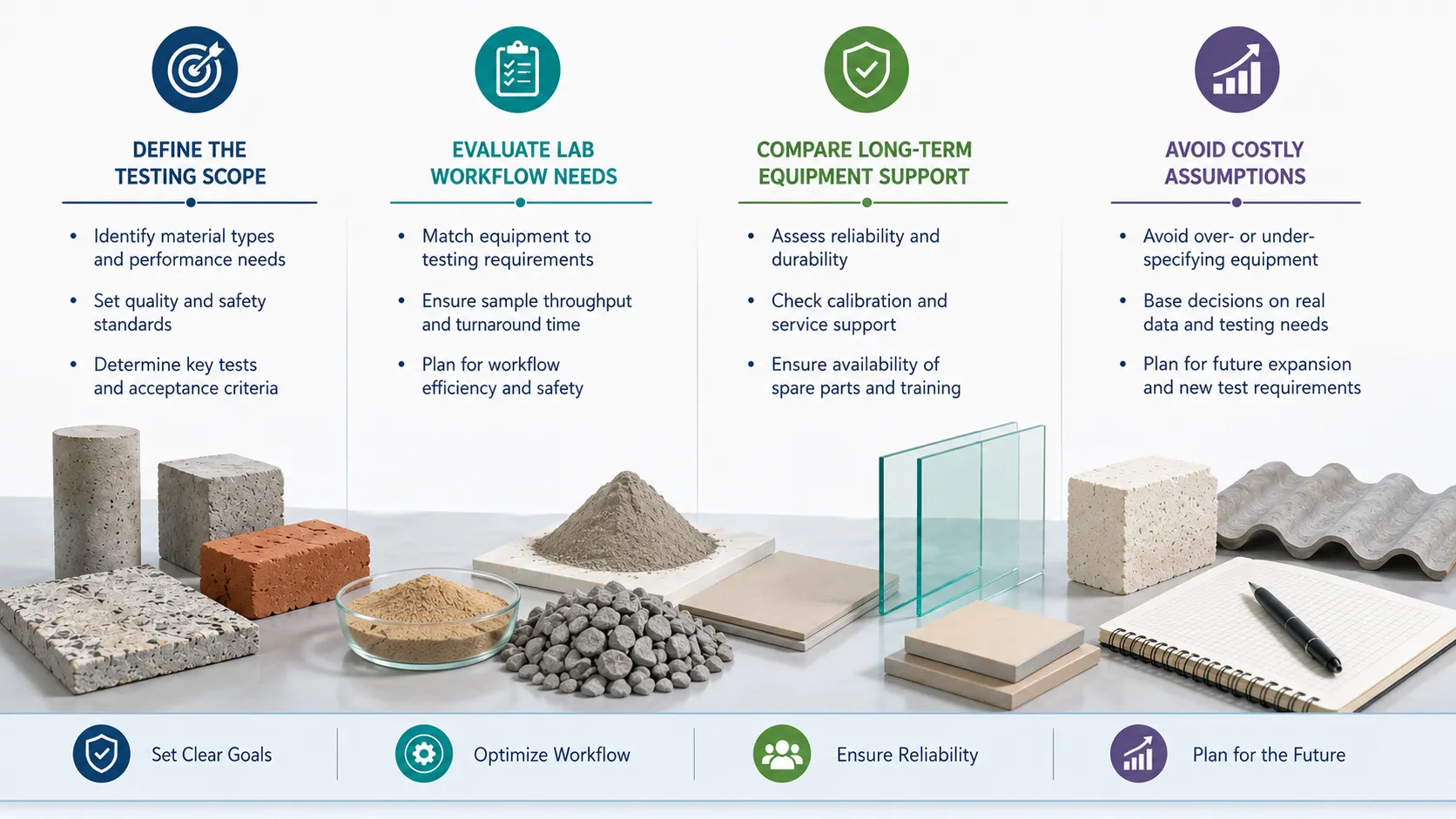
Selecting the right instruments for a building material testing laboratory requires a systematic evaluation of your specific products, applicable standards, and operational constraints.
Define the Testing Scope
Begin by listing the sample types you need to test—cement powder, concrete cylinders, ceramic tiles, glass sheets, or aggregates. Identify the required tests based on your quality control plan or regulatory standards. Determine the expected measurement range and accuracy needed. For instance, a universal testing machine must have sufficient capacity for high-strength concrete, while a moisture analyzer should offer rapid analysis suitable for production environments.
Evaluate Laboratory Workflow Requirements
Consider the daily testing volume and sample throughput. High-production plants may require automated or multi-station instruments to avoid bottlenecks. Assess operator skill level; some equipment like XRF spectrometers demands trained personnel, while moisture analyzers are more straightforward. Laboratory space, utilities (electricity, exhaust), and environmental controls (temperature, humidity) also influence equipment selection. Automation and data integration capabilities can streamline reporting and reduce manual errors.
Compare Long-Term Equipment Support
Long-term reliability depends on calibration services, availability of consumables, and technical support. Inquire about maintenance contracts, spare parts lead times, and training programs. Instruments that are widely supported locally minimize downtime. AELAB can assist manufacturers in matching their testing requirements with suitable instrument categories, ensuring that the chosen equipment integrates smoothly into existing workflows and can be maintained efficiently over its lifetime.
Who Needs Laboratory Testing Solutions for This Industry?
- Cement and concrete producers requiring compressive strength and chemical analysis.
- Ceramic tile and sanitaryware manufacturers monitoring dimensional and mechanical properties.
- Glass manufacturers checking annealing quality, chemical durability, and optical parameters.
- Independent testing laboratories offering third-party quality verification.
- Construction companies performing on-site quality control of incoming materials.
Frequently Asked Questions
What is the most essential equipment for a basic building material testing lab?
A basic lab should at least include an analytical balance, moisture analyzer, sieve shaker, laboratory oven, and digital calipers. These instruments cover fundamental tests like particle sizing, moisture content, and dimensional checks, which are critical for daily production control.
How do I select the right universal testing machine for concrete?
Start with the specimen type, expected maximum test load, and the test method your laboratory must follow. The machine should provide suitable capacity for the intended concrete specimens and support the fixtures or accessories required for any additional flexural testing. Confirm method-specific machine, platen, calibration, and reporting requirements before purchase.
Can I use the same XRF instrument for cement, ceramics, and glass?
Potentially, but suitability depends on the elements to be measured, required performance, calibration strategy, and sample preparation method for each material. Cement, ceramics, and glass can require different calibrations and reference materials, so the intended applications should be defined before selecting an XRF system.
What are common mistakes when setting up a building material lab?
Common pitfalls include underestimating the importance of sample preparation equipment, ignoring environmental conditions (like ambient temperature and humidity), failing to plan for calibration and maintenance, and selecting instruments without considering operator training requirements. Proper workflow design and future expansion needs are also often overlooked.
Conclusion
Establishing a building material analysis laboratory is a strategic investment for manufacturers aiming to ensure product consistency, comply with standards, and reduce quality-related costs. By systematically addressing raw material control, in-process monitoring, and final product testing, companies can build a robust quality framework. The selection of appropriate laboratory equipment—from simple balances to advanced thermal analyzers—must be guided by the specific materials, required tests, and operational context.
Laboratory Equipment Solutions for Cement, Ceramics, Glass & Building Materials
AELAB supports manufacturers that need to translate a building-material quality plan into practical laboratory equipment categories. The selection process should begin with the samples being tested and the required methods, then match each requirement to the necessary preparation, measurement, conditioning, and mechanical-testing equipment.
For an equipment recommendation, prepare the product or sample types, required test methods, expected testing volume, current laboratory setup, and main quality control challenges. These details make it easier to distinguish essential routine-QC instruments from advanced analytical equipment and to plan a laboratory configuration around the actual workflow.