Specialty Chemical Testing Methods and Instruments Overview
Specialty chemical testing combines chemical analysis, physical-property measurement, performance evaluation, and stability testing to confirm that raw materials, production batches, and finished products meet defined quality requirements. Depending on the formulation and specification, common laboratory instruments include chromatographs, titrators, moisture analyzers, pH meters, viscometers, spectrophotometers, particle size analyzers, thermal analyzers, mechanical testing systems, and stability chambers.
In the specialty chemicals industry, where products are formulated for specific performance requirements, systematic laboratory testing supports reliable manufacturing and consistent batch release. From adhesives and coatings to catalysts and surfactants, manufacturers may need to control chemical composition, moisture, viscosity, particle characteristics, thermal behavior, and application-specific performance.
The appropriate testing program depends on the product type, manufacturing process, internal specification, customer requirement, and validated test method. A well-planned QC workflow connects each production stage with the test being performed, the reason for the measurement, and the laboratory instrument needed to generate the result.
Main Products and Applications
Specialty chemicals encompass a wide range of formulations tailored for specific industrial or consumer applications. Typical product categories and their quality-control priorities include:
- Adhesives and Sealants – Used in automotive, construction, and packaging; testing may focus on bonding strength, viscosity, cure behavior, and application performance.
- Coatings and Paints – Including decorative, protective, and industrial coatings; important parameters can include viscosity, film properties, adhesion, gloss, and durability.
- Catalysts – Used in chemical processing and synthesis; testing may involve composition, purity, physical characteristics, and application-specific activity measurements.
- Surfactants and Emulsifiers – Used in detergents, personal care, and agrochemical formulations; relevant measurements may include composition, cloud point, foam behavior, and emulsion properties.
- Polymers and Resins – Used in composites, packaging, coatings, adhesives, and textiles; viscosity, thermal behavior, mechanical properties, and other formulation-specific characteristics can influence performance.
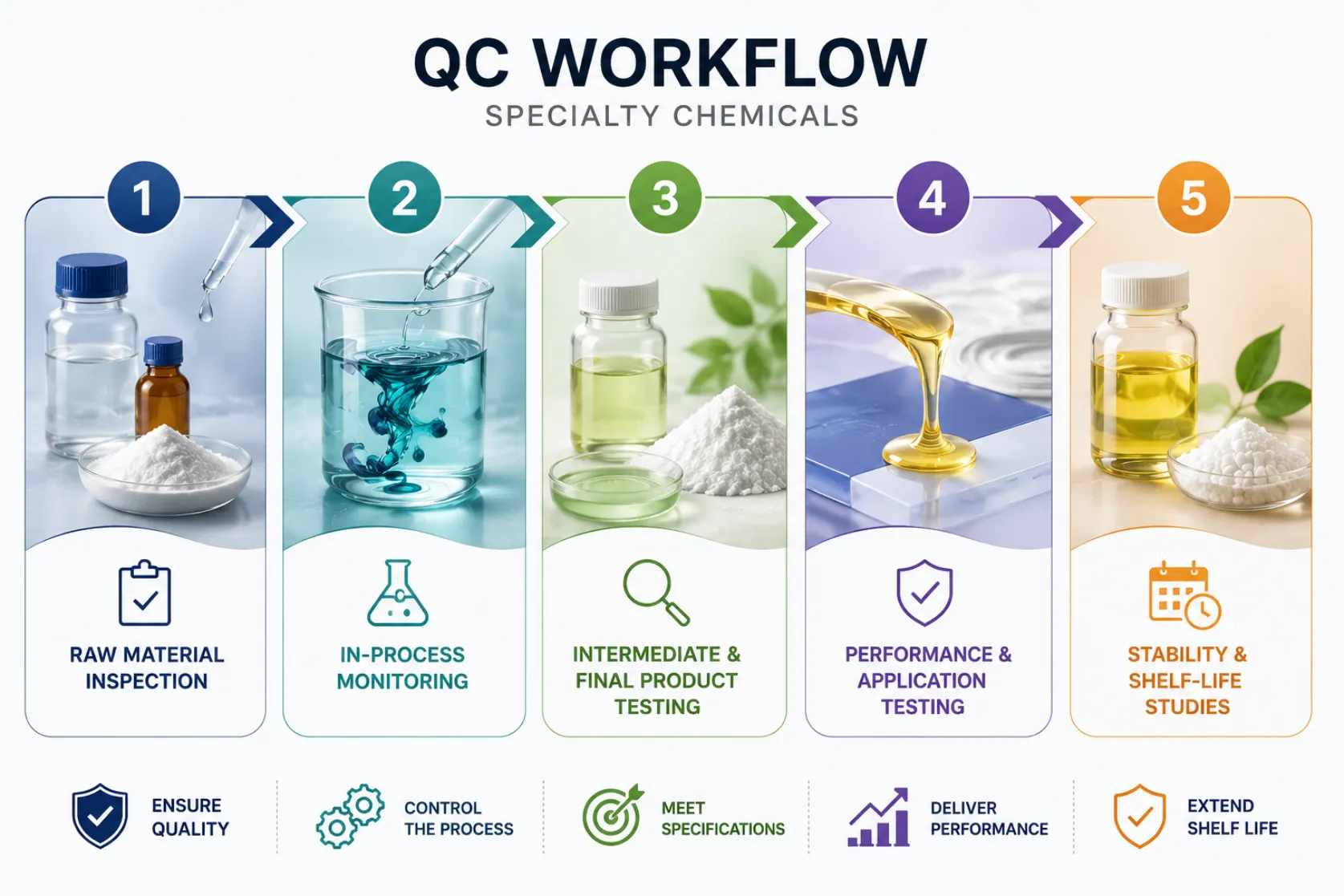
Specialty Chemical Quality Control Workflow
A practical specialty chemical QC program normally follows the material from incoming inspection through production, final release, application testing, and stability evaluation. Not every product requires every test; the laboratory configuration should reflect the actual formulation and specification.
1. Incoming Raw Material Inspection
Raw material quality directly influences final product consistency. Contaminated, incorrectly identified, or off-specification feedstocks can create downstream processing problems and finished-product failures. Incoming testing therefore focuses on confirming material identity and measuring the physical or chemical parameters that matter to the formulation.
Depending on the material, measurements may include refractive index, moisture content, acid or amine value, or chromatographic composition. Results support acceptance or rejection decisions before a material enters production.
Recommended laboratory equipment for this stage:
- Refractometer – Measures refractive index and can support concentration or identity checks where an appropriate method is established.
- Moisture Analyzer – Provides routine moisture determination for suitable raw materials.
- Gas Chromatograph-Mass Spectrometer (GC-MS) – Supports identification and characterization of suitable volatile or semi-volatile components when the analytical method requires mass-spectral information.
- Potentiometric Titrator – Supports acid number, amine value, and other titration-based measurements where applicable.
- Analytical Balance – Provides accurate sample and reagent weighing for laboratory procedures.


2. In-Process Reaction Monitoring
During synthesis or blending, in-process measurements help operators determine whether the batch is progressing within its defined process conditions. Parameters such as pH, viscosity, temperature, composition, or reaction-related values may be monitored depending on the chemistry involved.
Rapid measurements can identify process drift before final testing. The most useful instruments are those that measure parameters directly connected to the process endpoint or critical formulation characteristics.
Recommended laboratory equipment for this stage:
- pH Meter – Tracks acidity or alkalinity in systems where pH is a relevant process parameter.
- Viscometer – Measures viscosity changes during blending or reaction and supports consistency monitoring.
- Near-Infrared (NIR) Spectrometer – Can provide rapid compositional measurements when a suitable calibrated method has been developed for the application.
- Automated Reactor Calorimeter – Supports heat-flow and reaction-behavior studies for processes where reaction calorimetry is required.
- Laboratory Oven – Used for drying samples or controlled thermal treatment during applicable laboratory procedures.


3. Intermediate and Final Product Specification Testing
After synthesis or formulation, the product is tested against its defined release specification. The required measurements depend on the chemical and its intended application and may include composition, purity, particle size, color, density, thermal properties, or physical appearance.
Liquid and solid specialty chemicals often require different combinations of tests. The objective is not to run every available analytical technique, but to use validated measurements that distinguish acceptable material from off-specification product and generate reliable batch-release data.
Recommended laboratory equipment for this stage:
- Gas Chromatograph (GC) with FID – Quantifies suitable organic components and solvents using an established chromatographic method.
- Particle Size Analyzer – Measures particle size distribution for applicable powders, emulsions, or dispersions.
- Spectrophotometer – Supports quantitative color or optical measurements where the product specification defines the measurement method.
- Melting Point Apparatus – Measures melting behavior of applicable crystalline materials.
- Centrifuge – Can support comparative evaluation of separation, sedimentation, or emulsion behavior under defined test conditions.


4. Performance and Application Testing
Specialty chemicals are frequently purchased for what they do in an end-use process, so chemical composition alone may not provide enough information for release or product development. Application testing connects laboratory measurements with the performance characteristics expected by the customer.
For adhesives, relevant tests may include tensile or peel behavior and cure characteristics. Coatings may be evaluated for gloss, hardness, adhesion, drying behavior, or resistance to controlled environmental exposure. The exact test should reflect the product specification and intended application.
Recommended laboratory equipment for this stage:
- Universal Testing Machine – Measures tensile, peel, compression, or other mechanical properties using suitable fixtures and test procedures.
- Weathering Tester (QUV) – Provides controlled accelerated UV and moisture exposure for comparative weathering evaluations.
- Rotational Viscometer – Measures viscosity under defined test conditions and can support application-related flow evaluation.
- Gloss Meter – Quantifies surface gloss for applicable coatings and finished surfaces.
- Drying Time Recorder – Evaluates drying or curing progression under defined conditions for applicable coatings and related materials.

5. Stability and Shelf-Life Studies
Stability studies evaluate whether a specialty chemical maintains important physical and chemical characteristics during storage. Depending on the formulation, laboratories may monitor color, viscosity, pH, moisture, phase separation, precipitation, or other specification-related changes over time.
Controlled chambers provide defined storage conditions, while periodic laboratory measurements track changes in the product. Stability programs can also support evaluation of product and packaging compatibility. Study conditions, sampling intervals, and acceptance criteria should follow the manufacturer’s established stability protocol.
Recommended laboratory equipment for this stage:
- Stability Chamber – Provides controlled temperature and humidity conditions for applicable stability studies.
- Viscometer or Rheometer – Tracks changes in viscosity or flow behavior during storage.
- Karl Fischer Titrator – Measures water content when moisture is an important stability parameter.
- pH Meter – Monitors pH changes in formulations where pH is relevant to stability.
- Microbiological Incubator – Supports microbiological procedures for formulations where microbial quality is part of the testing program.

Common Quality Control Challenges in Specialty Chemicals
Manufacturers face several recurring difficulties that influence how a specialty chemical QC laboratory should be configured:
- Batch-to-batch variability – Changes in raw materials or process conditions can alter final product characteristics.
- Complex multi-component formulations – Small formulation changes can affect physical properties or end-use performance.
- Limited sample availability – High-value or difficult-to-handle materials may require testing approaches that use practical sample quantities.
- Customer-specific specifications – Niche products may require application-specific measurements in addition to routine chemical analysis.
- Stability concerns – Reactive or sensitive formulations may change during storage and therefore require controlled stability monitoring.
- Need for rapid decisions – Production laboratories often need useful results quickly enough to support material acceptance, process adjustment, or batch release.
Key Specialty Chemical Quality Control Tests
The table below shows common test-to-instrument relationships. The actual test program should be selected according to the product specification and validated laboratory method.
| Quality Challenge | Quality Control Test | Recommended Laboratory Equipment | Application |
|---|---|---|---|
| Raw material purity verification | GC purity assay | Gas Chromatograph with FID or MS | Solvents, monomers, surfactants |
| Moisture-sensitive reactions | Karl Fischer titration | Karl Fischer Titrator | Catalysts, polyurethanes, coatings |
| Viscosity control in production | Rotational viscometry | Rotational Viscometer | Adhesives, inks, polymer solutions |
| Color consistency | Spectrophotometric color measurement | Spectrophotometer | Dyes, pigments, clear coatings |
| Particle size specification | Laser diffraction | Particle Size Analyzer | Powders, emulsions, dispersions |
| Adhesion strength | Tensile lap-shear test | Universal Testing Machine | Structural adhesives, sealants |
| Thermal stability | TGA or DSC | Thermal Analyzer (TGA/DSC) | Polymers, catalysts, flame retardants |
| Shelf-life prediction | Accelerated aging study | Stability Chamber | All specialty chemical products |
Laboratory Equipment Required for Specialty Chemical Quality Control
A specialty chemical QC laboratory normally combines several instrument families rather than relying on a single analytical technique. Physical testing equipment such as viscometers, melting point apparatuses, and particle size analyzers characterizes properties such as flow, phase behavior, thermal transitions, and particle distribution. Chemical analysis instruments such as chromatographs, titrators, and spectrometers help determine composition and specification-related chemical parameters.
Performance testing equipment, including universal testing machines and weathering testers, is useful when the product specification includes end-use behavior. Stability chambers and ovens provide controlled environmental or thermal conditions, while analytical balances and appropriate sample-preparation equipment support the measurements performed throughout the laboratory.
The correct configuration therefore depends on the questions the QC laboratory must answer: Is the incoming material correct? Is the process within control? Does the finished batch meet specification? Does the material perform as intended? Does it remain acceptable during its defined storage period?
| Testing Requirement | Laboratory Equipment | Why Manufacturers Need It |
|---|---|---|
| Chemical composition analysis | Gas Chromatograph-Mass Spectrometer (GC-MS) | Supports identification and analysis of suitable organic components when chromatographic separation and mass-spectral information are required. |
| Moisture determination | Karl Fischer Titrator or Moisture Analyzer | Measures water or moisture where it affects raw-material acceptance, processing, formulation quality, or stability. |
| pH measurement | pH Meter | Monitors acidity or alkalinity in formulations and processes where pH is a defined quality parameter. |
| Viscosity and flow behavior | Rotational Viscometer or Rheometer | Supports control of flow-related properties important to mixing, processing, pumping, or product application. |
| Color and appearance | Spectrophotometer | Provides quantitative optical or color measurements where appearance is part of the product specification. |
| Thermal properties | Melting Point Apparatus, TGA, or DSC | Characterizes applicable melting, thermal-transition, mass-change, or decomposition-related behavior. |
| Mechanical performance | Universal Testing Machine | Measures defined mechanical properties such as tensile, peel, compression, or adhesion-related performance using appropriate fixtures and methods. |
| Stability and shelf life | Stability Chamber | Maintains controlled storage conditions for stability programs and periodic comparison of product properties. |
These instrument families address different parts of the specialty chemical testing workflow. Laboratories should select them according to the measurements required for material acceptance, process control, finished-product release, performance evaluation, and stability rather than attempting to equip every laboratory with every analytical technique.
Basic and Advanced Laboratory Setup for Specialty Chemical Manufacturers
The appropriate laboratory level depends on the complexity of the products and the testing that must be performed in-house. A small manufacturer performing routine physical and chemical checks may need a very different configuration from an R&D-driven producer performing impurity identification, thermal characterization, or detailed failure analysis.
| Laboratory Level | Recommended Equipment | Suitable For |
|---|---|---|
| Basic QC Laboratory | Analytical balance, pH meter, moisture analyzer, viscometer, melting point apparatus, basic glassware, laboratory oven | Small-scale manufacturers verifying simple physical and chemical properties; routine batch release. |
| Advanced QC Laboratory | All basic equipment plus gas chromatograph, spectrophotometer, Karl Fischer titrator, particle size analyzer, universal testing machine, stability chamber | Mid-sized operations needing full specification testing, performance evaluation, and stability studies. |
| Advanced Analysis Laboratory | All advanced equipment plus GC-MS, TGA/DSC, rheometer, weathering tester, ICP-OES or elemental analyzer | R&D-driven companies requiring detailed characterization, failure analysis, and new product development support. |
These levels are practical planning categories rather than universal requirements. Before purchasing equipment, manufacturers should map each proposed instrument to a specific test, sample type, specification, and expected testing volume.
How to Choose Laboratory Equipment for Specialty Chemical Testing
Selecting laboratory instruments for specialty chemical quality control requires more than comparing instrument categories. Buyers should first define what must be measured and then evaluate whether the proposed instrument and method can support the required samples, workflow, and quality decisions.
Define the Testing Scope
Begin by cataloging the sample types—such as liquids, powders, dispersions, or reactive compounds—and the parameters that must be measured, such as composition, moisture, viscosity, particle size, or thermal behavior. Determine the required analytical performance from the actual product specification or test method.
Advanced analytical equipment should be selected when the measurement requirement justifies it. For example, GC-MS may be appropriate when chromatographic separation must be combined with mass-spectral identification, while routine QC measurements may be handled by simpler instrumentation when the established method permits it.
Evaluate Laboratory Workflow Requirements
Consider daily sample volume, turnaround expectations, operator skill, sample preparation, and the number of methods that will run on each instrument. High-throughput laboratories may benefit from automation and autosampling where supported by the method, while lower-volume R&D laboratories may prioritize analytical flexibility.
Laboratory space and utilities should also be reviewed before purchase. Depending on the instrument, installation planning may involve environmental control, ventilation, gas supplies, electrical requirements, sample handling, or dedicated bench space. Where data integration is required, confirm that the selected system can support the laboratory’s intended data-management workflow.
Compare Long-Term Equipment Support
Equipment selection should include the practical requirements that continue after installation. Consider calibration and maintenance needs, operator training, consumables, spare-part availability, service access, and the expected total cost of ownership.
AELAB can help match sample types, required QC tests, analytical needs, and testing throughput with appropriate laboratory instrument categories. Before final selection, the proposed configuration should be checked against the manufacturer’s actual test methods and internal quality procedures.
Who Needs Laboratory Testing Solutions for This Industry?
- Specialty chemical manufacturers seeking more consistent raw-material inspection, process control, and finished-product release.
- Contract manufacturers and formulators requiring flexible QC capabilities across multiple formulations and product lines.
- R&D departments developing new formulations, comparing materials, investigating failures, or supporting process improvement.
- Independent testing laboratories providing analytical or physical testing services to specialty chemical producers and users.
- Quality assurance teams in downstream industries such as automotive or electronics that evaluate incoming specialty chemicals against purchasing or technical requirements.
Frequently Asked Questions
What are the most common laboratory tests for specialty chemicals?
Common tests include gas chromatography for suitable composition or purity measurements, Karl Fischer titration for water content, viscometry for flow properties, spectrophotometry for color or optical measurements, and particle size analysis for powders or dispersions. Performance and stability tests may also be required when those characteristics form part of the product specification.
How can a small manufacturer set up a basic QC lab for specialty chemicals?
A small manufacturer can begin with instruments that support its routine acceptance and batch-release tests, such as an analytical balance, pH meter, moisture analyzer, viscometer, melting point apparatus, and laboratory oven where applicable. More advanced instruments should be added when the product specification or analytical workload requires capabilities that the basic laboratory cannot provide.
Why is stability testing important for specialty chemicals?
Stability testing evaluates whether important product characteristics remain within the manufacturer’s defined requirements during storage. Depending on the formulation, laboratories may monitor properties such as appearance, viscosity, pH, moisture, or phase behavior under controlled storage conditions.
What factors influence the cost of laboratory equipment for chemical testing?
Equipment cost is influenced by the analytical technique, required performance, automation, accessories, sample-handling needs, and system configuration. Buyers should also consider training, consumables, calibration, maintenance, service, and other ongoing ownership requirements rather than comparing purchase price alone.
Conclusion
Effective specialty chemical quality control starts by mapping each manufacturing stage to the measurement needed for a reliable quality decision. Incoming materials may require identity, moisture, or composition checks; production may require pH, viscosity, or reaction monitoring; finished products may require chemical, physical, thermal, or performance testing; and stability programs may require controlled storage followed by periodic measurement.
The most suitable laboratory is therefore not necessarily the one with the largest number of instruments. It is the one in which each instrument supports a defined test, sample type, specification, and workflow. This test → purpose → equipment approach helps manufacturers prioritize essential QC capabilities first and add advanced analytical systems when the product or application requires them.
Laboratory Equipment Solutions for Specialty Chemicals
AELAB works with specialty chemical manufacturers to plan laboratory equipment around their actual testing requirements. Relevant inputs include the products and sample types being tested, required QC methods, expected testing volume, analytical needs, and current laboratory capabilities.
Using this information, equipment can be prioritized by production stage and testing purpose—from routine balances, pH meters, moisture analyzers, and viscometers to chromatographic, thermal, particle-size, mechanical, and stability-testing systems. This provides a practical basis for planning a new specialty chemical QC laboratory or identifying capability gaps in an existing facility.