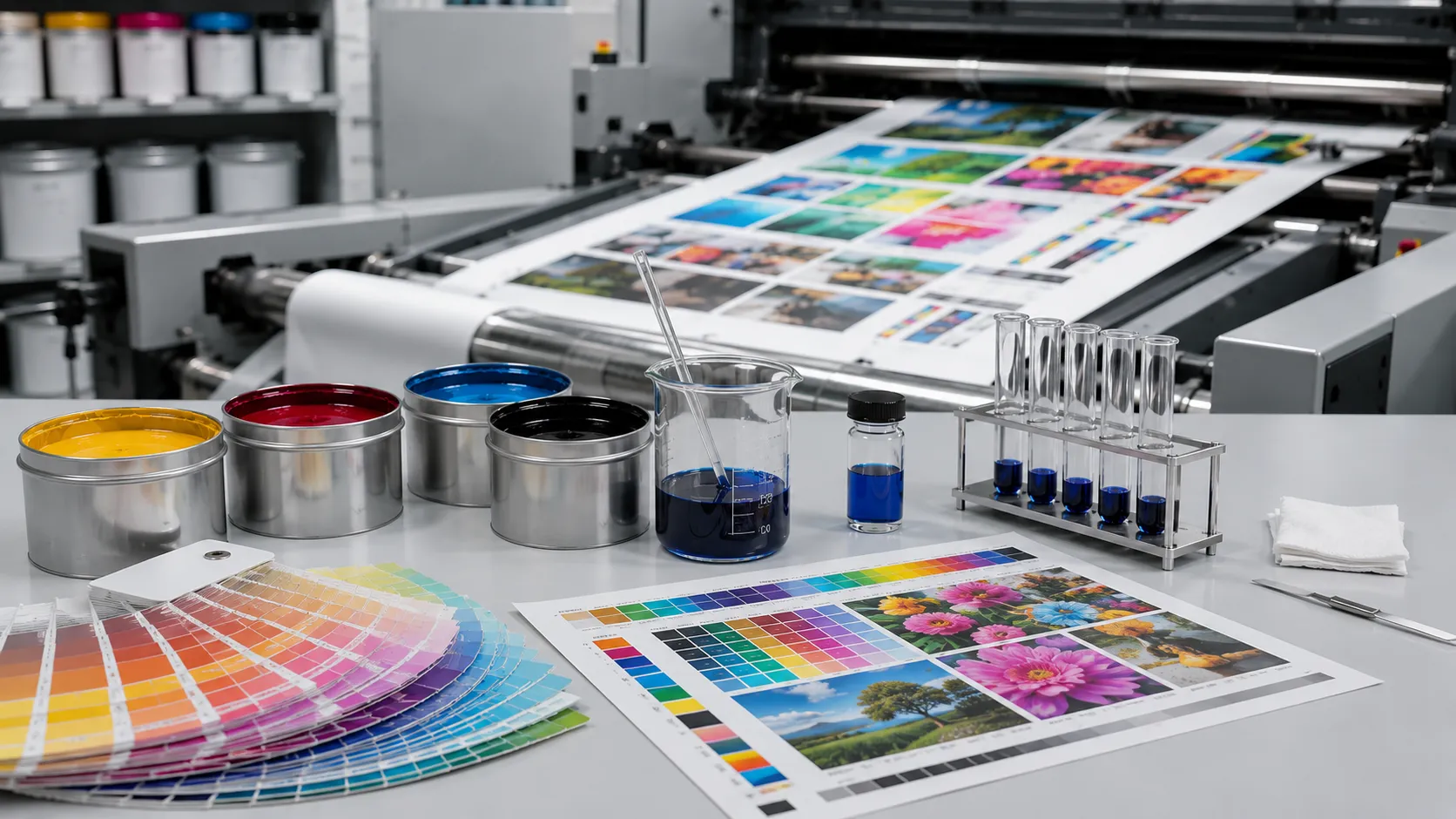
Printing Ink Quality Control Testing Overview
Printing ink quality control combines raw material inspection, dispersion and viscosity checks, color measurement, printability evaluation, and end-use performance testing. The core laboratory equipment typically includes spectrophotometers, viscometers, grindometers, drawdown or proofing equipment, and adhesion or abrasion testers, with advanced analytical instruments added when formulation development or troubleshooting requires them.
In the packaging, paper, and converting industry, these checks help manufacturers control visual appearance, press performance, durability, and batch-to-batch consistency before ink reaches the pressroom. A structured QC workflow also helps identify whether a deviation originates in raw materials, dispersion, finished-ink properties, application behavior, or the printed film.
Main Products and Applications
Printing inks vary widely based on the printing process, substrate, and end-use requirements. Common product categories and applications include:
- Flexographic and gravure inks – used on flexible packaging, corrugated boards, and labels, requiring fast drying and strong adhesion.
- Offset (lithographic) inks – applied in paper-based publications, folding cartons, and commercial printing, demanding high color strength and consistent tack.
- Digital printing inks – formulated for inkjet or electrophotographic presses, needing precise particle size control and reliable jetting properties.
- Screen printing inks – used for specialty graphics, textiles, and industrial products, often requiring thick film formation and outdoor durability.
- UV and EB curable inks – employed in high-speed packaging and label printing, where instant curing and chemical resistance are essential.
Printing Ink Quality Control Workflow
1. Raw Material Inspection
The quality of pigments, resins, solvents, and additives directly influences final ink performance. Incoming raw materials must be tested for purity, particle size, moisture content, and other critical parameters. Contaminants or batch variations can lead to color shifts, reduced gloss, or instability in the finished ink.
By verifying raw material conformity, the laboratory prevents downstream defects and ensures that the ink formulation starts with consistent building blocks. Early detection of raw material issues reduces production downtime and reformulation costs.
Recommended laboratory equipment for this stage:
- Spectrophotometer – measures color values of pigments and dyes to ensure they match the required shade and strength.
- Analytical Balance – precisely weighs small quantities of raw materials for formulation and density checks.
- Particle Size Analyzer – determines the distribution of pigment particle sizes, which affects dispersion and color development.
- Moisture Analyzer – checks moisture content in powders and pastes, as excess moisture can alter ink rheology.
- Fourier Transform Infrared Spectrometer (FTIR) – identifies chemical composition of resins and additives to confirm material identity.


2. Ink Mixing and Dispersion Process Control
During ink manufacture, pigment must be uniformly dispersed in the vehicle to achieve full color strength and stability. Incomplete dispersion leads to pigment agglomerates, which cause printing defects like streaks, low gloss, and poor transparency. In-process testing monitors the fineness of grind and viscosity to ensure proper milling.
Controlling dispersion quality directly impacts the final print appearance and the ink’s shelf life. Real-time measurements guide adjustments to milling time or additive dosage, preventing batch rejection.
Recommended laboratory equipment for this stage:
- Grindometer (Fineness of Grind Gauge) – evaluates the degree of pigment dispersion by detecting oversized particles in the liquid ink.
- Viscometer – measures the ink’s flow resistance, which must stay within target range for consistent application.
- pH Meter – monitors pH of water-based inks, as incorrect acidity can destabilize the dispersion or corrode press parts.
- Laboratory Mixer or High-Speed Disperser – prepares small samples under controlled conditions to simulate production and test dispersion quality.


3. Finished Ink Physical Property Testing
Once the ink is milled to specification, the laboratory verifies critical physical properties that affect press performance. Key parameters include viscosity, color (against a reference), density, and surface tension. Deviations can cause issues like misting, poor transfer, or incorrect thickness on the substrate.
Systematic physical testing ensures that every batch of ink will perform identically on the customer’s press, reducing the need for press-side adjustments and improving production efficiency.
Recommended laboratory equipment for this stage:
- Rotational Viscometer or Flow Cup – measures dynamic or kinematic viscosity to verify flow behavior under shear.
- Spectrophotometer – quantifies color coordinates (L*a*b*) and color difference (ΔE) against a standard for color matching.
- Densitometer – measures optical density of printed ink films, important for process control in four-color printing.
- Analytical Balance with Density Kit – determines specific gravity of liquid inks to check filling weights and viscosity relationships.
- Surface Tensiometer – measures surface tension of ink, which influences wetting and adhesion on substrates.

4. Printability and Application Testing
Printability tests simulate the actual printing process on a laboratory scale. They assess how ink transfers to the substrate, how it dries or cures, and its behavior under printing conditions. Poor printability leads to problems like set-off, poor trapping, or inadequate drying, which cause rejects in high-speed printing lines.
By using lab-scale drawdown, proofing, and drying tests, manufacturers can predict real-world performance and fine-tune formulations before commercial trials. This saves ink, substrate, and press time.
Recommended laboratory equipment for this stage:
- Laboratory Drawdown Coater or K-bar – produces uniform ink films on test substrates for color and adhesion evaluation.
- Drying/Curing Tester – measures drying time or cure speed under controlled temperature, airflow, or UV exposure.
- Tackmeter or Tack-O-Scope – gauges the ink’s tack, which affects ink splitting and transfer in offset printing.
- Proofing Press or Printability Tester – simulates actual printing to check print quality, ink-water balance, and pick resistance.
5. End-Use Performance Testing
Printed products must withstand mechanical, chemical, and environmental stresses according to their intended use. Tests for adhesion, scratch resistance, rub resistance, and lightfastness are performed on printed samples. Failures in these properties can result in ink flaking, fading, or product damage during transport and handling.
Performance testing ensures that the ink meets end-user expectations and industry requirements, protecting brand reputation and reducing claims. It is the final validation before the ink formulation is released for commercial production.
Recommended laboratory equipment for this stage:
- Abrasion/Rub Tester – assesses ink resistance to scuffing and rubbing, simulating packaging line and retail handling.
- Adhesion Tester (Cross-Hatch or Tape Test) – checks how well the ink bonds to the substrate, preventing peeling.
- Gloss Meter – measures the specular gloss of printed surfaces, important for aesthetic and barrier properties.
- Weathering/UV Accelerated Tester – exposes printed samples to accelerated light and moisture to predict long-term durability.
- Blocking Tester – evaluates the tendency of printed surfaces to stick together under pressure and temperature.

Common Quality Control Challenges in Printing Ink Manufacturing
- Consistent color reproduction across batches and substrates, especially with challenging pigments.
- Viscosity drift leading to variations in ink transfer and film thickness on press.
- Insufficient pigment dispersion causing graininess, low gloss, and reduced color strength.
- Adhesion failures on non-porous substrates like films and foils without proper treatment.
- Drying or curing irregularities that slow down production or cause blocking in stacked prints.
- Contamination from raw materials or cross-contamination during multi-product manufacturing.
Key Quality Control Tests for Printing Ink
| Quality Challenge | Quality Control Test | Recommended Laboratory Equipment | Application |
|---|---|---|---|
| Color deviation between batches | Colorimetric analysis (ΔE) | Spectrophotometer | Ensuring brand color consistency across runs |
| Pigment agglomeration | Fineness of grind | Grindometer | Controlling milling efficiency and ink smoothness |
| Ink flow problems during printing | Viscosity measurement | Rotational Viscometer or Flow Cup | Maintaining target transfer and film thickness |
| Slow drying on substrates | Drying time / Cure test | Drying/Curing Tester | Optimizing press speed and heat settings |
| Poor adhesion to plastic films | Adhesion test | Cross-Hatch Adhesion Tester | Preventing ink peeling in flexible packaging |
| Ink rub-off during handling | Abrasion resistance test | Rub/Abrasion Tester | Ensuring durability in shipping and retail |
| Gloss inconsistency | Gloss measurement | Gloss Meter | Meeting aesthetic specifications |
| Surface tension mismatch | Wettability test | Surface Tensiometer | Improving ink-substrate interaction |
Laboratory Equipment Required for Printing Ink Quality Control
An effective ink QC laboratory combines physical, optical, and mechanical testing instruments to cover the entire workflow from raw material receipt to final product performance. Physico-chemical instruments like viscometers, pH meters, and moisture analyzers verify the basic properties of liquid inks, while optical instruments such as spectrophotometers and gloss meters ensure visual consistency. Mechanical testers like adhesion and abrasion testers validate the durability of the printed film under real-world conditions.
The most essential instrument categories include spectrophotometers for color control, viscometers for rheology, grindometers for dispersion quality, and drawdown equipment for print simulation. Together, these instruments provide the data needed to adjust formulations, approve raw material lots, and release finished products with confidence.
| Testing Requirement | Laboratory Equipment | Why Manufacturers Need It |
|---|---|---|
| Color accuracy and batch matching | Spectrophotometer | Quantifies color and ensures tight tolerances for brand owners |
| Viscosity control | Rotational Viscometer | Critical for stable ink transfer and consistent laydown |
| Particle dispersion quality | Grindometer | Detects oversize particles that can ruin print quality |
| Print simulation and proofing | Drawdown Coater / K-bar | Replicates press application for visual and physical evaluation |
| Ink-substrate adhesion | Adhesion Tester | Prevents peeling and ensures packaging integrity |
| Durability in handling | Abrasion/Rub Tester | Guarantees print durability during transport and use |
| Gloss and appearance | Gloss Meter | Meets aesthetic requirements for premium packaging |
| Chemical resistance | Solvent Rub Tester | Verifies ink resistance to cleaning agents or product contact |
The combined use of these instruments supports a comprehensive quality control laboratory, enabling manufacturers to troubleshoot issues, validate process changes, and deliver inks that consistently meet customer specifications.
Equipment Priorities by Printing Ink Type
Different ink systems place different demands on the QC laboratory. The table below summarizes practical priorities based on the testing needs already described in this workflow.
| Ink Type | Priority QC Checks | Typical Equipment Focus |
|---|---|---|
| Flexographic and gravure inks | Viscosity, color, dispersion, drying, adhesion | Flow cup or viscometer, spectrophotometer, grindometer, drawdown equipment, drying and adhesion testers |
| Offset inks | Color, tack, rheology, transfer, drying | Spectrophotometer, rotational viscometer, tackmeter, proofing or printability tester |
| Digital printing inks | Color, particle size, viscosity, formulation consistency | Spectrophotometer, particle size analyzer, viscometer, analytical balance |
| Screen printing inks | Viscosity, film formation, adhesion, durability | Viscometer, drawdown equipment, adhesion tester, abrasion tester, weathering tester where required |
| UV and EB curable inks | Color, viscosity, cure behavior, adhesion, cured-film performance | Spectrophotometer, viscometer, curing tester, adhesion tester, abrasion or other relevant performance testers |
Basic Laboratory Setup for Printing Ink Manufacturers
| Laboratory Level | Recommended Equipment | Suitable For |
|---|---|---|
| Basic QC Laboratory | Viscometer, spectrophotometer, grindometer, drawdown coater, analytical balance, drying oven | Small ink manufacturers checking essential batch-to-batch consistency |
| Advanced QC Laboratory | All basic equipment plus abrasion tester, adhesion tester, gloss meter, densitometer, tackmeter, proofing press | Mid-size companies serving demanding packaging and label markets |
| Advanced Analysis Laboratory | All of the above plus particle size analyzer, FTIR, surface tensiometer, weathering tester, advanced rheometer | R&D centers and large manufacturers developing new formulations or troubleshooting complex issues |
How to Choose Laboratory Equipment for Printing Ink QC
Selecting the right laboratory instruments requires a clear understanding of the inks you produce, the substrates you print on, and the performance demands of your customers. A systematic approach prevents overspending on unnecessary equipment or under-investing in critical testing capabilities.
Define the Testing Scope
Start by identifying the types of inks (solvent-based, water-based, UV, etc.) and the key properties that must be controlled. For example, a UV ink manufacturer will prioritize cure speed testing, while a producer of high-gloss paper inks will focus on color and gloss measurement. Determine the expected measurement ranges, repeatability needs, and internal acceptance criteria before selecting an instrument. Tighter color-control requirements may justify a more capable spectrophotometer and a more controlled measurement workflow. Also consider the variety of substrates; testing ink adhesion on film requires suitable substrate preparation and an appropriate adhesion test method.
Evaluate Laboratory Workflow Requirements
Consider how often tests will be performed and the volume of samples. High-throughput labs benefit from automated viscometers or spectrophotometers that reduce operator time. Operator skill level is also important; simple flow cups may suffice for routine viscosity checks, but more precise rotational viscometers are needed for formulation work. Laboratory space and environment must be assessed—some instruments require stable temperature/humidity or fume extraction for solvent-based inks. AELAB can help manufacturers match their specific testing workflows and throughput expectations with suitable instrument categories, ensuring the laboratory operates efficiently without bottlenecks.
Compare Long-Term Equipment Support
Instrument calibration, maintenance, and availability of consumables are critical for sustained accuracy. Inquire about the calibration support services (parameters, methods, and recommended intervals vary depending on instrument design and usage) and whether the supplier can provide access to certified reference materials. Training for operators ensures correct usage and reduces measurement errors; consider suppliers that offer application support. Spare parts availability and responsive technical support minimize downtime. Evaluating these factors upfront protects the investment and ensures the laboratory can reliably produce valid test results over time.
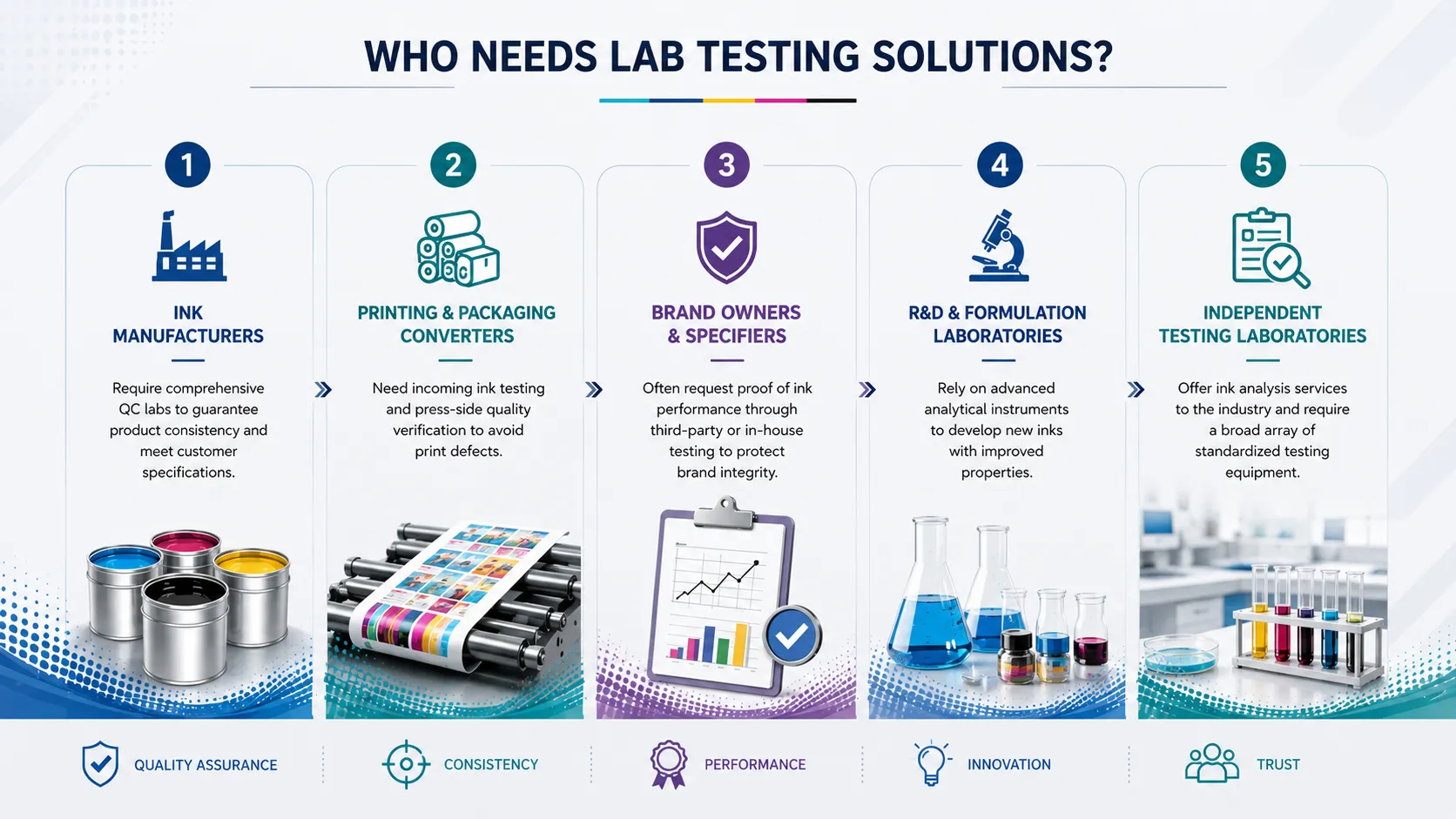
Who Needs Laboratory Testing Solutions for This Industry?
- Ink Manufacturers – require comprehensive QC labs to guarantee product consistency and meet customer specifications.
- Printing and Packaging Converters – need incoming ink testing and press-side quality verification to avoid print defects.
- Brand Owners and Specifiers – often request proof of ink performance through third-party or in-house testing to protect brand integrity.
- R&D and Formulation Laboratories – rely on advanced analytical instruments to develop new inks with improved properties.
- Independent Testing Laboratories – offer ink analysis services to the industry and require a broad array of standardized testing equipment.
Frequently Asked Questions
What is the most important laboratory instrument for ink quality control?
The spectrophotometer is often considered the most critical instrument because color consistency is the foremost quality attribute for most printing inks. It allows precise color matching and communication across the supply chain.
How often should laboratory instruments for ink testing be calibrated?
Calibration frequency depends on the instrument type, usage intensity, the manufacturer’s recommendations, and internal quality procedures. Typically, instruments like spectrophotometers and viscometers require scheduled verification using reference standards, which may range from daily checks to annual professional calibration.
Can one viscometer cover all types of printing inks?
No. Different printing processes require different viscosity ranges and shear conditions. For low-viscosity flexo and gravure inks, flow cups are common, while offset inks, which are paste-like, require rotational viscometers or tackmeters to measure rheology accurately.
What tests are essential for UV-curable ink quality control?
Beyond color and viscosity, UV-curable inks require testing for cure speed (using a UV curing tester), adhesion on non-porous substrates, hardness/flexibility of the cured film, and residual odor or migration potential, making specialized equipment necessary.
Conclusion
Printing ink quality control demands a structured laboratory approach that integrates raw material analysis, in-process checks, and final performance validation. By deploying the right combination of physical and optical testing instruments, manufacturers can consistently produce inks that meet the high standards of modern printing applications. Understanding the interplay between formulation, dispersion, and application properties is key to building an effective QC program.
Laboratory Equipment Solutions for Printing Ink Industry
A practical printing ink laboratory should be configured around the ink systems being produced, the required QC tests, sample throughput, and the level of formulation or troubleshooting work performed in-house. A basic laboratory may focus on viscosity, color, dispersion, and drawdown checks, while a more advanced facility can add printability, durability, particle-size, chemical-identification, and weathering capabilities as justified by the application.
For equipment selection, define the products or samples to be tested, the required test methods, expected daily testing volume, and the quality problems the laboratory must investigate. These inputs make it easier to distinguish essential routine-QC instruments from advanced equipment intended for development or deeper failure analysis.