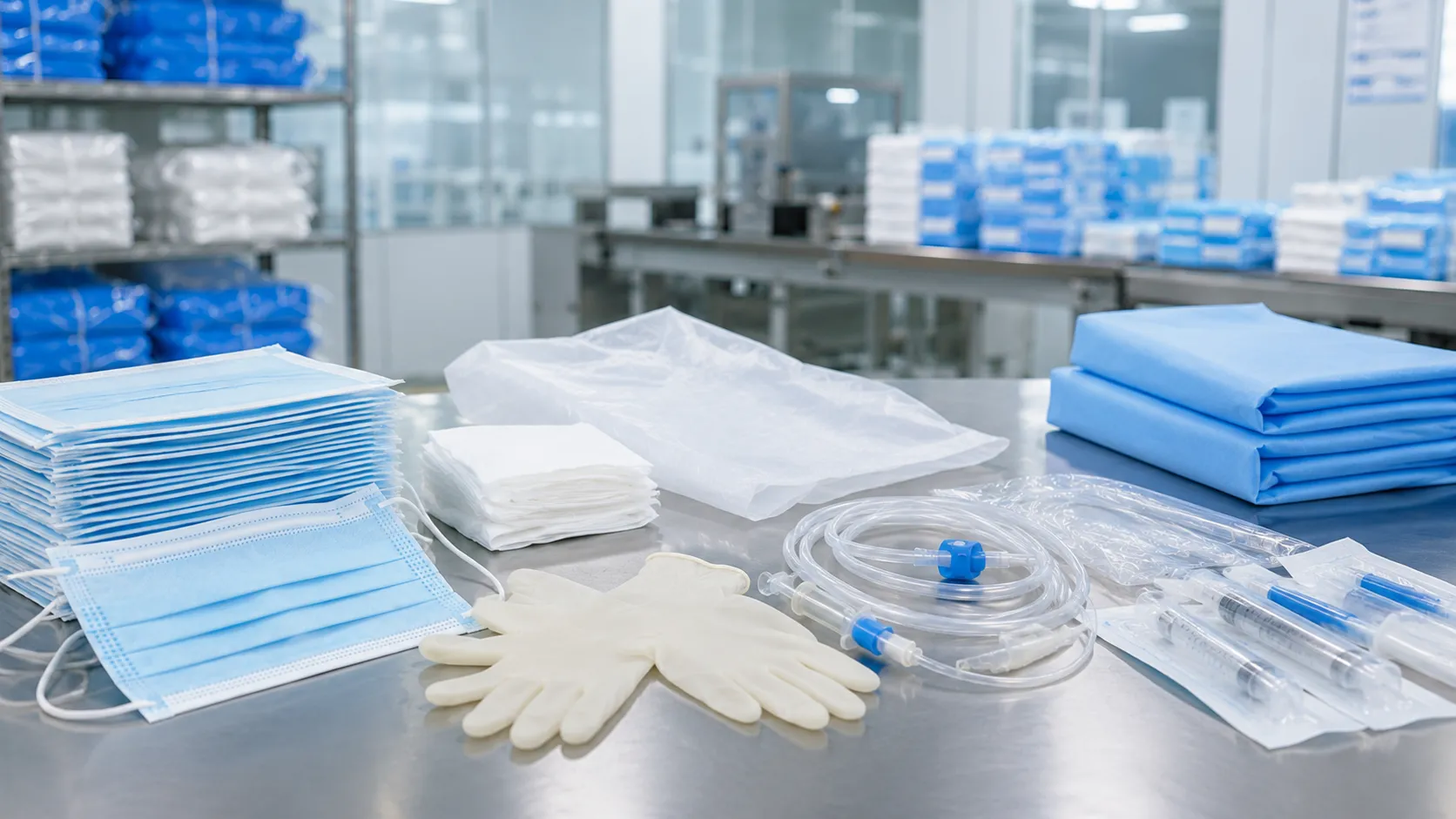
Quality Control Testing for Disposable Medical Products Manufacturing
In the clinical and diagnostics industry, disposable medical products such as syringes, gloves, masks, and catheters are essential for preventing cross-contamination and ensuring patient safety. Manufacturing these items requires rigorous quality control testing to verify that every batch meets strict safety and performance standards before reaching healthcare facilities.
Laboratory testing plays a central role in this process, enabling manufacturers to detect material defects, dimensional inconsistencies, and contamination risks early. By implementing a structured quality control workflow, production teams can reduce waste, protect end users, and maintain regulatory compliance while ensuring that disposable products perform reliably in critical medical applications.
In practice, disposable medical product QC combines material identification, dimensional and visual inspection, mechanical testing, package integrity checks, microbiological testing where applicable, and final release verification. The laboratory equipment required depends on the product type, its materials, whether a sterile barrier or sterilization process is involved, and the quality attributes defined in the manufacturer’s approved specifications.
Main Products and Applications
Disposable medical products cover a wide range of single-use devices designed for clinical, surgical, and diagnostic procedures. Common product categories include:
- Injection devices (syringes, needles, insulin pens)
- Protective wear (surgical gloves, face masks, gowns)
- Fluid handling products (IV sets, blood bags, catheters, tubing)
- Wound care (adhesive bandages, surgical drapes, sterile gauze)
- Diagnostic consumables (specimen containers, swabs, test strips)
Quality Control Workflow for Disposable Medical Products Manufacturing
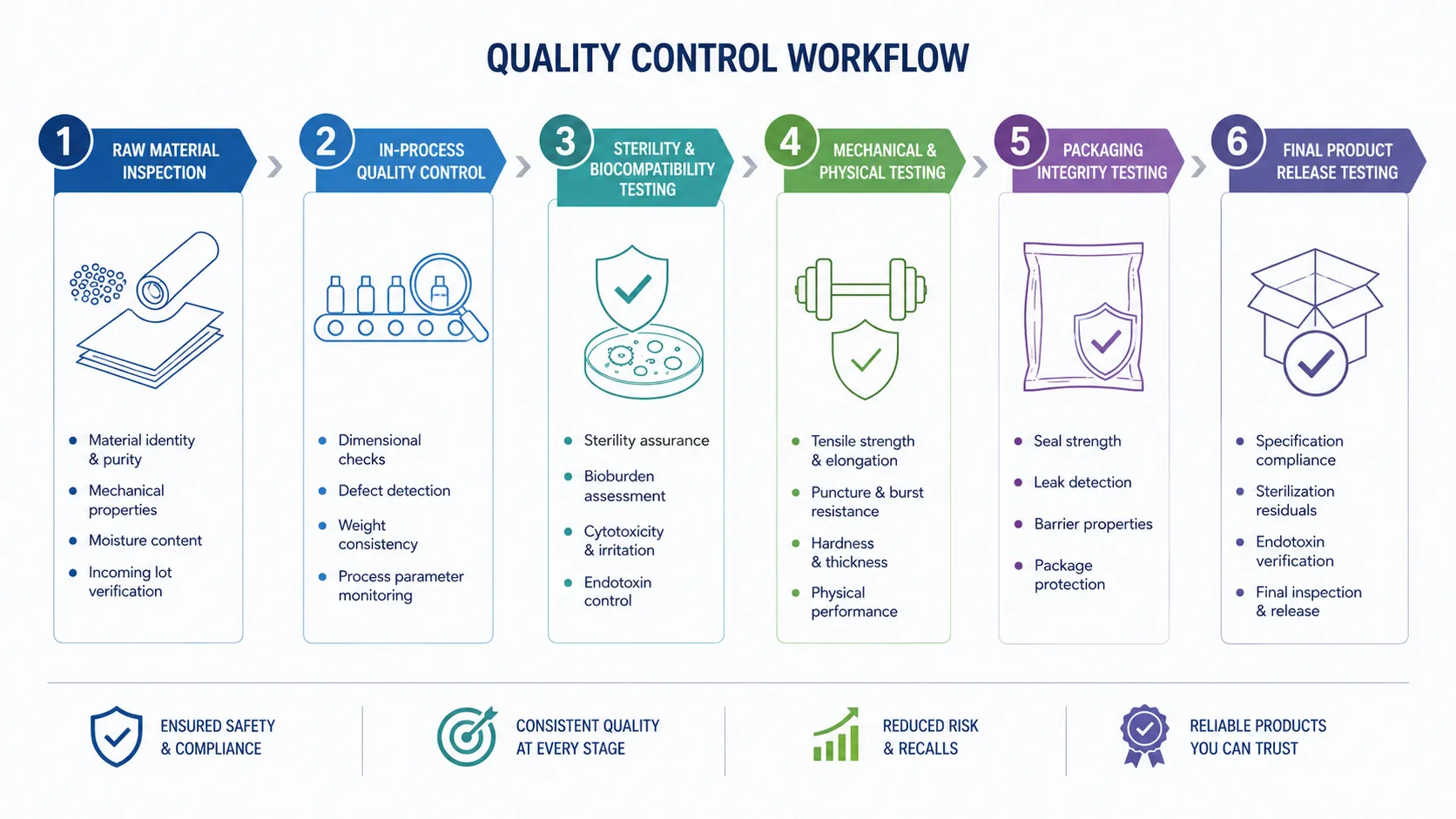
A typical quality control framework for disposable medical products spans from incoming raw materials through to finished product release. The following stages outline the critical testing points and recommended laboratory instruments.
1. Raw Material Inspection
At the start of production, polymers, elastomers, adhesives, and packaging films must be verified for identity, purity, and mechanical properties. Contaminated or off-specification raw materials can lead to product failures such as tearing, leaking, or chemical incompatibility. Tests include melt flow index for thermoplastics, infrared spectroscopy for material identification, and moisture analysis for hygroscopic materials.
By screening incoming materials, manufacturers can reject substandard lots before they enter production, avoiding costly batch recalls and ensuring consistent product quality.
Recommended laboratory equipment for this stage:
- Melt Flow Indexer – Measures the viscosity of thermoplastic raw materials to confirm they meet processing specifications.
- Fourier Transform Infrared Spectrometer (FTIR) – Identifies polymer types and detects contaminants through chemical fingerprinting.
- Moisture Analyzer – Determines water content in raw materials that could affect molding or extrusion quality.
- Analytical Balance – Provides precise weighing for sample preparation and density determination.
- Universal Testing Machine – Checks tensile strength and elongation of raw material films or sheets.


2. In-Process Quality Control
During manufacturing steps such as injection molding, extrusion, or assembly, real-time checks prevent non-conforming products from proceeding. Typical defects include short shots, flash, improper bonding, or dimensional drift. In-process testing often includes dimensional measurement, visual inspection, and online weight checks.
Immediate feedback allows machine operators to adjust parameters and maintain production within control limits, reducing scrap and improving efficiency.
Recommended laboratory equipment for this stage:
- Digital Caliper – Measures critical dimensions of molded components to verify drawing tolerances.
- Vision Inspection System – Automates defect detection for surface flaws, missing features, or contamination.
- Analytical Balance – Checks component weight to ensure material dosage consistency.
- Hardness Tester (Durometer) – Assesses the hardness of elastomeric parts like seals or grips.
- Leak Tester – Tests the integrity of sealed components such as connectors or valves.
3. Sterility and Biocompatibility Testing
Sterility, bioburden, endotoxin, and biocompatibility requirements depend on the device type, intended use, contact route, labeling, and validated manufacturing process. For products supplied sterile, microbiological controls and finished-product testing form part of the overall sterility-assurance strategy. Biocompatibility evaluation may also be required for materials and finished devices according to the manufacturer’s applicable regulatory and quality framework.
Where microbiological or biological testing is performed in-house, manufacturers need controlled workflows, suitable sample handling, validated methods, and equipment appropriate to the specific test. Products sterilized by processes such as ethylene oxide or irradiation may also require process-specific verification and release controls.
Recommended laboratory equipment for this stage:
- Autoclave (Steam Sterilizer) – Sterilizes media and waste for sterility testing workflows.
- Laminar Flow Hood (Biosafety Cabinet) – Supports controlled sample handling; the required enclosure type should be selected according to the microbiological procedure and operator/sample protection needs.
- Microbiological Incubator – Cultivates samples at controlled temperatures for sterility or bioburden testing.
- ELISA Reader – Supports absorbance-based biological assays when required by the validated laboratory method.
- TOC Analyzer – Measures total organic carbon where water quality, cleaning verification, or extraction-related monitoring is part of the laboratory method.


4. Mechanical and Physical Property Testing
Products must withstand mechanical stresses during use, such as tensile forces on gloves, burst pressure in IV sets, or puncture resistance in sharps containers. Testing mechanical properties ensures that the product will not fail under expected handling. Key parameters include tensile strength, elongation, tear resistance, and compression set.
Mechanical test data support material selection, design validation, and comparison against competitor products or specification limits.
Recommended laboratory equipment for this stage:
- Universal Testing Machine – Measures tensile strength, elongation, and break force on products and components.
- Puncture Resistance Tester – Evaluates the ability of a material to resist penetration, important for gloves and packaging.
- Burst Tester – Determines the internal pressure at which a product fails, e.g., for IV bags or tubing.
- Thickness Gauge – Ensures consistent material thickness in films and sheets.
- Durometer – Checks the hardness of elastomeric components like syringe plunger tips.
5. Packaging Integrity Testing
Proper packaging maintains sterility and protects the product during shipping and storage. A compromised package can lead to contamination or physical damage. Packaging tests verify seal strength, barrier properties, and leak tightness. Common failures include weak seals, pinholes, or delamination.
Packaging integrity data can support sterile-barrier verification, storage studies, transport evaluation, and shelf-life justification where these are applicable to the product and packaging system.
Recommended laboratory equipment for this stage:
- Seal Strength Tester – Quantifies the force required to open a sealed pouch or tray.
- Leak Detection System – Uses pressure decay or tracer gas methods to detect micro-leaks.
- Oxygen Permeability Tester – Measures the barrier properties of packaging films against gas transmission.
- Bubble Emission Tester – A simple visual method for detecting gross leaks by submerging the package in water.
- Thickness Gauge – Checks packaging material thickness for uniformity.

6. Final Product Release Testing
Before shipping, final product release testing verifies that the finished item meets all approved specifications. This stage typically consolidates results from earlier tests and may include additional checks such as visual inspection, dimensional final audit, residual sterilant analysis, and endotoxin testing. A non-conforming lot at this point triggers a root-cause investigation.
A robust release testing protocol helps manufacturers verify that each lot meets the approved release criteria before distribution and provides documented evidence for the quality system.
Recommended laboratory equipment for this stage:
- EtO Residual Analyzer (Gas Chromatograph) – Quantifies residual ethylene oxide after sterilization cycles.
- Endotoxin Test System (LAL Assay) – Detects bacterial endotoxins in products directly or indirectly contacting the bloodstream.
- Particle Counter – Assesses cleanliness of packaging and surfaces for particulate contamination.
- Digital Caliper / Vision System – Performs final dimensional verification on a sampling basis.
- Analytical Balance – Records final product weight for compliance check.

Common Quality Control Challenges in Disposable Medical Products Manufacturing
Manufacturers often encounter the following difficulties that can disrupt quality control operations:
- Inconsistent raw material properties leading to variable product performance.
- High-speed production lines that make real-time defect detection difficult.
- Maintaining sterility assurance while scaling up production volumes.
- Balancing comprehensive testing with cost and time constraints.
- Operator-dependent variability in manual inspection and testing.
- Keeping up with evolving regulatory expectations without over-testing.
Key Quality Control Tests for Disposable Medical Products Manufacturing
| Quality Challenge | Quality Control Test | Recommended Laboratory Equipment | Application |
|---|---|---|---|
| Raw material variation | Melt flow index testing | Melt Flow Indexer | Verify polymer flow characteristics for injection molding |
| Dimensional drift | Dimensional measurement | Digital Caliper / Vision System | Check critical sizes of molded components |
| Weak seams and seals | Seal strength test | Seal Strength Tester | Assess packaging integrity for sterile barrier systems |
| Material contamination | FTIR spectroscopy | FTIR Spectrometer | Identify unknown residues or foreign materials |
| Incomplete sterilization | Sterility test | Microbiological Incubator, Laminar Flow Hood | Confirm absence of viable microorganisms |
| Poor mechanical durability | Tensile strength and elongation | Universal Testing Machine | Evaluate product strength, e.g., glove break force |
| Excessive residual sterilant | EtO residual analysis | Gas Chromatograph | Quantify ethylene oxide levels after sterilization |
| Endotoxin presence | LAL endotoxin assay | LAL Test System / Incubator | Detect pyrogens in fluid-contact devices |
Laboratory Equipment Required for Clinical, Diagnostics & Medical Devices Quality Control
Setting up a QC laboratory for disposable medical products demands a balanced selection of instruments covering physical, chemical, microbiological, and environmental testing. Core equipment categories include mechanical testers (Universal Testing Machines, burst testers), analytical instruments (spectrometers, moisture analyzers), microbiological tools (incubators, biosafety cabinets), and dimensional measurement devices.
A well-equipped lab integrates these systems to provide complete traceability from raw material intake to final product release, supporting both routine production checks and investigational failure analysis.
| Testing Requirement | Laboratory Equipment | Why Manufacturers Need It |
|---|---|---|
| Material identification and purity | FTIR Spectrometer | Confirms raw material composition to prevent mix-ups |
| Polymer flow consistency | Melt Flow Indexer | Ensures stable molding and extrusion processes |
| Mechanical strength verification | Universal Testing Machine | Validates product durability under load |
| Package seal integrity | Leak Detection System | Helps verify package integrity and sterile-barrier performance |
| Sterilization effectiveness | Autoclave, Incubator, Laminar Flow Hood | Supports sterility testing and media preparation |
| Residual chemical analysis | Gas Chromatograph | Measures harmful residues after sterilization |
| Cleanliness and particulate control | Particle Counter | Monitors environmental and product cleanliness |
| Dimensional accuracy | Vision Inspection System | Automates high-speed dimensional checks |
Together, these instruments form a comprehensive QC system that allows manufacturers to detect defects early, reduce recalls, and meet stringent regulatory expectations for disposable medical products.
Basic Laboratory Setup for Clinical, Diagnostics & Medical Devices Manufacturers
| Laboratory Level | Recommended Equipment | Suitable For |
|---|---|---|
| Basic QC Laboratory | Digital Caliper, Durometer, Analytical Balance, Moisture Analyzer, Burst Tester, Seal Strength Tester | Routine dimensional and mechanical checks, small-scale production |
| Advanced QC Laboratory | Universal Testing Machine, FTIR Spectrometer, Melt Flow Indexer, Leak Detection System, Microbiological Incubator, Laminar Flow Hood | Full material characterization, sterility testing, medium-to-high volume manufacturing |
| Advanced Analysis Laboratory | Gas Chromatograph, TOC Analyzer, ELISA Reader, Particle Counter, Vision Inspection System | Residual analysis, endotoxin testing, automated inspection, high-precision R&D support |
How to Choose Laboratory Equipment for Quality Control Testing for Disposable Medical Products Manufacturing
Selecting the right instruments requires a careful analysis of your specific products, testing goals, and operational constraints. Below are three essential considerations.
Define the Testing Scope
Start by listing the sample types (e.g., films, molded parts, finished devices) and the critical quality attributes you must control. Then define the measurement range, resolution, accuracy, detection capability, fixtures, and sample dimensions required by your approved test methods and product specifications. This mapping helps prevent both under-specifying an instrument and paying for capabilities that the routine QC workflow does not need.
Evaluate Laboratory Workflow Requirements
Consider daily or weekly sample volumes, the number of operators, and their skill level. High-throughput production lines may demand automated vision systems or rapid-cycle testers to keep pace. If space is limited, prioritize compact or multifunctional instruments. Also think about environmental conditions—some equipment requires stable temperature and humidity control, which influences laboratory design.
Match Equipment to the Product and Test Method
A single instrument category may require different fixtures, accessories, chambers, sensors, or software depending on the disposable product being tested. For example, tensile testing of gloves, tubing, films, and package seals can involve different sample preparation and gripping requirements. Before purchasing, confirm that the proposed configuration supports the actual sample geometry, method workflow, throughput, and data-recording needs.
Compare Long-Term Equipment Support
Beyond purchase price, factor in calibration programs, availability of certified reference materials, preventive maintenance, and technical support. Reliable after-sales service minimizes downtime and ensures continued accuracy. AELAB works with manufacturers to align testing requirements with suitable instrument categories, helping you build a sustainable QC operation without overinvesting in unnecessary features.
Equipment Selection Priorities by QC Need
| QC Need | Typical Equipment Family | Selection Priority |
|---|---|---|
| Incoming polymer verification | FTIR Spectrometer, Melt Flow Indexer, Moisture Analyzer | Match the instrument to the material type, approved method, sample preparation, and required repeatability. |
| Dimensional and visual inspection | Digital Caliper, Vision Inspection System | Consider tolerance requirements, feature size, inspection speed, and the need for automated records. |
| Mechanical performance | Universal Testing Machine, Burst Tester, Puncture Resistance Tester, Durometer | Confirm force or pressure range, fixtures, sample geometry, test speed control, and throughput needs. |
| Sterile-package integrity | Seal Strength Tester, Leak Detection System, Bubble Emission Tester | Select the method according to package format, defect type of concern, sensitivity requirement, and validated procedure. |
| Microbiological or biological testing | Incubator, controlled sample-handling enclosure, assay-specific instrumentation | Base the setup on the validated method, contamination-control needs, sample volume, and operator protection requirements. |
| Sterilization residual or cleanliness analysis | Gas Chromatograph, TOC Analyzer, Particle Counter | Use advanced analytical equipment only where the product, process, release specification, or investigation requires it. |
Who Needs Laboratory Testing Solutions for This Industry?
- Disposable medical device manufacturers establishing in-house QC laboratories.
- Contract manufacturing organizations (CMOs) serving medical device brands.
- R&D and product development teams validating new disposable products.
- Regulatory affairs professionals preparing technical documentation.
- Third-party testing labs offering specialized services to device makers.
Frequently Asked Questions
What is the most important quality control test for disposable medical gloves?
For disposable gloves, key QC checks include tensile strength and elongation for mechanical durability and leak or pinhole testing for barrier integrity. For glove products supplied as sterile, the quality system must also address the applicable sterility-assurance and release requirements.
How often should we calibrate laboratory equipment used in medical product testing?
Calibration frequency should be defined by the manufacturer’s quality system based on instrument type, usage, risk, historical performance, method requirements, and the equipment manufacturer’s recommendations. Routine verification checks may also be scheduled between formal calibrations where appropriate.
Can one laboratory setup handle testing for multiple disposable product types?
Yes, a well-planned lab can accommodate various products by selecting versatile instruments. For example, a universal testing machine with different fixtures can test gloves, tubing, and packaging. Careful method development and validation ensure reliable results across product lines.
What role does microscopic analysis play in disposable medical product QC?
Microscopy is used for failure analysis, examining surface defects, foreign inclusions, or cross-sections of multi-layer materials. It supports root-cause investigation and can be coupled with FTIR for chemical identification of contaminants.
Conclusion
A structured QC program for disposable medical products should connect each product risk and critical quality attribute to a defined test method, acceptance criteria, responsible production stage, and suitable laboratory instrument. The most useful laboratory setup is therefore not the one with the most equipment, but the one that reliably supports the manufacturer’s actual materials, products, packaging systems, sterilization processes, throughput, and approved quality procedures.
Laboratory Equipment Solutions for Clinical, Diagnostics & Medical Devices
AELAB assists manufacturers in building tailored QC laboratories by connecting sample characteristics, required tests, and desired accuracy with the right instrument categories. Whether you need to inspect raw polymers, verify sterile packaging, or perform mechanical strength checks, the correct equipment configuration depends on your production volume and workflow.
If you are planning to upgrade your testing capabilities, share details about the products you manufacture, the test methods you follow, your expected testing volume, and the challenges you currently face. With this information, AELAB can help map out a practical laboratory equipment setup that fits your quality control goals.