Refinery Quality Control Laboratory Equipment Overview
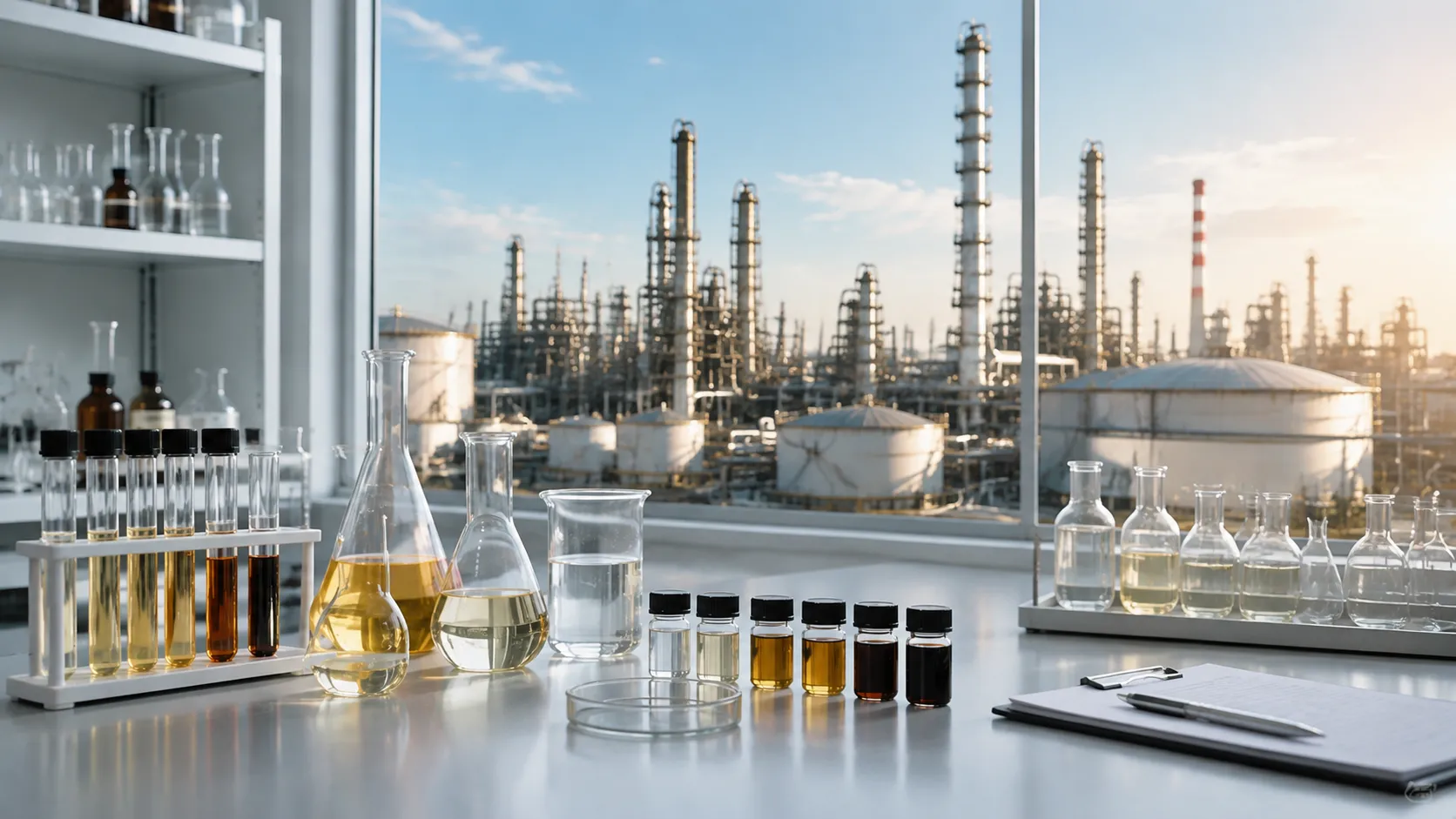
The oil refinery industry transforms crude oil into fuels and petrochemical feedstocks, making laboratory quality control essential for product consistency, process control, safe handling, and specification compliance. Refinery QC laboratories support testing from incoming crude characterization through intermediate-stream monitoring, final blending, product certification, storage, and distribution.
In practical terms, a refinery quality control laboratory typically needs equipment for physical-property testing, composition and contaminant analysis, fuel-performance testing, and contamination or stability checks. Core instrument families can include distillation apparatus, density meters, sulfur analyzers, flash point testers, gas chromatographs, cold-flow testers, vapor pressure apparatus, corrosion testers, and fuel-performance analyzers. The exact laboratory configuration depends on the refinery’s product slate, required test methods, sample throughput, and whether the laboratory performs routine release testing or advanced process analysis.
Main Products and Applications
- Motor gasoline – spark-ignition engine fuel, with critical parameters such as octane number, vapor pressure, distillation characteristics, and sulfur content.
- Diesel fuel – compression-ignition fuel requiring control of ignition quality, sulfur, cold-flow behavior, lubricity, and contamination.
- Jet fuel (kerosene) – aviation turbine fuel requiring careful control of properties including flash point, freezing behavior, composition, and stability.
- Naphtha – refinery stream and petrochemical feedstock used in processes that produce olefins and aromatics.
- Liquefied petroleum gas (LPG) – refinery product used for fuel and other applications, with composition and purity requiring verification.
Refinery Quality Control Workflow
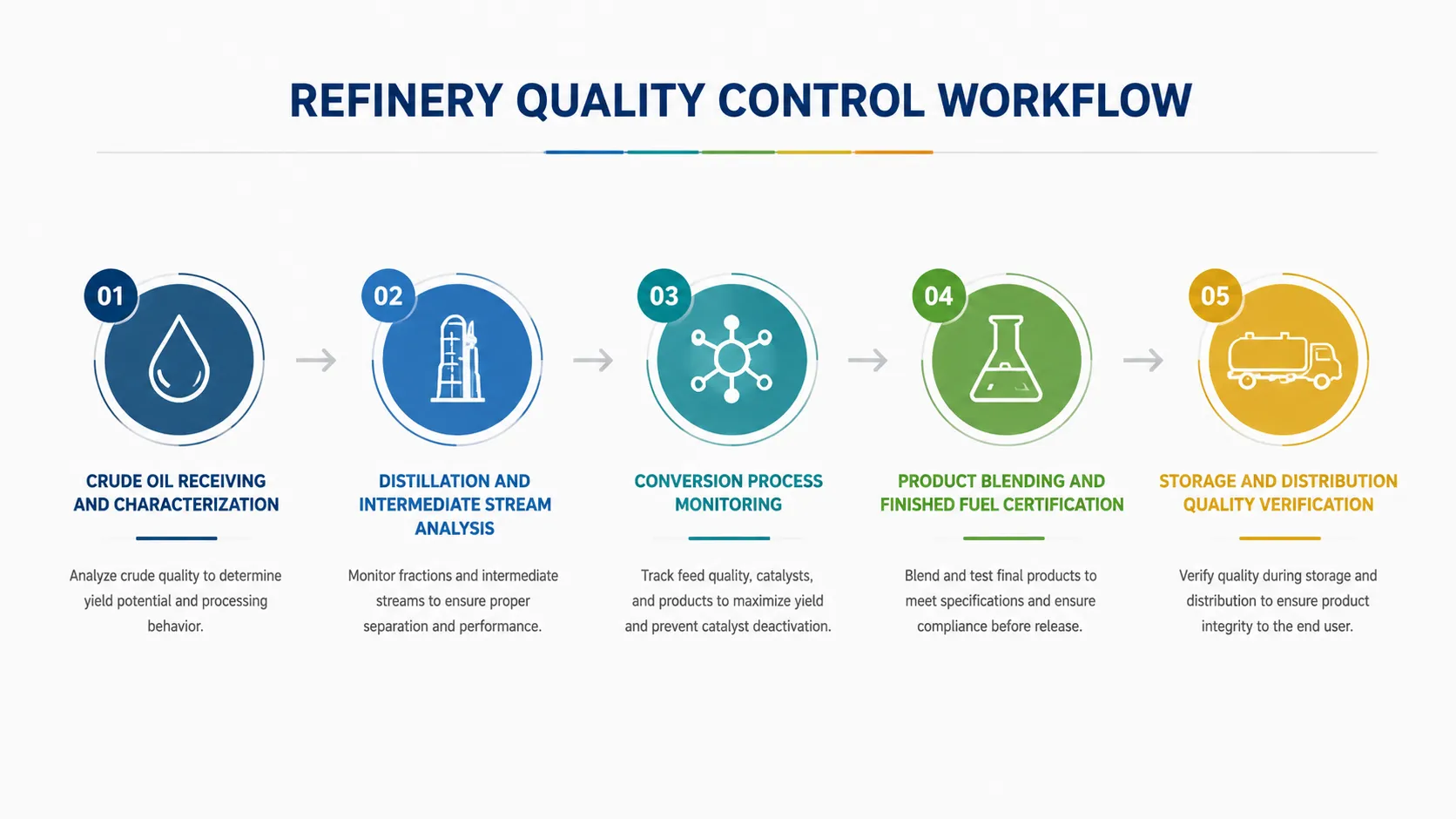
Refinery laboratory requirements change as material moves from crude oil to intermediate streams and finished products. The most useful way to plan equipment is to connect each production stage with the quality decision the laboratory must support.
| Refinery Stage | Main QC Requirement | Typical Equipment Families |
|---|---|---|
| Crude oil receiving | Characterize incoming feed and identify contaminants that can affect processing | Density meter, sulfur analyzer, water content analyzer, salt content analyzer, distillation equipment |
| Distillation and intermediate streams | Verify boiling behavior, stream identity, safety properties, and composition | Distillation apparatus, flash point tester, density meter, refractometer, gas chromatograph |
| Conversion processes | Monitor feed quality, contaminants, product distribution, and fuel properties | ICP-OES or XRF, GC, sulfur/nitrogen analyzer, viscosity meter, octane/cetane equipment |
| Product blending and certification | Confirm finished fuels meet required quality specifications before release | Octane/cetane equipment, vapor pressure apparatus, corrosion tester, oxidation stability tester, lubricity tester |
| Storage and distribution | Detect contamination or quality changes after product certification | Density meter, water analysis equipment, flash point tester, microbial test kits, portable analytical equipment |
Crude Oil Receiving and Characterization
Upon arrival, crude oil must be characterized to understand its quality and processing behavior. Important parameters can include density, sulfur content, water and sediment, salt content, and distillation behavior. Poor characterization can contribute to corrosion, fouling, blending problems, or unexpected processing behavior downstream.
Laboratory analysis at this stage supports crude acceptance, blending decisions, and process planning. The required tests should be selected according to the crude types handled and the refinery’s operating and contractual requirements.
Recommended laboratory equipment for this stage:
- Density meter – determines density, specific gravity, or related gravity values used in crude characterization and quantity calculations.
- Sulfur analyzer (XRF or UV fluorescence) – measures total sulfur for feed characterization and downstream process control.
- Water content analyzer (Karl Fischer or distillation) – quantifies water in crude and petroleum samples using the applicable laboratory method.
- Salt content analyzer – evaluates salt contamination relevant to crude processing and corrosion control.
- Distillation apparatus – characterizes boiling behavior or boiling-range distribution for feed evaluation and process planning.


Distillation and Intermediate Stream Analysis
Crude oil is separated into fractions such as naphtha, kerosene, diesel, and gas oil according to boiling behavior. Intermediate streams must be monitored to verify separation performance and determine whether they are suitable for downstream processing or blending.
Testing boiling range, flash point, physical properties, and composition helps laboratory and operations teams identify abnormal streams, contamination, or separation problems before they affect later units or finished products.
Recommended laboratory equipment for this stage:
- Atmospheric distillation apparatus – determines boiling-range characteristics of suitable petroleum fractions.
- Flash point tester (Pensky-Martens or Abel) – determines flash point using the test configuration appropriate to the sample and required method.
- Cloud and pour point tester – evaluates low-temperature behavior where cold-flow properties are relevant.
- Refractometer or density meter – provides physical-property data useful for stream identification and routine process monitoring.
- Gas chromatograph (GC) – analyzes hydrocarbon composition when more detailed stream characterization is required.


Conversion Process Monitoring
Conversion units such as fluid catalytic crackers (FCC) and hydrocrackers process heavier refinery streams into lighter products. Laboratory testing can support feed characterization, contaminant monitoring, product distribution analysis, and evaluation of properties that affect downstream blending.
The appropriate analytical scope depends on the conversion unit and the decisions the laboratory must support. Advanced elemental and chromatographic instruments are most valuable when their results are directly connected to process-control, catalyst-management, troubleshooting, or product-quality decisions.
Recommended laboratory equipment for this stage:
- Metal analyzer (ICP-OES or XRF) – measures metals such as nickel, vanadium, and iron where elemental contamination must be monitored.
- Simulated distillation GC – characterizes boiling-range distribution of suitable refinery feedstocks and products.
- Total sulfur/nitrogen analyzer – monitors sulfur and nitrogen where these parameters affect processing or product requirements.
- Viscosity meter – measures viscosity for feedstock or intermediate-stream characterization.
- Octane and cetane analyzers (or knock engines) – support evaluation of gasoline or diesel ignition-performance characteristics where applicable.


Product Blending and Finished Fuel Certification
Final blending combines refinery streams and blend components to achieve the required finished-product properties. The laboratory must verify the parameters relevant to each fuel grade before product release. For gasoline these can include octane, volatility, distillation behavior, sulfur, and corrosion characteristics; diesel testing may include ignition quality, sulfur, cold-flow properties, lubricity, and stability.
The laboratory configuration should therefore follow the actual finished-product specifications rather than a generic equipment list. A refinery producing several fuel grades may need broader testing capability than a terminal performing a limited set of routine release tests.
Recommended laboratory equipment for this stage:
- Octane rating engine (or portable octane analyzer) – evaluates gasoline antiknock characteristics according to the laboratory’s required test approach.
- Cetane rating engine (or cetane analyzer) – evaluates diesel ignition quality where cetane testing is required.
- Reid vapor pressure (RVP) apparatus – evaluates gasoline volatility using the applicable vapor-pressure method.
- Copper strip corrosion tester – evaluates the corrosive tendency of petroleum products toward copper under specified test conditions.
- Oxidation stability tester – evaluates resistance to oxidation under the applicable fuel test method.
- Lubricity tester (HFRR) – evaluates diesel-fuel lubricity where HFRR testing is required.
Storage and Distribution Quality Verification
After certification, fuels may be stored in tanks and transported through pipelines, ships, rail systems, or trucks. During these stages, water ingress, cross-contamination, particulate contamination, or product degradation can create quality problems even when the fuel originally passed refinery release testing.
Retesting at storage or transfer points should focus on the properties most useful for confirming product identity and detecting likely contamination. This can reduce unnecessary duplicate testing while still protecting product integrity.
Recommended laboratory equipment for this stage:
- Portable density and API gravity meter – supports rapid product identity and density checks.
- Water-in-oil analyzer – evaluates water contamination using the appropriate measurement principle for the application.
- Flash point meter – provides flash-point verification where safety or product identity checks require it.
- Microbial contamination test kits – support investigation of microbial contamination where storage conditions or product type create a relevant risk.
- Portable gas chromatograph – provides composition information when field-level chromatographic verification is justified.
Common Quality Control Challenges in Refinery Operations
- Sulfur compliance – controlling sulfur in finished fuels according to the specifications and requirements applicable to the target product and market.
- Blend variability – maintaining consistent finished-product properties when crude slates and blend components vary.
- Corrosion control – monitoring feed and product characteristics associated with corrosion risk in refinery and distribution systems.
- Cold flow performance – verifying low-temperature behavior of diesel and other applicable middle-distillate products.
- Octane/cetane control – meeting required fuel-performance targets without unnecessary quality giveaway.
- Contamination detection – identifying water, sediment, cross-contamination, or other changes during storage and transport.
Key Quality Control Tests for Refinery Operations
The exact method required depends on the sample type, product specification, contractual requirement, and laboratory quality system. The following table summarizes important refinery QC relationships already covered in this guide.
| Quality Challenge | Quality Control Test | Recommended Laboratory Equipment | Application |
|---|---|---|---|
| High sulfur levels in fuels | Sulfur determination (ASTM D4294, D5453) | Energy-dispersive X-ray fluorescence (EDXRF) or UV fluorescence sulfur analyzer | Verification of sulfur content in applicable petroleum products |
| Incorrect octane number | Octane rating (ASTM D2699, D2700) | Cooperative fuel research (CFR) engine or portable octane analyzer | Evaluation of gasoline antiknock performance |
| Poor cold-flow performance | Cloud point and pour point (ASTM D5771, D5949) | Automated cloud and pour point tester | Evaluation of low-temperature behavior for applicable petroleum products |
| Corrosive fuel characteristics | Copper strip corrosion test (ASTM D130) | Copper strip corrosion test bath | Evaluates corrosive tendency toward copper under specified test conditions |
| Fuel instability during storage | Oxidation stability (ASTM D2274, D5304) | Oxidation stability test apparatus | Evaluates oxidation behavior of applicable fuels |
| Water and sediment contamination | Free water and sediment (centrifuge method) | Centrifuge, glass tubes, and graduated measures | Supports contamination assessment during handling and storage |
| Improper vapor pressure | Reid vapor pressure (ASTM D323) | RVP bomb and constant temperature bath | Evaluates volatility of applicable petroleum products |
| Low diesel lubricity | High-frequency reciprocating rig (HFRR) test (ASTM D6079) | HFRR lubricity tester | Evaluates lubricity of applicable diesel fuels |
Laboratory Equipment Required for Refinery Quality Control
A refinery QC laboratory does not necessarily need every analytical instrument listed in this guide. The required equipment should be determined by the refinery’s products, process units, mandatory test methods, sample volume, turnaround requirements, and the division of work between on-site and external laboratories.
For routine physical-property testing, common equipment includes distillation apparatus, density meters, viscometers, flash point testers, vapor-pressure apparatus, and cold-flow testers. Chemical and compositional analysis may require sulfur analyzers, gas chromatographs, water analyzers, or elemental-analysis systems. Performance-oriented fuel testing can add octane, cetane, oxidation-stability, corrosion, and lubricity equipment.
| Testing Requirement | Laboratory Equipment | Why Refineries Need It |
|---|---|---|
| Boiling range characterization | Atmospheric and simulated distillation analyzers | Supports stream characterization, cut-point monitoring, and product evaluation |
| Sulfur content measurement | EDXRF or UV fluorescence sulfur analyzer | Measures sulfur in refinery feeds, streams, or finished products where required |
| Octane/cetane rating | CFR octane and cetane engines or analyzers | Evaluates gasoline or diesel ignition-performance characteristics |
| Flash point testing | Pensky-Martens or Abel flash point tester | Supports product characterization and safe handling decisions |
| Cold-flow properties | Cloud point, pour point, and CFPP testers | Evaluates low-temperature behavior of applicable fuels |
| Vapor pressure control | Reid vapor pressure apparatus | Evaluates volatility where vapor-pressure testing is required |
| Corrosivity assessment | Copper strip corrosion tester | Evaluates corrosive tendency toward copper under specified conditions |
| Contamination and stability | Water content analyzer, oxidation stability tester | Supports investigation of water contamination and oxidation behavior |
Together, these instruments allow refinery laboratories to build a testing program around the decisions they actually need to make: accepting feedstocks, monitoring process streams, adjusting blends, releasing finished products, investigating off-specification results, and verifying product integrity during storage and distribution.
Basic Laboratory Setup for Refinery Manufacturers
Laboratory scope should increase with testing responsibility. A small terminal performing routine verification may need a focused physical-property laboratory, while a full refinery supporting process units and finished-product certification requires broader analytical capability.
| Laboratory Level | Recommended Equipment | Suitable For |
|---|---|---|
| Basic QC Laboratory | Distillation apparatus, flash point tester, density meter, sulfur analyzer, centrifuge, cloud and pour point tester, copper strip corrosion tester, RVP apparatus | Small refineries or terminals performing a defined range of routine product tests |
| Advanced QC Laboratory | All basic equipment plus: octane and cetane engines, simulated distillation GC, lubricity tester, oxidation stability reactor, metal analyzer (ICP or XRF) | Full-service refinery laboratories supporting broader product certification and process-monitoring requirements |
| Advanced Analysis Laboratory | All above plus: high-resolution GC-MS for detailed hydrocarbon analysis, NMR spectrometer, specialized wear metal detection, automated sample preparation systems, LIMS integration | Research-oriented facilities, central laboratories, troubleshooting laboratories, or facilities requiring advanced compositional analysis |
The levels above are planning frameworks rather than fixed purchasing lists. A laboratory should only add advanced instrumentation when the required methods, analytical questions, sample volume, or operational value justify the additional capability.
How to Choose Laboratory Equipment for Refinery Quality Control
Selecting refinery laboratory equipment requires more than matching an instrument name to a test. Buyers should first define the required method and sample type, then evaluate throughput, automation, operator requirements, utilities, maintenance, and long-term support.
Define the Testing Scope
Begin by identifying the products manufactured or handled and the specifications that must be verified. Map each sample type—from crude oil and intermediate streams to finished fuels—to its required test parameters and methods.
Then separate mandatory routine tests from process-support or troubleshooting tests. This prevents a laboratory from purchasing advanced analytical equipment that is rarely used while overlooking high-frequency instruments needed for daily release testing.
Instrument capability should be matched to the actual method and expected sample range. For sulfur analysis, for example, the appropriate analyzer depends on the petroleum product, sulfur range, required method, and laboratory performance requirements rather than simply choosing the most sensitive available instrument.
Evaluate Laboratory Workflow Requirements
Assess daily sample volume, required turnaround time, operator expertise, and the consequences of delayed results. High-throughput laboratories may benefit from automation where it improves repeatability and reduces manual handling.
Also evaluate practical installation requirements. Instruments may differ in their needs for ventilation, gases, temperature control, electrical supply, sample preparation, calibration materials, and laboratory space. These requirements should be considered before purchase rather than after equipment arrives.
For lower sample volumes, a robust manual or semi-automated system may be sufficient. Where many repetitive tests must be completed every shift, automation can become more valuable.
Compare Long-Term Equipment Support
Purchase price is only one part of laboratory cost. Buyers should also evaluate calibration and verification requirements, consumables, reference materials, spare parts, service availability, operator training, preventive maintenance, and expected instrument utilization.
A practical equipment comparison should therefore ask:
- Does the instrument support the required test method and sample type?
- Can it handle the laboratory’s expected sample throughput?
- Is its level of automation appropriate for operator skills and workload?
- What utilities, consumables, calibration materials, and maintenance are required?
- Is local or regional technical support available?
- Will the instrument be used frequently enough to justify bringing the test in-house?
AELAB helps manufacturers match testing requirements with appropriate laboratory equipment categories and can support equipment selection based on product type, required tests, sample throughput, and laboratory workflow.
Who Needs Laboratory Testing Solutions for This Industry?
- Petroleum refineries operating crude distillation, conversion, treatment, and blending units.
- Petrochemical plants using refinery streams such as naphtha as feedstocks.
- Independent fuel terminals and storage depots requiring product verification before or during distribution.
- Third-party inspection and testing laboratories serving petroleum producers, traders, terminals, and other industry clients.
- Research and development centers investigating refinery processes, fuels, feedstocks, or analytical methods.
Frequently Asked Questions
What is the most essential equipment for a refinery QC lab?
The essential equipment depends on the products and tests the laboratory is responsible for. For many routine refinery QC laboratories, core equipment can include a distillation apparatus, sulfur analyzer, density meter, flash point tester, and copper strip corrosion tester. Laboratories responsible for gasoline, diesel, or broader process support may require additional vapor-pressure, cold-flow, octane/cetane, chromatographic, stability, or lubricity equipment.
How often should refinery laboratory instruments be calibrated?
Calibration and verification frequency depends on the instrument, test method, usage, manufacturer instructions, laboratory quality procedures, and observed performance. Instead of applying one schedule to every instrument, laboratories should establish method-appropriate calibration, verification, quality-control, and maintenance procedures for each system.
Can one instrument test multiple fuel properties?
Some analytical platforms can provide more than one measurement or calculated parameter, but many standardized refinery quality tests still require dedicated apparatus or method-specific configurations. Equipment should therefore be selected according to the required test method rather than assuming that one multifunction instrument can replace every dedicated test system.
What is the typical budget for a basic refinery QC laboratory setup?
There is no reliable single budget for a refinery QC laboratory because the required investment depends on the number of test methods, automation level, analytical technology, sample throughput, installation requirements, and whether advanced tests are performed in-house or outsourced. A useful budget should be built from the required test list and laboratory workflow first, then from instrument quotations and lifecycle costs.
Conclusion
A refinery quality control laboratory should be designed around the decisions it must support rather than around the largest possible equipment list. Incoming crude characterization, intermediate-stream monitoring, blending control, finished-fuel certification, and distribution verification each create different testing requirements.
For a basic laboratory, the priority is reliable coverage of frequent routine tests. Advanced refinery laboratories can add chromatographic, elemental, fuel-performance, and automated analytical systems when process-support needs, required methods, and sample throughput justify them.
The most effective procurement process is therefore to map sample type → required test → applicable method → instrument category → throughput and support requirements before comparing equipment.
Laboratory Equipment Solutions for Refinery Quality Control
AELAB supports refinery laboratories by helping match sample types, required tests, analytical methods, throughput requirements, and laboratory workflows with appropriate instrument categories. This approach can be used for both new QC laboratory planning and upgrades to existing testing capabilities.
For equipment selection, prepare a list of the refinery products and streams to be tested, required test parameters or methods, expected daily sample volume, existing laboratory equipment, and tests currently outsourced. These details provide a practical basis for identifying essential equipment, advanced options, and a suitable laboratory configuration.