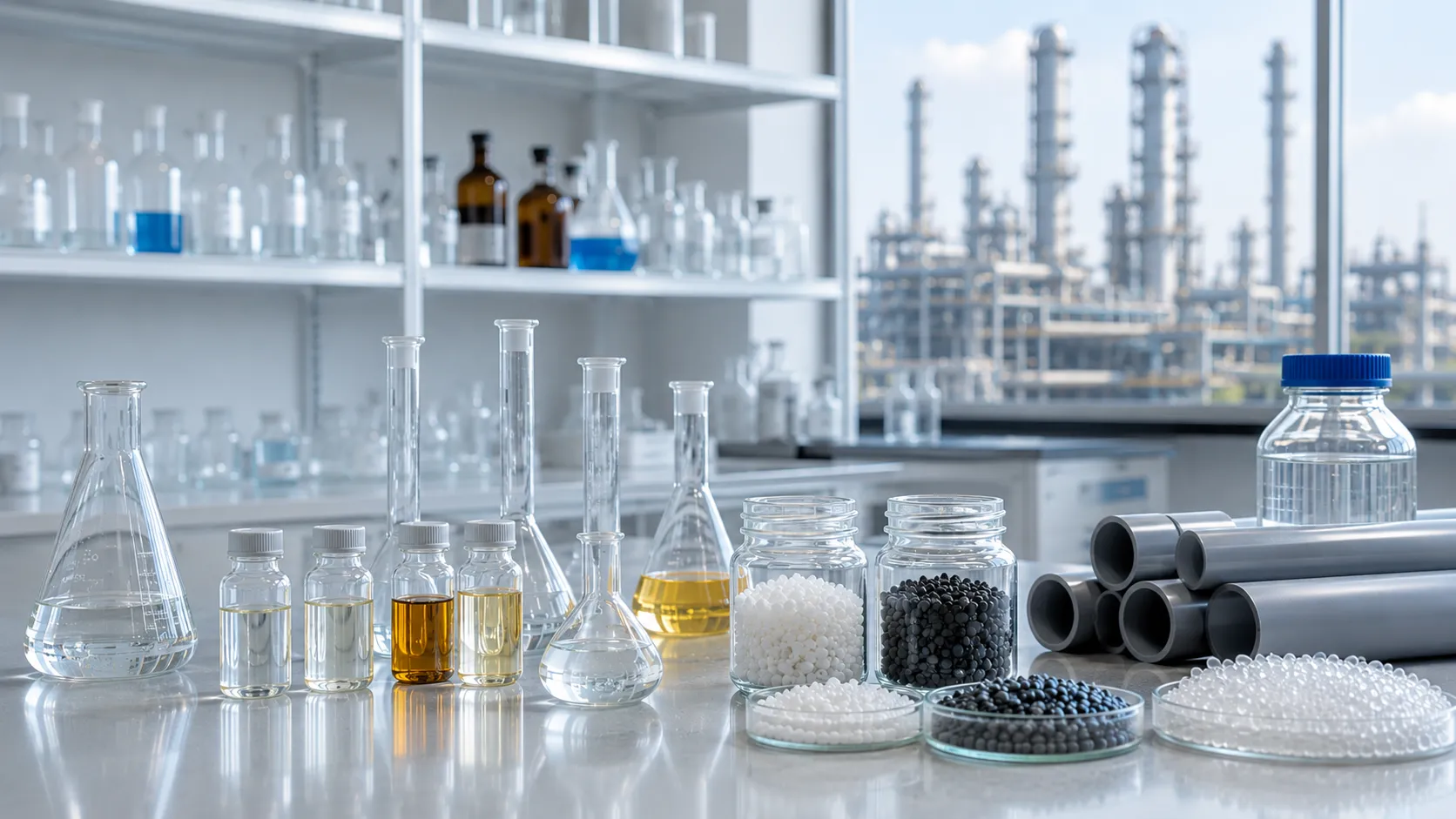
Petrochemical Product Quality Control Laboratory Setup Overview
The petrochemical industry transforms hydrocarbon feedstocks into base chemicals, intermediates, polymers, solvents and other industrial materials. A petrochemical product quality control laboratory supports this production chain by verifying feedstock suitability, monitoring process streams, checking intermediate purity, certifying finished products and investigating quality deviations.
For most petrochemical laboratories, the core testing requirements include hydrocarbon composition, distillation behavior, sulfur, trace metals, moisture, density and other product-specific physical or chemical properties. Common equipment families include gas chromatographs, sulfur analyzers, spectrometers, moisture analyzers, distillation analyzers, density meters, titrators, viscometers and, where polymers are produced, melt flow and thermal analysis instruments.
The exact laboratory configuration should follow the plant’s product slate, sample types, required test methods, expected sample volume and customer specifications. Routine QC instruments can handle frequent release and process-control tests, while advanced analytical systems are more appropriate for trace analysis, contaminant identification and complex troubleshooting.
Main Products and Applications
Petrochemical plants produce a broad spectrum of intermediates and finished products. Common product groups include:
- Olefins – Ethylene, propylene and butadiene serve as building blocks for polymers and synthetic rubbers.
- Aromatics – Benzene, toluene and xylenes are used in solvents, adhesives and polyester fibers.
- Polymers – Polyethylene, polypropylene and PVC are converted into packaging, automotive parts and construction materials.
- Solvents and intermediates – Methanol, glycols and acetates are produced for industrial and consumer applications.
- Specialty chemicals – Lubricant additives, surfactants and plasticizers may require additional composition and purity control depending on the product specification.
Because these product groups differ substantially in physical state, composition and end-use requirements, a single instrument list is rarely appropriate for every petrochemical plant. Laboratory planning should begin with the materials being tested and the parameters that control acceptance, processing or final release.
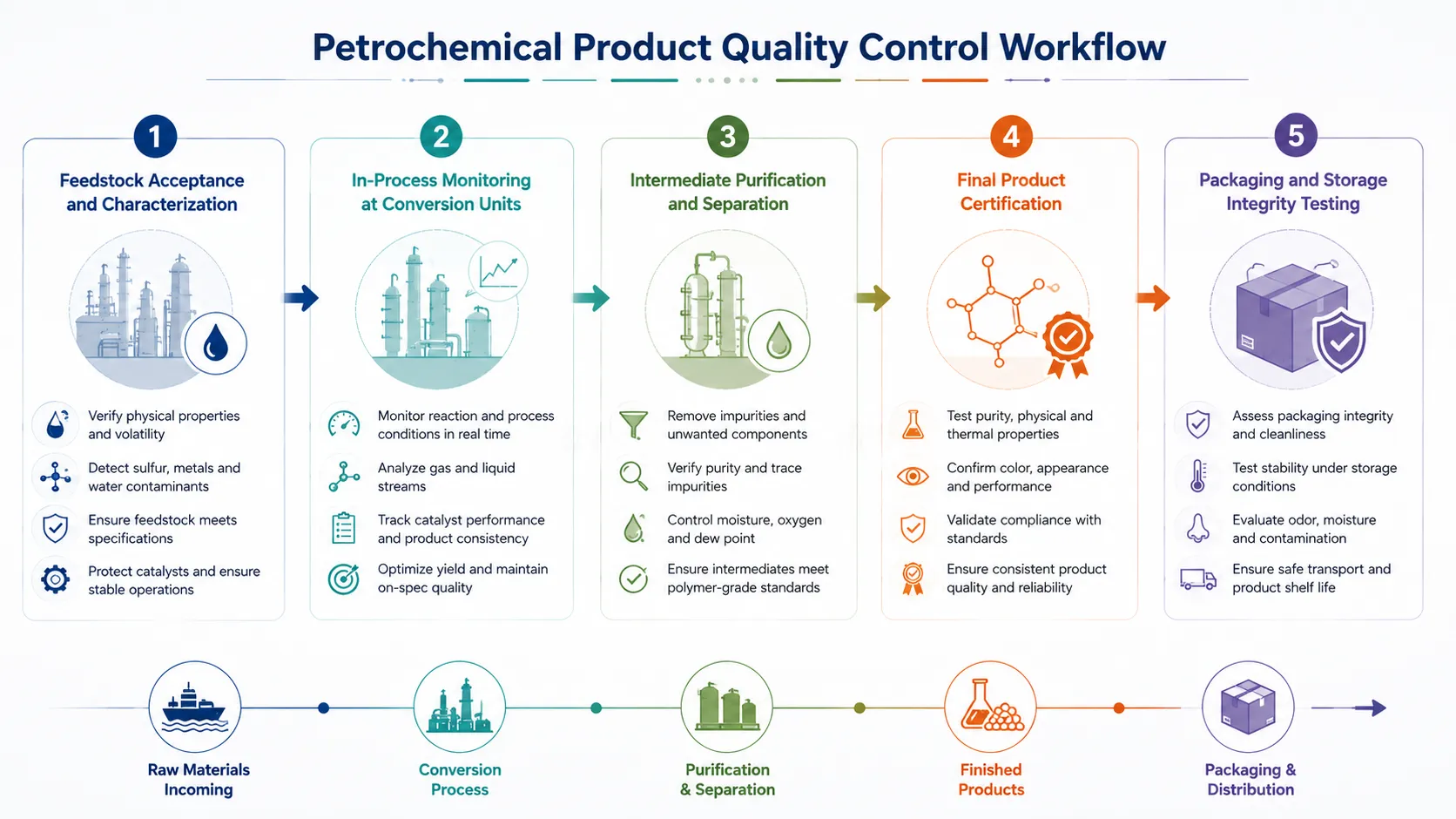
Petrochemical Product Quality Control Workflow
A practical QC workflow places analytical checkpoints where laboratory results can support an operational decision: accepting a feedstock, adjusting a process, confirming intermediate purity, releasing a finished product or investigating storage and packaging problems.
Feedstock Acceptance and Characterization
Incoming hydrocarbon feeds such as naphtha, natural gas liquids or crude oil cuts must meet agreed specifications to support stable plant operation. Depending on the feed and process, water, sulfur-containing compounds or trace metals may affect corrosion, catalyst performance or downstream processing. Typical laboratory checks include density, distillation range, sulfur content, moisture and trace metal analysis.
Recommended laboratory equipment for this stage:
- Automatic Distillation Analyzer – Determines boiling-range distribution for volatility and feedstock characterization.
- Energy Dispersive X-ray Fluorescence (EDXRF) Analyzer – Provides instrumental sulfur determination for suitable petroleum and petrochemical samples.
- ICP-OES Spectrometer – Supports multi-element analysis when trace metal monitoring is required.
- Karl Fischer Moisture Analyzer – Determines water content in suitable liquid samples.
- Density Meter – Measures density for feedstock characterization and process or commercial quality checks.


In-Process Monitoring at Conversion Units
During cracking, reforming, polymerization and related conversion operations, composition data can help operators identify process changes and maintain consistent production. Depending on the unit, laboratories may need to analyze light hydrocarbons, permanent gases, sulfur-containing components, catalyst samples or the physical properties of process streams.
Online or at-line instruments can shorten response time for high-frequency process measurements, while laboratory instruments provide reference analysis, confirmation and troubleshooting capability.
Recommended laboratory equipment for this stage:
- Process Gas Chromatograph – Analyzes hydrocarbon stream composition for process monitoring and optimization.
- Refinery Gas Analyzer (RGA) – Separates and quantifies components in refinery and petrochemical gas mixtures according to the configured analytical method.
- Thermogravimetric Analyzer (TGA) – Measures sample mass change with temperature and can support characterization of catalyst deposits or other thermally responsive materials.
- Online Viscometer – Provides continuous viscosity monitoring where viscosity is a meaningful process-control parameter.
- Chemiluminescence Sulfur Analyzer – Supports low-level sulfur monitoring when the required method and sample type are compatible with this analytical technique.


Intermediate Purification and Separation
Petrochemical intermediates such as ethylene, propylene and aromatic streams may require tight purity control before downstream polymerization, synthesis, storage or sale. The relevant impurities depend on the product and process, but laboratories may need to monitor hydrocarbon contaminants, moisture, oxygen or other trace components.
At this stage, instrument selection is strongly influenced by the required detection capability and the composition of the sample matrix. Routine purity verification and unknown-contaminant identification may therefore require different analytical systems.
Recommended laboratory equipment for this stage:
- Gas Chromatograph with Flame Ionization Detector (GC-FID) – Quantifies hydrocarbon components and impurities using an appropriate separation method.
- Gas Chromatograph with Mass Spectrometry (GC-MS) – Supports identification of unknown or unexpected organic components and more complex troubleshooting.
- Trace Oxygen Analyzer – Measures low oxygen concentrations where oxygen control is part of the product or process requirement.
- Hydrocarbon Dew Point Analyzer – Evaluates hydrocarbon condensation behavior in applicable gas streams.
- Moisture Analyzer (Chilled Mirror) – Measures moisture or dew-point characteristics in compatible gas applications.

Final Product Certification
Finished petrochemical products must be tested against the specification that applies to the individual product, grade and customer agreement. A polymer pellet and an aromatic solvent, for example, require different release tests. Final QC may therefore combine composition analysis with physical-property, thermal, color, moisture, viscosity or titration-based testing.
Recommended laboratory equipment for this stage:
- Melt Flow Indexer – Determines melt flow behavior of applicable thermoplastic materials and supports polymer grade and processing QC.
- Differential Scanning Calorimeter (DSC) – Characterizes thermal transitions and other thermal behavior relevant to polymer quality assessment.
- Spectrophotometer – Supports instrumental color measurement for products where color is part of the release specification.
- Automatic Titrator – Automates applicable titration-based quality tests such as acid number, bromine index or hydroxyl value when required by the product method.
- Kinematic Viscometer Bath – Supports controlled-temperature viscosity testing of suitable liquid products.

Packaging and Storage Integrity Testing
Quality control does not necessarily end when a product leaves the production unit. Polymers and liquid chemicals may also need checks for contamination, moisture pickup, appearance changes, packaging performance or stability during storage and transport.
The appropriate tests depend on the product, packaging system and storage conditions. Laboratory planning should therefore distinguish product-quality testing from packaging-performance testing rather than assuming the same equipment is required for every material.
Recommended laboratory equipment for this stage:
- Stability Chamber – Provides controlled environmental conditions for planned stability or storage studies.
- Odor Panel Test Equipment (Standardized Sniffing Ports) – Supports controlled sensory evaluation where odor is an established product-quality parameter.
- Microscope with Polarized Light – Supports investigation of particles, gels or other visible contamination in suitable samples.
- Karl Fischer Titrator – Measures moisture where water content is a critical storage or packaging quality parameter.
- Automated Drop Tester – Evaluates package impact performance where transport-package testing is required.


Common Quality Control Challenges in the Petrochemical Industry
- Maintaining consistent feedstock quality when raw-material sources or compositions change.
- Detecting contaminants that may affect catalysts, equipment or downstream product quality.
- Obtaining reliable trace impurity measurements in complex hydrocarbon matrices.
- Maintaining polymer melt-flow, thermal and other grade-specific properties within product specifications.
- Preventing cross-contamination when production units switch between products or grades.
- Ensuring routine laboratory results remain comparable with the reference methods used for specification or contractual decisions.
- Balancing rapid process feedback with the accuracy and analytical depth required for final product certification.
Key Quality Control Tests for Petrochemical Products
The following table maps common petrochemical quality problems to the corresponding test and instrument family. The exact method should be selected according to the product specification, sample matrix and required analytical performance.
| Quality Challenge | Quality Control Test | Recommended Laboratory Equipment | Application |
|---|---|---|---|
| Variable feedstock sulfur content | Total sulfur analysis | EDXRF or UV Fluorescence Analyzer | Feedstock acceptance |
| Inconsistent olefin purity | Gas chromatography with FID | GC-FID | Intermediate purification |
| Off-spec polymer melt flow | Melt flow rate test | Melt Flow Indexer | Final product release |
| Color deviation in solvents | APHA/Pt-Co color measurement | Spectrophotometer | Final product certification |
| Excess moisture in dry products | Karl Fischer titration | Karl Fischer Moisture Analyzer | Packaging integrity |
| Catalyst poisoning metals | Trace metal analysis | ICP-OES Spectrometer | Feedstock evaluation |
| Low conversion yields | Refinery gas analysis | Refinery Gas Analyzer (RGA) | In-process monitoring |
| Polymer degradation during storage | Oxidative stability (DSC) | Differential Scanning Calorimeter | Stability assessment |
Laboratory Equipment Required for Petrochemical Industry Quality Control
A well-equipped petrochemical quality control laboratory combines routine physical-property instruments with chemical and instrumental analysis according to the materials being produced. Gas chromatographs are important where hydrocarbon composition and purity must be determined, while elemental analyzers and spectrometers support sulfur and metal analysis. Polymer plants may additionally require melt-flow and thermal characterization equipment.
Supporting instruments such as titrators, viscometers, density meters and moisture analyzers cover frequent routine measurements. The objective is not to install every available analytical technique, but to match each instrument to a defined test, sample type and quality decision.
| Testing Requirement | Laboratory Equipment | Why Manufacturers Need It |
|---|---|---|
| Hydrocarbon composition analysis | Gas Chromatograph (GC-FID/GC-MS) | Supports feedstock, intermediate and final-product composition or purity analysis, depending on the configured method. |
| Sulfur content determination | EDXRF or UV Fluorescence Sulfur Analyzer | Supports sulfur monitoring where sulfur affects feedstock acceptance, process requirements or finished-product specifications. |
| Trace metal detection | ICP-OES Spectrometer | Supports monitoring of metallic contaminants and other elements relevant to feedstock, process or troubleshooting requirements. |
| Physical property testing of polymers | Melt Flow Indexer, DSC | Supports polymer grade, processing and thermal-property quality control. |
| Color and appearance | Spectrophotometer | Provides objective color measurement where appearance is part of the product specification. |
| Moisture measurement | Karl Fischer Titrator or Moisture Analyzer | Measures water content where moisture can affect processing, storage or product acceptance. |
| Distillation range | Automatic Distillation Analyzer | Characterizes boiling behavior for applicable hydrocarbon feedstocks and liquid products. |
| Viscosity control | Kinematic Viscometer Bath | Measures viscosity at controlled conditions for products where flow behavior is a specified QC parameter. |
These instrument families can form the basis of a practical petrochemical QC laboratory, but the final configuration should be built from the plant’s actual test list rather than from a generic equipment checklist.
Basic vs Advanced Petrochemical Quality Control Laboratory Setup
The difference between a basic and advanced petrochemical laboratory is primarily the analytical problem each laboratory must solve. Routine physical-property measurements can often be handled with comparatively simple dedicated instruments, while composition analysis, trace contaminants and unknown-component identification require more advanced analytical systems.
| Laboratory Level | Recommended Equipment | Suitable For |
|---|---|---|
| Basic QC Laboratory | Analytical Balance, Moisture Analyzer, Density Meter, Colorimeter, Simple Viscometer | Small-scale blending operations, initial feedstock checks |
| Advanced QC Laboratory | GC-FID, Melt Flow Indexer, Automatic Titrator, Sulfur Analyzer, Stability Chamber | Integrated petrochemical plants producing polymers and intermediates |
| Advanced Analysis Laboratory | GC-MS, ICP-OES, DSC, Refinery Gas Analyzer, Trace Oxygen Analyzer | R&D, catalyst evaluation, complex troubleshooting, contract testing |
A basic laboratory is appropriate when the required QC decisions are based mainly on routine physical properties and straightforward acceptance tests. Advanced instrumentation becomes justified when the laboratory must separate individual components, identify unknown contaminants, measure trace constituents, characterize thermal behavior or support complex process investigations.
How to Choose Laboratory Equipment for Petrochemical Product Quality Control
Selecting laboratory instruments should start with the required quality decisions rather than with an equipment catalogue. A useful selection sequence is: sample type → required test → applicable method → required analytical performance → sample throughput → instrument configuration and support requirements.
Define the Testing Scope
Start by listing the actual products and samples handled by the laboratory and the parameters that determine acceptance or release. Liquid monomers may require composition, purity and moisture testing, while polymer resins may require melt-flow, thermal and appearance measurements. Gas streams can require composition, sulfur, moisture or oxygen analysis depending on the process.
For each parameter, identify the test method and the analytical performance it requires. Instrument range, sensitivity, repeatability and sample compatibility should be evaluated against the real quality-control requirement rather than selected in isolation.
Separate Routine QC from Advanced Analysis
Not every test requires the most advanced analytical platform. Dedicated routine instruments can be more practical for frequent measurements such as density, viscosity, moisture or melt flow. Advanced systems such as GC-MS or ICP-OES are more appropriate when the laboratory needs greater analytical selectivity, multi-component analysis, trace-element measurement or troubleshooting capability.
Separating routine release testing from advanced investigative analysis helps avoid both under-equipping the laboratory and purchasing complex instruments that do not solve a defined testing requirement.
Evaluate Laboratory Workflow Requirements
Consider daily sample load, turnaround-time requirements, the need for continuous operation and the skill level of laboratory technicians. Automated analyzers can reduce repetitive manual work and improve throughput for suitable routine methods.
Laboratory layout, utilities, sample preparation, environmental conditions and safety requirements also influence equipment selection. Where laboratory information management systems are used, data-transfer and integration requirements should be considered during instrument evaluation.
Compare Long-Term Equipment Support
Instrument selection should account for more than the initial purchase. Calibration and verification requirements, application training, preventive maintenance, consumables, spare parts and technical support all affect long-term laboratory availability.
AELAB can help manufacturers compare suitable instrument categories against their sample types, required tests and workflow requirements so that the laboratory configuration remains practical to operate and maintain.
Who Needs Laboratory Testing Solutions for This Industry?
- Petrochemical production plants establishing or upgrading in-house quality control laboratories.
- Contract laboratories serving oil, gas and chemical clients with routine or advanced analytical testing.
- R&D centers developing or evaluating catalysts, processes, polymers or petrochemical formulations.
- Traders and distributors that require independent product-quality verification before commercial acceptance or transfer.
- Engineering firms specifying laboratory capabilities for new or expanded petrochemical facilities.
Frequently Asked Questions
What are the essential laboratory tests for petrochemical feedstocks?
Essential feedstock tests depend on the material and process, but common requirements include distillation characteristics, density, sulfur, moisture and trace metal analysis. These measurements help determine whether an incoming feed is suitable for the intended processing unit and whether contaminants require closer control.
How can I set up a basic polymer testing laboratory?
Start with the release and process-control tests required for the polymer grades you manufacture. A basic polymer laboratory may include a melt flow indexer, density measurement equipment, a moisture analyzer and a color spectrophotometer. Thermal analysis such as DSC can be added when thermal transitions or related polymer characteristics are part of the QC requirement.
What instruments are needed for trace sulfur analysis in gasoline blending components?
UV fluorescence and EDXRF are two instrumental approaches used for sulfur determination in petroleum-related samples. The appropriate analyzer should be selected according to the applicable test method, sample matrix, required measurement range and laboratory workflow.
How often should petrochemical laboratory instruments be calibrated?
There is no single calibration interval for every petrochemical laboratory instrument. The schedule should follow the instrument type, applicable test method, manufacturer guidance, laboratory quality procedures and actual use. Critical analytical systems should also be checked with suitable reference or control materials at intervals defined by the laboratory’s quality plan.
Conclusion
An effective petrochemical product quality control laboratory is built by mapping each material and production stage to the quality decision that must be made, the test that supports that decision and the instrument needed to perform it.
For routine QC, the priority is reliable and efficient testing of frequently measured properties. Advanced analytical systems become more important when the laboratory must resolve complex hydrocarbon compositions, investigate unknown contaminants, measure trace constituents or support process troubleshooting. Defining these requirements before purchasing equipment produces a laboratory configuration that is better aligned with actual production needs.
Laboratory Equipment Solutions for the Petrochemical Industry
AELAB supports manufacturers in developing fit-for-purpose laboratory configurations by evaluating sample types, required test methods and throughput expectations. This analysis can help identify appropriate instrument categories for routine QC, process support or advanced analytical work.
When planning a new laboratory or reviewing an existing setup, prepare a list of the products and samples to be tested, required test methods, expected sample volume and current testing challenges. These inputs provide a practical basis for comparing equipment requirements and determining which capabilities are essential and which should be added as advanced laboratory functions.