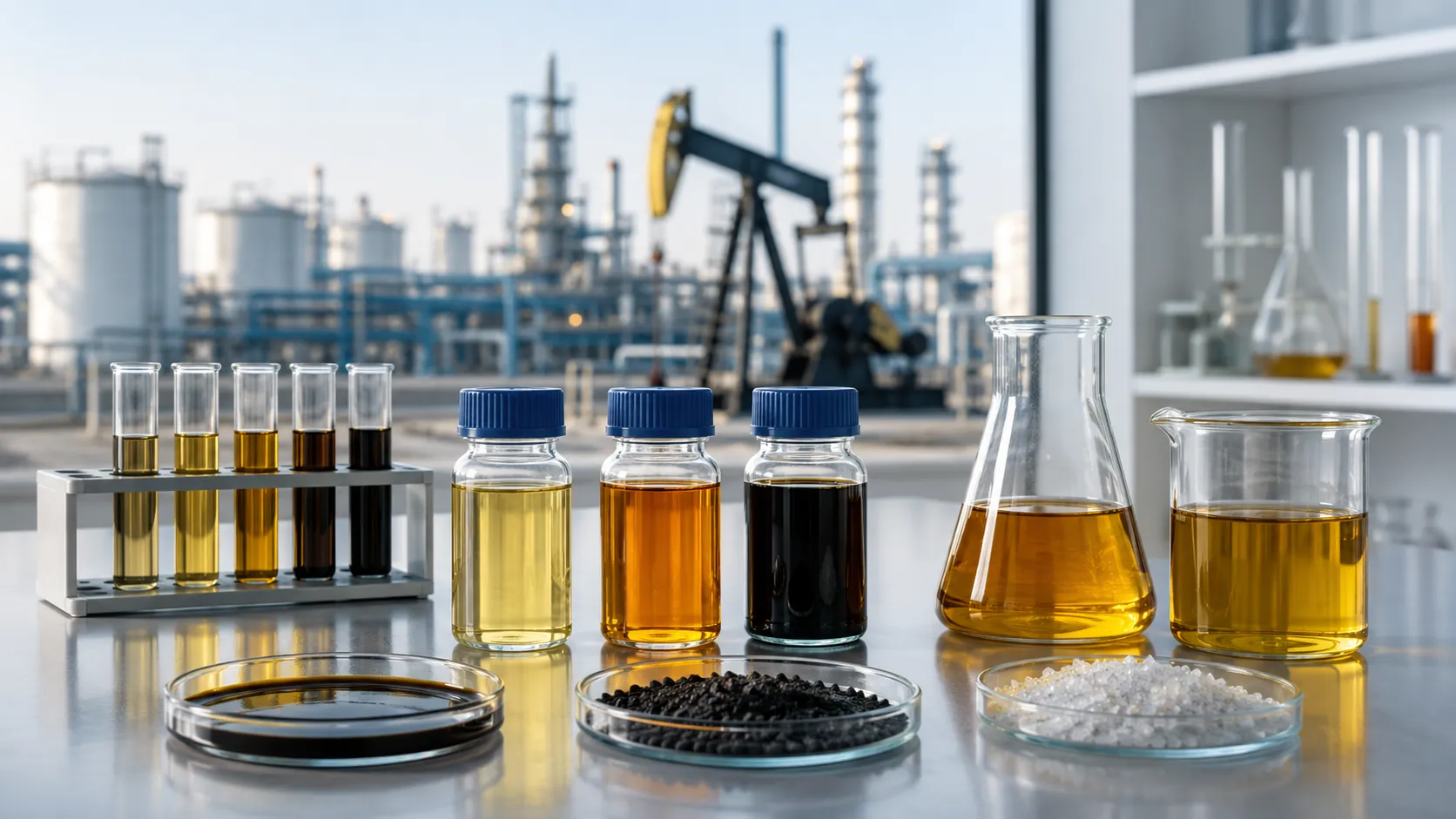
Fuel Quality Testing Methods and Laboratory Instruments Overview
The oil, gas, petrochemical, and energy industry depends on consistent fuel quality to support engine performance, emissions compliance, operational safety, and reliable product release. Fuel quality testing methods are used throughout refining, blending, storage, and distribution to verify that gasoline, diesel, jet fuel, marine fuel, and alternative fuel blends meet their required quality targets.
In practical terms, a fuel quality laboratory typically needs to evaluate composition, volatility, ignition quality, sulfur content, distillation behavior, flash point, viscosity, density, oxidation stability, corrosion potential, moisture, and contamination. The required laboratory instruments range from routine physical testers such as viscometers, distillation units, and flash point testers to advanced analytical systems such as gas chromatographs, XRF spectrometers, ICP spectrometers, and GC-MS.
Modern fuel manufacturing involves blending hydrocarbon streams and additives to achieve multiple performance parameters. Testing at each production stage provides the data needed to identify unsuitable feedstocks, adjust blends, certify finished products, investigate quality problems, and monitor fuel condition during storage and distribution.
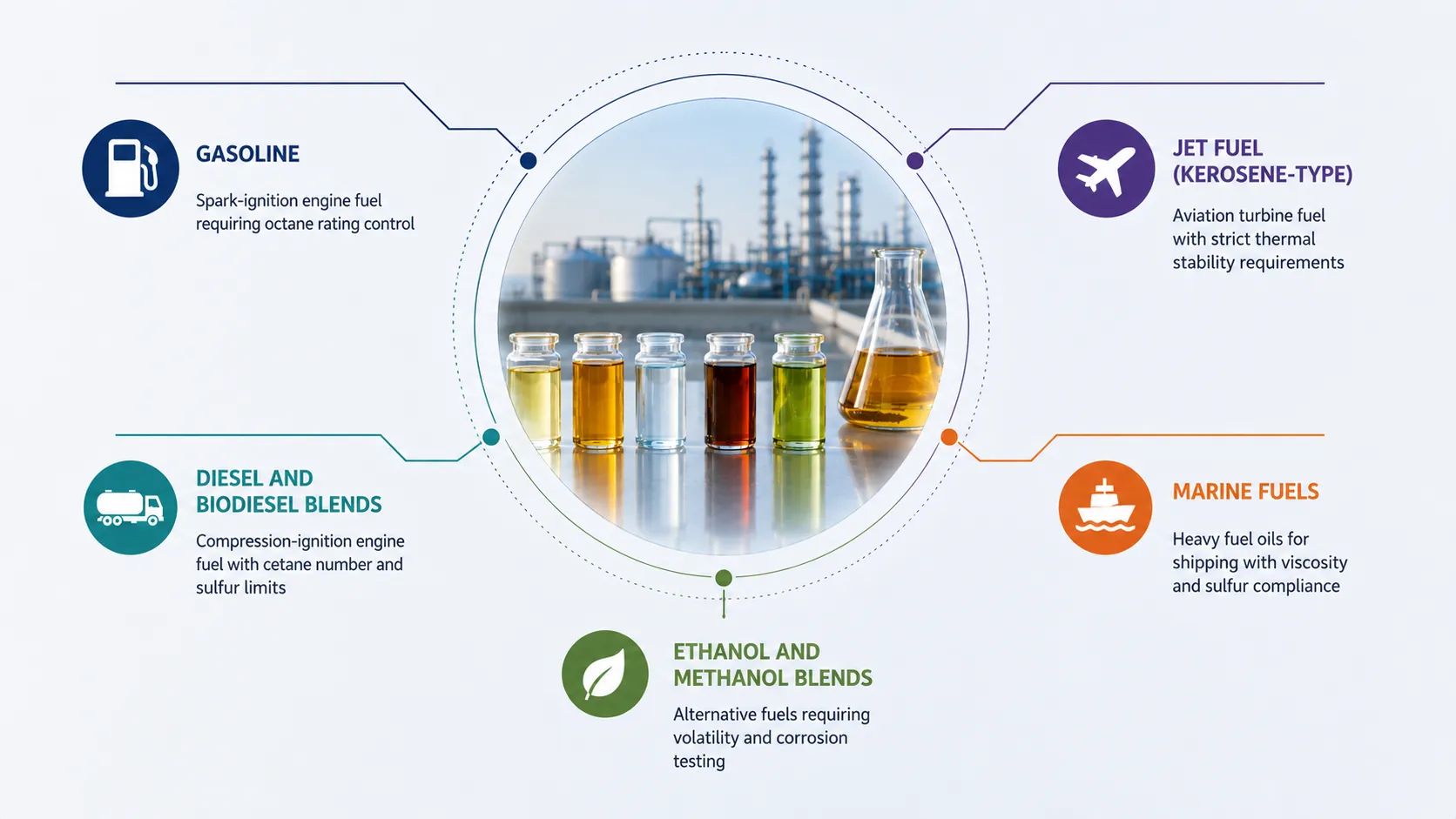
Main Fuel Products and Testing Applications
- Gasoline – Spark-ignition engine fuel requiring control of octane rating, volatility, composition, sulfur, and stability
- Diesel and biodiesel blends – Compression-ignition fuels requiring evaluation of ignition quality, sulfur, cold-flow behavior, oxidation stability, and contamination
- Jet fuel (kerosene-type) – Aviation turbine fuel requiring close control of thermal stability, contamination, water, and other critical quality parameters
- Marine fuels – Marine fuel products requiring viscosity, sulfur, stability, and contamination assessment according to the fuel and application
- Ethanol and methanol blends – Alternative fuel blends requiring attention to volatility, composition, moisture, and corrosion-related properties
Fuel Quality Control Workflow and Testing Methods
Fuel testing requirements change as material moves from incoming feedstock to blended and finished fuel. Organizing the laboratory around these production stages helps determine which instruments are required for routine process control and which advanced analytical systems are justified for troubleshooting, trace analysis, or specialized applications.
Raw Material and Feedstock Inspection
Before blending or refining, incoming crude oil or intermediate streams must be assessed for characteristics that can affect downstream processing. Important parameters can include density, sulfur content, distillation behavior, viscosity, and trace metals. These measurements help laboratories determine whether the feedstock is compatible with processing targets and identify material that may create operational or product-quality problems.
Typical relationships at this stage include feedstock → boiling-point distribution → simulated distillation analyzer, feedstock → sulfur analysis → X-ray fluorescence spectrometer, and feedstock → flow behavior → kinematic viscometer.
Recommended laboratory equipment for this stage:
- Simulated Distillation Analyzer – Determines boiling point distribution of crude or intermediate streams to support feedstock characterization
- X-ray Fluorescence Spectrometer – Measures total sulfur in feedstock for process and quality assessment
- Kinematic Viscometer – Assesses flow properties at defined test temperatures
- Digital Density Meter – Provides density measurements used in fuel characterization and mass/volume calculations
- Inductively Coupled Plasma Spectrometer – Supports trace-metal analysis when detailed elemental characterization is required


In-Process Blend Monitoring
During fuel blending, components are combined to achieve the target product properties. Rapid laboratory feedback helps operators identify octane, cetane, volatility, or compositional deviations before a large batch becomes off specification. The appropriate test package depends on whether the facility is blending gasoline, diesel, oxygenated fuels, or another fuel type.
For gasoline, important relationships include blend quality → octane number → octane analyzer/CFR engine and volatility → vapor pressure → vapor pressure tester. For diesel, ignition quality → cetane assessment → cetane analyzer may be important. Chromatographic or spectroscopic techniques can provide additional compositional or rapid multi-parameter information where justified.
Recommended laboratory equipment for this stage:
- Fuel Octane Analyzer (CFR Engine) – Measures research octane number (RON) and motor octane number (MON) for gasoline
- Reid Vapor Pressure Tester – Determines fuel volatility and supports gasoline blend control
- Gas Chromatograph – Quantifies individual hydrocarbon groups and oxygenates when detailed composition is required
- Cetane Number Analyzer – Evaluates ignition quality of diesel fuels
- Near-Infrared Spectrometer – Can support rapid multi-parameter analysis when an appropriate fuel application and calibration model are available
Final Product Specification Testing
Finished fuels require a defined release-testing package before distribution. The exact tests depend on the fuel type and the specification being followed, but commonly controlled properties include sulfur, flash point, distillation behavior, corrosion tendency, oxidation stability, ignition quality, and volatility.
This stage connects the finished product directly with release decisions: finished fuel → required quality parameter → appropriate standardized test method → laboratory instrument → release or corrective action. A laboratory should therefore select equipment according to the actual products and methods it is responsible for performing rather than attempting to use one generic instrument package for every fuel.
Recommended laboratory equipment for this stage:
- UV Fluorescence Sulfur Analyzer – Supports low-level sulfur measurement in refined fuel products
- Automatic Flash Point Tester – Determines flash point using the test configuration appropriate to the required method
- Atmospheric Distillation Unit – Produces distillation data used to evaluate fuel volatility and boiling behavior
- Copper Strip Corrosion Tester – Evaluates the corrosive tendency of fuel toward copper under defined test conditions
- Oxidation Stability Apparatus – Evaluates resistance to oxidation and deposit-forming degradation

Storage and Distribution Stability Testing
Fuel quality can change during storage and distribution because of oxidation, contamination, water ingress, temperature exposure, or other handling conditions. The relevant laboratory tests depend strongly on the product. Diesel may require attention to oxidation stability and cold-flow behavior, while aviation fuel applications may require specialized thermal-stability and contamination testing.
Testing these properties helps laboratories distinguish between a production problem and deterioration or contamination that occurs after manufacture. The resulting data can support storage decisions, troubleshooting, and product-condition monitoring.
Recommended laboratory equipment for this stage:
- Jet Fuel Thermal Oxidation Tester – Evaluates jet fuel behavior under defined high-temperature test conditions
- Oxidation Stability Bath – Measures oxidation stability or induction behavior for applicable fuel types and methods
- Cold Filter Plugging Point Analyzer – Evaluates low-temperature filterability and operability of applicable diesel fuels
- Water Content Titrator – Uses Karl Fischer titration for moisture determination
- Fourier Transform Infrared Spectrometer – Supports spectroscopic assessment of fuel composition or degradation when an appropriate analytical method is used
Regulatory Compliance and Trace Analysis
Some fuel laboratories need analytical capability beyond routine physical testing. Detailed compositional, elemental, or trace analysis may be required for compliance work, troubleshooting, research, product development, or independent certification. These applications can justify more advanced instruments such as GC-MS, wavelength dispersive XRF, liquid chromatography, or dedicated elemental analyzers.
Advanced analytical instruments should be selected according to the target analyte, required method, expected concentration range, sample matrix, throughput, and available operator expertise. They are not automatically necessary for every routine fuel QC laboratory.
Recommended laboratory equipment for this stage:
- Gas Chromatograph–Mass Spectrometer – Supports identification and quantification of selected fuel components and trace compounds using suitable analytical methods
- Wavelength Dispersive XRF Spectrometer – Provides elemental analysis capability for applications such as total sulfur determination
- Liquid Chromatograph – Supports selected compositional analyses where an applicable chromatographic method is used
- Total Nitrogen Analyzer – Measures nitrogen content in applicable petroleum and fuel samples
- Particulate Contamination Tester – Supports cleanliness and particulate contamination assessment for applications such as aviation fuel testing


Common Fuel Quality Control Challenges
- Variable feedstock quality – Can change process behavior and finished-product properties
- Blending errors – Can produce fuels outside the intended octane, cetane, volatility, or compositional targets
- Sulfur control – Requires analytical capability appropriate to the product and applicable specification
- Fuel instability – Oxidation and degradation can contribute to gums, sediments, or deposits during storage
- Water, sediment, or metal contamination – Can indicate handling, storage, feedstock, or process problems
- Testing inconsistency – Poor calibration, unsuitable equipment, incorrect method selection, or inadequate maintenance can reduce confidence in laboratory results
Key Fuel Quality Tests and Recommended Laboratory Equipment
| Quality Challenge | Quality Control Test | Recommended Laboratory Equipment | Application |
|---|---|---|---|
| Inconsistent feedstock | Simulated distillation | Simulated Distillation Analyzer | Feedstock characterization |
| Gasoline blending control | Octane number testing | Fuel Octane Analyzer | Gasoline blend assessment |
| Sulfur control | Total sulfur analysis | UV Fluorescence Sulfur Analyzer | Finished-fuel sulfur testing |
| Fuel instability | Oxidation stability test | Oxidation Stability Apparatus | Storage stability assessment |
| Cold-weather operability | Cold filter plugging point | CFPP Analyzer | Diesel cold-flow assessment |
| Corrosivity | Copper corrosion test | Copper Strip Corrosion Tester | Fuel corrosivity assessment |
| Volatility issues | Vapor pressure testing | Vapor Pressure Tester | Gasoline volatility control |
| Detailed compositional analysis | Chromatographic analysis | GC or GC-MS | Fuel composition and trace analysis |
Laboratory Equipment Required for Fuel Quality Control
Fuel quality laboratories normally combine physical testing instruments with chemical and analytical systems. Physical testers such as distillation units, flash point testers, density meters, and viscometers measure how the fuel behaves under defined test conditions. Chemical analysis equipment such as sulfur analyzers and Karl Fischer titrators measures constituents that can affect fuel quality, handling, or compliance. Chromatographs and spectrometers provide more detailed compositional or elemental information when routine physical testing is not sufficient.
The correct laboratory configuration depends on the fuel portfolio. A gasoline blending laboratory may place greater emphasis on octane and volatility testing, while a diesel laboratory may prioritize ignition quality, sulfur, cold-flow properties, and oxidation stability. Jet-fuel applications can require specialized thermal-stability, water, and contamination testing. This product-specific approach prevents both under-equipping a laboratory and purchasing advanced analytical instruments that are not needed for routine work.
| Testing Requirement | Laboratory Equipment | Why Manufacturers Need It |
|---|---|---|
| Octane rating of gasoline | Octane Analyzer | Evaluates gasoline knock resistance and supports blend control |
| Sulfur content in fuels | UV Fluorescence Analyzer | Supports sulfur measurement for product control and applicable specifications |
| Distillation range | Atmospheric Distillation Unit | Evaluates fuel volatility and boiling behavior |
| Flash point | Flash Point Tester | Provides a key safety and handling characteristic for applicable fuel products |
| Diesel ignition quality | Cetane Analyzer | Evaluates diesel ignition characteristics |
| Fuel corrosion potential | Copper Corrosion Tester | Assesses corrosive tendency under defined test conditions |
| Oxidation stability | Oxidation Stability Apparatus | Evaluates resistance to oxidative degradation |
| Vapor pressure | Vapor Pressure Tester | Supports gasoline volatility and blending control |
The instruments listed above provide a practical foundation for fuel quality control, but not every laboratory requires every instrument. Equipment selection should begin with the products being tested and the methods the laboratory is required to perform, then expand according to sample volume, troubleshooting needs, analytical complexity, and future production plans.
Basic and Advanced Fuel Quality Laboratory Setup
| Laboratory Level | Recommended Equipment | Suitable For |
|---|---|---|
| Basic QC Laboratory | Sulfur analyzer, flash point tester, distillation unit, analytical balance | Routine fuel quality control in smaller refineries or blending terminals where these tests match the required product scope |
| Advanced QC Laboratory | Octane engine, gas chromatograph, XRF spectrometer, oxidation stability baths | Facilities requiring broader blend control, compositional analysis, or higher testing capability |
| Advanced Analysis Laboratory | GC-MS, ICP spectrometer, JFTOT, particle counter | Research, specialized analysis, troubleshooting, regulatory work, or complex fuel development |
A basic laboratory should cover the tests that directly control routine production and product release. Advanced equipment becomes more valuable when the laboratory must identify unknown compounds, investigate contamination, perform detailed elemental or compositional analysis, support specialized fuels, or handle more complex testing requirements.
How to Choose Laboratory Equipment for Fuel Quality Testing
Selecting fuel testing instruments begins with the required test methods rather than with an equipment list. Buyers should first identify the fuels they handle, the properties that must be measured, the methods they need to follow, and the number of samples the laboratory expects to process. These requirements determine whether a routine physical tester, dedicated analyzer, or advanced analytical instrument is appropriate.
Define the Fuel Types and Testing Scope
Begin by listing the products the laboratory must test and the quality parameters required for each one. A diesel laboratory may need a different instrument package from a gasoline blending laboratory, while jet-fuel testing can introduce specialized stability and contamination requirements.
For each required test, confirm the measurement range, expected sample type, method requirements, and the level of analytical sensitivity needed. This prevents selecting an instrument that is technically capable of measuring a parameter but unsuitable for the laboratory’s actual method or sample matrix.
Evaluate Laboratory Workflow Requirements
Consider how frequently each test will be performed and how many samples must be processed per shift or day. A laboratory performing occasional troubleshooting has different automation needs from a refinery laboratory processing a continuous stream of routine QC samples.
Operator skill, sample preparation, test duration, instrument footprint, utility requirements, laboratory environment, and data-handling needs should also be considered. Automated or multi-parameter systems can be valuable in high-throughput applications, but only when their validated application matches the fuels and parameters being tested.
Separate Essential Equipment from Advanced Analysis
Not every fuel laboratory needs GC-MS, ICP, or other advanced analytical systems. Routine physical and chemical testing may cover the essential production and release requirements of a smaller facility. Advanced analytical equipment is more justified when the laboratory must perform detailed composition analysis, identify contaminants, investigate process problems, support research, or conduct specialized trace analysis.
Separating essential tests from advanced capabilities helps establish a realistic laboratory budget and a practical expansion path.
Compare Long-Term Equipment Support
Instrument reliability depends on calibration, maintenance, consumables, spare parts, operator training, and technical support. Buyers should consider these factors alongside the initial equipment cost.
AELAB can help manufacturers compare suitable instrument categories based on the fuel types being tested, required methods, expected sample throughput, and laboratory workflow so that equipment selection reflects both immediate QC requirements and future laboratory expansion.
Who Needs Fuel Quality Laboratory Testing Solutions?
- Petroleum refineries processing crude oil and intermediate streams into finished fuels
- Fuel blending terminals controlling component ratios, additives, volatility, and finished-blend properties
- Independent testing laboratories providing third-party fuel analysis and certification services
- Pipeline and storage operators monitoring product condition and contamination during distribution
- Regulatory and research institutions performing fuel analysis, method development, or specialized investigations
Frequently Asked Questions
What are the most critical fuel quality tests for refinery laboratories?
The most critical tests depend on the fuel type but generally include octane or cetane number, sulfur content, distillation profile, flash point, and oxidation stability. Gasoline refineries focus on octane and volatility, while diesel producers prioritize cetane, sulfur, and cold flow properties.
How often should fuel testing equipment be calibrated?
Calibration frequency varies by instrument type, usage intensity, manufacturer recommendations, and internal quality procedures. High-volume analyzers may require daily verification, while less frequently used instruments can follow a monthly or quarterly schedule. Laboratories should implement a documented calibration plan based on the specific instrument and applicable requirements.
What is the difference between RON, MON, and AKI for gasoline?
RON (Research Octane Number) measures knock resistance under mild driving conditions, while MON (Motor Octane Number) tests under more severe, high-speed conditions. AKI (Anti-Knock Index) is the average of RON and MON, commonly displayed at U.S. fuel pumps. These values guide blending to prevent engine knocking.
How can small refineries build a cost-effective quality control lab?
Start with the most essential instruments for regulatory compliance: a sulfur analyzer, flash point tester, and distillation unit. For blend control, consider a single multi-parameter analyzer like an NIR spectrometer that replaces multiple single-purpose instruments. Prioritize equipment with straightforward operation and local support to minimize training and downtime.
Conclusion
Fuel quality testing is most effective when the laboratory is designed around the products, production stages, and test methods it actually needs to support. Feedstock characterization may require distillation, density, viscosity, sulfur, and elemental analysis; blending laboratories may prioritize octane, cetane, volatility, and composition; finished-product laboratories require reliable release testing; and storage or specialized applications can add stability, moisture, cold-flow, and contamination testing.
For equipment planning, the key is to map fuel type → required quality parameter → test method → instrument → testing frequency. This approach helps manufacturers distinguish essential routine QC equipment from advanced analytical capability and build a laboratory that can expand as production and testing requirements change.
Laboratory Equipment Solutions for Oil, Gas, Petrochemical & Energy
Manufacturers face different testing demands depending on their fuel portfolio, production process, required methods, and sample volume. A well-configured laboratory therefore needs instruments matched to the actual sample types and QC decisions the facility must make rather than a generic equipment package.
When evaluating a fuel testing laboratory, document the products you test, the methods you follow, expected daily sample volume, required analytical capabilities, and current quality-control challenges. These details provide the practical basis for comparing instrument categories and developing an appropriate laboratory configuration.