Lubricant Testing Laboratory Equipment and Analysis Methods Overview
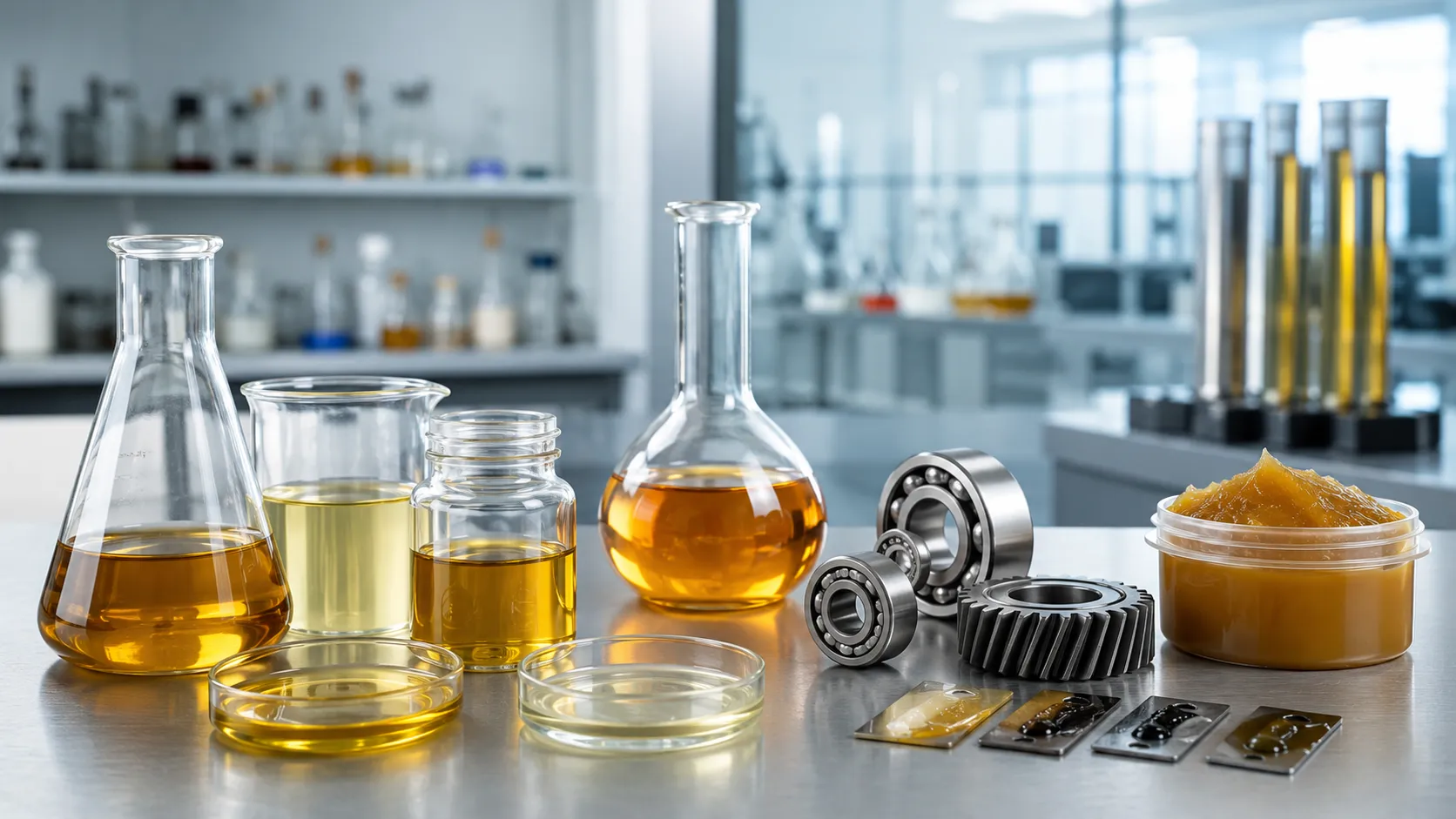
Lubricant testing laboratories use a combination of physical, chemical, elemental, and tribological tests to verify lubricant quality and monitor oil condition. Core equipment typically includes viscometers, Karl Fischer titrators, automatic potentiometric titrators, FTIR spectrometers, elemental analyzers, oxidation stability testers, flash and pour point testers, and contamination-monitoring instruments.
In the oil, gas, and energy sector, lubricants are critical to the reliability and efficiency of machinery, from hydraulic systems to gas turbines. Laboratory testing helps manufacturers verify product consistency, identify contamination or formulation problems, evaluate important performance properties, and support in-service condition monitoring.
The required equipment depends on the sample type and testing objective. Base oils and additives require incoming verification, blended products require formulation and consistency checks, finished lubricants require release testing, and used oils require condition and wear monitoring. A practical laboratory therefore starts by mapping each sample type and quality risk to the required test and instrument.
Main Products and Applications
Lubricants encompass a wide range of products used to reduce friction, control wear, transfer heat, and protect surfaces. Key types include:
- Engine oils – lubricants for internal combustion engines where viscosity, additive condition, contamination, and degradation are important quality considerations.
- Industrial oils – hydraulic fluids, turbine oils, compressor oils, and gear oils used in manufacturing, processing, and power generation.
- Metalworking fluids – fluids used for lubrication, cooling, and process control during machining and forming operations.
- Greases – semi-solid lubricants used for bearings, joints, and other applications where lubricant retention is required.
- Specialty lubricants – application-specific lubricants designed for demanding temperature, environmental, processing, or compatibility requirements.
Different lubricant types do not require identical test programs. The appropriate laboratory configuration should therefore be based on the products being manufactured or monitored, the applicable product specifications, and the decisions that laboratory results must support.
Lubricant Testing Quality Control Workflow
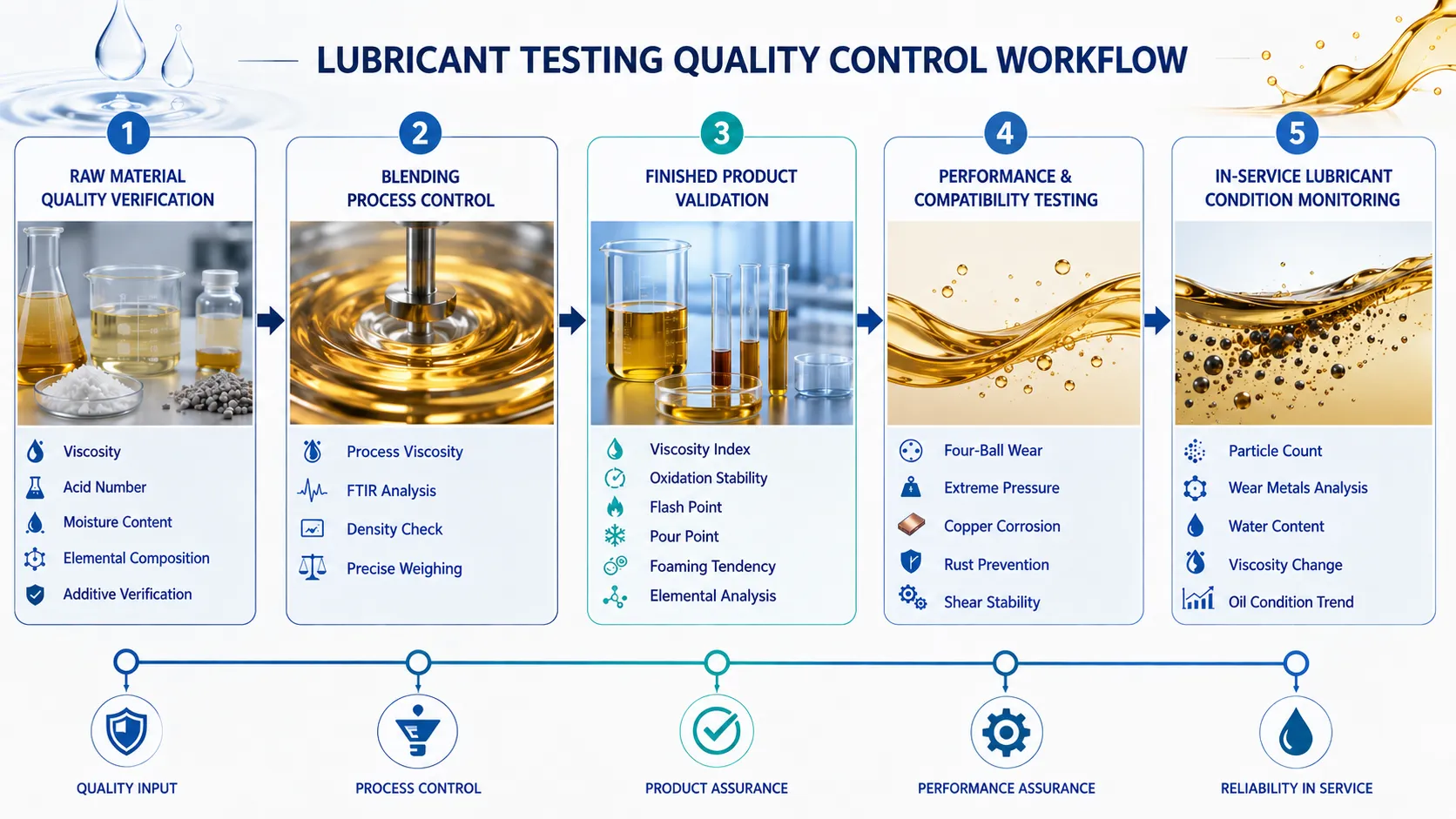
A lubricant quality control laboratory can be organized around five testing stages: incoming material verification, blending control, finished-product validation, performance testing, and in-service condition monitoring. Each stage addresses different risks and therefore requires a different combination of instruments.
Raw Material Quality Verification
Base oils and additives establish the starting properties of a lubricant formulation. Incoming testing helps identify variation, contamination, or material differences before the materials enter production.
For base oils, laboratories may evaluate viscosity, moisture, acid number, density, and chemical characteristics according to the required material specification. Additive packages may require chemical or elemental characterization to confirm that incoming material is consistent with formulation requirements.
Recommended laboratory equipment for this stage:
- Viscometer – Measures lubricant viscosity for incoming base-oil verification and comparison with material requirements.
- Automatic Potentiometric Titrator – Performs acid number or base number determinations where these parameters are required for the material or formulation.
- Karl Fischer Moisture Titrator – Quantifies water content to identify moisture contamination.
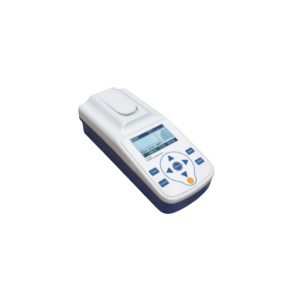
- Inductively Coupled Plasma Optical Emission Spectrometer (ICP-OES) – Provides elemental analysis for applications such as additive-element verification and contaminant or wear-metal analysis.
- Fourier Transform Infrared Spectrometer (FTIR) – Provides infrared spectral information for material identification, comparison, and chemical condition assessment.



Blending Process Control
During blending, the laboratory verifies that the combination of base oils and additives remains consistent with the intended formulation. Incorrect proportions, inadequate mixing, contamination, or material variation can result in an off-specification batch.
Fast at-line or laboratory checks can help operators identify deviations before the product proceeds to final release testing. The exact tests depend on the formulation, but viscosity, density, and spectral comparison can provide useful process-control information.
Recommended laboratory equipment for this stage:
- Process Viscometer – Monitors viscosity during processing where real-time or near-real-time viscosity control is required.
- FTIR Spectrometer – Supports spectral comparison of blends with appropriate reference materials or established formulation profiles.
- Density Meter – Measures density as a rapid physical-property check for blend consistency.
- Analytical Balance – Supports accurate weighing of laboratory samples, additives, standards, and formulation components.


Finished Product Validation
Finished-product testing determines whether a lubricant meets the defined release specification before shipment or use. The required test panel varies by lubricant type, but commonly evaluated properties include viscosity, low-temperature behavior, flash point, oxidation-related performance, foaming characteristics, and chemical condition.
A useful release laboratory should distinguish between routine batch tests required for every production lot and more specialized performance tests used for formulation qualification, troubleshooting, or periodic verification.
Recommended laboratory equipment for this stage:
- Kinematic Viscometer Bath – Measures kinematic viscosity at specified temperatures and provides data used for viscosity-related product evaluation.
- Automated Oxidation Stability Tester – Evaluates oxidation-related performance using the test method appropriate to the lubricant type, such as RPVOT where applicable.
- Flash Point Tester – Determines flash point for product characterization, safety-related evaluation, and possible contamination investigation.
- Pour Point Tester – Evaluates low-temperature flow behavior.
- Foam Test Apparatus – Assesses lubricant foaming tendency and foam stability under defined test conditions.
- Atomic Absorption Spectrometer (AAS) – Provides elemental measurement capabilities for appropriate lubricant-analysis applications as an alternative analytical technique to ICP-based analysis.


Performance and Compatibility Testing
Property measurements alone do not describe every aspect of lubricant performance. Formulation development and qualification may therefore include tribology, corrosion, rust-prevention, extreme-pressure, and shear-stability testing.
These tests are particularly useful when R&D teams need to compare formulations, investigate performance problems, or evaluate whether a lubricant provides the required protection under defined test conditions.
Recommended laboratory equipment for this stage:
- Four-Ball Wear Tester – Evaluates anti-wear performance by measuring wear produced under defined test conditions.
- Extreme Pressure (EP) Tester – Evaluates lubricant load-carrying or extreme-pressure behavior using the applicable test configuration.
- Copper Strip Corrosion Tester – Assesses the corrosive effect of a lubricant on copper under defined conditions.
- Rust Prevention Tester – Evaluates the ability of applicable lubricants to protect metal surfaces against rust under the selected test method.
- Shear Stability Tester – Evaluates viscosity change associated with mechanical shear for lubricants where shear stability is an important performance characteristic.
In-Service Lubricant Condition Monitoring
Used-oil analysis has a different objective from finished-product release testing. Instead of confirming a new lubricant formulation, condition monitoring looks for changes that may indicate lubricant degradation, contamination, or machine wear.
Useful parameters can include viscosity change, water contamination, particle contamination, wear metals, additive-element trends, and wear-debris characteristics. Interpretation is strongest when current results can be compared with suitable baseline or historical data from the same lubricant and equipment application.
Recommended laboratory equipment for this stage:
- Portable Particle Counter – Measures particle contamination and supports oil-cleanliness assessment, including reporting based on ISO 4406 where applicable.
- Ferrography Unit – Separates and examines wear debris to support investigation of wear mechanisms and abnormal machine condition.
- Water Content Sensor / Karl Fischer Titrator – Measures or monitors moisture contamination in used lubricants.
- ICP-OES or Rotrode Atomic Emission Spectroscopy (RDE) – Measures elemental concentrations associated with wear, contamination, and additive chemistry.
- Viscosity Comparator or Portable Viscometer – Provides a rapid check for viscosity changes that may result from contamination, degradation, or other changes in lubricant condition.

Common Quality Control Challenges in Lubricant Manufacturing
Lubricant manufacturers need a testing program capable of identifying both formulation problems and contamination. Common quality-control challenges include:
- Viscosity drift caused by raw-material variation, formulation differences, or process deviations.
- Incorrect additive concentration caused by dosing or blending problems.
- Contamination by water, particulates, or cross-mixing with other products.
- Oxidation and degradation that can alter lubricant chemistry and performance.
- Foaming and air-related problems that may interfere with effective lubrication in applicable systems.
- Product specification compliance requiring consistent testing and documented batch-release decisions.
The most useful QC program does not simply accumulate instruments. It connects each significant quality risk to a defined test, a suitable instrument, and a decision such as incoming-material acceptance, blend adjustment, batch release, formulation investigation, or maintenance action.
Key Quality Control Tests for Lubricant Testing
The following table summarizes important test-to-equipment relationships across lubricant manufacturing and condition monitoring.
| Quality Challenge | Quality Control Test | Recommended Laboratory Equipment | Application |
|---|---|---|---|
| Inconsistent viscosity | Kinematic viscosity at 40°C and 100°C | Kinematic viscometer bath | Raw material acceptance and batch release |
| Oxidation stability | Rotary Pressure Vessel Oxidation Test (RPVOT) | Automated oxidation stability tester | Turbine and industrial oil evaluation where the method is applicable |
| Water contamination | Karl Fischer titration | Karl Fischer moisture titrator | Incoming base oil and in-service oil monitoring |
| Chemical condition or additive-related changes | FTIR spectroscopy | FTIR spectrometer | Blend comparison and condition monitoring |
| Wear metals & contaminants | Elemental analysis (ASTM D5185) | ICP-OES or RDE spectrometer | Condition monitoring and failure analysis |
| Poor low-temperature flow | Pour point determination | Pour point tester | Low-temperature product evaluation |
| Corrosive potential | Copper strip corrosion test | Copper strip corrosion tester | Evaluation of lubricant interaction with copper |
| Inadequate anti-wear properties | Four-ball wear test | Four-ball wear tester | Lubricant formulation and performance evaluation |
Laboratory Equipment Required for Lubricant Quality Control
A complete lubricant testing laboratory normally combines physical-property testing with chemical, elemental, contamination, and performance analysis. The exact configuration should be based on the products being tested rather than on a universal equipment list.
For routine manufacturing QC, viscosity, moisture, density, flash point, pour point, and acid/base number testing may form an important part of the laboratory workload. Laboratories responsible for formulation development or troubleshooting may add FTIR, elemental analysis, oxidation stability, particle counting, and tribology equipment.
For used-oil condition monitoring, priorities shift toward detecting change: water, particles, viscosity variation, elemental trends, and wear debris become particularly important.
| Testing Requirement | Laboratory Equipment | Why Manufacturers Need It |
|---|---|---|
| Viscosity profile and index | Kinematic viscometer bath | Verifies viscosity-related product properties and supports grade or specification checks. |
| Oxidation resistance | RPVOT or oxidation stability bath | Supports oxidation-performance evaluation using the applicable lubricant test method. |
| Chemical identity and condition | FTIR spectrometer | Supports material comparison, formulation checks, and evaluation of chemical changes. |
| Elemental wear metals and additives | ICP-OES or RDE | Provides elemental data for formulation verification, contamination investigation, and condition monitoring. |
| Water content | Karl Fischer titrator | Quantifies moisture in raw materials, finished lubricants, or used-oil samples. |
| Particulate cleanliness | Automatic particle counter | Measures particulate contamination in cleanliness-sensitive lubrication systems. |
| Acid/Base number | Automatic potentiometric titrator | Supports acid/base number measurement for applicable new and used lubricant samples. |
| Low-temperature behavior | Pour point/cloud point tester | Evaluates low-temperature behavior where required by the product specification or application. |
The most effective equipment combination is the one that covers the laboratory’s actual decision points. A manufacturer performing routine batch release does not necessarily need the same analytical capability as an R&D laboratory or a condition-monitoring service.
Basic Laboratory Setup for Lubricant Manufacturers
Laboratory capability can be expanded in stages. A basic QC laboratory should first cover routine release parameters for the products being manufactured. More advanced analytical instruments are justified when the laboratory must investigate formulations, diagnose failures, perform condition monitoring, or conduct specialized performance testing.
| Laboratory Level | Recommended Equipment | Suitable For |
|---|---|---|
| Basic QC Laboratory | Kinematic viscometer, flash point tester, KF moisture titrator, density meter, automatic potentiometric titrator | Routine incoming and batch-release testing for lubricant products where these parameters are required |
| Advanced QC Laboratory | Automated oxidation stability testers, FTIR, ICP-OES, four-ball tester, pour point testers, particle counter | Broader formulation verification, product qualification, contamination investigation, and troubleshooting |
| Advanced Analysis Laboratory | All of the above plus RPVOT, GC-MS for detailed organic analysis, ferrography, advanced tribometers | R&D, failure analysis, condition monitoring, and advanced product development |
A staged approach helps avoid purchasing advanced instruments before the laboratory has a defined need, trained operators, suitable sample throughput, and a plan for calibration, consumables, maintenance, and data interpretation.
How to Choose Laboratory Equipment for Lubricant Testing
Selecting lubricant testing equipment starts with the tests the laboratory must perform, not with the instrument itself. Define the samples, required measurements, workload, methods, and decisions first; then select equipment capable of supporting that workflow.
Define the Testing Scope
Start by identifying the sample types: base oils, additives, finished products, greases, metalworking fluids, or in-service oils. Then determine which tests are required for incoming inspection, process control, release testing, formulation work, or condition monitoring.
For each test, identify the applicable method or internal procedure, expected sample characteristics, measurement needs, and reporting requirements. This prevents purchasing instruments that are unnecessarily advanced or unsuitable for the laboratory’s actual workload.
Separate Routine QC from Advanced Analysis
Routine manufacturing QC generally prioritizes repeatable tests needed frequently for production decisions. Advanced analytical equipment becomes more valuable when the laboratory needs deeper chemical characterization, elemental analysis, failure investigation, formulation development, or condition monitoring.
This distinction is important because an instrument that provides valuable R&D information may not be the highest-priority purchase for a laboratory whose main responsibility is rapid batch release.
Evaluate Laboratory Workflow Requirements
Consider daily sample throughput, required turnaround time, sample preparation, and operator workload. High-volume laboratories may benefit from automation, sample handling features, or instruments designed for repeated testing.
Also evaluate operator training requirements, laboratory space, ventilation, utilities, temperature control, waste handling, and other installation needs relevant to the selected methods. Equipment capability should fit the laboratory environment as well as the analytical requirement.
Compare Long-Term Equipment Support
Purchase price is only one part of instrument selection. Laboratories should also consider calibration requirements, reference materials, consumables, reagents, replacement parts, preventive maintenance, operator training, and technical support.
AELAB assists manufacturers by matching their testing requirements with appropriate instrument categories and helping define a practical laboratory configuration based on sample type, required tests, workflow, and expected testing volume.
Who Needs Laboratory Testing Solutions for This Industry?
- Lubricant manufacturers conducting raw material verification, blend monitoring, and finished-product release testing.
- Oil blending plants requiring rapid laboratory or at-line checks during production.
- Petrochemical laboratories performing formulation development, material characterization, and troubleshooting.
- Condition monitoring service providers analyzing in-service lubricants for contamination, degradation, and wear indicators.
- Large industrial end-users such as power plants, refineries, and steel mills operating on-site oil-analysis laboratories.
Frequently Asked Questions
What is the most essential lubricant testing equipment for a basic QC lab?
A basic lubricant QC laboratory typically starts with instruments for the routine properties required by its product specifications. For many lubricant operations, this can include a kinematic viscometer, flash point tester, Karl Fischer moisture titrator, density meter, and automatic potentiometric titrator. The exact equipment list should be determined by the lubricant types and required release tests.
How often should lubricant testing equipment be calibrated?
Calibration and verification intervals depend on the instrument, test method, usage, manufacturer guidance, and the laboratory’s quality procedures. Laboratories should establish documented intervals for each instrument rather than applying one universal calibration frequency to all lubricant testing equipment.
Can one instrument analyze multiple lubricant properties?
Some analytical instruments can provide information relevant to several lubricant characteristics. FTIR, for example, can support chemical identification, comparison, and condition assessment. However, physical properties, moisture, elemental composition, contamination, and tribological performance require different measurement techniques, so comprehensive lubricant analysis normally uses multiple instruments.
What are the benefits of automated lubricant testing versus manual methods?
Automation can improve repeatability, increase sample throughput, standardize test sequences, and reduce repetitive operator tasks. Its value is greatest when the laboratory processes enough samples to justify the additional automation and when the selected system supports the required test method and workflow.
Conclusion
A lubricant testing laboratory should be designed around the samples it receives and the decisions its results must support. Routine manufacturing QC may focus on viscosity, moisture, density, flash point, pour point, and acid/base number, while advanced laboratories may add FTIR, elemental analysis, oxidation testing, tribology, particle counting, ferrography, and other specialized techniques.
Mapping each production stage or condition-monitoring problem to the required test and instrument helps laboratories prioritize essential equipment, identify where advanced analysis is justified, and build testing capability in practical stages.