Laboratory Equipment for Food Nutritional Analysis Overview
Food and beverage manufacturers use nutritional analysis to verify product composition, support accurate labelling, control batch-to-batch consistency, and investigate production variation. For routine proximate analysis, the main testing areas are typically moisture, protein, fat, and fibre, supported by accurate weighing and appropriate sample preparation.
For most food nutritional analysis laboratories, the core equipment includes:
- Moisture analyser or laboratory oven for moisture and dry-matter determination
- Analytical balance for accurate sample and residue weighing
- Kjeldahl or Dumas protein analyser for nitrogen-based protein determination
- Soxhlet or automated extraction system for fat determination
- Crude or dietary fibre analysis equipment selected according to the required method
- Sample preparation equipment such as grinders and homogenisers for representative testing
Additional instruments such as NIR analysers, water activity meters, titration systems, and stability chambers can extend the laboratory from basic composition testing to faster process control and shelf-life investigation.
This article examines where nutritional tests fit into the food manufacturing workflow, common quality control challenges, and the laboratory equipment used at each stage. The goal is to help technical buyers, QC managers, and laboratory supervisors identify a practical equipment configuration for their products, testing methods, and sample workload.
Main Products and Applications
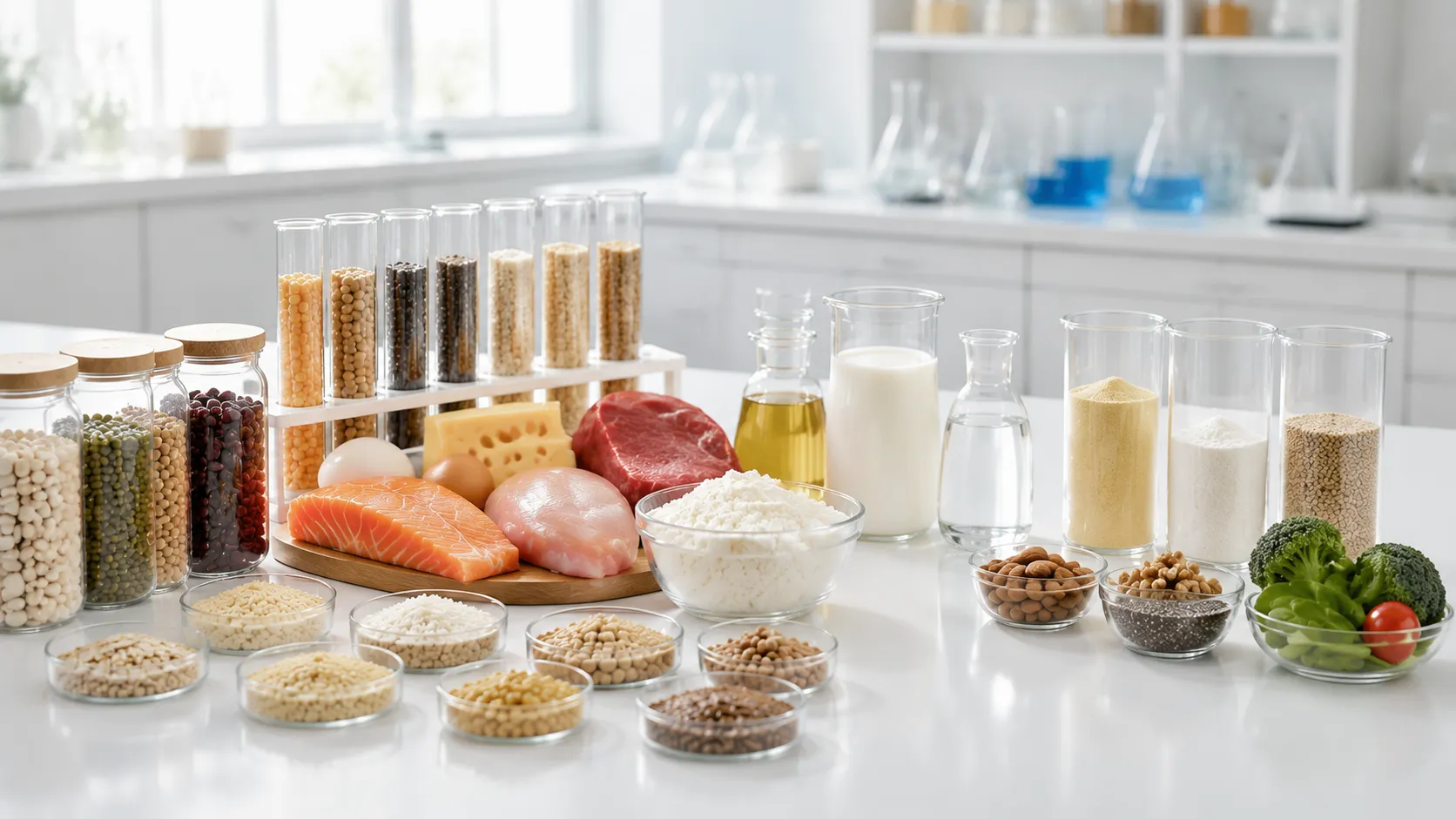
Nutritional testing is applied across a wide range of food and beverage categories. Typical products requiring protein, fat, fibre, moisture, or related compositional analysis include:
- Dairy products such as cheese, milk powder, and yoghurt
- Meat, poultry, and processed meat products
- Baked goods like bread, biscuits, and pastry
- Cereals, grains, and breakfast products
- Ready meals, snacks, and confectionery
The exact test method and equipment configuration depend on the product matrix and the nutritional parameters that must be measured. Dry powders, high-fat foods, fibrous materials, emulsions, and finished packaged products can require different sample preparation and analytical workflows.
Quality Control Workflow for Nutritional Analysis
Raw Material Verification
Before production begins, incoming ingredients can be tested to confirm that their composition matches purchasing or formulation specifications. Variation in flour protein, ingredient fat content, or grain moisture can influence processing behaviour and the composition of the finished product. Raw-material testing therefore helps manufacturers identify variation before ingredients enter production.
Recommended laboratory equipment for this stage:
- Moisture Analyser – Provides rapid moisture measurements for ingredients where water content affects formulation, storage, or processing.
- Analytical Balance – Provides accurate weighing for sample preparation and gravimetric analytical methods.
- Kjeldahl/Dumas Protein Analyser – Determines nitrogen for calculation of protein where a nitrogen-based method is appropriate.
- Fat Extractor (Soxhlet/Hydrolysis unit) – Supports fat determination in matrices that require solvent extraction and, where applicable, hydrolysis preparation.
- Fibre Analyser – Supports crude or dietary fibre workflows according to the selected analytical method.


In-Process Monitoring
During production, intermediate products such as doughs, batters, powders, blends, or other formulations may be tested to determine whether processing is producing the expected composition. Early identification of moisture or formulation variation can allow corrective action before an entire batch reaches final-product testing.
Recommended laboratory equipment for this stage:
- Near-Infrared (NIR) Analyser – Can provide rapid multi-parameter screening for properties such as moisture, protein, and fat when suitable matrix-specific calibrations are available.
- Rapid Moisture Analyser – Provides faster moisture checks for intermediate materials where water content is an important process variable.
- Bench-top Centrifuge – Supports sample or phase separation where required by the laboratory preparation workflow.
- pH Meter – Measures acidity during processing and supports analytical procedures in which pH control is important.


Final Product Release
Finished-product testing verifies whether measured composition agrees with internal specifications and supports nutritional declaration or quality documentation where applicable. The laboratory method should be selected according to the product matrix, required parameter, applicable reference method, and the manufacturer’s quality or regulatory requirements.
Recommended laboratory equipment for this stage:
- Combustion Protein Analyser (Dumas method) – Supports rapid nitrogen determination and can be suitable for laboratories processing larger numbers of protein samples.
- Automated Soxhlet Extraction System – Automates parts of the solvent extraction workflow to improve routine throughput and consistency.
- Dietary Fibre Analysis System (Enzymatic-Gravimetric) – Supports enzymatic-gravimetric dietary fibre workflows where this method is required.
- Vacuum Oven – Supports drying-based moisture determination for products and methods where controlled vacuum drying is appropriate.

Shelf-Life and Stability Testing
During storage, changes in moisture distribution, water activity, lipid quality, texture, and other characteristics can affect product stability. Shelf-life studies can combine compositional testing with physical and chemical measurements to understand how a product changes under defined storage conditions.
Recommended laboratory equipment for this stage:
- Stability Chamber (Temperature/Humidity Controlled) – Provides controlled environmental conditions for planned storage and stability studies.
- Water Activity Meter – Measures water activity, complementing total moisture measurements when evaluating product stability.
- Titration System – Supports titrimetric measurements such as free fatty acid determination where relevant to the product and study.
- Texture Analyser – Measures physical changes such as hardening, softening, or staling during storage studies.


Common Quality Control Challenges in Food Nutritional Analysis
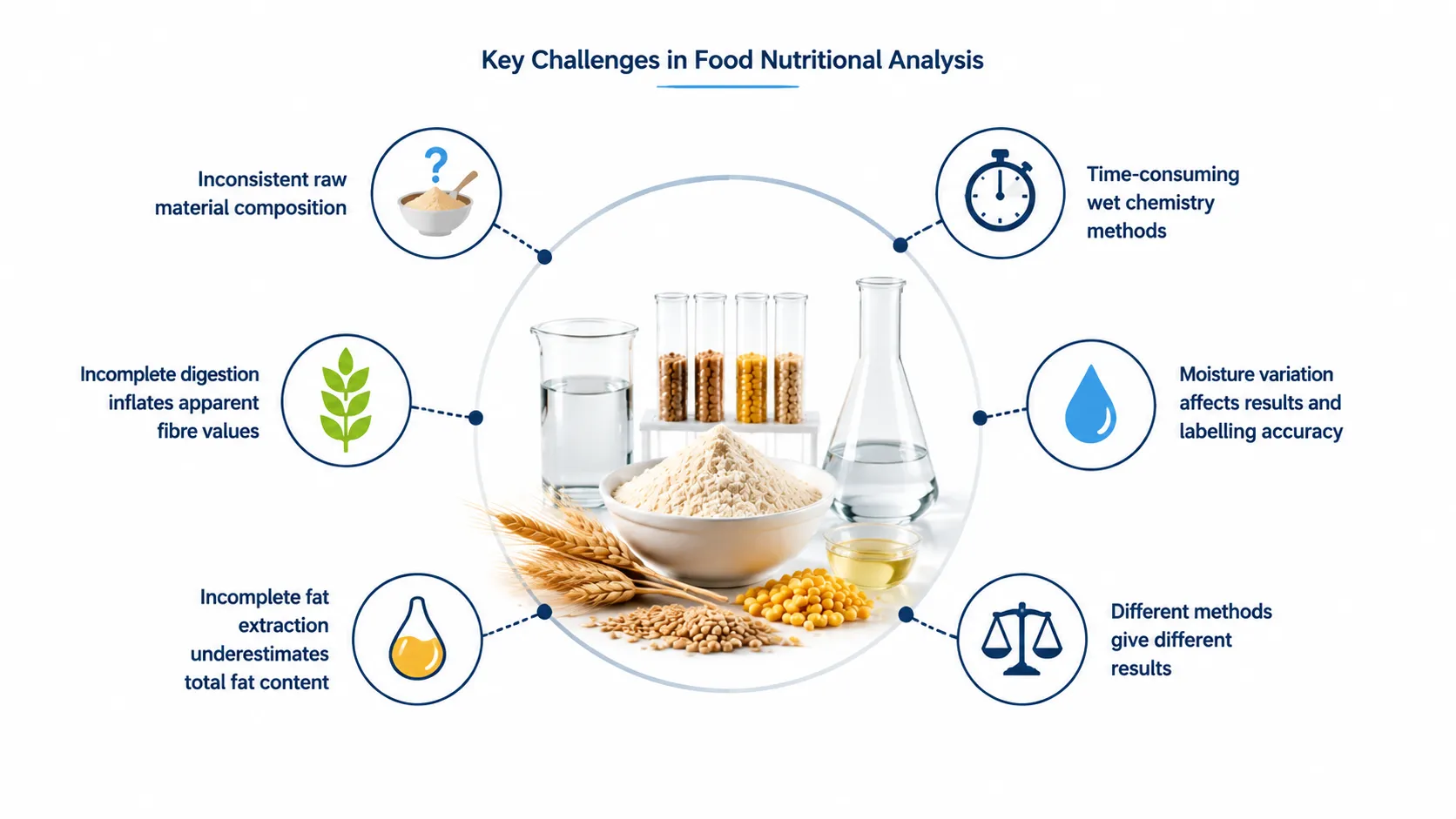
- Raw-material variation: Changes in ingredient composition can affect formulation calculations and finished-product consistency.
- Slow reference methods: Classical wet-chemistry procedures for protein, fat, and fibre can require multiple preparation, digestion, extraction, drying, or weighing steps.
- Moisture variability: Changes in sample moisture can influence results reported on an as-is or dry-matter basis and can complicate comparison between batches.
- Method-to-method differences: Results obtained using different analytical principles should be interpreted according to the selected method and laboratory procedure rather than assumed to be directly interchangeable.
- Difficult fat extraction: Complex food matrices may require appropriate preparation or hydrolysis before extraction to obtain representative fat results.
- Complex fibre workflows: Dietary fibre analysis can involve multiple digestion, filtration, drying, weighing, and correction steps, making procedural control important.
- Non-representative samples: Poor grinding, mixing, homogenisation, or subsampling can introduce variation before the analytical measurement even begins.
Key Quality Control Tests for Food Nutritional Analysis
| Quality Challenge | Quality Control Test | Recommended Laboratory Equipment | Application |
|---|---|---|---|
| Unexpected protein variation | Nitrogen/Protein determination | Kjeldahl/Dumas protein analyser | Meat, dairy, cereals, pet food |
| Fat content out of specification | Total fat by solvent extraction | Soxhlet extraction unit, hydrolysis apparatus | Snacks, bakery, processed meats |
| Incorrect dietary fibre claim | Enzymatic-gravimetric fibre analysis | Fibre analysis system, analytical balance, desiccator | High-fibre cereals, protein bars |
| High or variable moisture | Moisture content by drying | Moisture analyser, vacuum oven | Powders, dried fruit, baked goods |
| Fat quality changes during storage | Free fatty acid titration | Autotitrator, pH meter | Oils, fried snacks, nuts |
| Crude fibre measurement required | Crude fibre determination | Fibre analyser (Weende method) | Animal feed, grain by-products |
| Water activity too high | Water activity measurement | Chilled mirror or capacitance water activity meter | Cheese, jerky, confectionery |
| Weighing variation across analytical procedures | Sample mass verification | Analytical balance, calibration weights | All preparation steps |
Laboratory Equipment Required for Food Industry Quality Control
A food nutritional analysis laboratory normally combines reference or routine analytical instruments with sample preparation and supporting equipment. The exact configuration should be based on the parameters the laboratory actually needs to report rather than on purchasing every available instrument.
For moisture analysis, laboratories may use rapid moisture analysers or drying ovens depending on the method and required turnaround time. Protein analysis commonly uses nitrogen determination by Kjeldahl or Dumas approaches. Fat analysis may use solvent extraction systems, with additional preparation such as hydrolysis where required by the matrix and method. Fibre analysis requires equipment matched to the specific crude-fibre or dietary-fibre procedure being performed.
Supporting equipment is equally important. Analytical balances provide accurate mass measurements for gravimetric procedures, while grinders and homogenisers help produce representative samples. Centrifuges, desiccators, pH meters, water activity meters, and controlled storage equipment may be required depending on the laboratory workflow.
Rapid techniques such as NIR can add substantial value when a manufacturer needs frequent process measurements. However, rapid screening instruments and reference analytical methods serve different purposes: NIR performance depends on suitable calibration for the relevant product matrix, while reference methods provide the laboratory data used for method comparison, calibration development, or required reporting.
| Testing Requirement | Laboratory Equipment | Why Manufacturers Need It |
|---|---|---|
| Moisture determination | Halogen or infrared moisture analyser, vacuum oven | Measures moisture or dry matter for formulation, process control, and product verification |
| Protein content | Kjeldahl digestion and distillation unit, Dumas combustion analyser | Supports nitrogen-based protein determination |
| Fat content | Soxhlet extractor, automated fat extraction system | Supports extraction-based determination of lipid content |
| Dietary fibre | Enzymatic fibre analysis system, analytical balance, muffle furnace | Supports multi-step gravimetric dietary fibre procedures |
| Sample weighing | Analytical balance, anti-vibration table | Provides accurate mass measurements for sample preparation and gravimetric methods |
| Water activity | Water activity meter | Provides an additional parameter for evaluating product stability and available water |
| Fat quality | Automatic titrator, pH meter with electrodes | Supports titrimetric analysis where required by the product or quality procedure |
| Sample preparation | Laboratory grinder, homogeniser | Helps produce representative and uniform analytical samples |
Together, these instruments can form a practical proximate-analysis platform. The most appropriate configuration is not necessarily the largest one: it is the combination that covers the required parameters, sample matrices, reference procedures, throughput, and quality-control objectives without unnecessary complexity.
Basic Laboratory Setup for Food Manufacturers
The equipment required for a new food laboratory depends strongly on whether the laboratory performs only routine QC or also handles higher sample volumes, advanced nutritional characterization, and research work.
| Laboratory Level | Recommended Equipment | Suitable For |
|---|---|---|
| Basic QC Laboratory | Moisture analyser, analytical balance, Kjeldahl protein system (manual), Soxhlet extraction unit (manual), crude fibre apparatus, pH meter, water activity meter | Smaller processors and laboratories performing routine composition and quality checks |
| Advanced QC Laboratory | Automated Dumas protein analyser, automated fat extraction, enzymatic dietary fibre system, auto-titrator, NIR analyser, stability chambers, UV-Vis spectrophotometer | Higher-throughput manufacturers, contract laboratories, and multi-product facilities |
| Advanced Analysis Laboratory | All above plus HPLC for amino acid profiling, ICP-OES for mineral analysis, advanced sample preparation robots, LIMS integration | Central R&D facilities, nutritional research institutions, and laboratories requiring broader analytical capabilities |
A basic laboratory should therefore be defined by the tests that must be performed routinely, not simply by laboratory size. Automation and additional analytical technologies become more valuable as sample numbers, matrix diversity, turnaround requirements, and analytical scope increase.
How to Choose Laboratory Equipment for Food Nutritional Analysis
Selecting equipment for nutritional analysis requires matching the analytical method to the product matrix and then matching the instrument to the laboratory workflow. A practical selection process should consider the required tests, sample characteristics, sample volume, turnaround time, operator capability, utilities, maintenance, and long-term support.
Define the Testing Scope
Start by listing the products and sample matrices the laboratory will test, such as dry powders, dairy products, high-fat foods, meat products, cereals, or fibrous plant materials. Then identify the nutritional parameters that must be measured and whether the laboratory requires reference analysis, routine QC screening, or both.
Where a particular reference or official method applies, the equipment configuration should support that method. This decision should be made before comparing instrument brands because different analytical principles may require different preparation steps, reagents, utilities, and laboratory infrastructure.
Match the Method to the Sample Matrix
Sample matrix is a major equipment-selection factor. A method that works well for a dry homogeneous powder may require different preparation for an emulsion, high-fat product, fibrous ingredient, or heterogeneous finished food.
For example, fat analysis may require additional preparation for some matrices, while fibre analysis can involve several digestion and gravimetric stages. Representative grinding and homogenisation should therefore be considered part of the analytical system rather than an afterthought.
Evaluate Laboratory Workflow Requirements
Estimate how many samples the laboratory expects to process per shift or day and how quickly results are needed. Manual Kjeldahl, Soxhlet, or fibre systems may be appropriate where sample numbers are limited and turnaround time is flexible. Higher sample volumes can make automated extraction, combustion protein analysis, or rapid screening technologies more attractive.
Operator experience also matters. Automation can reduce repetitive manual operations, but it does not eliminate the need for appropriate sample preparation, calibration, quality checks, and method control.
Also assess available bench space, ventilation, reagent handling, waste handling, electrical supply, and other utilities required by the selected analytical workflow.
Decide Between Reference Testing and Rapid Screening
Reference and rapid methods should be selected according to their role in the laboratory rather than treated as direct substitutes in every situation.
A laboratory performing occasional composition measurements may prioritize established wet-chemistry or gravimetric equipment. A production facility testing many samples throughout the day may benefit from NIR screening once suitable calibrations have been established for its products.
For laboratories using both approaches, reference-method results can support verification and calibration of rapid analytical systems.
Compare Long-Term Equipment Support
Purchase price is only one part of equipment selection. Laboratories should also consider consumables, reagents, routine calibration or verification, preventive maintenance, spare-part availability, operator training, and technical support.
When starting a new laboratory or expanding an existing one, the most useful equipment proposal should therefore be based on four pieces of information: sample type, required tests or methods, expected sample volume, and existing laboratory infrastructure. This helps prevent both overspecification and the purchase of equipment that cannot support the intended analytical workflow.
Who Needs Laboratory Testing Solutions for This Industry?
- Food manufacturers needing to verify nutritional composition and label data
- Contract testing laboratories that offer proximate analysis as a service
- R&D departments formulating new products and optimising recipes
- Ingredient suppliers generating analytical data for quality documentation
- QA/QC teams managing multiple production lines and raw-material intake
Frequently Asked Questions
What is the most common method for protein analysis in food?
The Kjeldahl method is widely used because it is recognised by most food regulations. It measures total organic nitrogen and converts it to protein using a conversion factor. Alternatively, the Dumas combustion method is faster and does not use hazardous chemicals, making it increasingly popular in high-throughput labs.
How often should moisture analysers be calibrated?
Calibration frequency depends on instrument type, usage intensity, and internal quality procedures. In a busy food lab, daily checks with certified reference materials or comparison to a standard oven method are common. Manufacturer guidelines and applicable laboratory requirements should define the exact interval.
Can one instrument measure fat, protein, and moisture simultaneously?
Near-infrared (NIR) analysers can predict multiple nutritional parameters in seconds, but they must be calibrated against reference methods for each matrix. They are excellent for rapid routine screening, though official label verification often still requires wet chemistry backup.
What sample preparation is needed before fibre analysis?
Most dietary fibre methods require the sample to be dried, defatted if high in fat, and ground to a uniform particle size. The official enzymatic-gravimetric procedure then uses a series of enzyme digestions to mimic human digestion, so precise temperature control and pH adjustment are critical.
Conclusion
A food nutritional analysis laboratory should be designed around the products being tested, the required analytical methods, and the number of samples that must be processed. Moisture analysers or ovens, accurate balances, protein analysis systems, fat extraction equipment, fibre analysis equipment, and suitable sample preparation form the core of many proximate-analysis laboratories.
Advanced equipment should be added when it solves a defined workflow problem. Automated Dumas or extraction systems can support higher sample throughput, while NIR can provide rapid routine screening when suitable calibrations are available. Water activity meters, titration systems, stability chambers, and additional analytical instruments extend the laboratory into broader product-quality and stability investigations.
The most effective equipment selection therefore begins with the testing requirement rather than the instrument catalogue: define the sample matrix, required parameters and methods, daily sample volume, and existing laboratory infrastructure, then build the laboratory configuration around those needs.