Textile Quality Control Laboratory Equipment Overview
A textile quality control laboratory helps manufacturers verify raw fibers, yarns, fabrics, dyed and finished textiles, and finished products before quality problems move further through production. The laboratory equipment required depends on the materials being tested, the applicable test methods and buyer requirements, production volume, and whether testing is performed for routine process control or more advanced analysis.
For most textile manufacturers, the main testing groups include fiber and yarn analysis, fabric physical and mechanical testing, dimensional stability, color measurement and color fastness, and chemical or safety-related testing. Common equipment families therefore include microscopes and balances, yarn and fiber testers, universal testing machines and abrasion testers, spectrophotometers and color fastness testers, and analytical instruments such as pH meters and UV-Visible spectrophotometers.
From raw fiber to finished garment, each manufacturing step introduces variables that can affect textile quality. Laboratory testing connects production conditions with measurable product characteristics, helping manufacturers identify problems earlier, compare production lots, and make more consistent quality decisions. This guide outlines the main equipment categories used across the textile QC workflow and explains how to build a practical laboratory around the tests a manufacturer actually needs.
Main Products and Applications
Textile quality control laboratories serve a broad range of products and materials. The following categories represent typical testing areas:
- Raw fibers – Natural fibers such as cotton, wool, and silk and synthetic fibers such as polyester and nylon may require identification, grading, dimensional characterization, and contamination analysis before processing.
- Yarns – Spun or filament yarns can be tested for count, twist, evenness, moisture, and tensile properties to support consistent weaving or knitting performance.
- Woven and knitted fabrics – Fabric construction, weight, thickness, dimensional stability, and mechanical properties are evaluated according to the intended end use and quality specification.
- Dyed and finished textiles – Color consistency, color fastness, chemical finishes, and surface treatments can be evaluated against internal or customer requirements.
- Apparel and home textiles – Finished products may require performance testing such as seam strength, pilling resistance, dimensional stability, appearance evaluation, and application-specific safety testing.
Textile Quality Control Workflow
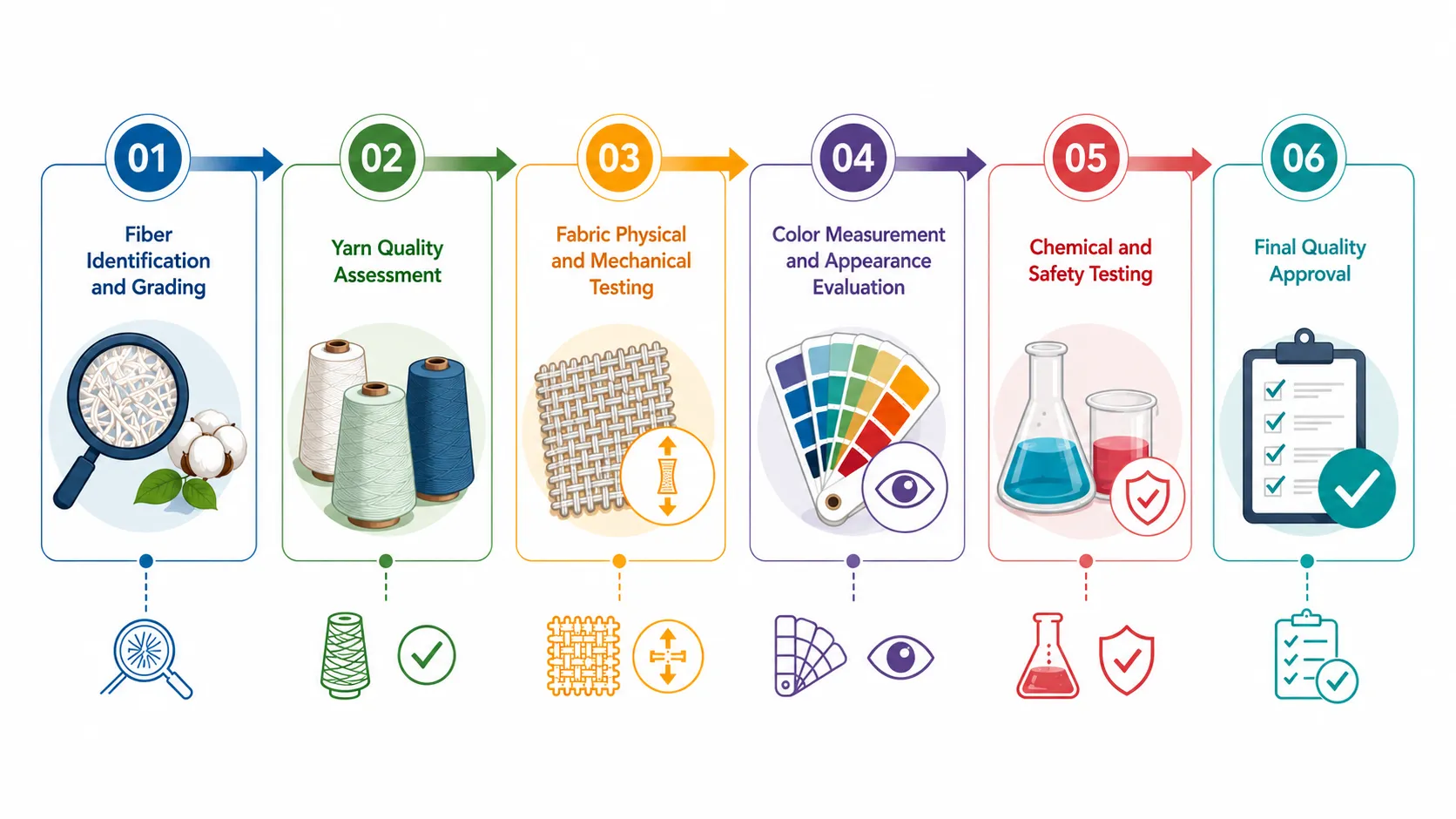
Effective textile quality control follows the production sequence. The most useful laboratory configuration therefore starts by identifying where quality decisions must be made—from incoming fiber inspection through yarn and fabric production to dyeing, finishing, and final product release.
Fiber Identification and Grading
Incoming fiber must be identified and evaluated before use. Natural fibers can contain foreign matter or vary in physical characteristics, while synthetic fibers may need confirmation of dimensions or morphology. Microscopic analysis can help distinguish fiber types based on longitudinal and cross-sectional features, while appropriate chemical identification procedures may provide additional composition information. Parameters such as fiber length, fineness, and appearance can also be used for incoming material assessment.
Accurate fiber analysis reduces the risk of material mix-ups and provides information that can affect downstream spinning and fabric performance. Where quantitative fiber composition is required, the laboratory should use an appropriate validated method for the specific fiber blend rather than relying on visual identification alone.
Recommended laboratory equipment for this stage:
- Microscope with image analysis – Examines fiber morphology and can support dimensional measurements and comparison of characteristic fiber structures.
- Fiber fineness tester (airflow or optical) – Supports fineness evaluation using the method appropriate to the fiber type and laboratory requirement.
- Microbalance – Weighs small fiber samples for quantitative preparation and measurement procedures.
- Fibre length analyzer – Measures staple length characteristics relevant to fiber grading and spinning performance.
- Chemical fume hood – Provides controlled ventilation when approved fiber-identification or sample-preparation procedures involve volatile or hazardous reagents.


Yarn Quality Assessment
Yarn quality directly affects weaving or knitting efficiency and the appearance of the finished fabric. Important variables can include linear density, twist, mass variation, tensile properties, moisture, and the presence of thick or thin places. Measuring these characteristics before weaving or knitting gives production teams an opportunity to identify inconsistent yarn before it creates larger quantities of defective fabric.
Yarn count testing verifies linear density against the required specification. Tensile testing measures breaking force and elongation, while evenness testing helps quantify mass variation along the yarn. Twist measurement provides another important process-control parameter because twist level and direction influence yarn behavior and final fabric characteristics.
Recommended laboratory equipment for this stage:
- Yarn count tester (wrap reel and balance) – Prepares a defined yarn length for linear-density determination using the applicable count system.
- Yarn twist tester – Measures twist per unit length and twist direction for comparison with production specifications.
- Yarn evenness tester – Measures mass variation along the yarn and helps identify thick places, thin places, and neps.
- Single yarn strength tester – Determines breaking force and elongation of individual yarn specimens.
- Moisture analyzer – Supports moisture-content assessment where moisture is relevant to material weight, conditioning, or processing behavior.

Fabric Physical and Mechanical Testing
Woven, knitted, and nonwoven fabrics can experience different mechanical stresses during processing and end use. The required tests should therefore be selected according to fabric construction and intended application. Tensile, tear, bursting, abrasion, pilling, thickness, air permeability, and dimensional-change tests are common examples, but not every test is necessary for every textile product.
Mechanical testing provides objective data for comparing production lots, investigating failures, and checking conformance with internal or customer specifications. Dimensional stability is particularly important where laundering or finishing can change garment fit, while abrasion and pilling testing provide information about surface durability under repeated use.
Recommended laboratory equipment for this stage:
- Universal Testing Machine (UTM) with appropriate fabric grips – Supports tensile and other force-based textile tests when configured with the fixtures required by the applicable method.
- Bursting strength tester (hydraulic or pneumatic) – Evaluates resistance to multidirectional loading and is commonly relevant to knitted fabrics and other materials suited to bursting tests.
- Martindale abrasion and pilling tester – Assesses abrasion resistance and/or pilling behavior under controlled rubbing conditions using the appropriate test configuration.
- Dimensional stability/shrinkage testing setup (washing machine and drying equipment) – Conditions textiles through specified laundering and drying procedures so dimensional change can be measured.
- Fabric thickness gauge – Measures thickness under defined test conditions for comparison between materials or against specifications.
- Air permeability tester – Measures airflow through a textile under defined conditions, supporting evaluation of breathable and technical fabrics.

Color Measurement and Appearance Evaluation
Color consistency is one of the most visible textile quality attributes. Differences between dye lots, uneven dyeing, or changes in appearance under different illumination conditions can lead to production or customer-acceptance problems. Instrumental color measurement gives manufacturers an objective way to compare samples with approved references.
Reflectance spectrophotometers can report color coordinates and color-difference values for comparison with established tolerances. Visual assessment in a controlled light booth complements instrumental measurement because appearance can change under different illumination conditions. Color fastness testing then evaluates how well the textile retains color or resists transfer under specified exposure conditions such as washing, rubbing, or light.
Recommended laboratory equipment for this stage:
- Benchtop spectrophotometer (reflectance) – Measures textile color and supports objective comparison of production samples with reference standards.
- Light booth / color viewing booth – Provides controlled illumination for consistent visual comparison of textile samples.
- Crockmeter / rubbing fastness tester – Evaluates color transfer under specified dry or wet rubbing conditions.
- Wash fastness tester (launderometer) – Provides controlled washing conditions for evaluating color change and staining according to the selected method.
- Xenon light fastness tester – Provides controlled light exposure for evaluating color or material changes where light fastness is relevant to the end use.

Chemical and Safety Testing
Chemical and safety testing requirements vary by textile type, chemical treatment, intended use, customer specification, and target market. Depending on those requirements, laboratories may need to evaluate characteristics such as extract pH or screen for selected chemical residues and restricted substances using an appropriate analytical method.
The analytical technique must match the substance being measured and the required sensitivity. A pH meter can support textile-extract pH testing, while UV-Visible spectrophotometry may be suitable for specific validated colorimetric methods. Other chemical targets can require more specialized analytical techniques that should be selected according to the required test method rather than assumed to be covered by one general-purpose instrument.
Flammability testing is similarly application-dependent. Where a product or customer specification requires a particular flammability method, the tester configuration must match that method and specimen type.
Recommended laboratory equipment for this stage:
- pH meter – Measures the pH of prepared textile extracts where extract-pH testing is required.
- UV-Visible spectrophotometer – Supports applicable validated colorimetric analyses where UV-Vis measurement is appropriate to the target analyte.
- Flammability tester (vertical or 45°) – Supports specified flammability procedures when the tester configuration matches the required method.
- Moisture analyzer / oven (for controlled drying) – Supports drying, moisture determination, or sample-preparation procedures where required.
- Analytical balance – Provides accurate sample and reagent weighing for quantitative laboratory procedures.
- Chemical fume hood – Provides controlled ventilation for laboratory procedures involving appropriate hazardous or volatile chemicals.


Common Quality Control Challenges in Textile Manufacturing
Textile manufacturers can encounter quality problems at multiple stages of production. Connecting each problem to a measurable test helps the laboratory determine which instrument is actually needed.
- Inconsistent raw material quality – Variation in fiber characteristics between lots can contribute to yarn and fabric inconsistency.
- Color shade variation across dye lots – Changes in dyeing conditions or materials can produce visible differences between batches.
- Poor color fastness – Insufficient color durability can result in fading, bleeding, or staining during use or care.
- Fabric strength failures – Insufficient mechanical performance can lead to tearing or failure during manufacturing or end use.
- Dimensional instability – Excessive shrinkage or growth after laundering or processing can affect garment dimensions and appearance.
- Chemical or safety non-conformance – A product may fail an applicable customer, test-method, or market requirement if relevant chemical or safety characteristics are not adequately controlled.
Key Quality Control Tests for Textile Quality Control
The table below connects common textile quality problems with useful laboratory tests, equipment, and production applications. The exact method and acceptance criteria should be selected according to the textile type and applicable specification.
| Quality Challenge | Quality Control Test | Recommended Laboratory Equipment | Application |
|---|---|---|---|
| Variation in raw fiber quality | Fiber fineness and length analysis | Fiber fineness tester, fibre length analyzer | Raw material selection and bale management |
| Yarn breakage during weaving | Single yarn strength and evenness | Yarn strength tester, yarn evenness tester | Yarn quality grading before processing |
| Color mismatch between dye lots | Instrumental color difference measurement | Benchtop spectrophotometer | Dye formulation and final inspection |
| Fading or staining after washing | Color fastness to washing | Wash fastness tester (launderometer) | Dye and finishing process evaluation |
| Fabric tearing during use | Tensile and applicable tear testing | Universal Testing Machine with appropriate fixtures | In-process and final fabric evaluation |
| Shrinkage after laundering | Dimensional stability testing | Washing machine, drying equipment, dimensional measurement tools | Fabric relaxation and finishing control |
| Finished-textile chemical concern | Extract pH or applicable chemical analysis | pH meter, UV-Vis spectrophotometer where method-appropriate | Finished fabric evaluation |
| Application-specific flammability concern | Specified flammability test | Flammability tester matched to the required method | Products subject to applicable flammability requirements |
Laboratory Equipment Required for Textile Quality Control
Setting up an effective textile quality control laboratory requires a balanced mix of physical testing instruments, color measurement devices, analytical tools, sample-preparation equipment, and appropriate environmental control. The correct combination depends on what the facility manufactures and which quality decisions must be made in-house.
Mechanical testers—including universal testing machines, bursting strength testers, and abrasion or pilling testers—support evaluation of fabric durability and mechanical performance. Color measurement is typically handled using spectrophotometers and controlled viewing booths, while dedicated fastness equipment reproduces specified rubbing, washing, or light-exposure conditions.
Chemical testing requires the analytical technique to be selected according to the target analyte and test method. Supporting equipment such as analytical balances, ovens, moisture analyzers, and fume hoods can be equally important because accurate sample preparation is part of the measurement workflow.
Textile laboratories should also consider sample conditioning and environmental monitoring. Where a test method specifies conditioning or atmospheric requirements, temperature and humidity should be controlled or monitored appropriately before and during testing. This helps reduce variability caused by differences in textile moisture condition.
The following table summarizes a practical equipment framework based on common textile testing needs.
| Testing Requirement | Laboratory Equipment | Why Manufacturers Need It |
|---|---|---|
| Fiber identity and quality | Microscope, fiber fineness tester, length analyzer | Supports incoming-material identification and characterization before spinning or blending. |
| Yarn performance | Yarn strength tester, evenness tester, twist tester | Identifies weak, inconsistent, or incorrectly twisted yarn before downstream processing. |
| Fabric mechanical properties | Universal Testing Machine, bursting strength tester, thickness gauge | Provides quantitative data for evaluating fabric performance against product requirements. |
| Color management | Spectrophotometer, light booth, crockmeter, wash fastness tester | Supports objective shade comparison, controlled visual assessment, and evaluation of selected color-fastness properties. |
| Dimensional stability | Washing machine, drying equipment, dimensional measurement tools | Measures dimensional change after specified conditioning, laundering, and drying procedures. |
| Chemical testing | pH meter, UV-Vis spectrophotometer where method-appropriate, analytical balance | Supports textile extract measurements and applicable quantitative analytical procedures. |
| Surface durability | Martindale tester, pilling box where required | Evaluates abrasion and pilling behavior for products where surface durability is an important quality attribute. |
| Flammability | Flammability tester matched to the required method | Supports application-specific flammability evaluation where such testing is required. |
| Sample conditioning | Controlled conditioning area and temperature/humidity monitoring equipment | Helps maintain consistent specimen condition when the selected textile test method requires defined atmospheric conditions. |
The instruments listed above form a practical foundation, but a manufacturer does not necessarily need every instrument in-house. The most cost-effective laboratory starts with high-frequency tests that directly affect production decisions, then adds specialized capabilities where sample volume, customer requirements, turnaround time, or outsourcing costs justify them.
Basic Laboratory Setup for Textile Manufacturers
The scale of a textile QC laboratory should match the product range, testing frequency, required methods, and production volume. A tiered approach helps separate routine process-control instruments from equipment that is justified only when more advanced testing is performed regularly.
| Laboratory Level | Recommended Equipment | Suitable For |
|---|---|---|
| Basic QC Laboratory | Microscope, yarn count tester, yarn twist tester, fabric thickness gauge, crockmeter, pH meter, analytical balance, light booth, washing machine, oven | Small mills or garment producers needing routine incoming-material, dimensional, appearance, and basic process checks. |
| Advanced QC Laboratory | Universal Testing Machine, yarn evenness tester, yarn strength tester, bursting strength tester, Martindale tester, spectrophotometer, wash fastness tester, dimensional stability kit | Mid-to-large producers performing broader physical, mechanical, yarn, color, and fastness testing in-house. |
| Advanced Analysis Laboratory | UV-Vis spectrophotometer, xenon light fastness tester, flammability tester, chemical safety testing setup, fiber length analyzer, high-end image analysis | Large integrated mills or testing laboratories that routinely perform specialized analytical, durability, fiber, or application-specific testing. |
These levels should be treated as planning frameworks rather than fixed packages. A dyehouse may prioritize color measurement and fastness equipment before mechanical testing, while a spinning mill may place greater emphasis on fiber and yarn analysis. Equipment selection should follow the actual production process and test workload.
How to Choose Laboratory Equipment for Textile Quality Control
Selecting textile testing equipment starts with the tests the laboratory must perform—not with a list of available instruments. Map each material or finished product to its quality requirement, required test method, expected sample volume, and decision point in production. The resulting test matrix can then be translated into an equipment list.
Define the Testing Scope
Start by identifying the sample types handled daily—fibers, yarns, woven fabrics, knitted fabrics, finished garments, or a combination—and the tests required by customers, internal specifications, or applicable methods.
For each test, identify the measurement capability required by the method rather than selecting equipment from a generic specification list. Color measurement, for example, may require careful consideration of instrument geometry, sample presentation, software workflow, and agreement between instruments used at different locations. Chemical analysis requires similar attention to the target analyte, preparation procedure, and required analytical sensitivity.
Separate routine high-frequency tests from specialized or occasional tests. A test performed on every production lot is a stronger candidate for in-house equipment than a complex analysis performed only a few times per year.
Evaluate Laboratory Workflow Requirements
Consider how many samples are processed daily, how quickly results are needed, and whether testing delays can stop production. High-volume operations may justify automated instruments, additional test stations, or software features that improve repeatability and data handling.
Operator skill level is also important. Equipment should match the laboratory team’s ability to prepare specimens, select methods, interpret results, perform routine checks, and maintain the instrument. Laboratory space and utilities must also be considered. Some instruments require dedicated ventilation, controlled environmental conditions, specific specimen-preparation areas, or separation from vibration, heat, moisture, or chemical handling.
For textile physical testing in particular, verify whether the applicable method requires specimens to be conditioned at defined temperature and humidity before testing. If so, environmental conditioning and monitoring are part of the laboratory system rather than optional accessories.
Decide What to Test In-House
Not every test needs to be brought into the factory laboratory. Routine measurements that affect immediate production decisions are usually the first candidates for in-house testing. Specialized chemical analysis or low-frequency application-specific tests may be more practical to outsource until testing volume justifies dedicated equipment and trained personnel.
A useful purchasing question is therefore not simply, “Which instrument can perform this test?” but also, “How often will we perform the test, how quickly do we need the result, and what expertise is required to produce reliable data?”
Compare Long-Term Equipment Support
Reliable testing depends on more than initial instrument performance. Before purchasing, consider the availability of installation support, operator training, routine maintenance, calibration or verification services, spare parts, consumables, software support, and suitable test accessories.
Also confirm that the proposed instrument configuration is appropriate for the test methods your laboratory actually uses. Fixtures, specimen holders, grips, environmental accessories, and software can be as important as the base instrument.
Companies like AELAB can help match specific textile testing requirements and workflow constraints to appropriate instrument categories. Providing the supplier with your sample types, required tests, expected daily volume, existing equipment, and main quality problems makes equipment selection more practical and reduces the risk of buying unnecessary capability.
Who Needs Laboratory Testing Solutions for This Industry?
The following professionals and organizations commonly benefit from dedicated textile quality control laboratory equipment:
- Vertical textile mills – From spinning through weaving, knitting, dyeing, and finishing, integrated mills can use in-house testing to make quality decisions at multiple production stages.
- Garment and home textile manufacturers – Incoming fabric and trim testing can identify problems before cutting and assembly add further value to the material.
- Dyehouses and finishing plants – Color measurement, fastness testing, dimensional evaluation, and process-related testing support consistent finishing results.
- Third-party testing laboratories – Independent laboratories may require a broader instrument portfolio because they handle multiple textile types, methods, and customer requirements.
- Retail and brand compliance teams – In-house laboratory capability can support supplier evaluation, comparative testing, troubleshooting, and selected verification checks.
Frequently Asked Questions
What is the most essential equipment for a textile quality control laboratory?
A basic textile QC laboratory should include a microscope for fiber identification, a universal testing machine for fabric strength, a spectrophotometer for color measurement, and a washing machine/oven for dimensional stability tests. These core instruments cover fiber, physical, color, and shrinkage testing, which are the most common quality checks.
How often should textile testing instruments be calibrated?
Calibration frequency depends on the instrument type, usage intensity, manufacturer recommendations, and your internal quality procedures. High-usage instruments like spectrophotometers and tensile testers typically require calibration every 3 to 6 months, while less used equipment can be calibrated annually. Always follow the manufacturer’s guidelines and applicable laboratory accreditation standards.
Can one laboratory setup test both woven and knitted fabrics?
Yes, most textile testing instruments can evaluate both woven and knitted fabrics. However, certain tests are specific: bursting strength is more relevant for knits, while tear strength applies to wovens. A well-equipped laboratory includes both a universal testing machine (with appropriate grips) and a bursting strength tester to accommodate all fabric types.
What training is required for laboratory staff operating textile QC equipment?
Operators should be trained in standard test methods, instrument operation, and basic troubleshooting. For many instruments, a combination of supplier-provided training and standard operating procedure documentation is sufficient. Staff performing chemical testing or operating advanced analysis equipment may need more specialized background in chemistry or textile engineering.
Conclusion
A textile quality control laboratory is most effective when its equipment reflects the manufacturer’s actual materials, production stages, quality risks, and testing workload. Rather than purchasing every available textile tester, manufacturers should begin with the measurements that drive routine production decisions and expand into specialized testing when customer requirements, turnaround time, or sample volume justify the investment.
A practical laboratory may combine fiber and yarn analysis, mechanical testing, dimensional stability testing, color measurement and fastness testing, and selected chemical or safety-related capabilities. Appropriate specimen conditioning, trained operators, documented procedures, and ongoing equipment support are equally important for producing useful and repeatable results.
Laboratory Equipment Solutions for Textile Quality Control
Implementing the right laboratory setup depends on matching your product range, required test methods, expected sample volume, and existing in-house capabilities with suitable instrument categories. AELAB can help textile manufacturers evaluate the required testing workflow—from raw fibers and yarns through fabrics and finished garments—and identify which equipment should be prioritized for routine QC versus advanced analysis.
For a more useful equipment recommendation, prepare a list of the products you test, required test methods, expected daily sample volume, existing laboratory equipment, and the main quality problems you need to control. This information provides a practical basis for comparing laboratory configurations without adding instruments that do not support a real testing requirement.