Apparel Material Testing Equipment Overview
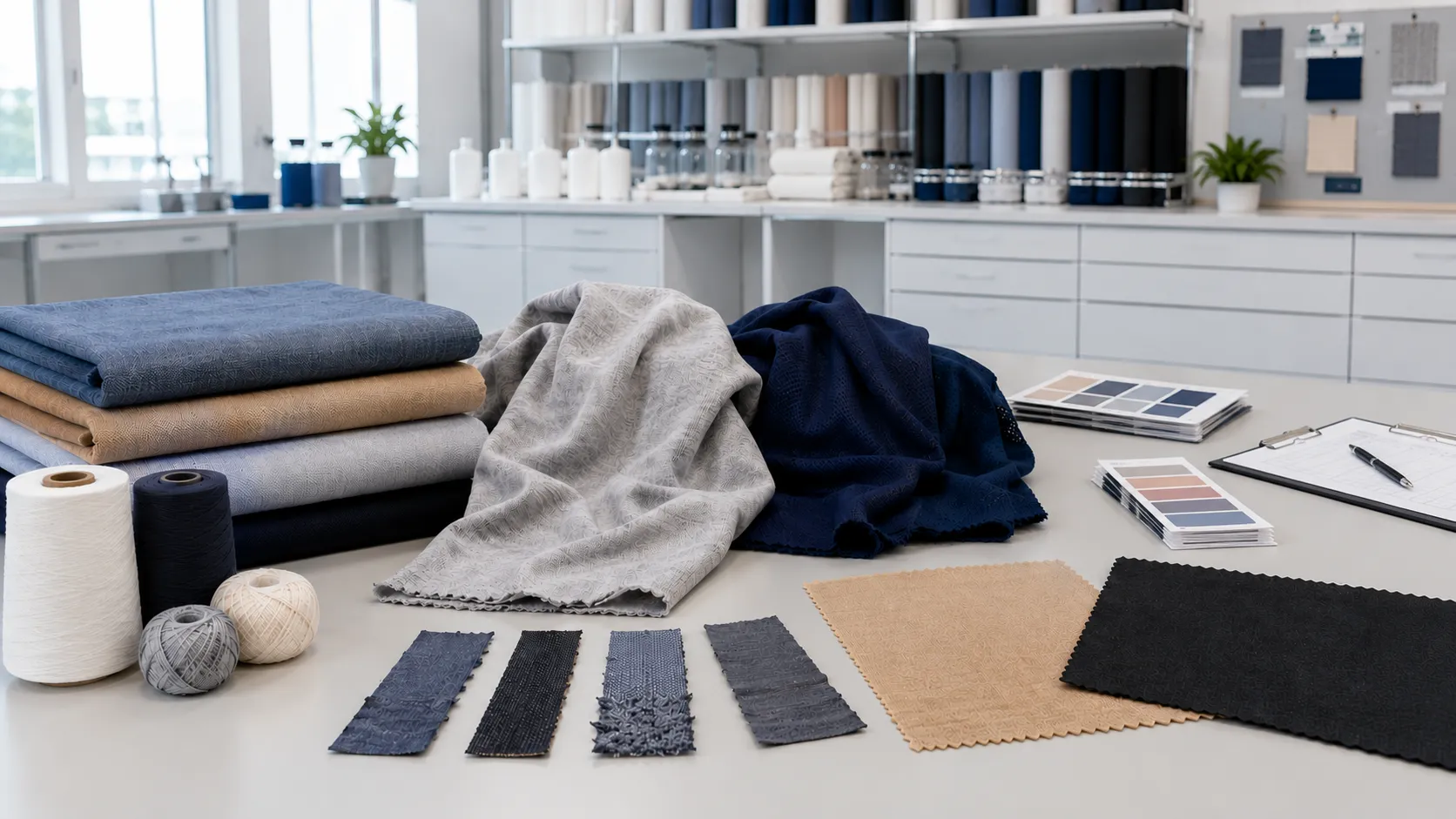
In the textiles and apparel industry, apparel material testing equipment helps manufacturers evaluate whether fabrics, trims, and finished garments meet defined quality requirements before shipment. A practical apparel quality control laboratory typically combines fabric inspection and measurement tools, color and color-fastness instruments, mechanical testing equipment, laundering and dimensional-stability equipment, and trim or garment performance testers.
The exact testing program depends on the material, garment type, production stage, buyer test methods, and known failure risks. Incoming inspection can identify variations before cutting, in-process testing helps control construction and finishing problems, and final testing verifies properties that affect garment durability, appearance, fit, and use. Connecting each quality problem to the appropriate test and instrument allows manufacturers to detect issues earlier and make more consistent production decisions.
Main Products and Applications
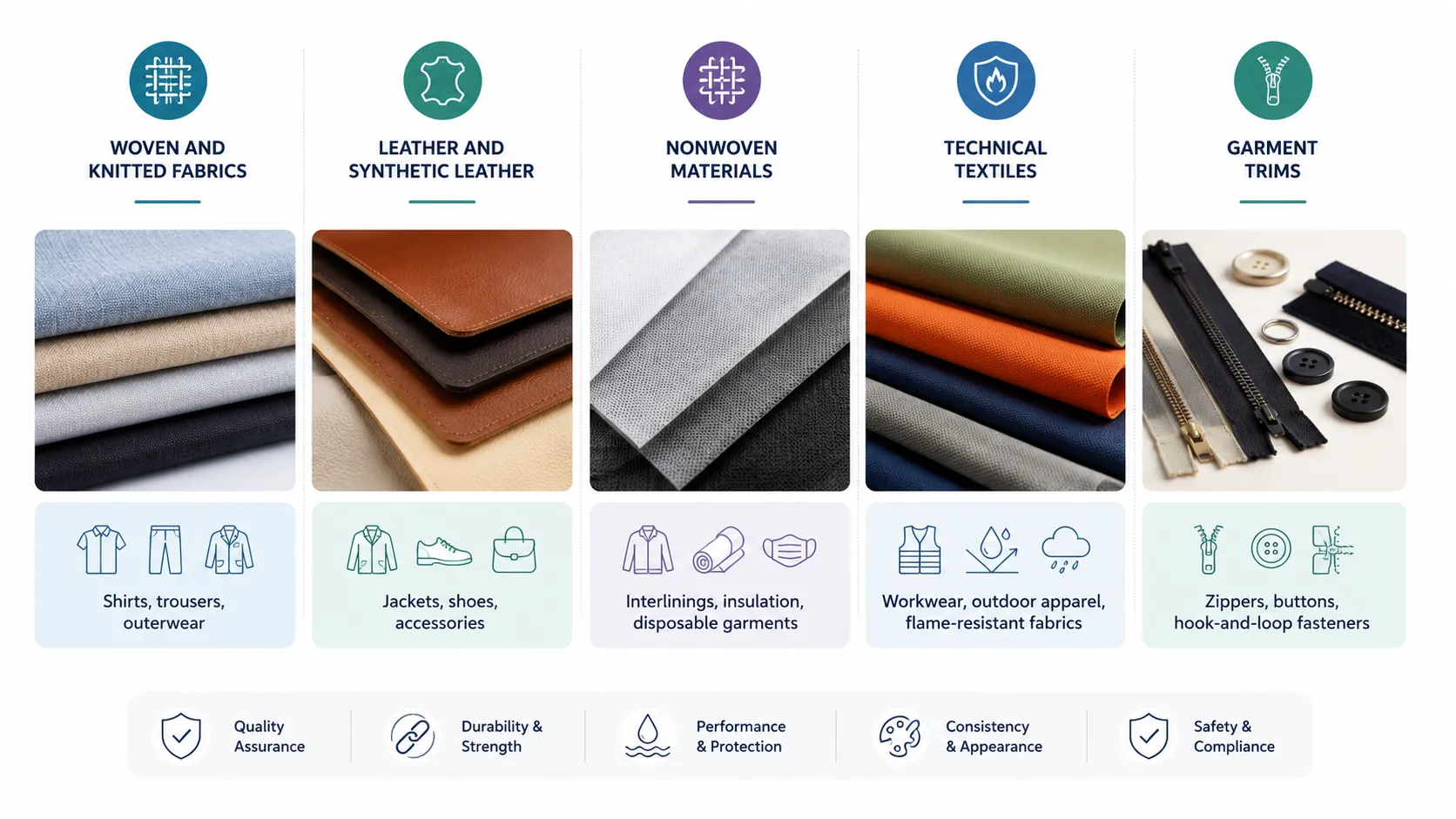
Apparel manufacturers work with a broad range of materials and components, each requiring specific quality checks. Common products and applications include:
- Woven and knitted fabrics – cotton, polyester, nylon, wool, and blends used in shirts, trousers, knitwear, outerwear, and other garments
- Leather and synthetic leather – used in jackets, footwear, and accessories where strength, thickness, and surface integrity may be important
- Nonwoven materials – used in interlinings, insulation, and disposable garments and evaluated according to their intended performance
- Technical textiles – performance fabrics used in workwear, outdoor apparel, and other applications requiring additional functional testing
- Garment trims – zippers, buttons, snaps, and hook-and-loop fasteners that require attachment and durability checks
Apparel Material Testing Quality Control Workflow
A useful apparel testing workflow follows the material from incoming inspection through processing and final garment verification. At each stage, the laboratory should focus on tests that can support an actual production or acceptance decision rather than testing properties without a defined purpose.
Raw Material Inspection
Before cutting and sewing begin, incoming fabrics and components should be checked for defects and property variations that could affect downstream production. Fabric rolls may contain weave faults, shade differences between lots, thickness variations, or other inconsistencies that influence garment appearance and performance. Detecting these problems before cutting can reduce material waste, sewing problems, and finished-product rejection.
Common incoming checks include fabric mass per unit area, yarn characteristics, thread density, thickness where relevant, moisture condition for moisture-sensitive materials, and visual inspection. The exact acceptance criteria should follow the manufacturer’s or buyer’s approved test method and specification.
Recommended laboratory equipment for this stage:
- Analytical Balance – supports accurate mass measurements used in fabric weight and sample preparation checks
- Fabric Inspection Table – provides a controlled viewing surface for identifying weaving faults, stains, holes, and other visible defects
- Yarn Count Tester (Wrap Reel method) – supports determination of yarn linear density when yarn count is part of incoming material control
- Pick Glass or Magnifier – enables close examination of weave structure and thread density
- Moisture Meter – supports moisture checks where material moisture can influence handling, mass, or dimensional behavior


In-Process Fabric Testing
During cutting, sewing, pressing, and finishing, the way a fabric responds to processing becomes important. Seam opening, excessive stretch, unsuitable stiffness, or heat-related appearance changes can affect garment construction and lead to rework. In-process testing gives production teams data that can support adjustments to sewing conditions, material selection, and finishing parameters.
Recommended laboratory equipment for this stage:
- Seam Slippage Tester – evaluates the tendency of yarns to move apart at a seam under applied force
- Fabric Stiffness Tester – measures bending behavior related to fabric handling and drape
- Heat Press or Scorch Tester – evaluates fabric response to controlled heat or pressing conditions
- Thread Tension Meter – helps monitor sewing-thread tension during process setup and troubleshooting
Color Fastness and Appearance Evaluation
Color consistency is a major quality requirement in apparel because shade variation, fading, and staining are immediately visible to buyers and consumers. Different tests are needed because a fabric can perform well under one exposure and poorly under another. Washing, rubbing, perspiration, and light exposure therefore need to be evaluated according to the product’s intended use and applicable test requirements.
Instrumental color measurement can also help compare production lots with an approved reference, while controlled visual assessment helps identify differences that may appear under specified lighting conditions.
Recommended laboratory equipment for this stage:
- Light Fastness Tester (Xenon Arc) – exposes specimens to controlled light conditions to evaluate color change over time
- Wash Fastness Tester (Launder-Ometer) – provides controlled laundering conditions for evaluating color change and staining
- Rubbing Fastness Tester (Crockmeter) – evaluates color transfer under controlled dry or wet rubbing conditions
- Spectrophotometer – provides objective color measurements and supports comparison of samples with reference colors
- Perspirometer – supports color-fastness testing under controlled perspiration-test conditions
- Standard Lighting Booth – provides controlled illuminants for consistent visual color comparison and appearance assessment

Physical and Mechanical Performance Testing
Apparel materials experience pulling, stretching, rubbing, tearing, and repeated surface contact during manufacturing and use. Mechanical testing helps determine whether the material has suitable strength and durability for its intended application. The most relevant test depends on the material structure: woven fabrics may require tensile and tear evaluation, while knitted and some nonwoven materials are commonly assessed using bursting methods. Abrasion and pilling tests address surface durability and appearance retention.
Recommended laboratory equipment for this stage:
- Universal Tensile Testing Machine – measures properties such as breaking force and elongation under a defined tensile test method
- Elmendorf Tear Tester – determines tear-propagation resistance for materials and methods suited to this test principle
- Bursting Strength Tester – evaluates resistance to multidirectional loading, commonly relevant to knitted and nonwoven materials
- Martindale Abrasion Tester – supports controlled abrasion and, where the applicable method allows, pilling evaluation
- ICI Pilling Box – evaluates pilling behavior under a controlled tumbling test procedure
Dimensional Stability and Care Simulation
Dimensional change after washing or drying can alter garment fit, seam alignment, and appearance. Laboratory care simulation allows manufacturers to expose specimens or garments to defined washing and drying conditions and measure the resulting dimensional change. The data can support fabric approval, process adjustments, and pattern or finishing decisions when those actions are permitted by the manufacturer’s quality procedure.
Recommended laboratory equipment for this stage:
- Washing Machine (Laboratory Grade) – provides controlled laundering conditions for dimensional-stability and appearance testing
- Tumble Dryer (Laboratory Grade) – provides controlled drying conditions as part of the selected care-simulation method
- Fabric Dimensional Stability Template – supports consistent marking and measurement of dimensional change
- Steam Iron and Pressing Table – supports controlled pressing or finishing evaluations where required by the test procedure
Final Garment Inspection and Performance Verification
Finished garments combine the fabric, seams, trims, color, dimensions, and workmanship into one product, so final inspection should connect laboratory results with actual garment quality. Measurements can be checked against the approved size specification, while attachment and cycling tests can evaluate buttons, snaps, zippers, and other functional components. Visual inspection also identifies workmanship problems such as loose threads, seam distortion, print misalignment, and unacceptable shade variation.
Sampling plans, acceptance criteria, and destructive-test frequency should be defined by the manufacturer’s quality system or buyer requirements rather than assumed from a universal rule.
Recommended laboratory equipment for this stage:
- Button Pull Tester – measures attachment force for buttons, snaps, and related components under the applicable test procedure
- Zipper Fatigue Tester – repeatedly cycles zippers to evaluate functional durability
- Fabric Thickness Gauge – measures material thickness under defined measurement conditions
- Portable Spectrophotometer – supports production-floor color comparison when the instrument and measurement geometry are suitable for the material
- Light Box with Illuminants – provides controlled viewing conditions for visual appearance and color comparison

Common Quality Control Challenges in Apparel Manufacturing
Apparel quality problems often originate in raw materials but become visible only after cutting, sewing, finishing, laundering, or use. Common issues include:
- Inconsistent dye lot coloration – producing visible shade differences between panels, garments, or production lots
- Uncontrolled dimensional change – altering garment size, fit, seam alignment, or appearance after care
- Low seam performance – allowing seams to open or distort under applied stress
- Pilling and surface fuzzing – reducing the appearance quality of fabrics after repeated friction or wear
- Inadequate color fastness – causing unacceptable color change or staining under washing, rubbing, perspiration, or other exposures
- Variations in fabric weight and thickness – affecting material consistency, handling, drape, and garment construction
Key Quality Control Tests for Apparel Materials
The table below maps common apparel quality problems to the test and instrument type that can help investigate or control them. The exact test procedure and acceptance limit should follow the applicable buyer, internal, or recognized test method.
| Quality Challenge | Quality Control Test | Recommended Laboratory Equipment | Application |
|---|---|---|---|
| Fabric tears or breaks too easily | Tensile strength test | Universal Tensile Testing Machine | Measures breaking behavior and elongation under a defined tensile method |
| Garment changes size after washing | Dimensional stability test | Laboratory Washing Machine and Dryer | Measures dimensional change after specified care cycles |
| Colors bleed or fade during laundering | Wash fastness test | Launder-Ometer | Evaluates color change and staining under controlled laundering conditions |
| Fabric surface pills after wear | Pilling resistance test | Martindale Abrasion Tester or ICI Pilling Box | Evaluates pilling tendency using the selected test method |
| Buttons or snaps detach under strain | Attachment strength test | Button Pull Tester | Measures the force associated with fastener attachment performance |
| Fabric shades mismatch between lots | Color difference measurement | Spectrophotometer | Provides objective color data for comparison with an approved reference |
| Seam opens under tension | Seam slippage test | Seam Slippage Tester | Evaluates yarn movement or seam opening under a defined load procedure |
| Zipper performance deteriorates with repeated use | Zipper durability test | Zipper Fatigue Tester | Cycles the zipper repeatedly to evaluate functional durability |
Laboratory Equipment Required for Apparel Material Quality Control
A practical apparel quality control laboratory combines instruments according to the tests that affect material approval and production decisions. Mechanical equipment such as Universal Tensile Testing Machines and Bursting Strength Testers evaluates material behavior under load, while abrasion and pilling instruments assess surface durability. Color control can require both instrumental measurement and fastness testing, using equipment such as spectrophotometers, launder-ometers, crockmeters, light-fastness testers, perspirometers, and controlled lighting booths.
Supporting equipment is equally important. Analytical balances support accurate mass measurements, fabric thickness gauges provide controlled thickness measurements, and suitable sample-conditioning or environmental control may be needed when the applicable test method requires defined laboratory conditions. The laboratory should therefore be configured around required test methods rather than around the largest possible list of instruments.
| Testing Requirement | Laboratory Equipment | Why Manufacturers Need It |
|---|---|---|
| Fabric strength and elongation | Universal Tensile Testing Machine | Provides mechanical-performance data for material approval and failure investigation |
| Color accuracy and consistency | Spectrophotometer | Supports objective comparison between production samples and approved references |
| Abrasion and pilling resistance | Martindale Abrasion Tester | Evaluates surface durability or pilling behavior under the applicable method |
| Dimensional change after care | Laboratory Washing Machine & Dryer | Measures how specified laundering and drying conditions affect garment or fabric dimensions |
| Seam performance | Seam Slippage Tester | Helps determine whether fabric and seam construction remain stable under applied force |
| Light and perspiration fastness | Xenon Arc Tester & Perspirometer | Evaluates color response to defined light or perspiration test conditions |
| Trim attachment security | Button Pull Tester | Provides quantitative attachment-force data for buttons, snaps, and related components |
| Raw material uniformity | Analytical Balance & Fabric Thickness Gauge | Supports comparison of fabric mass and thickness between incoming samples or lots |
The instruments listed above form the core of many apparel testing workflows, but not every manufacturer needs every instrument. Equipment priorities should be determined by the materials being produced, the required test methods, the most frequent quality failures, testing volume, and whether specialized testing is performed internally or outsourced.
Basic Laboratory Setup for Apparel Manufacturers
Laboratory capability can be built in stages. The categories below are practical planning examples rather than universal requirements; the final equipment list should follow the manufacturer’s products, test methods, buyer requirements, and expected workload.
| Laboratory Level | Recommended Equipment | Suitable For |
|---|---|---|
| Basic QC Laboratory | Analytical Balance, Fabric Thickness Gauge, Crockmeter, Standard Lighting Booth, Laboratory Washing Machine, Dimensional Stability Template | Manufacturers prioritizing incoming fabric checks, rubbing fastness, visual color assessment, and basic dimensional-stability testing |
| Advanced QC Laboratory | Universal Tensile Testing Machine, Spectrophotometer, Martindale Abrasion Tester, Launder-Ometer, Seam Slippage Tester, Pilling Box | Manufacturers that need broader mechanical, color, fastness, seam, abrasion, and pilling capabilities in-house |
| Advanced Analysis Laboratory | All advanced equipment plus Light Fastness Tester, Perspirometer, Zipper Fatigue Tester, Button Pull Tester, Spectrophotometer with integration software | High-throughput manufacturers, technical textile operations, or testing laboratories requiring a wider range of apparel performance tests |
How to Choose Laboratory Equipment for Apparel Material Testing
Selecting apparel material testing equipment should begin with the tests the laboratory actually needs to perform. Product type, material structure, applicable test method, sample volume, expected measurement range, operator capability, laboratory environment, and long-term service requirements all influence the appropriate configuration.
Define the Testing Scope
Start by identifying the products you manufacture and the failure modes that create the greatest production or customer risk. A manufacturer working primarily with woven fabrics may prioritize fabric construction, tensile or tear behavior, seam performance, color fastness, and dimensional stability. A producer of knitted or stretch garments may place greater emphasis on bursting performance, dimensional behavior, abrasion, pilling, and other tests relevant to the material and intended use.
Next, identify the actual test methods required by your internal quality system or buyers. Equipment should be selected to perform those methods and accommodate the expected specimen type and measurement range. This avoids purchasing an instrument that cannot support the required procedure or paying for capabilities that will not be used.
Evaluate Laboratory Workflow Requirements
Testing volume can change which equipment configuration is practical. A laboratory processing a small number of samples may prioritize straightforward operation and flexible instruments, while a higher-throughput facility may benefit from programmable methods, efficient specimen handling, data recording, and repeatable workflows.
Also consider specimen preparation, operator training, available bench or floor space, utilities, and any environmental conditions required by the applicable test method. An instrument that is technically capable of a test may still be a poor choice if the laboratory cannot prepare, condition, test, and document samples consistently.
Compare Instrument Capability and Test Requirements
Before purchasing, compare the required test method with the instrument’s operating principle and relevant capabilities. For mechanical testing, consider the specimen type, expected force range, fixtures or grips, and required measurements. For color measurement, consider the material surface, sample presentation, measurement geometry, and how results will be compared with approved references. For abrasion, pilling, washing, and fastness testing, confirm that the instrument configuration supports the procedure your laboratory intends to use.
This method-first approach is more reliable than selecting equipment solely by instrument name.
Compare Long-Term Equipment Support
Laboratory instruments are long-term assets, so equipment selection should also consider calibration, maintenance, replacement parts, consumables, operator training, and technical support. Items such as standard fabrics, abradants, adjacent fabrics, specimen holders, or other test accessories may be essential to routine operation depending on the method.
Before purchase, confirm what is included with the instrument, what must be sourced separately, and how ongoing calibration or service will be handled. A laboratory configuration is only practical when the required instrument, accessories, consumables, and support can be maintained throughout its working life.
Who Needs Laboratory Testing Solutions for This Industry?
- Garment factories and sewing plants that need to verify fabric, trim, construction, and finished-garment quality
- Textile mills performing in-house quality checks before supplying fabric to apparel manufacturers
- Buying houses and brand quality teams using laboratory results to support supplier and batch evaluation
- Third-party testing laboratories providing independent textile and apparel testing services
- R&D and product development departments evaluating new materials, constructions, colors, and finishes
Frequently Asked Questions
What is the most important piece of apparel material testing equipment for a small garment factory?
For a small factory, a Standard Lighting Booth and a basic Color Fastness Tester (Crockmeter) are often the first purchases, because color issues directly lead to buyer complaints. Combining these with an Analytical Balance to check fabric weight (GSM) covers critical raw material acceptance checks.
How often should tensile testing machines be calibrated?
Calibration frequency depends on instrument usage intensity, manufacturer recommendations, and internal quality procedures. Many facilities calibrate tensile testers annually or after a specified number of cycles. It is important to follow the equipment supplier’s guidelines and maintain records to support quality audits.
Can one spectrophotometer handle all apparel color measurement needs?
A benchtop spectrophotometer with a sphere-based optical geometry is suitable for most solid-color fabrics. However, materials with texture, sheen, or multicolored patterns may require specialized measurement modes or additional accessories. It is advisable to match the instrument capabilities with the specific material types your lab routinely tests.
Do we need a Martindale Abrasion Tester if we only produce woven fabrics?
Woven fabrics also benefit from abrasion testing, especially those used in high-wear areas like jacket sleeves or trouser seats. The Martindale method is widely accepted for evaluating both abrasion and pilling on woven and knitted textiles, making it a versatile addition even for woven-only product lines.
Conclusion
An effective apparel testing laboratory is built around the quality decisions a manufacturer needs to make. Incoming material inspection helps identify variation before production; in-process testing supports control of construction and finishing; color, mechanical, abrasion, pilling, and dimensional-stability testing evaluate important fabric properties; and final garment testing connects laboratory measurements with finished-product performance.
The best equipment configuration is therefore not necessarily the largest one. It is the configuration that covers the required test methods, material types, production risks, and sample volume with equipment that can be operated, calibrated, maintained, and supported consistently. Defining those requirements before purchasing makes it easier to separate essential instruments from advanced capabilities that can be added as testing needs grow.