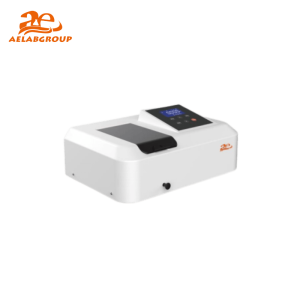
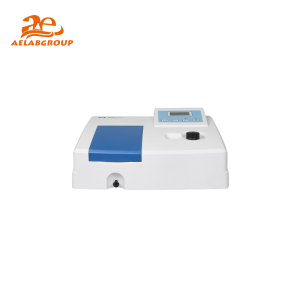
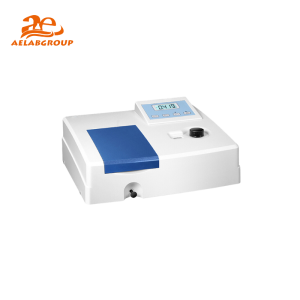
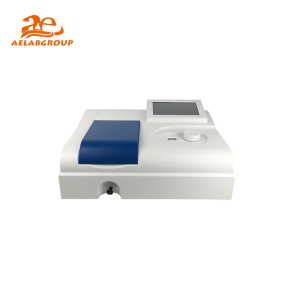
Overview
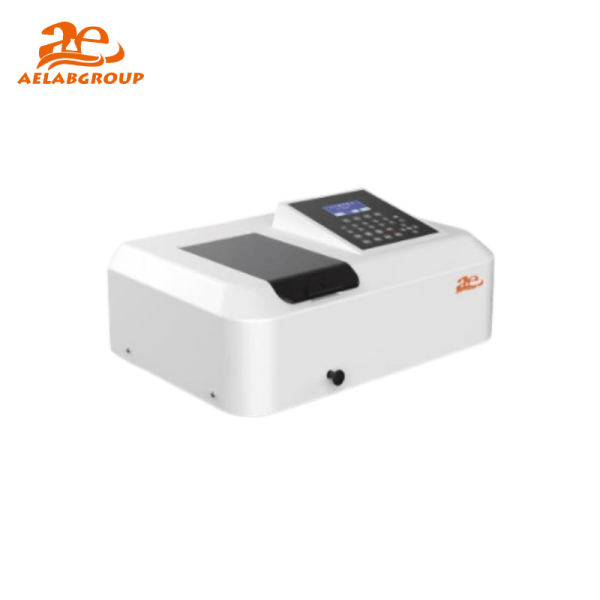
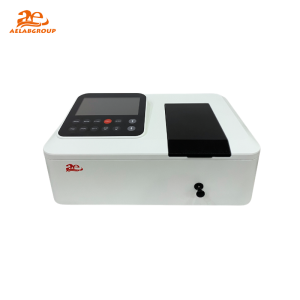
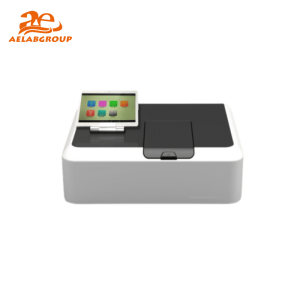
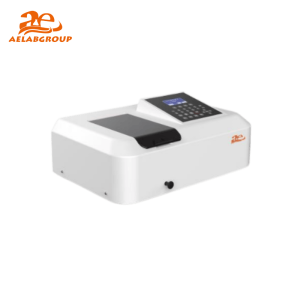
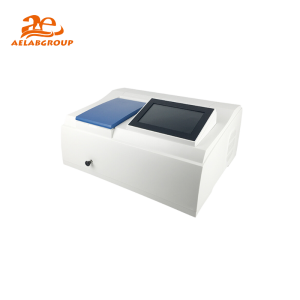
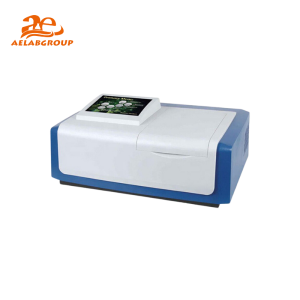
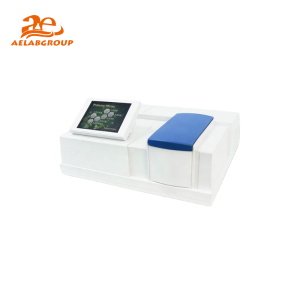
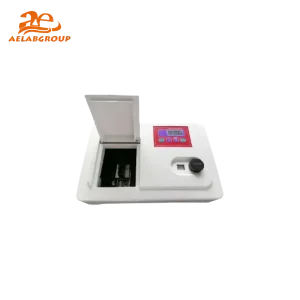
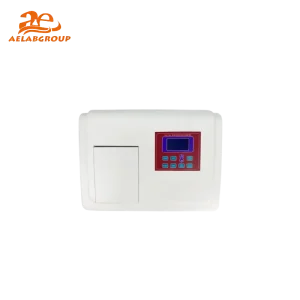
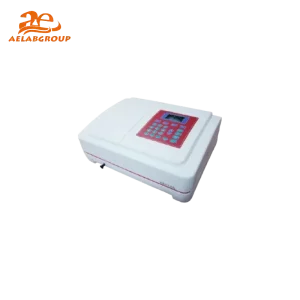
The AELAB AE-SP2000 Series UV-Visible Spectrophotometer integrates an ARM-based control platform with a 128×64 graphic LCD for fast processing and clear operation. It supports USB data export, one-click system upgrades, customizable wavelength calibration values, and automatic wavelength calibration. Lamp usage time is accumulated automatically, and the source switch menu can be closed when not in use. Chinese/English file management is supported.
The AELAB AE-SP2000 Series includes built-in programs for photometry, quantitative measurement (standard curve), spectrum scanning, time scanning, DNA/protein measurement, instrument verification measurement, and multi-wavelength measurement. Up to 1000 data sets can be stored; optional built-in/external mini printers and PC analysis software extend data processing. Optional accessories—such as an 8-position auto sample rack, microsample rack, 5–10 cm racks, and single/three-slot water-bath cuvette racks—expand testing capability.
⚙️ Design & Construction
- Single-beam optical system with 1200 line/mm grating for stable dispersive performance.
- Dual-lamp configuration: Tungsten lamp & Deuterium lamp for VIS and UV coverage.
- Graphic LCD (128×64) with ARM microcomputer control and structured menu navigation.
- Chassis designed for 450×390×210 mm footprint; model weight 11 kg (VIS) / 12 kg (UV).
- Power input AC90–250 V, 50–60 Hz for global laboratory compatibility.
🔬 Working Principle / Testing Method
The spectrophotometer measures absorbance or transmittance by directing a stabilized broadband lamp through a monochromator (1200 line/mm grating) to select the target wavelength. A single-beam optical path passes through the sample cuvette, and photometric detection quantifies absorbance (A), transmittance (%T), reflectance, or energy. Calibration functions set wavelength points and verify wavelength/photometric accuracy and stray light for GLP documentation. Time scanning acquires kinetic curves; multi-wavelength mode measures up to 10 set points; DNA/Protein mode calculates concentration and ratios at 260/280/230/320 nm.
💡 Key Advantages
- 2 nm spectral bandwidth with ±1 nm wavelength accuracy for routine analytical precision.
- Wavelength repeatability ≤0.5 nm and stray light ≤0.1%T (VIS @360 nm; UV @360 nm/220 nm) for reliable baselines.
- Automatic wavelength calibration and customizable calibration values reduce manual adjustment.
- Stores up to 1000 results; USB/CSV export with optional printing for GLP records.
- Comprehensive modes: photometry, quantitation (1st/zero-cross/2nd/3rd order), spectrum/time scans, multi-wavelength, DNA/protein.
- Lamp time accumulation and independent D2/W lamp control to optimize service life.
- Expandable with auto sampler, microsample, 5–10 cm, and water-bath cuvette racks.
🔗 Connectivity & Integration
- Data Output: U Disk, Bluetooth, and upload to PC via USB port.
- Data Format: CSV for LIMS/ELN and spreadsheet workflows.
- Optional PC control/analysis software for extended processing and reporting.
🧠 Model Insight
| Model |
Wavelength Range (nm) |
Lamp |
Optical System |
Weight (kg) |
| AE-SP2000 (VIS) |
320–1100 |
Tungsten & Deuterium |
Single beam; 1200 line/mm grating |
11 |
| AE-SP2000 (UV) |
190–1100 |
Tungsten & Deuterium |
Single beam; 1200 line/mm grating |
12 |
🧪 Testing Applications
- Environmental analysis: nitrate, phosphate, COD/kinetic measurements, colorimetric assays.
- Pharmaceutical and biochemical labs: API content, protein/DNA quantification at 260/280/230/320 nm.
- Food and beverage quality control: color, additives, and concentration by standard curves.
- Materials and general chemistry: absorbance/transmittance, spectrum scans, multi-wavelength evaluations.
Compliance & Quality Assurance
Supports GLP instrument verification measurements (wavelength accuracy, photometric accuracy, stray light) with results that can be stored, exported, and printed. Conforms to ISO/CE laboratory instrumentation norms. Calibration and verification steps provide traceable documentation for audits and method validation.