Overview
The AE-SP7000 Series Double Beam UV-Visible Spectrophotometer is a high-performance analytical instrument designed for precise and reliable spectroscopic measurements across a wide wavelength range of 190–1100 nm. Featuring a high-resolution C-T structure monochromator, aviation-grade aluminum alloy baseplate, and precision-machined mirror holder, it ensures long-term optical stability and accuracy. Powered by advanced ARM microcomputer technology and superior signal processing, it offers excellent stability, reproducibility, and efficient data handling with multiple output options including USB, Bluetooth printing, and software upgrades.
The instrument integrates a 7-inch full-color LCD touchscreen with an intuitive interface, complemented by physical buttons for convenient operation—even when wearing gloves. It supports a wide range of measurement functions, including absorbance, transmittance, concentration, quantitative analysis with standard curves, qualitative scanning, time/kinetic measurements, DNA/protein concentration analysis, and multi-wavelength testing. Enhanced spectral processing features such as peak/valley detection, smoothing, filtering, and curve fitting (up to third order) are also available.
With stringent 32-point quality control, robust internal memory, and internationally sourced key components such as deuterium/tungsten lamps and photodetectors, the AE-SP7000 Series guarantees durability and reliability. Additional GLP-compliant validation, lamp runtime tracking, wavelength auto-calibration, and optional PC software for 3D and overlay analysis make it ideal for research, quality control, and advanced laboratory applications.
Features:
- High – resolution C – T structure monochromator, excellent stability, reproducibility, and accuracy.
- Advanced ARM microcomputer technology, superior electronic circuits and signal processing. Data stored in the instrument can be exported via USB drive, and the software supports one – click upgrades and Bluetooth printing, among other data output options.
- Integrated aviation – grade aluminum alloy baseplate and precision – machined mirror holder to ensure long – term optical stability.
- Seven – inch color LCD touchscreen display with a user – friendly navigation interface. The interface offers clear operating commands and special features to prevent user errors, eliminating the need to consult the user manual. The instrument can be operated via both touchscreen and buttons, even while wearing gloves.
- Stringent manufacturing processes with 32 quality control points to ensure durability and robustness in every unit.
- Large internal memory for storing extensive test data.
- Key components such as deuterium lamp, tungsten lamp, photodetectors, precision lead screws, etc., are sourced from reputable international brands to guarantee instrument reliability.
- Four – slot adjustable manual sample rack with a range of 10 – 50mm cuvette length, accommodating various cuvette sizes for testing requirements.
- Independently designed deuterium lamp and tungsten lamp replacement windows with a flange – style positioning structure for easy replacement.
Product Functions:
- Absorbance Measurement: You can perform absorbance or transmittance measurements of samples within the range of 190 – 1100 nm, selecting single – point test wavelengths and methods as needed. Alternatively, you can directly read sample concentrations by inputting standard sample concentrations or concentration factors.
- Quantitative Measurement: Measure the concentration of unknown solution solutions using known parameter factors or by automatically creating standard solution curves. The instrument supports first – order zero crossing, second – order, and third – order curve fitting, as well as single – wavelength correction, dual – wavelength correction, and the optional three – point method. Standard curves can be stored and retrieved.
- Qualitative Measurement: Define the wavelength range, scan intervals, and measure absorbance, transmittance, reflectance, and energy of solid or liquid samples at intervals. You can also overlay, zoom, smooth, filter, detect peaks and valleys, save, print, and perform other actions on previously measured spectra.
- Time Measurement: Time measurement, also known as kinetic measurement, scans samples at time intervals for absorbance or transmittance at specified wavelengths. You can also calculate concentration from absorbance using concentration factors. Enzyme kinetics reaction rate calculations are also supported. Various spectral processing methods such as stalling, smoothing, filtering, peak valley detection, and differentiation are available.
- DNA/Protein Measurement: Primarily measures absorbance at 260nm/280nm/230nm/320nm to calculate DNA and protein concentrations and ratios using predefined formulas.
- Multi – wavelength Measurement: Configure multiple test wavelengths for measuring absorbance or transmittance of samples, with support for setting N test wavelengths.
- GLP General Laboratory Practice: Verify wavelength accuracy, photometric accuracy, and stray light, and provide validation data storage, export, and print.
- Additional Features: Accumulated runtimes for deuterium and tungsten lamps, independent on/off control for deuterium and tungsten lamps, wavelength selection for UV and visible light switching, language selection, wavelength auto – calibration, Bluetooth functionality, and more.
- Optional PC Control Software Package Functions: Quantitative measurement, qualitative measurement, time measurement, DNA/protein measurement, multi – wavelength measurement, 3D graphical analysis, spectral overlay analysis, and more.

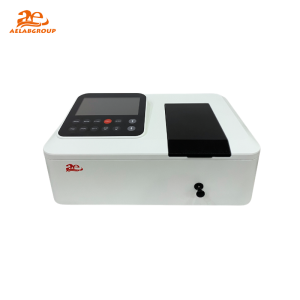
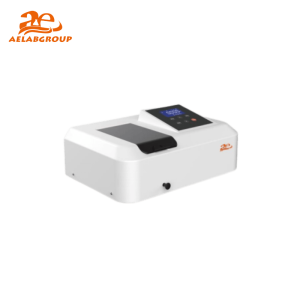
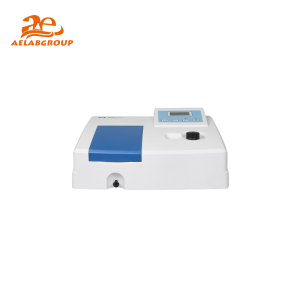
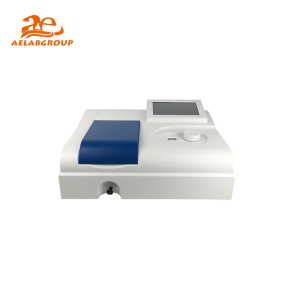
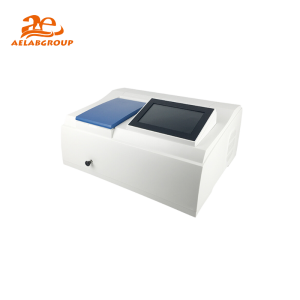
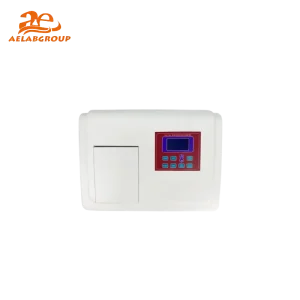
The front view highlights the benchtop instrument’s layout, with the operating panel on the left and sample compartment on the right. Both areas are accessible from the operator’s position.
|

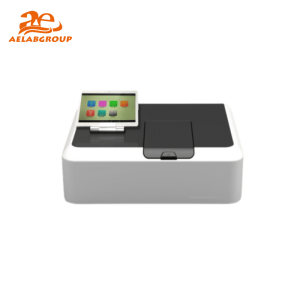
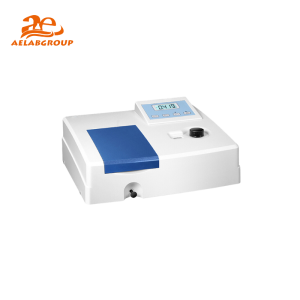
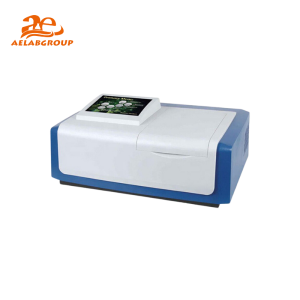
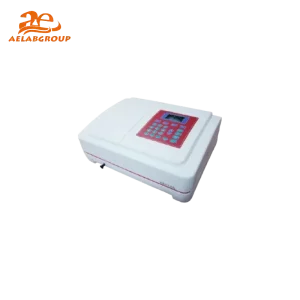
This angled view shows the instrument’s enclosure depth, raised operating panel, and sample compartment cover. It helps buyers assess the physical arrangement when planning placement on a laboratory bench.
|

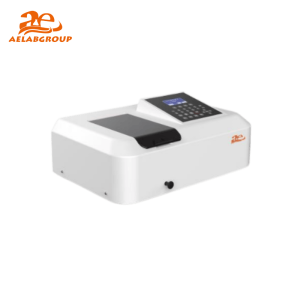
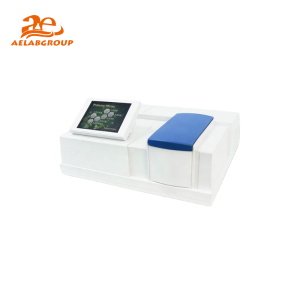
The overhead view clearly shows the screen and physical controls, including START, ZERO, and wavelength-setting buttons. The product page confirms touchscreen and button operation, giving users two ways to control the instrument.
|

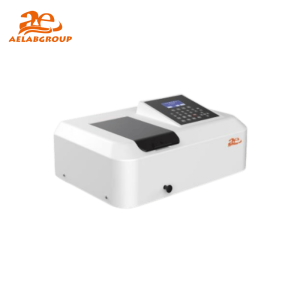
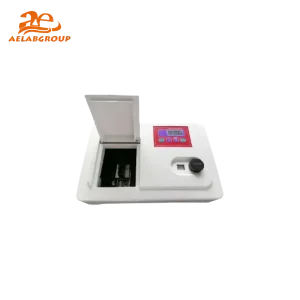
The rear view identifies the power and USB connection locations alongside the ventilation openings. These details help laboratories plan cable access and avoid obstructing the instrument’s ventilation during installation.
|