Laboratory Equipment for Color Fastness Testing in Textiles: Methods, Tests & Quality Control
Color fastness testing evaluates how well dyed or printed textiles resist color change and staining when exposed to conditions such as washing, light, perspiration, water, and rubbing. Because each exposure mechanism is different, textile quality control normally requires several test methods and specialized instruments rather than a single color fastness tester.
The core laboratory equipment typically includes a wash fastness tester for laundering-related color change and staining, a light fastness tester for resistance to light exposure, a crockmeter for dry and wet rubbing, and a perspirometer for perspiration testing. Grey scales support standardized visual assessment, while a spectrophotometer can provide objective instrumental color measurements where numerical color-difference data is required.
For textile mills, dyehouses, garment manufacturers, and quality laboratories, the appropriate laboratory setup depends on the products being tested, the required fastness properties, testing volume, customer methods, and whether visual assessment alone is sufficient or instrumental color measurement is also needed.
Main Products and Applications
- Dyed and printed apparel fabrics (cotton, polyester, blends)
- Finished garments and fashion accessories
- Home textiles (bedding, upholstery, curtains)
- Technical textiles and outdoor gear
- Leather and synthetic leather products
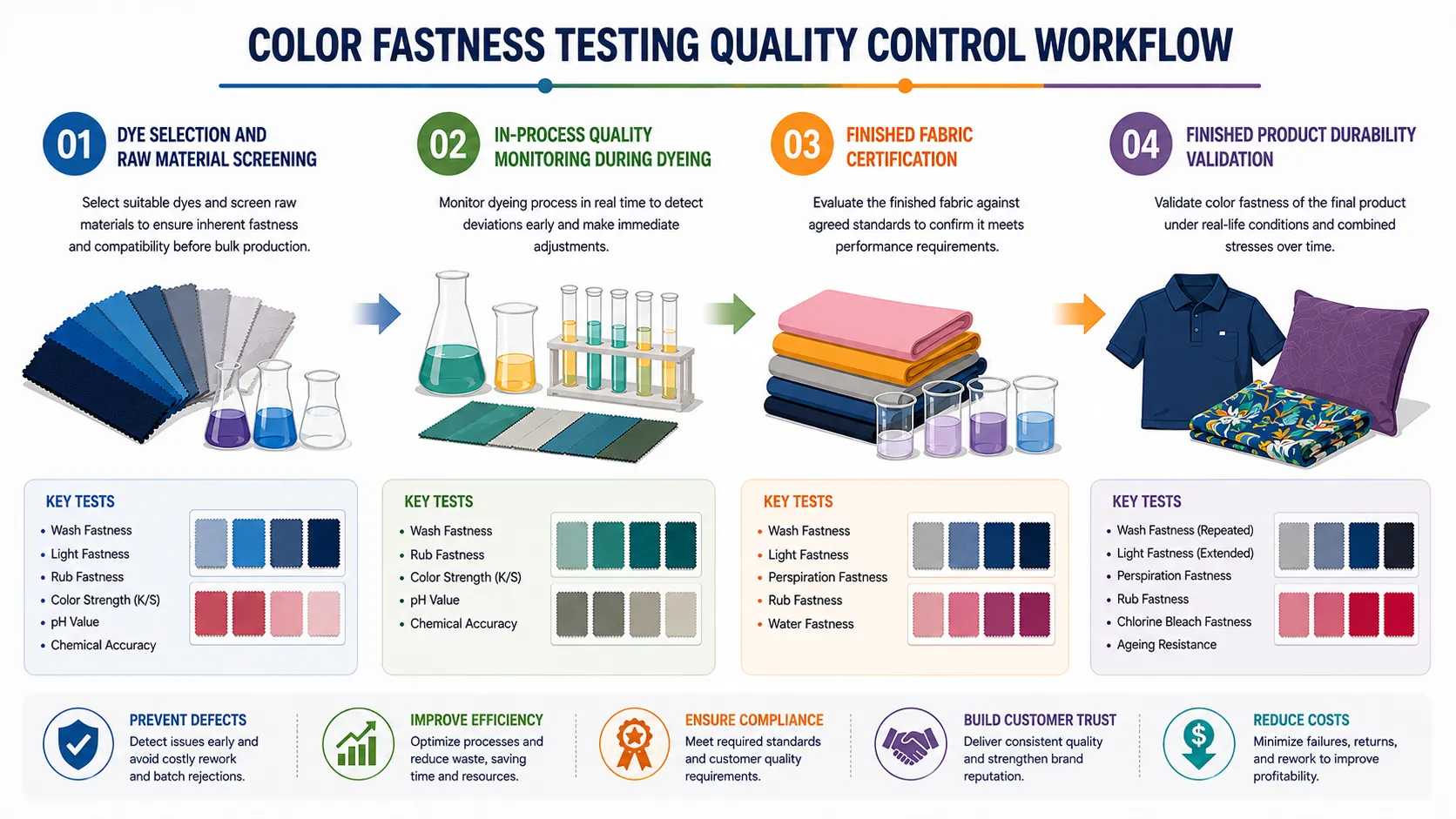
Color Fastness Testing Quality Control Workflow
Color fastness should be considered throughout textile production rather than only during final inspection. Early laboratory trials help screen dye systems, in-process checks help identify fixation or shade problems, finished-fabric testing supports lot release, and finished-product validation evaluates performance after components have been assembled.
1. Dye Selection and Raw Material Screening
At the earliest stage of textile manufacturing, selecting appropriate dyestuffs and chemical auxiliaries is important for achieving the required color performance. Laboratory dyeing trials on small fabric swatches allow candidate dye formulations to be compared before full-scale production.
The main properties evaluated at this stage may include wash fastness, light fastness, and rubbing fastness of laboratory-dyed samples. Results can support formulation adjustments and dye-selection decisions before a formulation is transferred to bulk production.
Recommended laboratory equipment for this stage:
- Laboratory Dyeing Machine – Prepares small-scale dyed samples under controlled laboratory conditions for formulation and process evaluation.
- Wash Fastness Tester – Simulates specified washing conditions to assess color change and staining of adjacent materials.
- Light Fastness Tester – Exposes specimens to controlled artificial light to evaluate resistance to fading.
- Crockmeter – Performs dry and wet rubbing tests to evaluate color transfer from the textile surface.
- Grey Scales – Provide standardized visual references for assessing color change and staining.
- Spectrophotometer – Provides instrumental color measurement where objective color-difference data is required.

2. In-Process Quality Monitoring During Dyeing
Once production dyeing begins, QC teams can evaluate samples during or after key processing stages to identify shade or fixation problems before the material progresses further. Variations in processing conditions can influence final color performance, making timely sampling valuable for process control.
Wash and rubbing fastness checks can help identify excessive bleeding or surface color transfer, while instrumental color measurement can be used to compare shade development and batch consistency. Supporting measurements such as pH and accurate chemical weighing can also help laboratories control dyeing and adjustment procedures.
Recommended laboratory equipment for this stage:
- Wash Fastness Tester – Evaluates resistance to color change and staining under specified washing conditions.
- Crockmeter – Checks dry or wet surface color transfer that may indicate inadequate fixation, washing-off, or finishing.
- Spectrophotometer – Supports objective shade comparison and color consistency assessment.
- pH Meter – Measures pH during laboratory preparation and process-control procedures where pH influences the dyeing or finishing process.
- Analytical Balance – Supports accurate weighing of dyes, chemicals, and auxiliary materials used in laboratory preparation and process adjustments.


3. Finished Fabric Certification
Before release to cutting, garment production, or a customer, finished fabric lots may undergo a broader color fastness evaluation based on the intended end use and agreed test requirements. This stage verifies that the finished textile achieves the required resistance to relevant exposure conditions.
Common evaluations include color fastness to washing, light, perspiration, rubbing, and water. Depending on the method and acceptance criteria, color change and staining may be assessed using grey scales, instrumental color measurement, or a combination of assessment approaches.
Recommended laboratory equipment for this stage:
- Wash Fastness Tester – Subjects specimens to specified washing conditions involving solution, temperature, time, and mechanical action.
- Light Fastness Tester – Provides controlled light exposure for evaluating fading resistance.
- Perspirometer – Applies controlled pressure to specimens treated with artificial perspiration solutions for color fastness assessment.
- Crockmeter – Evaluates color transferred to a standard rubbing cloth under dry or wet conditions.
- Water Fastness Tester – Supports assessment of color change and staining after exposure to water under the required test conditions.
- Grey Scales and Spectrophotometer – Support visual grading and, where required, objective instrumental color measurement.
4. Finished Product Durability Validation
Finished garments, upholstery, accessories, and other textile products may introduce additional color-performance risks because different fabrics, prints, trims, linings, and components are combined in one article. Testing the assembled product or representative components can identify problems such as color transfer between materials or differential fading.
The appropriate tests depend on intended use. Examples include repeated standardized washing assessments, chlorine-related fastness testing for relevant products, extended light exposure for textiles used in illuminated or outdoor environments, perspiration testing for garments worn next to the skin, and rubbing tests on printed or heavily dyed surfaces.
Recommended laboratory equipment for this stage:
- Wash Fastness Tester – Supports repeated standardized wash fastness evaluations where multiple test cycles are part of the laboratory assessment plan.
- Light Fastness Tester – Evaluates fading behavior of textile materials and components under controlled light exposure.
- Perspirometer – Supports perspiration fastness testing of garments and component materials.
- Crockmeter – Evaluates dry and wet rubbing color transfer on dyed, printed, coated, or finished surfaces.
- Laboratory Oven – Provides controlled heating or drying where required by the applicable laboratory procedure.
- Chlorine Bleach Fastness Tester – Supports evaluation of color resistance to chlorine-related exposure where this property is relevant to the product and required test method.

Common Quality Control Challenges in Textile Color Fastness
- Inconsistent dye uptake across different fabric lots, leading to variable color and fastness performance.
- Inadequate resistance to washing, causing unacceptable fading or color change during care.
- Poor light fastness in apparel, furnishings, or technical textiles exposed to sunlight or artificial light.
- Staining or color migration during washing, water exposure, or contact with perspiration.
- Color transfer during dry or wet rubbing, particularly on dark shades, prints, denim, and coated surfaces.
- Differences between laboratory exposure conditions and actual consumer use, making correct method selection important.
Key Quality Control Tests for Color Fastness in Textiles
Different color fastness tests answer different quality questions. The test should therefore be selected according to the exposure the textile is expected to encounter rather than treating “color fastness” as a single property.
| Quality Challenge | Quality Control Test | Recommended Laboratory Equipment | Application |
|---|---|---|---|
| Fading or color change after repeated laundering | Color Fastness to Washing | Wash Fastness Tester, Grey Scales, Spectrophotometer | Apparel, bed linen, towels |
| Fading due to sunlight or artificial light exposure | Color Fastness to Light | Light Fastness Tester (Xenon Arc), Blue Wool Standards | Curtains, outdoor textiles, garments |
| Staining of other materials during washing | Color Fastness to Washing (Staining) | Wash Fastness Tester, Multifiber Adjacent Fabric | Multi-color garments, linings |
| Color change or staining from perspiration | Color Fastness to Perspiration | Perspirometer, Artificial Perspiration Solution | Sportswear, workwear, intimate apparel |
| Color transfer due to rubbing (dry or wet) | Color Fastness to Rubbing (Crocking) | Crockmeter, Standard Rubbing Cloth | Denim, printed fabrics, upholstery |
| Color bleeding upon immersion in water | Color Fastness to Water | Water Fastness Tester, Laboratory Oven | Swimwear, rainwear, towels |
| Color degradation from chlorine bleach | Color Fastness to Chlorine Bleach | Chlorine Bleach Fastness Tester | Swimwear, towels, healthcare textiles |
| Batch-to-batch shade inconsistency | Color Measurement and Shade Matching | Spectrophotometer, Light Booth | All dyed and printed textiles |
Laboratory Equipment Required for Textile Color Fastness Quality Control
A color fastness laboratory combines exposure equipment with assessment tools. Wash fastness testers, light fastness testers, crockmeters, and perspirometers create controlled test conditions, while grey scales and instrumental color-measurement equipment help assess the resulting color change or staining.
For a basic textile QC laboratory, wash fastness and rubbing tests are often practical starting points because they address common risks in apparel and general textile production. Laboratories handling a broader range of products may add perspiration, water, and light fastness testing. A spectrophotometer becomes particularly valuable when objective color comparison, numerical tolerances, or tighter batch-to-batch shade control is required.
| Testing Requirement | Laboratory Equipment | Why Manufacturers Need It |
|---|---|---|
| Evaluate color change and staining after washing | Wash Fastness Tester | Provides controlled washing exposure for assessing whether dyed or printed textiles retain acceptable color and avoid excessive staining. |
| Assess resistance to prolonged light exposure | Light Fastness Tester | Evaluates fading risk for textiles exposed to sunlight or artificial light during use. |
| Measure color transfer when rubbed | Crockmeter | Evaluates dry and wet rubbing transfer, particularly for dark shades, denim, prints, and surface finishes. |
| Test color fastness to sweat | Perspirometer | Supports assessment of color change and staining caused by perspiration exposure. |
| Verify water fastness | Water Fastness Tester | Evaluates color behavior when textile materials are exposed to water under specified test conditions. |
| Objectively measure color difference | Spectrophotometer | Provides numerical color measurement to complement visual assessment and support objective shade comparison. |
| Provide standardized visual ratings | Grey Scales | Provide standardized references for visual assessment of color change and staining. |
| Provide controlled heating or drying | Laboratory Oven | Supports laboratory procedures that require controlled temperature, drying, or conditioning steps. |
Together, these instruments allow a laboratory to match specific textile failure risks with the appropriate exposure and assessment method. The most suitable configuration is therefore determined by the products manufactured and the fastness properties that must be evaluated, not simply by purchasing the largest possible instrument set.
Basic Laboratory Setup for Textile Color Fastness Testing
The distinction between basic and advanced laboratories should be based on testing scope. A small dyehouse performing routine internal checks may need only the most frequently used fastness tests, while a textile mill, brand laboratory, R&D center, or third-party laboratory may require broader exposure testing and more objective color analysis.
| Laboratory Level | Recommended Equipment | Suitable For |
|---|---|---|
| Basic QC Laboratory | Wash Fastness Tester, Crockmeter, Grey Scales, Laboratory Oven | Small dyehouses, garment checkers, quick in-house checks |
| Advanced QC Laboratory | Wash Fastness Tester, Light Fastness Tester, Perspirometer, Water Fastness Tester, Crockmeter, Grey Scales, Spectrophotometer | Mid-size manufacturers, brand QC departments, textile mills |
| Advanced Analysis Laboratory | All of the above plus Xenon Arc Weatherometer, Chlorine Bleach Fastness Tester, Color Matching Cabinet, Data Management Software | R&D centers, third-party testing labs, high-accuracy requirements |
How to Choose Laboratory Equipment for Color Fastness Testing
Selecting color fastness equipment starts with the tests your products actually require. A laboratory should define its sample types, required exposure methods, assessment approach, expected workload, and support requirements before deciding which instruments belong in the initial configuration.
Define the Testing Scope
Begin by identifying the samples tested most frequently, such as yarn, fabric, printed material, or finished products, and the fastness properties most important to their intended use. Apparel laboratories may prioritize washing, rubbing, and perspiration, while textiles exposed to strong or prolonged illumination may require greater emphasis on light fastness.
The required customer or laboratory test methods should be identified before equipment selection because the instrument must support the procedure the laboratory intends to perform. Assessment requirements should also be considered: some workflows rely primarily on standardized visual grading, while tighter color-control programs may also require instrumental color measurement with a spectrophotometer.
A company like AELAB can assist in matching your testing requirements with the appropriate instrument categories.
Evaluate Laboratory Workflow Requirements
Consider how many samples the laboratory processes and how quickly results are required. Testing volume can affect the importance of sample capacity, programmable operation, workflow efficiency, and operator involvement.
Laboratory space and installation conditions also matter. Larger light-exposure systems and other specialized instruments may require more dedicated laboratory space and facility planning than compact benchtop equipment. These practical requirements should be evaluated before the laboratory configuration is finalized.
Separate Essential Equipment from Advanced Capabilities
Not every laboratory needs every color fastness instrument at the beginning. A practical configuration should first cover the fastness properties most closely connected to the manufacturer’s products and customer requirements.
Additional equipment can then be justified by broader product coverage, new customer methods, increased testing volume, R&D requirements, or the need for more objective color analysis. This approach helps avoid both under-equipped laboratories that cannot perform necessary tests and over-equipped laboratories with instruments that are rarely used.
Compare Long-Term Equipment Support
Equipment selection should include the ongoing requirements of the test method, not only the instrument itself. Consider access to appropriate consumables and reference materials, calibration or verification support, replacement components, operator training, maintenance, and technical assistance.
For laboratories using light sources, adjacent fabrics, rubbing cloths, grey scales, or other method-specific materials, continued availability of these items is an important part of maintaining a usable testing workflow.
Who Needs Laboratory Testing Solutions for This Industry?
- Textile mills and dyehouses that need to monitor shade consistency and fastness performance across production lots.
- Garment manufacturers evaluating finished products against brand, customer, or internal color fastness requirements.
- Home textile and upholstery producers evaluating color durability under washing, rubbing, water, or light exposure.
- R&D departments developing or comparing dye formulations, printing systems, and fabric finishes.
- Third-party testing laboratories and quality assurance service providers performing multiple color fastness methods.
Frequently Asked Questions
What is the most important color fastness test for everyday apparel?
Color fastness to washing and rubbing are typically the most critical for everyday apparel, as garments frequently undergo laundering and experience friction during wear.
Can one instrument perform all color fastness tests?
No, color fastness testing requires multiple specialized instruments because different tests simulate distinct environmental conditions, such as mechanical agitation for washing, arc lamp exposure for light, and pressure cells for perspiration.
How do I know if my laboratory needs a spectrophotometer for color fastness?
A spectrophotometer is essential when objective, numerical color difference data is required for pass/fail decisions or when visual grey scale ratings are not sufficient for your quality tolerance. It also helps in reducing operator bias.
What support should I expect after purchasing color fastness equipment?
Reliable suppliers offer installation and commissioning, operator training, regular calibration services, prompt technical support, and availability of spare parts and consumables to keep instruments operating accurately over their lifespan.
Conclusion
Effective textile color fastness testing depends on matching each expected exposure condition with the appropriate test method and laboratory equipment. Washing, light, rubbing, perspiration, and water represent different performance risks and therefore require different testing approaches.
For a basic QC laboratory, the priority is to cover the fastness properties most relevant to the products being manufactured. More advanced laboratories can expand into light exposure, additional chemical or environmental fastness tests, and instrumental color measurement as customer requirements, product scope, and testing volume increase. Building the laboratory around actual test requirements creates a more practical and maintainable quality-control system than selecting instruments without a defined testing workflow.