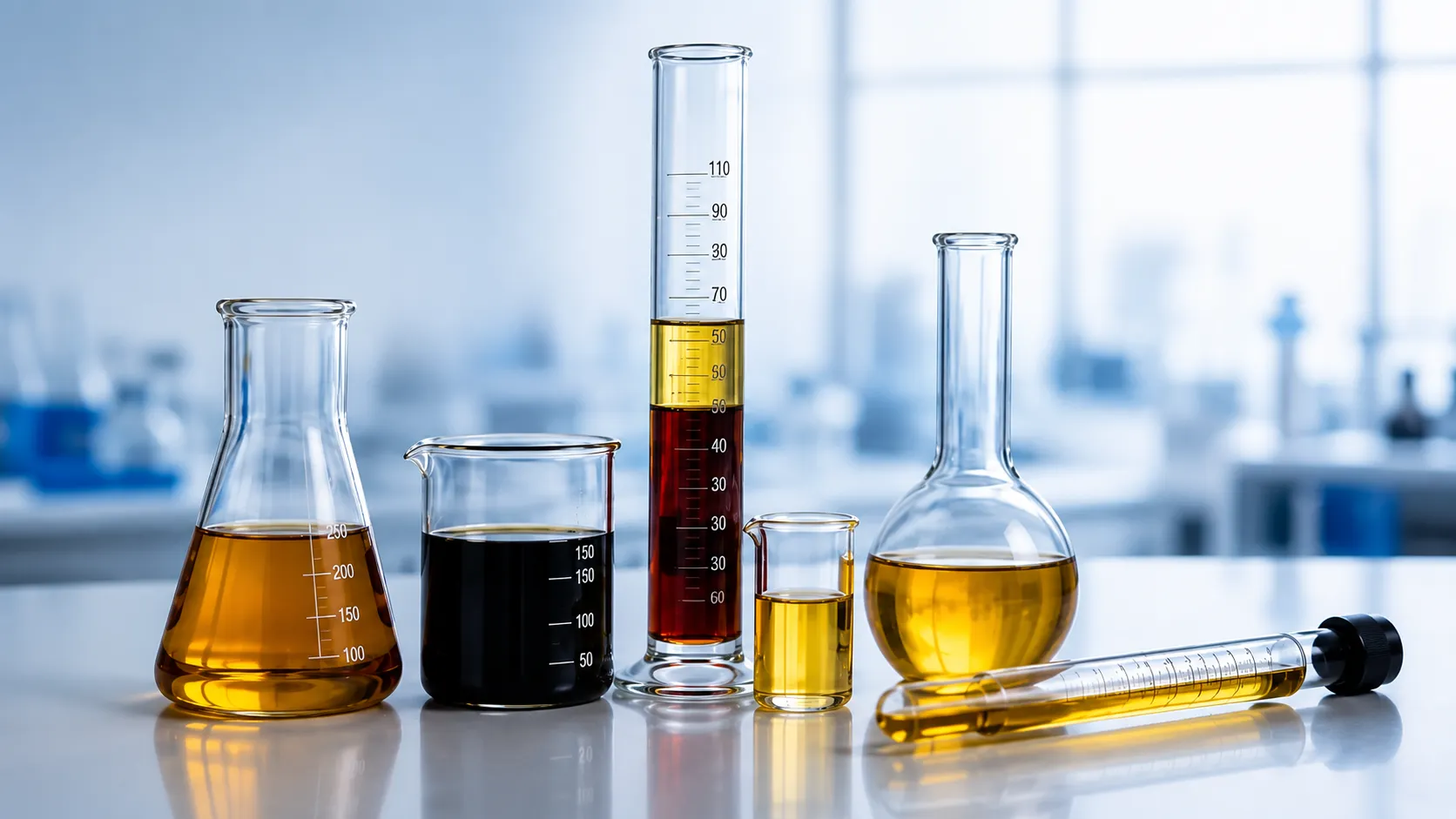
Laboratory Equipment for Petroleum Testing and Quality Control
Petroleum testing laboratories use specialized instruments to measure the physical, chemical, and performance properties of crude oil, fuels, lubricants, and other petroleum products. Common testing requirements include distillation, viscosity, flash point, density, sulfur, water content, low-temperature properties, oxidation stability, and compositional analysis.
The required laboratory equipment depends on the petroleum product, applicable test methods, sample workload, and the level of analysis required. Routine quality control laboratories may focus on physical-property testing, while laboratories supporting product development, troubleshooting, or detailed composition analysis may also require advanced analytical instruments such as gas chromatographs or XRF spectrometers.
This article explains the main laboratory equipment used in petroleum testing, where each instrument fits into the testing workflow, and the practical factors to consider when selecting equipment.
What Is Petroleum Testing Laboratory Equipment?
Petroleum testing laboratory equipment includes instruments and supporting laboratory systems used to evaluate the quality, safety, identity, handling characteristics, and performance of petroleum products.
Different tests answer different quality-control questions. Distillation testing evaluates boiling-range and volatility characteristics, viscosity testing measures resistance to flow, flash point testing supports flammability assessment, density testing assists with product characterization, and chemical analysis can identify sulfur, water, metals, or hydrocarbon composition.
Because petroleum products range from volatile fuels to lubricating oils and heavy residues, there is no single universal petroleum testing instrument. Equipment selection should begin with the product being tested and the required test method, followed by the appropriate instrument type.
Common Petroleum Laboratory Tests
The most frequent analyses in a petroleum lab include:
- Distillation characteristics (ASTM D86)
- Viscosity measurement (ASTM D445)
- Flash point determination (ASTM D93)
- Density and API gravity (ASTM D4052)
- Sulfur content (ASTM D5453)
- Oxidation stability (ASTM D2274)
- Pour point and cloud point (ASTM D97)
- Octane and cetane number
These tests do not apply equally to every petroleum product. A gasoline laboratory, lubricant laboratory, crude-oil laboratory, and refinery QC laboratory may therefore require different combinations of instruments.
Petroleum Testing Workflow
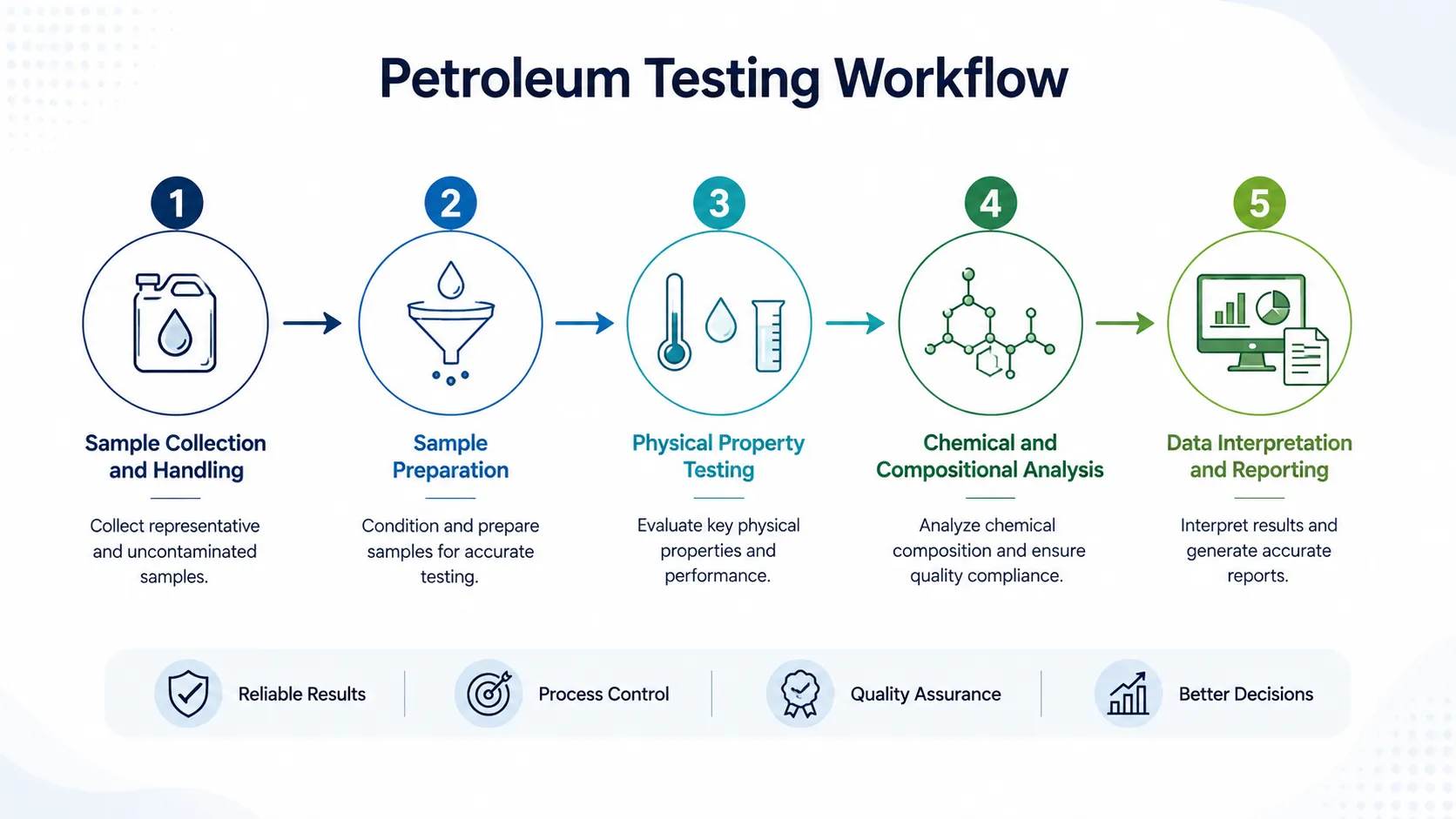
A reliable petroleum testing workflow begins before the sample reaches the analytical instrument. Sampling, preparation, conditioning, measurement, calibration, and data review can all affect the usefulness of the final result.
Sample Collection and Handling
Proper sampling is critical because the laboratory result must represent the material being evaluated. Samples should be collected, contained, transported, and stored in a way that minimizes contamination or unintended changes before testing. For volatile products, sampling practices should also minimize loss of light components.
QC checks: Verify container cleanliness, sample identification, sample homogeneity where applicable, and appropriate transportation and storage conditions.
- Sampling cans and bottles
- Sample coolers
- In-line sample probes
Sample Preparation
The required preparation depends on the petroleum product and test method. Conditioning may include controlled heating, mixing, filtration, separation, or other method-specific preparation before measurement.
QC checks: Confirm required conditioning temperature, preparation procedure, filtration requirements where applicable, and equilibration time.
- Laboratory ovens and water baths
- Centrifuges for sediment separation
- Magnetic stirrers with heating


Physical Property Testing
Physical-property testing is a major part of routine petroleum quality control. These tests can evaluate boiling behavior, flow characteristics, density, ignition-related safety properties, and low-temperature performance.
The instrument should be selected according to the required test method and petroleum matrix rather than by instrument name alone.
QC checks: Follow the applicable test method, verify instrument condition and calibration or verification requirements, and use appropriate reference materials where required.
- Automatic distillation analyzers
- Kinematic viscosity baths
- Pensky-Martens flash point testers
- Density meters
- Pour point analyzers


Chemical and Compositional Analysis
Chemical and compositional testing is used when the laboratory needs information beyond bulk physical properties. Depending on the application, laboratories may measure sulfur, elemental contaminants, hydrocarbon composition, or other constituents that influence product quality, processing, or downstream performance.
Advanced analytical techniques such as gas chromatography are particularly useful when detailed separation and identification of petroleum components are required.
QC checks: Apply method-appropriate calibration, blanks, quality-control samples, sensitivity checks, and instrument-performance verification.
- Sulfur analyzers (UV fluorescence)
- Gas chromatographs with FID/TCD detectors
- X-ray fluorescence (XRF) spectrometers for metals analysis


Data Interpretation and Reporting
Testing is complete only when the laboratory can review, trace, and report the result correctly. Laboratory Information Management Systems (LIMS) and other data-management tools can support result capture, specification comparison, traceability, and trend analysis.
QC checks: Review results against the applicable specification or internal control limits, investigate unusual results, and use duplicate analysis or proficiency testing where required by the laboratory’s quality system.
- Laboratory data management software
- Computers and printers
Key Quality Control Tests for Petroleum Products
The most useful way to plan a petroleum laboratory is to connect each product requirement to a test and then to the instrument needed to perform that test.
| Quality Control Test | Purpose | Common Laboratory Equipment | Relevant Product Types |
|---|---|---|---|
| Distillation | Determines volatility and boiling range distribution | Automatic distillation analyzer | Gasoline, diesel, jet fuel, crude oil |
| Kinematic Viscosity | Measures fluid resistance to flow at specific temperatures | Viscometer bath, capillary viscometers | Lubricating oils, base oils, diesel |
| Flash Point | Indicates the lowest temperature at which vapors ignite | Pensky-Martens or Abel flash point tester | All flammable petroleum liquids |
| Density / API Gravity | Correlates to crude oil quality and product identification | Digital density meter, hydrometers | Crude oil, refined products |
| Sulfur Content | Critical for environmental compliance and corrosion control | UV fluorescence sulfur analyzer, XRF | Fuels, diesel, gasoline, crude oil |
| Water Content | Prevents corrosion, microbial growth, and fuel line freezing | Karl Fischer titrator | Crude oil, lubricants, diesel, gasoline |
| Pour Point | Determines the lowest temperature at which oil flows | Pour point analyzer | Lubricating oils, diesel, heavy fuels |
| Oxidation Stability | Evaluates resistance to sludge and acid formation | Oxidation stability bath | Transformer oils, turbine oils, lubricants |
| Octane Number | Measures knocking resistance in spark-ignition engines | Octane rating engine, knock intensity meter | Gasoline |
Recommended Laboratory Equipment for Petroleum Testing Laboratories
A petroleum laboratory does not necessarily need every instrument listed below. The appropriate configuration depends on the products handled and the tests the laboratory is responsible for performing.
| Laboratory Equipment | Main Application | Why It Matters |
|---|---|---|
| Automatic Distillation Analyzer | Boiling range distribution of petroleum fractions | Ensures product volatility meets engine requirements |
| Kinematic Viscometer Bath | Viscosity measurement of oils and fuels | Direct impact on lubrication and fuel injection |
| Flash Point Tester | Safety assessment of flammable liquids | Regulatory compliance for transport and storage |
| Digital Density Meter | Density and API gravity determination | Quick, accurate alternative to manual hydrometers |
| Sulfur Analyzer (UV Fluorescence) | Measurement of total sulfur in liquid fuels | Meets low-sulfur regulations (Euro V, VI) |
| Gas Chromatograph (GC) | Detailed hydrocarbon analysis, simdist | Essential for PONA, PIANO, and impurity profiling |
| Karl Fischer Titrator | Trace water quantification | Prevents pipeline corrosion and fuel instability |
| Pour Point / Cloud Point Analyzer | Low-temperature fluidity | Ensures operability in cold climates |
| Oxidation Stability Bath | Ageing resistance of lubricants | Predicts in-service oil life |
| XRF Spectrometer | Elemental analysis of metals in crude and residues | Monitors catalyst poisons and corrosion risks |
Core vs Advanced Petroleum Laboratory Equipment
A practical equipment plan should separate routine QC requirements from specialized analytical work.
Core routine equipment is determined by the tests performed regularly for product release, process monitoring, incoming material inspection, or routine quality control. Depending on the product slate, this may include equipment for viscosity, flash point, density, distillation, water content, or low-temperature testing.
Advanced analytical equipment becomes relevant when the laboratory needs detailed compositional or elemental information, higher analytical capability, troubleshooting support, or specialized product characterization. Gas chromatography, sulfur analysis systems, and XRF are examples of equipment that may fall into this category depending on the laboratory’s responsibilities.
This distinction helps avoid selecting equipment solely because it is technically advanced. The correct instrument is the one that supports the laboratory’s required methods, samples, workload, and reporting responsibilities.
How to Choose Laboratory Equipment for Petroleum Testing
Start equipment selection with the tests the laboratory must perform rather than with a general instrument list. Identify the petroleum products being tested, the required methods, expected sample workload, and whether the laboratory is responsible for routine QC, detailed analytical work, R&D, troubleshooting, or a combination of these activities.
1. Match the instrument to the test method. Confirm that the equipment is suitable for the method your laboratory intends to use. Method requirements should guide instrument selection rather than assuming that every instrument in the same equipment category is interchangeable.
2. Consider the petroleum sample matrix. Crude oil, gasoline, diesel, lubricating oil, and heavy petroleum fractions can create different handling and testing requirements. Temperature control, sample preparation, materials compatibility, and cleaning requirements should therefore be considered during selection.
3. Evaluate laboratory throughput. A laboratory processing occasional samples may prioritize straightforward operation and maintenance, while a high-throughput refinery or commercial testing laboratory may place greater value on automation, repeatable workflows, data handling, and shorter operator time per sample.
4. Review calibration, verification, and maintenance requirements. Equipment should fit the laboratory’s quality system and available technical resources. Consider how routine checks are performed, what reference materials or consumables are required, and how easily critical components can be serviced.
5. Plan the laboratory as a system. The primary analyzer is only part of the testing workflow. Sample preparation, temperature control, laboratory utilities, consumables, data management, and operator training can all influence whether a method can be implemented effectively.
6. Consider future testing needs. If additional petroleum products or test methods are likely to be introduced, evaluate whether the laboratory configuration can expand without unnecessarily replacing existing equipment.
Supplier support and spare-parts availability should also be considered, particularly for instruments that are important to routine release testing. AELAB offers petroleum testing instruments across multiple equipment categories, allowing laboratories to evaluate equipment according to their specific testing workflow.
Frequently Asked Questions
What laboratory equipment is used for viscosity testing in petroleum labs?
The standard method for kinematic viscosity involves capillary viscometers placed in a thermostated bath, typically at 40°C or 100°C. Automated viscometer systems can clean and process multiple samples without operator intervention.
How often should petroleum testing equipment be calibrated?
Calibration frequency depends on usage and instrument stability, but most methods require daily or weekly verification with certified reference standards. Critical tests like sulfur analysis may need more frequent calibration checks.
What ASTM standards apply to petroleum testing equipment?
Key standards include ASTM D86 for distillation, D445 for viscosity, D93 for flash point, D4052 for density, D5453 for sulfur, and D97 for pour point. Each standard defines the apparatus design and procedural requirements.
Can a single instrument test multiple petroleum parameters?
Some analyzers are multi-functional, like the combined flash point/density tester or GC systems that can perform simulated distillation and impurity profiling simultaneously. However, most dedicated instruments offer better accuracy for specific tests.
What factors should be considered when buying a distillation analyzer?
Look for conformance to ASTM D86 or equivalent, automatic temperature control, precise volume measurement, and a user-friendly interface. Sample size compatibility and speed of analysis are also important for high-throughput labs.
Why is sulfur analysis critical in petroleum testing?
Sulfur compounds contribute to acid rain, engine corrosion, and catalyst poisoning. Regulations worldwide mandate ultra-low sulfur levels in fuels, making accurate analysis a top priority for refineries and fuel distributors.
Conclusion
The right petroleum testing laboratory configuration depends on the products being tested, the required test methods, and the laboratory’s workload and analytical responsibilities. Routine QC may require instruments for properties such as distillation, viscosity, flash point, density, water content, and low-temperature behavior, while more specialized laboratories may also require sulfur, chromatographic, or elemental analysis.
Rather than purchasing equipment from a generic checklist, map each petroleum product to its required tests and then map each test to the appropriate instrument. This approach creates a more practical laboratory configuration, supports consistent testing workflows, and makes it easier to prioritize essential equipment before adding advanced analytical capability.